
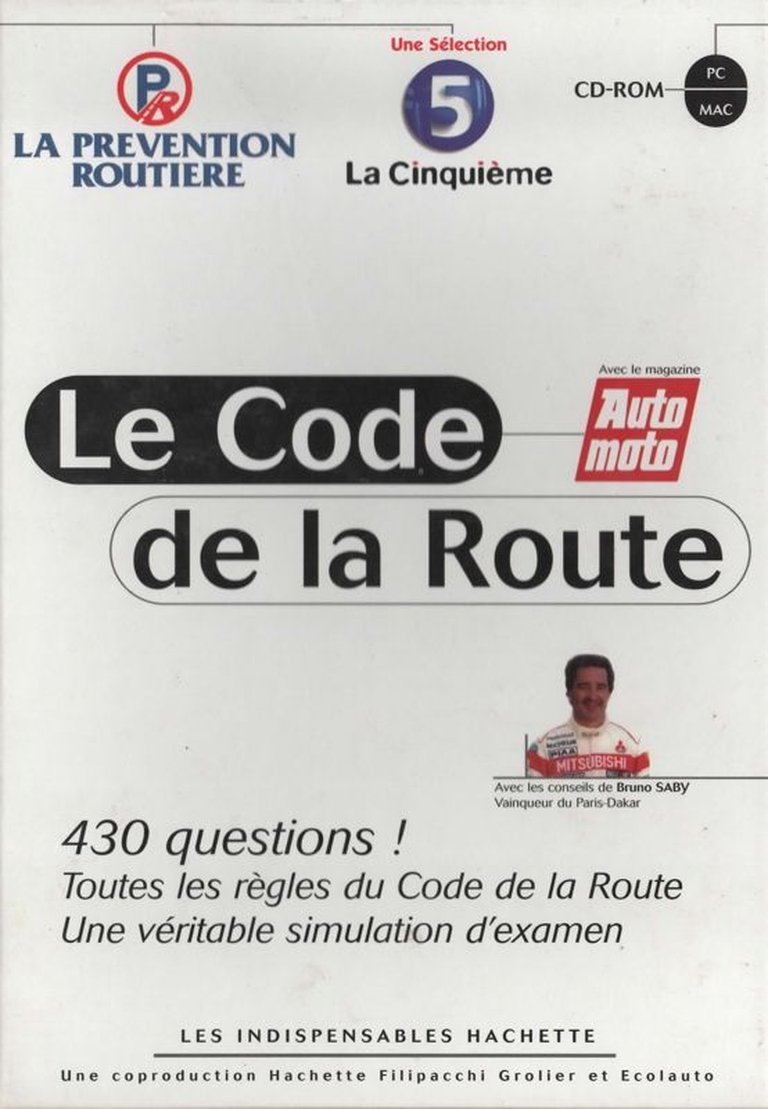
Description
Le Code de la Route is an educational CD-ROM game released in 1996 designed to help drivers prepare for the French driving license exam. It features 430 questions and answers on traffic rules and laws, along with a multiplayer mode where up to three players can compete locally.
Le Code de la Route: Review
Introduction
In the nascent years of CD-ROM gaming, when interactive multimedia was still a frontier of experimentation, Le Code de la Route emerged as a uniquely French artifact. Released in 1996, this educational CD-ROM transcends mere utility, offering a time capsule of a nation’s bureaucratic rites of passage. As a tool designed to aspirant drivers navigate the labyrinthine French highway code, it stands as a testament to the era’s earnest belief in technology as a pedagogical force. This review will dissect Le Code de la Route not merely as a driving simulator, but as a cultural document—a digital primer on citizenship, authority, and the mechanics of state-sanctioned mobility. Its legacy lies in its unassuming efficiency, proving that even the most utilitarian software could embed itself in the collective memory of a generation.
Development History & Context
Le Code de la Route was conceived in the mid-1990s, a period when CD-ROMs represented the cutting edge of home computing. The game arrived on Windows and Macintosh platforms, capitalizing on the multimedia capabilities of the era to deliver an experience impossible on floppy disks. Its development was pragmatic: studios like Anuman Interactive (later involved in the 2007 DS port) focused on creating a no-frills, high-value educational product. The technological constraints were evident—fixed, flip-screen visuals and a point-and-select interface—but they were secondary to the core goal: mastery of 430 meticulously crafted questions and answers.
The gaming landscape of 1996 was dominated by burgeoning 3D adventures and console wars, yet Le Code de la Route carved a niche in edutainment. It mirrored France’s own cultural moment, where driving a car symbolized newfound adulthood and autonomy. The game’s creators, though unnamed in the sources, envisioned a tool that demystified state regulations, transforming dry legalese into digestible quizzes. This vision was pure functionalism: no sprawling narratives, no character arcs—just a digital classroom where failure meant repeating a module, not losing a life. Its multiplayer “Hot Seat” mode (supporting 1-3 players) was a clever nod to social learning, framing test preparation as a competitive, communal ritual.
Narrative & Thematic Deep Dive
As an educational title, Le Code de la Route shuns traditional narrative in favor of a simulated bureaucracy. The “plot” is procedural: players progress through a series of quizzes, each topic a gateway to the next. The dialogue is sparse, confined to instructional prompts and feedback (“Correct!” or “Incorrect. See §4.3”). Yet beneath this utilitarian surface lies a subtle thematic richness. The game embodies the French concept of l’administration—the faceless, yet omnipresent, machinery of the state. Every correct answer reinforces a compact between citizen and authority: obey the rules, earn the privilege of the road.
The absence of characters is deliberate. There are no heroes or villains, only abstract symbols of order (traffic signs, speed limits) and disorder (violations, accidents). The 430 questions themselves form a fragmented narrative of societal norms. A query about right-of-way at a roundabout isn’t just a technicality; it’s a micro-lesson in civic harmony. The game’s world is one of unspoken consequences: a missed question isn’t a game over, but a metaphor for the real-world risks of ignorance. Thematically, it elevates the mundane to the existential, framing the highway code as a moral code for modern life.
Gameplay Mechanics & Systems
At its core, Le Code de la Route is a quiz engine with the precision of a Swiss watch. Gameplay revolves around answering multiple-choice questions drawn from its 430-item database. Correct answers unlock modules, while incorrect ones trigger immediate, corrective feedback—a stark departure from the “try-again” loops of contemporary entertainment titles. The systems are ruthlessly efficient:
– Progression: Linear and unforgiving. Players must demonstrate mastery of topics like traffic signals or parking regulations before advancing.
– Scoring: Implicit. No visible points accumulate, but the cumulative effect of correct answers builds toward the ultimate goal: passing the simulated exam.
– Multiplayer: The “Hot Seat” mode transforms solo study into a rivalry. Up to three players take turns answering questions, with the fastest correct answer claiming points. It gamifies camaraderie, turning the drudgery of studying into a social event.
– UI/UX: The point-and-select interface is dated but functional. Flip-screen visuals transition between questions and explanatory diagrams, creating a rhythm of question-illustration-feedback. No innovation, but no friction either.
The game’s brilliance lies in its restraint. It avoids “edutainment” gimmicks, trusting that the subject matter—French traffic law—was inherently compelling enough. Its systems are invisible, serving the pedagogical goal without distraction.
World-Building, Art & Sound
Le Code de la Route‘s world is one of abstraction and function. There are no cities, no people, only the symbolic language of the road: road signs painted in primary colors, traffic signals blinking red, yellow, and green. The art style is minimalist, prioritizing clarity over artistry. Diagrams of intersections or braking distances are rendered in crisp vector graphics, ensuring legibility even on early 1996 monitors. The visual palette is monochromatic save for the occasional splash of regulatory red or green—a nod to the authoritative nature of the material.
Sound design is equally utilitarian. Tense MIDI scores underscore incorrect answers, while triumphant fanfare greets correct ones. These auditory cues are Pavlovian, conditioning players to associate right answers with positive reinforcement. The absence of voice acting is notable; instead, text-based prompts force players to engage with the material directly. The result is a sterile, focused atmosphere—a digital study hall where every visual and audio element serves pedagogy. It’s a world devoid of life, yet pulsing with the quiet urgency of a learner striving for comprehension.
Reception & Legacy
Upon its 1996 release, Le Code de la Route was a commercial footnote, overshadowed by blockbuster titles. Yet its utility ensured enduring relevance. GameFAQs data from later DS ports (2007) reveals a high completion rate (100% of surveyed players “beat it”) and a “Just Right” difficulty rating, suggesting it fulfilled its promise as an effective study aid. Though critical reviews are scarce, its legacy endures through a long line of sequels (Réussir: Code de la Route, 2019; Code de la route: Édition 2008, 2007), each iterating on the 1996 template for new platforms.
Historically, the game represents a bridge between text-based learning and interactive multimedia. It popularized the “edutainment” quiz format in France, influencing titles like the Driver’s Ed series. Its multiplayer “Hot Seat” mode was a prescient take on local social gaming, predating the resurgence of couch co-op by decades. While not a technological landmark, Le Code de la Route remains a cultural touchstone—a reminder that games don’t need explosions to leave their mark. It’s the digital equivalent of a well-worn textbook: dog-eared, pragmatic, and irreplaceable to those it taught.
Conclusion
Le Code de la Route is the anti-Road 96. Where DigixArt’s 2021 masterpiece celebrates narrative chaos and player-driven rebellion, this 1996 CD-ROM is a monument to order, purpose, and institutional compliance. It lacks the emotional resonance or procedural storytelling of its spiritual successor, yet it succeeds on its own terms: it demystifies bureaucracy with unerring precision. Its gameplay loop—question, learn, repeat—may seem archaic, but its impact is undeniable. For thousands of French learners, it was the first step toward freedom on the open road.
In the pantheon of educational games, Le Code de la Route holds a unique place. It’s not art, nor is it entertainment; it’s infrastructure. A digital paving stone on the highway of progress. Its legacy is not in its innovation, but in its unwavering commitment to its purpose—a lesson that even in a world of open worlds and endless choices, sometimes the most meaningful journeys are mapped out in 430 questions.