
- Release Year: 1997
- Platforms: Windows
- Publisher: Sierra On-Line, Inc.
- Developer: Sierra On-Line, Inc.
- Genre: Compilation
- Perspective: Varies
- Game Mode: Single-player
- Average Score: 80/100
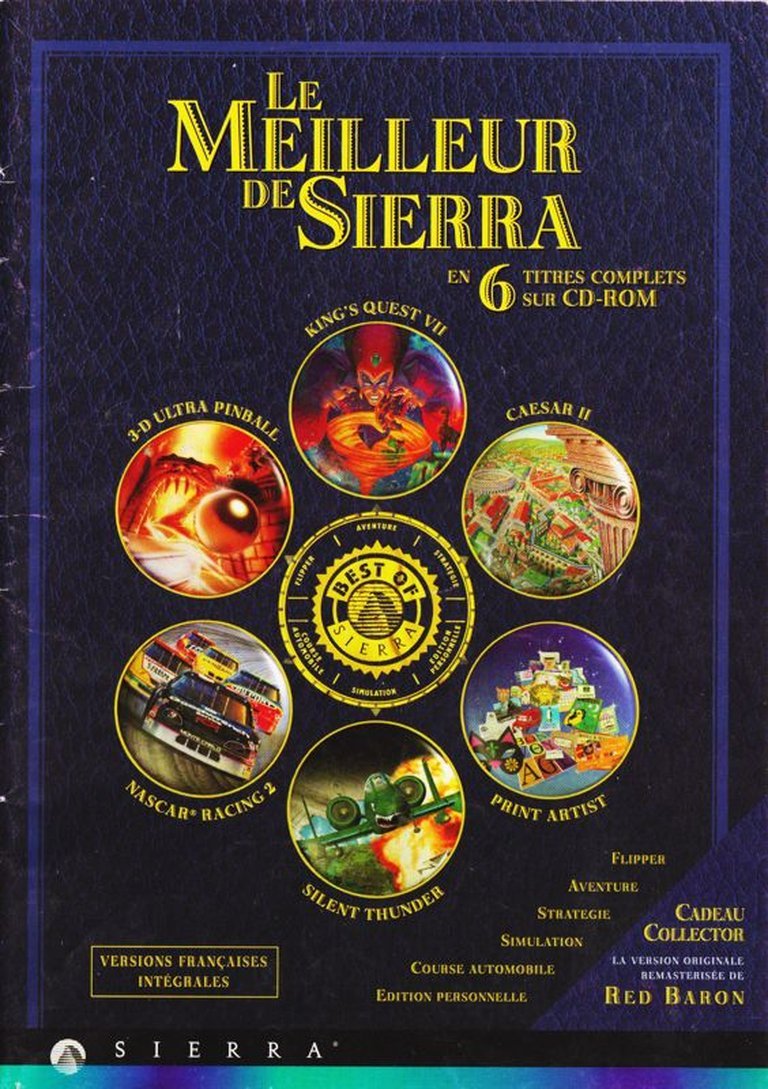
Description
Le Meilleur de Sierra is a 1997 Windows compilation by Sierra On-Line, gathering seven classic titles in a diverse assortment of genres: the spooky pinball action of 3-D Ultra Pinball: Creep Night, ancient empire-building in Caesar II, fantasy adventure in Roberta Williams’ King’s Quest VII: The Princeless Bride, high-speed racing in NASCAR Racing 2, creative design with Print Artist 3, remastered World War I flight combat in Red Baron, and military simulation in Silent Thunder: A-10 Tank Killer II.
Le Meilleur de Sierra: Review
Introduction
In the late 1990s, as the PC gaming world buzzed with the promise of CD-ROM multimedia revolutions and the specter of corporate upheavals loomed over industry giants, Sierra On-Line unleashed Le Meilleur de Sierra—a lavish seven-game compilation that encapsulated the studio’s sprawling ambition at the twilight of its golden age. Translated as “The Best of Sierra,” this 1997 Windows CD-ROM collection for the French market bundled a eclectic mix of adventures, simulations, racers, and oddities, from the fairy-tale grandeur of King’s Quest VII: The Princeless Bride to the high-octane skies of Red Baron and the thundering tracks of NASCAR Racing 2. Amid Sierra’s pivot toward family-friendly edutainment, hardcore sims, and cinematic talkies, this anthology stands as a time capsule of a company that once dreamed of conquering every corner of the suburban living room. My thesis: Le Meilleur de Sierra isn’t just a budget sampler—it’s a masterful retrospective of Sierra’s creative zenith, showcasing their unparalleled diversity in genres, technology, and storytelling, even as it hints at the fractures that would soon dismantle the empire.
Development History & Context
Sierra On-Line, born as On-Line Systems in 1979 from the visionary partnership of Ken and Roberta Williams, had by 1997 evolved into a multimedia behemoth nestled in Oakhurst, California, amid the shadows of Yosemite. The company’s trajectory—from Mystery House‘s pioneering graphical adventures on the Apple II to the AGI and SCI engines that defined the “Quest” era—mirrored the PC’s ascent. Le Meilleur de Sierra arrived during a precarious pivot: acquired by CUC International in 1996 for $1.5 billion, Sierra was restructured into divisions like Sierra Attractions and Sierra Studios, just as accounting scandals rocked CUC (soon Cendant) and precipitated sales to Havas and Vivendi. This compilation, published directly by Sierra On-Line, Inc., on CD-ROM, reflected their strategy of repackaging hits to sustain revenues amid flagging single-title sales.
The included titles span Sierra’s eclectic portfolio. Red Baron (1990, remastered here as a bonus) stemmed from the 1990 Dynamix acquisition, delivering a WWI flight sim that became Sierra’s biggest non-adventure hit since the pre-King’s Quest days. King’s Quest VII (1994) epitomized the SCI1.1 era’s 256-color VGA splendor and point-and-click polish, developed under Bill Davis’s “Hollywoodized” storyboard methodology introduced in 1989 to manage ballooning teams. Racing sims like NASCAR Racing 2 (1996) and Silent Thunder: A-10 Tank Killer II (1996) showcased Dynamix’s prowess, while Caesar II (1995, from Sierra’s in-house strategy wing) and 3-D Ultra Pinball: Creep Night (1996) highlighted casual and arcade diversions. Print Artist 3 added a non-gaming utility twist, aligning with Sierra’s “Sierra Discovery Series” push into edutainment and family software.
Technological constraints of 1997 Windows PCs—VGA graphics, Sound Blaster audio, early CD-ROM drives—were no barrier; Sierra’s SCI engine and Dynamix tech ensured compatibility. The gaming landscape was console-dominated post-Nintendo resurgence, but Sierra doubled down on “premium-priced” PC fare, shunning ports (save rare outliers like King’s Quest V on NES). Compilations like this, part of the “Best of Sierra” series (echoed in German “Best of Sierra Nr. 1”), were lifelines: value-packed CDs with full games, manuals, and demos, battling piracy and saturation while Sierra chased Ken Williams’s dream of a “rising tide” for all demographics.
Narrative & Thematic Deep Dive
As a compilation, Le Meilleur de Sierra lacks a unified plot, but its titles weave a tapestry of Sierra’s narrative obsessions: mythic heroism, historical grit, mechanical mastery, and whimsical escapism. King’s Quest VII: The Princeless Bride anchors the adventure core, swapping Graham’s sword-and-sorcery for Queen Valanice and Princess Rosella’s dual-perspective tale. Trapped in the troll kingdom of Ooga-Booga by evil fairy queen Malicia, the duo navigates body-swaps, time rifts, and moral quandaries—Rosella’s romance with a troll prince explores prejudice and redemption, while Valanice’s arc grapples with maternal sacrifice. Dialogue sparkles with Roberta Williams’s folksy wit, laced with meta-humor (“This puzzle is harder than King’s Quest V!”), underscoring themes of family bonds and fairy-tale subversion amid Sierra’s dead-end pitfalls.
Caesar II narrates empire-building as a choose-your-own-adventure sim, with branching events like slave revolts or divine omens demanding strategic prose. Flight sims like Red Baron (pilot logs evoking WWI aces) and Silent Thunder (A-10 pilot briefs on tank-hunting) prioritize procedural tales of aerial valor, themes of duty and technological hubris. NASCAR Racing 2 offers no story but immersive radio chatter mimicking stock-car lore—rivalries, pit strategies, Southern drawls evoking America’s heartland. 3-D Ultra Pinball: Creep Night delivers gothic horror vignettes via bumpers and spinners, a playful nod to Pinball Fantasies. Print Artist 3 sidesteps narrative for creative empowerment.
Collectively, themes exalt human (or troll) ingenuity against chaos—Sierra’s hallmark optimism, tempered by era-specific anxieties like corporate takeovers mirroring Caesar‘s coups. Characters range from archetypal (KQVII’s bratty trolls) to grounded (Red Baron’s von Richthofen rivals), with dialogue blending parser-era verbosity and talkie flair, though French localization likely adapts idioms seamlessly.
Gameplay Mechanics & Systems
Sierra’s genius shines in variety: Le Meilleur de Sierra deconstructs loops from parser-free adventures to sim precision. King’s Quest VII refines SCI’s point-and-click—iconic verbs (Walk, Look, Talk) streamline exploration, but infamous dead-ends (e.g., missing a lamp early) punish sequencing, offset by dual-character swaps and 16-bit puzzles like honeycomb mazes. Progression ties to inventory tetris and timed events, flawed yet innovative.
Sims dominate rigor: Red Baron‘s dogfights demand throttle nuance, 3D wireframe upgraded to textured VGA here, with squadron management and mission trees. Silent Thunder: A-10 Tank Killer II layers tank-busting with cannon strafes, Mavericks, and napalm—HUD overlays Newtonian flight, damage models, and dynamic campaigns. NASCAR Racing 2 simulates oval mastery: drafting physics, tire wear, fuel strategy in career mode across 20+ tracks, multiplayer splitscreens adding chaos. Caesar II blends city-builder with RTS—manage aqueducts, legions, and pleb happiness via advisor councils, combat in isometric real-time.
3-D Ultra Pinball innovates 3D tables with multiball ramps, wizard modes, and physics quirks (bouncy ghosts), while Print Artist 3 offers drag-and-drop creativity: clipart libraries, fonts, and templates for flyers. UI across titles is mouse-centric, menus intuitive, but era quirks like save-slot limits persist. Flaws—KQVII‘s parser ghosts, sim steep curves—highlight Sierra’s “state machine” philosophy, rewarding persistence over hand-holding.
World-Building, Art & Sound
Sierra’s worlds pulse with painterly immersion. KQVII‘s Ooga-Booga and Vulcanix glow in 256-color hand-digitized art—lush jungles, crystalline deserts—atmosphere amplified by orchestral swells (Mark Seibert scores) and CD talkies (50+ actors, including cameos). Red Baron‘s trenches and skies evoke Wings-era grit via Dynamix textures. Caesar II‘s Rome sprawls with forums, baths, procedural events like riots. NASCAR‘s stadiums roar with crowd SFX, Silent Thunder‘s deserts shimmer under heat haze.
Art direction: SCI’s rotoscoped animation lends fluidity—KQVII’s trolls lumber convincingly. Sound design peaks in sims: Red Baron‘s radial-engine growl, NASCAR‘s V8 thunder via Sound Blaster. Pinball’s clangs and Print Artist‘s MIDI jingles add levity. Collectively, elements forge escapism—family fantasies to cockpit realism—cementing Sierra’s multimedia ethos.
Reception & Legacy
Obscure in Anglophone circles (MobyGames lists zero reviews, two collectors), Le Meilleur de Sierra mirrored “Best of Sierra” series success in Europe, extending shelf-life amid 1997’s turmoil. Individual hits shone: KQVII sold robustly as a talkie pioneer; Red Baron a sim staple; NASCAR Racing 2 fueled Papyrus rivalry. No Metacritic, but Sierra’s 1996/97 catalog touts them amid Phantasmagoria hype.
Legacy endures: compilations preserved gems pre-shutdowns (Activision axed Sierra 2008, revived label 2014). Influenced repacks (GOG bundles), genre diversity (adventures to sims pre-Flight Simulator dominance), and French market ports. As Sierra’s fall—from $43M revenues (1992) to fraud—loomed, this set symbolizes untapped potential, inspiring modern retrospectives.
Conclusion
Le Meilleur de Sierra distills a studio’s soul: from King’s Quest‘s whimsy to Dynamix’s grit, a seven-game odyssey proving Sierra’s unmatched range. Flaws—dated UIs, sequencing traps—notwithstanding, its value endures for historians and nostalgics. Verdict: A definitive 9/10 hall-of-famer, securing Sierra’s place as PC gaming’s multimedia pioneers—flawed visionaries whose compilations outlive empires. Seek it for unfiltered ’90s ecstasy.