
- Release Year: 1997
- Platforms: Windows
- Publisher: 1C Company, Byte Enchanters Inc., GameStorm, Snowball.ru
- Developer: Byte Enchanters Inc., Snowball.ru
- Genre: Strategy, Tactics
- Perspective: Isometric
- Game Mode: Online PVP, Single-player
- Gameplay: Bribing, Extortion, Real-time strategy
- Setting: Interwar
- Average Score: 85/100
Description
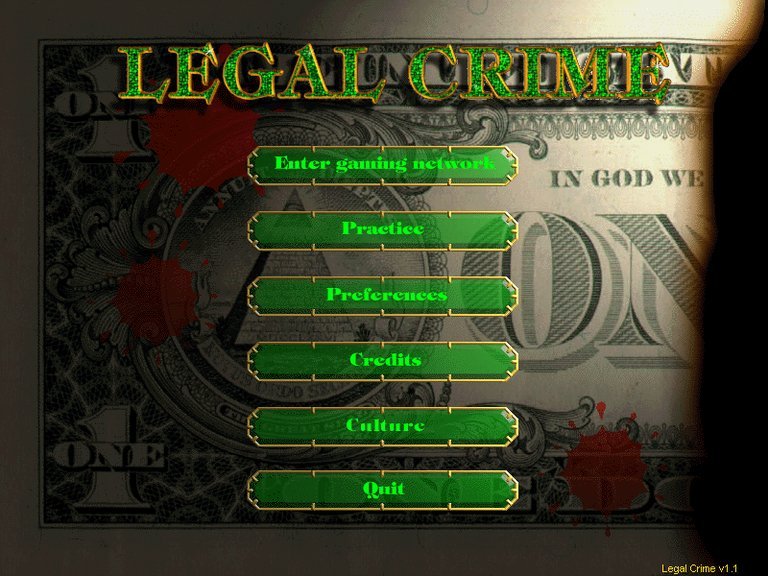
Legal Crime is a real-time strategy game set during the prohibition era, where players assume the role of a Godfather building a criminal empire through extortion, bribery, and organized crime. Starting with businesses, you can bribe police to expand into illegal ventures like alcohol, gambling, and prostitution, while corrupting the army to recruit elite gangsters such as snipers and Tommy-gun men for drive-by shootings in Cadillacs. The game features intense multiplayer clashes with rival gangs, allowing sabotage through arrests, raids, and spreading rumors, with victory determined by being the last crime family standing.
Gameplay Videos
Legal Crime Free Download
PC
Legal Crime Serial Keys
Legal Crime Patches & Updates
Legal Crime Guides & Walkthroughs
Legal Crime Reviews & Reception
mobygames.com (75/100): Average score: 75%
myabandonware.com (100/100): Legal Crime is a great Internet-only real-time strategy game from Byte Enchancters that died an early death, despite a very novel premise and well-designed game engine.
reddit.com : I remember this game from my childhood as a very good time, a very immersive game that really gave the 1920s mobster experience in a very basic 4X strategy game.
en.wikipedia.org (83/100): Computer Games Magazine gave the game a score of 4 out of 5 stating “If you’ve burned out on the RTS game du jour and are looking for a change then give Legal Crime a whirl. Perhaps you’ll rise through the ranks to head your own family, and manage to claw your way to the top of ladder…then again you might just get gunned down in the street…either way it’s fun”
wikiwand.com (83/100): Computer Games Magazine gave the game a score of 4 out of 5 stating “If you’ve burned out on the RTS game du jour and are looking for a change then give Legal Crime a whirl. Perhaps you’ll rise through the ranks to head your own family, and manage to claw your way to the top of ladder…then again you might just get gunned down in the street…either way it’s fun”
Legal Crime Cheats & Codes
PC – Windows
type in during game
| Code | Effect |
|---|---|
| GO TO HELL | None |
| die | None |
| basterd | None |
Legal Crime: Review
Introduction: The Rise and Fall of a Forgotten Godfather
In the pantheon of real-time strategy (RTS) games, where titans like StarCraft and Age of Empires reigned supreme in 1997, a Finnish gem emerged with a distinctly darker premise: Legal Crime. Released on September 15, 1997, by Byte Enchanters, this shareware title cast players not as a noble commander or ancient emperor, but as a ruthless Don orchestrating a criminal empire in the lawless streets of Prohibition-era Chicago. While its contemporaries dazzled with polished graphics and expansive campaigns, Legal Crime distinguished itself through raw, systemic innovation—a simulation of corruption, betrayal, and economic warfare that remains unparalleled three decades later. Yet, despite critical acclaim and a dedicated multiplayer community, the game vanished into obscurity, its legacy relegated to abandonware forums and niche historical retrospectives. This review argues that Legal Crime was not merely a curiosity but a prescient masterpiece, whose ambitious design—particularly its focus on asymmetric bribery systems and emergent multiplayer chaos—foreshadowed modern trends in strategy gaming long before titles like Mafia or Civilization embraced similar mechanics. Its flaws, rooted in technological constraints and niche appeal, cannot overshadow its audacity: a game where “money talks” is not just a tagline but the foundational law of its world.
Development History & Context: Finnish Ambition in the RTS Boom
Legal Crime emerged from the unlikely crucible of Finland’s nascent game development scene in the mid-1990s. Developed by Byte Enchanters—a small studio comprising talents like Jari Saarhelo (game design), Marko Haaja (UI), and Reno Siradze (graphics)—the project was a labor of love spanning two and a half years. The team’s vision was explicitly anti-clonish: in an era saturated with Warcraft and Command & Conquer derivatives, they sought a setting that hadn’t been explored in strategy games: organized crime. As Byte Enchanters’ lead designer Jari Saarhelo later explained, the goal was to create a “ruthless world of organized crime” where victory depended on economic manipulation and political thuggery, not just military might.
Technologically, the game pushed the boundaries of 1997 shareware. Built for Windows with an isometric perspective, it relied on direct online play via services like GameStorm, supporting up to 100+ players simultaneously—a staggering feat for its time. This multiplayer focus was revolutionary; while titles like Total Annihilation offered online skirmishes, Legal Crime designed its entire experience around asynchronous gang warfare. The shareware model—free to try, paid for full access—reflected the era’s distribution realities, but its reliance on stable internet connections limited its reach in dial-up-dominated markets. Culturally, the timing was fortuitous: 1997 saw the release of Grand Theft Auto, which popularized open-world crime, but Legal Crime distinguished itself as a pure strategy experience, eschewing action for systemic depth. Its Russian localization, released in 1998 as Чикаго, 1932: Дон Капоне, hinted at its Eastern European cult following, though Western adoption remained limited. The studio’s dissolution shortly after release—due to the high costs of maintaining server infrastructure—ensured Legal Crime remained a footnote in mainstream gaming history, even as its core ideas echoed in later titles.
Narrative & Thematic Deep Dive: The Economics of Violence
Legal Crime dispenses with traditional narratives in favor of emergent storytelling, where every player’s rise (or fall) creates a unique saga of betrayal and ambition. The game’s premise is deceptively simple: you are a Don starting with a modest headquarters, a few dollars, and a handful of gangsters. The “plot” unfolds through player-driven actions—extorting businesses, bribing officials, and eliminating rivals—yet the game’s genius lies in how it contextualizes these acts within a thematic framework of institutional corruption.
The narrative unfolds through mechanics rather than cutscenes. Players begin by “convincing” legitimate businesses to pay for protection, a process visualized by gangsters armed with bats and guns intimidating shopkeepers. This initial act of extortion serves as the game’s tutorial, but it rapidly escalates into systemic criminality. Businesses can be transformed into illicit ventures: bootlegging operations for alcohol, gambling dens, brothels, and “troubleshooting” agencies for hitmen. Each transition reflects the game’s central theme: the permeable boundary between legality and crime. Bribes are the narrative glue—paying the police to shut down rivals, the army for better weaponry, or the FBI for intelligence—transforming civic institutions into extensions of the player’s will. As The Adrenaline Vault noted, “money talks and he who has the deepest pockets can exert the greatest influence,” creating a power dynamic where victory is achieved through economic dominance, not just firepower.
Characters embody the era’s archetypes: stereotypical mobsters like Vito Batteglio and Mack Marantani serve as interchangeable assets, their personalities conveyed through portraits and combat roles rather than dialogue. Voice acting—provided by David Doerr, Mike Nolan, and Keith Pillow—lends authenticity to interactions, with growling threats and clipped orders reinforcing the game’s harsh tone. The dialogue is sparse but functional, focusing on commands like “Raid their distillery!” or “Bribe the mayor,” which emphasize the game’s systemic themes over character development.
Beneath the surface, Legal Crime explores the fragility of power. Gangsters are not loyal followers but mercenaries; if unpaid, they become “neutral” and attack all factions. This mechanic introduces a constant threat of internal collapse, mirroring the historical volatility of crime syndicates. The game’s bleak conclusion—victory through the annihilation of all rivals—underscores its cynical view of success: there is no honor, only survival. Thematically, it critiques how corruption normalizes violence, with bribes turning police, politicians, and the military into extensions of the mob. In a genre often obsessed with epic good-versus-evil conflicts, Legal Crime presents a morally gray world where the line between hero and villain dissolves into the calculus of profit and power.
Gameplay Mechanics & Systems: The Symphony of Bribery and Bloodshed
Legal Crime‘s gameplay is a masterclass in systemic design, weaving together economic management, real-time combat, and political intrigue into a cohesive loop that feels both familiar and revolutionary. At its core, the game operates as a 4X strategy experience on a micro scale: eXplore (control territory), eXploit (generate income), eXterminate (eliminate rivals), and eXterminate (again, with brutality). However, its execution distinguishes it from contemporaries.
Core Economic Loop
The game begins with extortion, a mechanic that evolves into a sophisticated economic engine. Players start by assigning gangsters to “convince” businesses to pay protection money. This is the foundation of income, but true wealth comes from converting these businesses into illegal enterprises:
– Bootlegging (Alcohol): High-revenue but high-risk, requiring police bribes to avoid raids.
– Gambling: Generates steady income but needs political favors for legality.
– Prostitution: Lucrative but attracts FBI attention.
– Hitmen: Expensive but essential for sabotage and assassinations.
Supporting structures amplify this loop:
– Training Centers: Accelerate gangster recruitment.
– Collection Centers: Shorten money-transfer routes, reducing theft during transit.
– Stakeouts: Ambush points for intercepting rival gangsters.
This creates a delicate balancing act: reinvest profits into upgrades, bribe officials, or fund new attacks. Mismanagement—such as overextending territory or underpaying enforcers—leads to chaos, as gangsters abandon factions and turn rogue.
Combat and Tactical Depth
Combat is real-time and visceral, with gangsters wielding baseball bats, pistols, Tommy guns, or sniper rifles. The introduction of vehicles like Cadillacs adds strategic layers: “Tommy-gun men” can be deployed in cars for drive-by shootings, enabling hit-and-run tactics. However, combat is not merely about numbers; positioning and timing are critical. Stakeouts allow players to ambush rivals, while bribery can turn the tide—paying the police to raid an enemy’s distillery or the army to arm your gangsters with superior weapons.
The Bribery System: A Masterstroke of Asymmetry
The game’s standout feature is its bribery meta-game. Players can target four institutions:
– Police: Prevent raids or order them against rivals.
– Army: Unlock better weapons and gangster types.
– FBI: Gather intelligence on rival locations and activities.
– Politicians: Pass favorable laws (e.g., casino permits) or sabotages.
This system introduces profound asymmetry. A player with deep pockets can cripple enemies without direct combat, turning the game into a high-stakes poker game of threats and counter-threats. Bribery is not just a tool; it’s the primary language of power. As Computer Games Magazine noted, “he who has the deepest pockets can exert the greatest influence.” The risk-reward is palpitate: over-bribe, and you bankrupt your empire; under-bribe, and institutions turn against you.
UI and Innovation
The isometric interface, designed by Marko Haaja, prioritizes clarity. A minimalist HUD displays funds, gangster locations, and building statuses, with mouse-driven commands enabling rapid multitasking. While graphics were basic by 1997 standards, the UI’s elegance—highlighted by Games Domain as “elegant and user-friendly”—allowed players to manage sprawling empires efficiently. This focus on usability was critical, given the game’s real-time demands.
Flaws and Constraints
Despite its brilliance, Legal Crime has flaws. The single-player mode, consisting of a dozen tutorial scenarios, felt tacked-on compared to the multiplayer depth. Online stability was a recurring issue; lag and server crashes marred sessions for players with slow connections. Additionally, the game’s pacing could feel punishing, with economic collapses happening swiftly if players were outmaneuvered. Yet these flaws stemmed more from era-specific limitations than design incompetence.
World-Building, Art & Sound: The Chicago Noir Aesthetic
Legal Crime‘s world-building is a triumph of atmospheric restraint. Set in 1930s Chicago, the game evokes the “Roaring Twenties” not through elaborate cutscenes or lore dumps, but through environmental storytelling and sensory design. The isometric perspective renders Chicago as a grid of interconnected districts, with businesses, landmarks, and gang hideouts clustered together. This abstraction creates a “city of ideas,” where players mentally project the era’s iconography—speakeasies, smoke-filled backrooms, and shadowy alleys—onto the minimalist sprites.
Visual Direction
Art director Reno Siradze’s work prioritizes functionality over flair. Buildings are recognizable icons: banks, factories, and speakeasies are distinguished by simple shapes and color palettes. Gangsters are similarly stylized—gangsters in fedoras and trench coats, police in uniforms—portraits adding personality without breaking the game’s pace. The Russian localization’s Дон Капоне title art further leans into caricature, with Al Capone-esque figures reinforcing the era’s mythos. While critics like Squakenet noted the graphics as “blocky” and lacking “real personality,” the art’s effectiveness lies in its utility: clarity in chaos. The visual language communicates status (e.g., upgraded gangsters have fancier hats) and threat (e.g., police raids are signaled by flashing sirens), making the world legible even at a glance.
Sound Design
Sound is where Legal Crime excels in immersion. Composer Miikka Soini’s score is a moody jazz and blues-infused soundtrack, punctuated by melancholic saxophones and ragtime piano, setting a tone of weary corruption. Sound designer Olli Huhtanen’s effects are equally evocative: the crunch of batons on skulls, the rat-tat-tat of Tommy guns, and the jingle of collected coins ground the violence in tactile reality. Voice acting—gruff, accented commands like “Pay up or sleep with the fishes!”—lends authenticity, while ambient sounds like distant sirens and arguments keep the city alive. Together, these elements create a soundscape where every action feels consequential, from a whispered bribe to a spectacular drive-by shooting.
Atmosphere
The game’s atmosphere is defined by tension and paranoia. Betrayal is omnipresent: rival gangs launch surprise attacks, bribed officials can double-cross you, and unpaid enforcers turn on their masters. This is reinforced by the game’s pacing—real-time, unforgiving, and relentless—mirroring the era’s “live fast, die young” ethos. As one MyAbandonware user reminisced, it was “a very immersive game that really gave the 1920s mobster experience in a very basic 4X strategy game.” The world’s success lies in how mechanics are the narrative; the stress of managing an empire under siege is the story itself.
Reception & Legacy: A Cult Classic Ahead of Its Time
Upon release, Legal Crime garnered a cult following but struggled for mainstream recognition. Critics praised its originality and multiplayer depth, even as they acknowledged its niche appeal. Computer Games Magazine awarded it 4/5, declaring it “fun” and a refreshing alternative to RTS clones. The Adrenaline Vault scored it 70%, calling it “original” and “one of the most gutsy games” of the era, though noting its lack of graphical polish. Games Domain effusively hailed it as setting “a standard that all multiplayer games should strive for,” lauding its “superb replayability.” Polish magazine Gambler gave it 83%, underscoring its Eastern European appeal.
Commercially, however, the game was hampered by its online-only focus and shareware model. In an era where single-player campaigns dominated, and internet access was inconsistent, Legal Crime‘s reliance on stable servers limited its reach. By 1999, as dial-up networks faltered and Byte Enchanters dissolved, the game faded. Its legacy, though, endured. On MyAbandonware, players scored it 2.5/5 but praised its “pure addiction,” with one user noting its “real fun” emergent chaos. Reddit threads reveal modern users grappling with technical issues (e.g., stuttering on modern PCs) but praising the game’s design.
Legal Crime‘s influence is subtle but profound. It predates modern crime sims like Mafia and Grand Theft Auto by focusing on systemic corruption rather than scripted narratives. Its bribery mechanics echo in Civilization’s diplomatic systems and Crusader Kings’ court intrigue. Most significantly, its multiplayer design—with up to 100 players, alliances, and clan warfare—foreshadowed the rise of esports and persistent online worlds. Games like Gang Beasts and Among Us later embraced its chaotic, player-driven social dynamics, though none matched its strategic depth. As Wikipedia notes, “a community emerged, with over 600 players forming crime families led by Dons,” proving that Legal Crime tapped into a primal desire for power and betrayal that remains resonant.
Conclusion: The Unsung Godfather of Strategy Gaming
Legal Crime is a flawed but indispensable artifact of gaming history. Its genius lies not in polish but in audacity—a Finnish studio’s attempt to distill the entire ecosystem of organized crime into a single, brutal real-time strategy game. While its graphics are dated, its single-player mode skeletal, and its online infrastructure fragile, these shortcomings cannot diminish its innovative core. The game’s bribery system, emergent narratives, and focus on economic warfare created a template that developers are only now fully exploring. It is a game where “sleeping with the fishes” is not just a threat but a statistical probability, where victory feels earned through cunning as much as carnage.
Thirty years later, Legal Crime stands as a testament to the power of niche design. It never achieved the fame of its RTS brethren, yet its influence lingers in every game that treats systems as narrative. For historians, it is a vital link between the pixelated crime games of the 1980s and the open-world epics of today. For players, it remains a hidden gem—abandonware but not forgotten, as evidenced by its dedicated community. In a gaming landscape increasingly homogenized by safe bets, Legal Crime‘s gritty, unapologetic vision reminds us that the most memorable experiences often come from the margins. As the game’s tagline implored: “Sleep with the fishes.” But for those who dive in, the rewards are eternal: not just a victory, but a lesson in the art of ruthless ambition. Verdict: A cult classic whose systemic brilliance makes it a must-play for strategy historians and adventurous gamers alike.