
- Release Year: 2000
- Platforms: Windows
- Publisher: Sierra On-Line, Inc.
- Genre: Compilation
- Perspective: Top-down
- Game Mode: Online PVP
- Gameplay: Base building, Real-time strategy, Resource Management, Strategy
- Setting: Fantasy, Medieval
- Average Score: 80/100
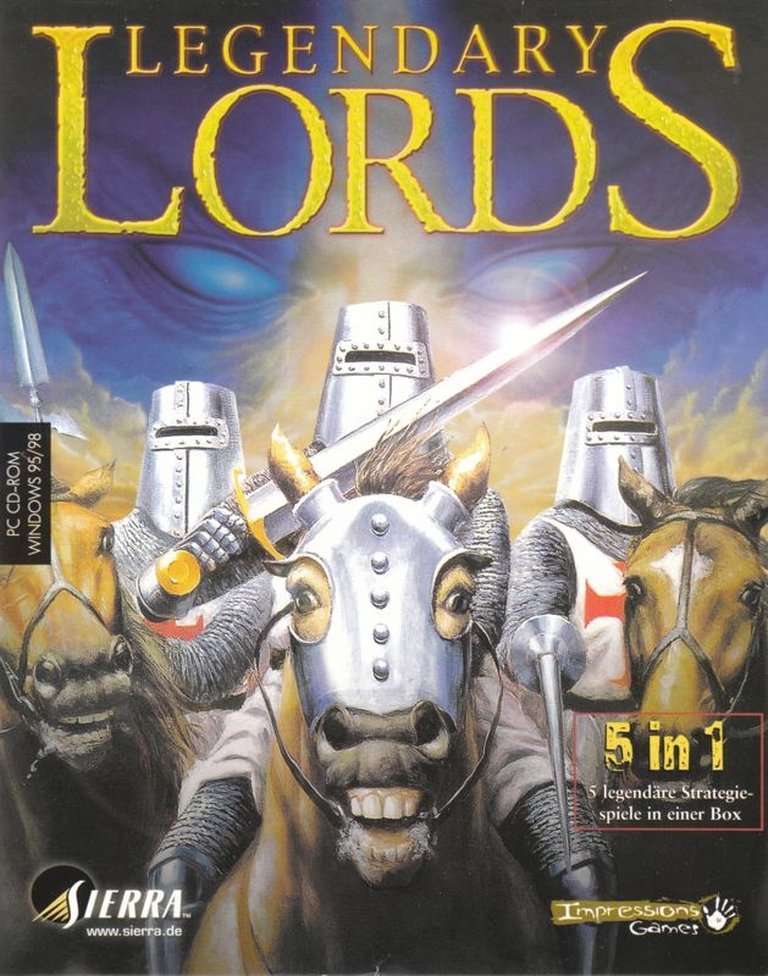
Description
Legendary Lords is a 2000 compilation bundle featuring three classic strategy games and their expansions, including Lords of the Realm and its sequel with the Siege Pack, alongside Lords of Magic: Special Edition. The games blend medieval castle-building, siege warfare, and dark fantasy real-time strategy, offering players diverse experiences in resource management, tactical battles, and magical conquest across a rich historical and mystical setting.
Legendary Lords Reviews & Reception
retro-replay.com : Legendary Lords delivers a feast of strategic depth by bundling three classic titles into one comprehensive package.
Legendary Lords Cheats & Codes
PC
Method 1 (Console): Add the ‘-console’ command line parameter to the game’s shortcut. Press the tilde key (~) during gameplay to open the console and enter the codes. Method 2 (Config File): Edit the DefaultInput.ini file and map a key to a command (e.g., ‘God’, ‘Ghost’, ‘Walk’).
| Code | Effect |
|---|---|
| Sentori | N/A |
| Make me Super Humman | N/A |
| God | N/A |
| Ghost | N/A |
| Walk | N/A |
Legendary Lords: Review
1. Introduction
In an era of bloated digital storefronts and disposable DLC, the concept of a curated anthology feels like a relic from a bygone age—a time when value was measured not in microtransactions, but in sheer depth and variety. Legendary Lords, released in 2000 by Sierra On-Line, embodies this ethos with audacious generosity, bundling five seminal strategy games into a single CD-ROM. This compilation isn’t merely a convenience; it’s a time capsule of 1990s strategy design, preserving the lineage that would later evolve into giants like Total War. At its core, Legendary Lords offers a masterclass in historical and fantasy strategy, merging the medieval realism of Lords of the Realm with the arcane mysticism of Lords of Magic. Yet, its true legacy lies in how it encapsulates the genre’s evolution—from resource-laden turn-based campaigns to real-time tactical warfare. This review deconstructs this anthology not just as a product, but as a historical document, arguing that Legendary Lords remains an indispensable benchmark for strategic depth and design purity.
2. Development History & Context
The Studio and Vision
Legendary Lords was published by Sierra On-Line, a titan of 1990s PC gaming known for narrative-driven adventures and ambitious strategy titles. The compilation’s contents, however, were developed by Impressions Games, a studio revered for its meticulous historical simulations. Impressions’ philosophy—blending accessible mechanics with granular detail—is evident in every title. The vision behind Legendary Lords was straightforward yet revolutionary: democratize access to strategy classics by packaging aging but influential titles alongside their expansions. For a retail price of approximately 40 German Marks (around $20 at the time), players received five games, a rarity in an industry increasingly fixated on premium pricing.
Technological Constraints and the Gaming Landscape
Released in 2000, Legendary Lords operated on the cusp of a technological shift. Its constituent titles (1994–1998) were products of the 2D era, constrained by resolutions capped at 800×600 and limited color palettes. Sierra compensated by including PDF manuals, acknowledging that modern displays would struggle with the games’ original interfaces. The gaming landscape of 2000 was dominated by the rise of 3D real-time strategy (Age of Empires, StarCraft), yet turn-based and hybrid approaches persisted. Legendary Lords arrived as a bridge: its games predated the genre’s 3D boom but captured the tactical complexity that defined its golden age. Multiplayer options—Internet and modem support—hinted at Sierra’s awareness of the burgeoning online community, though the compilation’s true strength lay in its single-player campaigns.
3. Narrative & Thematic Deep Dive
Lords of Magic: Special Edition – The Elemental Saga
The narrative heart of Legendary Lords resides in Lords of Magic, a fantasy epic where eight wizard lords vie for control over the elemental Moons. Each lord—ranging from the noble Fire Lord to the chaotic necromancer—embodies a distinct archetype, driving campaigns steeped in mythic conflict. Legends of Urak, the included expansion, deepens this lore by introducing the burly Jotnar and their pantheon of gods, weaving a side quest that feels both expansive and thematically resonant. Dialogue, sparse but evocative, reinforces the game’s core themes: order vs. chaos, and the corrupting influence of power. The narrative is less a linear story and more a sandbox of rivalries, where alliances fracture and betrayals unfold organically.
Lords of the Realm Series – Feudal Realism
In stark contrast, Lords of the Realm and its sequel abandon scripted narratives for emergent storytelling. Here, conquest is driven by player agency: a failed harvest sparks peasant revolts, unexpected marriages alter political alliances, and sacked villages birth new rival lords. The Siege Pack amplifies this by centering campaigns on brutal sieges, where narratives are written in the rubble of breached walls. While devoid of fantastical lore, these games explore grounded themes of feudal duty, resource scarcity, and the human cost of war. A king’s last stand, as depicted in Lords of the Realm II’s opening cinematic, becomes a player’s own legend—proof that the strongest stories in Legendary Lords are those forged through gameplay, not pre-written scripts.
4. Gameplay Mechanics & Systems
Lords of Magic: Hybrid Real-Time and Turn-Based Strategy
Legendary Lords’s most innovative offering is Lords of Magic, a genre-blending masterpiece. Players alternate between turn-based map exploration (securing resources, researching spells) and real-time battles where tactical positioning and spell timing decide outcomes. Heroes function as mobile artifacts, while unit rosters—griffins, golems, and undead—reflect each lord’s elemental alignment. The Legends of Urak expansion refines this with new units like the Jotnan siege-breakers and god-granted blessings, adding layers of replayability. The system’s brilliance lies in its balance of accessibility and depth: a novice can win with brute force, but mastery requires synergizing magic, terrain, and hero abilities.
Lords of the Realm: Resource Management and Tactical Combat
The Lords of the Realm titles pivot toward meticulous resource management. Peasants, the backbone of your economy, are allocated to farming, quarrying, or military service, with poor harvests leading to famine and desertion. Combat, however, is a triumph of minimalist design. Battles are resolved by dragging unit battalions (archers, knights, spearmen) into formations, with voice commands like “Stand tall!” echoing Warcraft’s charm. Lords of the Realm II and the Siege Pack elevate this with castle upgrades, siege engines (trebuchets, towers), and terrain modifiers (snow, forests) that alter tactics. The absence of base-building in battles shifts focus to army composition and morale, making each skirmish a tense chess match.
UI and Innovations
Across the anthology, the UI prioritizes clarity over flair. Lords of Magic’s spell interface is intuitive, while Lords of the Realm’s economic menus use icons to convey complex data. Flaws emerge in modern contexts: low resolutions necessitate alt-tabbing for PDF manuals, and multiplayer relies on outdated direct connections. Yet, these quirks underscore the games’ design purity—mechanisms exist to serve gameplay, not spectacle.
5. World-Building, Art & Sound
Aesthetic Dichotomy: Fantasy vs. Historical
Legendary Lords presents a striking visual dichotomy. Lords of Magic dazzles with hand-painted, 2D landscapes—each elemental realm rendered in vivid, thematic hues. The Special Edition’s art retains a timeless charm, unit portraits brimming with personality. Legends of Urak expands this with deserts and jungles, though asset reuse occasionally mars immersion. Conversely, Lords of the Realm adopts a muted, top-down isometric view, prioritizing functional clarity over flair. Castles, fields, and villages are rendered as distinct icons, ensuring players can assess resources at a glance. Lords of the Realm II slightly elevates detail with larger sprites and weather effects, but both series remain grounded in historical authenticity.
Sound Design and Atmosphere
Sound is a mixed bag, constrained by the era’s limitations. Lords of Magic’s battle cries and spell effects are whimsical yet repetitive, while Lords of the Realm’s ambient sounds—crows, clanging swords—enhance immersion. Voice acting, present in unit commands and cutscenes, ranges from serviceable (Lords of the Realm II’s king) to camp (Lords of Magic’s necromancer). The Siege Pack’s siege-themed audio—catapult impacts, crumbling stone—stands out as particularly evocative. Ultimately, sound design serves to reinforce each game’s tone: magic feels arcane, war feels visceral.
6. Reception & Legacy
Critical Response at Launch
Legendary Lords received a lukewarm but telling reception. German magazine PC Player awarded it a perfect 100%, praising its “convincing mix of fantasy and historical strategy” and value proposition. PC Games countered with 60%, criticizing the “somewhat dated graphics” of the older titles. The 80% MobyGames average reflects this duality: a compilation revered for its content but judged by contemporary standards.
Enduring Influence and Historical Significance
Where Legendary Lords truly shines is in its legacy. The anthology preserved games that directly influenced modern strategy:
– Resource Management: Lords of the Realm’s peasant-and-farm system laid groundwork for Civilization and Crusader Kings.
– Tactical Combat: Lords of Magic’s hybrid approach foreshadowed Total War’s blend of strategy and real-time battles.
– Character-Centric Design: The emphasis on lords as unique commanders (e.g., Lords of the Realm II’s elector counts) resonates with Total War: Warhammer’s “Legendary Lords,” a feature Sega credits to studying Impressions’ work.
Modding communities, like the GitHub project Mixu’s Legendary Lords, further extend this legacy, adding new lords and traits to Total War games. For historians, Legendary Lords is a Rosetta Stone, revealing how foundational mechanics—resource balancing, tactical depth, and emergent storytelling—coalesced into the genre’s DNA.
7. Conclusion
Legendary Lords is more than a compilation; it’s a museum of strategy, a testament to an era when games valued longevity over spectacle. Its flaws—dated visuals, manual dependency—are inseparable from its charm, artifacts of a time when design ingenuity trumped graphical fidelity. For modern players, it offers a challenging but rewarding dive into the genre’s roots, where every peasant allocation and spell choice carries weight. For historians, it’s an invaluable archive of Impressions Games’ genius.
Verdict: A timeless classic. Legendary Lords earns its place in video game history not through innovation, but through preservation. It is a reminder that the greatest strategy games are those that empower players to write their own sagas—whether through the elemental chaos of Lords of Magic or the feudal grit of Lords of the Realm. In an age of disposable content, this anthology stands as a monument to depth, value, and the enduring power of player-driven storytelling.