
- Release Year: 2010
- Platforms: Windows
- Publisher: Anuman Interactive SA, eGames, Inc.
- Genre: Compilation
- Game Mode: Single-player
- Gameplay: Hidden object, Puzzle
Description
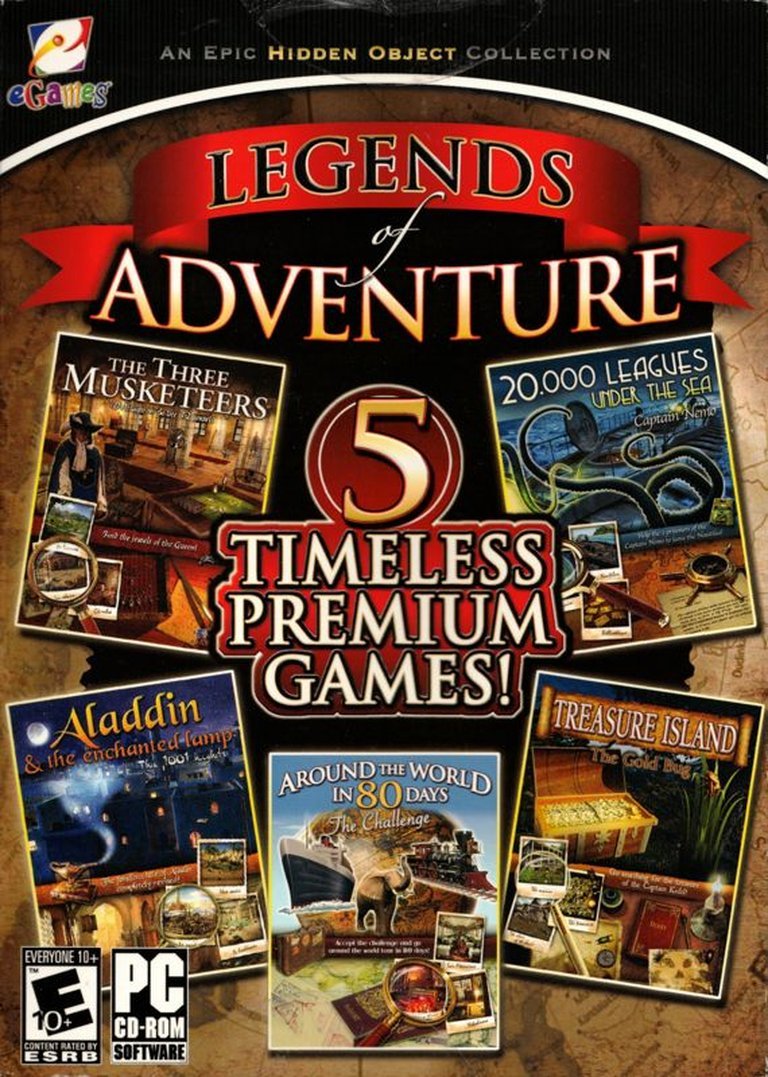
Legends of Adventure is a compilation of five hidden object games, each based on classic literary adventures. The collection includes ‘Aladin & the Enchanted Lamp’, ‘20,000 Leagues Under the Sea: Captain Nemo’, ‘The Three Musketeers: D’Artagnan and the 12 Jewels’, ‘Treasure Island: The Gold Bug’, and ‘Around the World in Eighty Days: Phileas Fogg’. Players can immerse themselves in these timeless stories while solving puzzles and uncovering hidden items.
Legends of Adventure Free Download
Legends of Adventure: A Collector’s Curio or Forgotten Footnote?
Introduction
In the crowded landscape of 2010s PC gaming, Legends of Adventure stands as an oddity: a compilation of five hidden object games repackaging classic literary tales into bite-sized interactive experiences. Developed by Anuman Interactive and published by eGames, this anthology aimed to marry timeless stories with the casual gaming boom of the late 2000s. But does it succeed as a homage to literature, or is it merely a commercial afterthought? This review argues that while Legends of Adventure fails to innovate, it offers a fascinating snapshot of a genre and era often overlooked by gaming historians—a time when hidden object games democratized gaming for audiences seeking narrative-driven escapism without mechanical complexity.
Development History & Context
Studio Vision & Technological Constraints
Anuman Interactive, a French studio known for budget-friendly casual titles, partnered with eGames—a publisher notorious for repackaging aging games into retail compilations—to create Legends of Adventure. Released in 2010 for Windows, the compilation targeted an audience of predominantly older, female gamers who fueled the hidden object genre’s rise on platforms like Big Fish Games. Technologically, the games were modest, built on simple 2D engines that prioritized accessibility over graphical fidelity. With system requirements low enough to run on decade-old hardware, Legends of Adventure was designed for PCs gathering dust in home offices.
The 2010 Gaming Landscape
2010 was a watershed year for AAA gaming (Red Dead Redemption, Mass Effect 2), but it also marked the peak of hidden object games’ popularity. Titles like Mystery Case Files dominated casual marketplaces, offering stress-free gameplay loops perfect for short sessions. Legends of Adventure attempted to capitalize on this trend by bundling five literary adaptations: 20,000 Leagues Under the Sea: Captain Nemo, Aladin & the Enchanted Lamp, Treasure Island: The Gold Bug, The Three Musketeers: D’Artagnan and the 12 Jewels, and Around the World in Eighty Days: Phileas Fogg. These games weren’t new—their original releases spanned 2009–2018—but their compilation reflected a broader industry strategy to monetize aging IP for physical retail shelves.
Narrative & Thematic Deep Dive
Adapting Classics for the Hidden Object Format
Each game in Legends of Adventure faithfully adapts its source material into a series of static scenes where players search for items to advance the plot. 20,000 Leagues Under the Sea, for example, tasks players with repairing the Nautilus by locating tools amid Jules Verne’s steampunk vistas, while Treasure Island reduces Long John Silver’s treachery to a treasure hunt across tropical backdrops. Dialogue is minimal, and character development is nonexistent; the stories serve as skeletal frameworks to contextualize the object searches.
Themes of Exploration and Discovery
Beneath the repetitive gameplay lies a unifying theme: the joy of exploration. Each game leverages its setting—whether the Arabian nights of Aladin or the gaslit streets of Victorian London in Around the World in Eighty Days—to create atmospheric vignettes. However, the shallow adherence to plot reduces iconic characters like Phileas Fogg to mere quest-givers, stripping the narratives of their emotional weight. The compilation’s greatest strength is its curation of settings, not stories, inviting players to briefly inhabit these worlds rather than engage with their themes.
Gameplay Mechanics & Systems
Core Loop: Simplicity Over Depth
All five games follow the same formula:
1. Hidden Object Scenes: Click-based searches for items listed at the bottom of the screen.
2. Puzzle Interludes: Simple minigames (e.g., sliding tiles, match-three) to break up the monotony.
3. Chapter Progression: Completing scenes unlocks new areas, loosely following the source material’s plot.
The UI is functional but dated, with small text and cluttered menus. There’s no difficulty adjustment, and puzzles often feel like filler. While the controls are intuitive for casual players, the lack of innovation—no multiplayer, no meta-progression—limits appeal beyond the genre’s core audience.
Flaws and Missed Opportunities
– Repetition: Identical mechanics across all five games lead to fatigue.
– Inconsistent Quality: The Three Musketeers (2012) features slightly more detailed art than Captain Nemo (2009), highlighting the jarring shifts between entries.
– No Replay Value: Once items are found, scenes offer little incentive to revisit.
World-Building, Art & Sound
Visual Direction: A Mixed Bag
The games’ artwork ranges from charmingly hand-drawn (Aladin) to stiff and dated (Phileas Fogg). Backgrounds are richly detailed but static, evoking the feeling of flipping through a illustrated storybook rather than inhabiting a living world. Unfortunately, low-resolution assets and recycled object designs (how many pocket watches must one find?) undermine immersion.
Sound Design: Functional Ambiance
Each game features looped ambient tracks—nautical creaks in 20,000 Leagues, bustling market noises in Treasure Island—that suit the settings but grow repetitive. Voice acting is sparse, limited to brief narration between chapters. The overall audio experience is forgettable but inoffensive.
Reception & Legacy
Commercial Performance and Critical Silence
Legends of Adventure flew under the radar at release. With no critic reviews on MobyGames and minimal player feedback, it likely performed poorly commercially. The compilation’s legacy lies not in its impact but in its representation of a bygone era: the late 2000s–early 2010s hidden object boom, when publishers flooded the market with low-risk, high-volume titles.
Industry Influence
While Legends of Adventure didn’t innovate, its bundling strategy echoed a broader industry shift toward repackaging digital casual games for physical retail—a practice that has since declined with the rise of subscription services like Xbox Game Pass. Today, it serves as a relic of a time when gaming’s accessibility was expanding in unexpected directions.
Conclusion
Legends of Adventure is neither a masterpiece nor a disaster. It’s a time capsule of casual gaming’s heyday, offering a low-stakes gateway to classic stories for players intimidated by AAA complexity. While its gameplay is shallow and its presentation uneven, the compilation holds historical value as a testament to how studios repurposed literature for interactive audiences. For retro gaming enthusiasts or hidden object devotees, it’s a curious footnote—not essential, but oddly nostalgic. In the annals of gaming history, Legends of Adventure earns a C+: passable for its target audience, forgettable for everyone else.