
- Release Year: 2013
- Platforms: Android, iPad, iPhone, Macintosh, Windows
- Publisher: Anuman Interactive SA, S.A.D. Software Vertriebs- und Produktions GmbH
- Developer: Mzone Studio, Solilab
- Genre: Adventure, Detective, Hidden object, Horror, Mini-games, Mystery
- Perspective: Fixed / flip-screen
- Game Mode: Single-player
- Gameplay: Hidden object, Mini-games
- Setting: Female protagonist, Literature
- Average Score: 63/100
Description
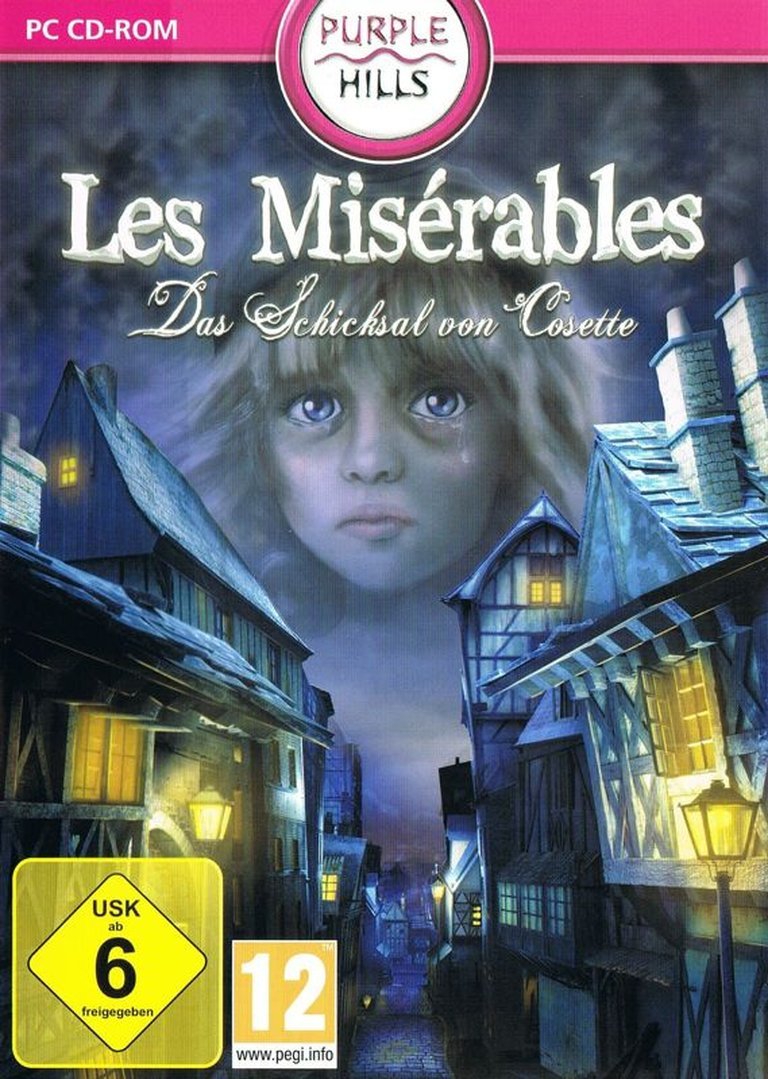
Les Misérables: Cosette’s Fate is a hidden object adventure game set in 19th-century France, inspired by Victor Hugo’s classic novel. Players take on the role of young Cosette, navigating through various scenes to escape the cruel Thénardiers. The game blends exploration, puzzle-solving, and narrative-driven gameplay, offering a reimagined interactive experience of Cosette’s journey toward freedom. With detailed backgrounds, mini-games, and a period-appropriate soundtrack, it immerses players in the struggles and triumphs of the beloved literary character.
Gameplay Videos
Where to Buy Les Misérables: Cosette’s Fate
PC
Les Misérables: Cosette’s Fate Guides & Walkthroughs
Les Misérables: Cosette’s Fate Reviews & Reception
gametop.com (65/100): Though not without flaws, Les Misérables: Cosette’s Fate presents an earnest attempt to blend classic literature with hidden object gameplay.
store.steampowered.com (62/100): Mixed (62% of the 35 user reviews for this game are positive).
steambase.io (62/100): Les Misérables: Cosette’s Fate has earned a Player Score of 62 / 100.
kinthdom.co.uk : As a hidden object game I feel that it does quite well.
Les Misérables: Cosette’s Fate: A Literary Adventure Lost in Translation
Introduction: The Promise and Pitfalls of a Classic Adaptation
Victor Hugo’s Les Misérables is a towering monument of world literature—a sprawling epic of redemption, revolution, and human suffering. Adapting such a work into a video game is a daunting task, one that Les Misérables: Cosette’s Fate (2013) attempts with mixed success. Developed by Mzone Studio and published by Anuman Interactive, this hidden object adventure game zeroes in on one of the novel’s most poignant subplots: the plight of young Cosette, trapped in servitude under the cruel Thénardiers. On paper, the concept is compelling—a chance to experience Hugo’s world through interactive storytelling. In practice, however, the game struggles to reconcile its literary ambitions with the constraints of its genre, resulting in a product that is earnest but flawed, a noble experiment that ultimately falls short of its potential.
This review will dissect Cosette’s Fate across its development, narrative, gameplay, and legacy, assessing whether it succeeds as a game, an adaptation, or both. Spoiler: it’s complicated.
Development History & Context: A Game Born of Literary Ambition
The Studio and the Vision
Mzone Studio, the primary developer behind Cosette’s Fate, is no stranger to narrative-driven adventure games. Their portfolio includes titles like Atlantis and Dracula, which suggests a penchant for adapting classic literature and historical settings. The studio’s collaboration with Anuman Interactive—a publisher known for its focus on casual and family-friendly games—hints at the target audience: players who enjoy light, story-rich experiences rather than hardcore gamers.
The game’s development coincided with a resurgence of interest in Les Misérables, thanks in part to the 2012 film adaptation starring Hugh Jackman and Anne Hathaway. This cultural moment likely influenced the decision to bring Hugo’s world to interactive life. However, the choice to frame the story around Cosette—a character whose arc is deeply tied to the novel’s broader themes of injustice and redemption—was a bold one. Unlike Jean Valjean or Javert, Cosette is a passive figure in much of the narrative, her agency limited by her circumstances. Turning her into a playable protagonist required creative liberties, some of which would prove controversial.
Technological Constraints and Design Choices
Released in 2013 for iOS and later ported to Windows, Mac, and Android, Cosette’s Fate is a product of its time. The hidden object genre was (and remains) a staple of casual gaming, particularly on mobile platforms. The game’s fixed/flip-screen visual style and point-and-click mechanics are reminiscent of early 2000s adventure games, a deliberate choice to evoke nostalgia while catering to modern audiences.
The development team faced several challenges:
1. Fidelity to the Source Material: Hugo’s novel is dense, with intricate subplots and philosophical digressions. Condensing this into a 3–4 hour hidden object game required drastic simplification.
2. Balancing Gameplay and Narrative: Hidden object games thrive on repetition and puzzle-solving, but Les Misérables demands emotional weight. Striking this balance was always going to be difficult.
3. Technical Limitations: The game’s engine, while serviceable, lacks the polish of contemporary titles. Animations are stiff, and the UI is functional but uninspired.
Despite these hurdles, the team’s ambition is evident. The inclusion of mini-games, interactive environments, and a focus on Cosette’s perspective suggests a genuine desire to create something more than a generic hidden object title.
Narrative & Thematic Deep Dive: A Story of Suffering and (Limited) Agency
Plot Overview: Cosette’s Journey
The game begins in 1826, in the village of Montfermeil, where Cosette is left in the care of the Thénardiers—greedy innkeepers who exploit her as a servant. The narrative follows her attempts to escape their abuse, culminating in her rescue by Jean Valjean. Along the way, players encounter key characters from the novel, including Fantine (Cosette’s mother) and the enigmatic Valjean himself.
The story is divided into chapters, each representing a different phase of Cosette’s ordeal. The game’s structure is linear, with little room for deviation, which mirrors Cosette’s lack of agency in the original novel. However, this linearity also makes the experience feel railroaded, with players merely going through the motions rather than shaping the narrative.
Characterization: A Mixed Bag
- Cosette: As the protagonist, Cosette is unfortunately underdeveloped. The game struggles to give her a distinct personality beyond her role as a victim. Her dialogue is minimal, and her actions are largely reactive.
- The Thénardiers: The game’s villains are appropriately despicable, though their cruelty is more cartoonish than nuanced. Madame Thénardier, in particular, is a one-dimensional harpy, lacking the complexity of her literary counterpart.
- Jean Valjean: His appearance is a highlight, but his role is limited to a deus ex machina figure who swoops in to save Cosette. The game misses an opportunity to explore his moral dilemma or his relationship with Cosette in depth.
Themes: Poverty, Oppression, and Hope
Cosette’s Fate touches on the novel’s central themes but does so superficially. The game’s environments—dilapidated inns, dark forests, and grimy streets—visually reinforce the oppressive atmosphere of 19th-century France. However, the thematic depth is often sacrificed for gameplay mechanics. For example:
– Poverty and Exploitation: The Thénardiers’ abuse of Cosette is depicted, but the broader social critique of Hugo’s work is absent. There’s no exploration of the systemic forces that trap characters like Fantine and Cosette in cycles of suffering.
– Redemption and Sacrifice: Valjean’s role as a savior is present, but the game doesn’t delve into his internal struggle or the cost of his actions.
– Hope and Resilience: The game’s ending is abrupt, offering a glimmer of hope but little resolution. Players familiar with the novel will recognize the setup for Cosette’s later life, but newcomers may feel cheated.
Dialogue and Writing: Lost in Translation
The game’s writing is its weakest link. The dialogue is stilted, and the translation (for non-French versions) is often clunky. Key moments from the novel are either glossed over or altered for the sake of gameplay. For instance:
– Fantine’s Fate: In the novel, Fantine’s death is a heartbreaking climax. In the game, it’s reduced to a brief cutscene with little emotional impact.
– Valjean’s Rescue: The iconic scene where Valjean lifts the cart to save a man is absent, robbing the character of one of his defining moments of strength and compassion.
The game’s attempt to include educational tidbits—such as facts about Victor Hugo or the historical context—is commendable but feels tacked on. These are presented as optional “butterfly” collectibles, which players can click on for trivia. While this adds a layer of depth for literature enthusiasts, it does little to enhance the core experience.
Gameplay Mechanics & Systems: Hidden Objects and Hidden Frustrations
Core Gameplay Loop: Find, Collect, Repeat
Cosette’s Fate is, at its heart, a hidden object game. Players are tasked with finding items in cluttered scenes, solving puzzles, and using collected objects to progress. The loop is familiar:
1. Explore a Scene: Players navigate through fixed screens representing locations like the Thénardiers’ inn or the woods outside Montfermeil.
2. Find Objects: A list of items appears at the bottom of the screen, and players must locate them. Some objects require interaction (e.g., cutting an apple to get slices).
3. Solve Puzzles: Mini-games, such as lock-picking or pattern-matching, break up the hidden object segments.
4. Progress the Story: Completed tasks unlock new areas or advance the narrative.
Innovations and Flaws
The game attempts to innovate within its genre:
– Interactive Objects: Some items must be manipulated before they can be collected (e.g., using a knife to cut an apple). This adds a layer of problem-solving but can be frustrating when the required action isn’t intuitive.
– Puzzle Variety: The mini-games range from simple (matching symbols) to moderately challenging (reassembling broken objects). However, the difficulty curve is inconsistent, with some puzzles feeling arbitrarily hard.
– Backtracking: Players frequently revisit locations to use newly acquired items. While this is standard for adventure games, Cosette’s Fate lacks a fast-travel system, making backtracking tedious.
UI and Accessibility
The user interface is functional but unremarkable. Key issues include:
– Hint System: The hint mechanism is underwhelming. It highlights one random object rather than guiding players toward their current objective. In some cases, hints are wasted on items hidden behind interactive elements (e.g., a drawer that needs to be opened first).
– Inventory Management: The inventory system is straightforward, but the lack of tooltips or descriptions can leave players confused about how to use certain items.
– Bugs and Glitches: Several reviews mention game-breaking bugs, particularly in puzzle sections. For example, failing a puzzle and exiting to the menu can soft-lock the game, forcing players to restart.
Progression and Replayability
The game’s linear structure and lack of branching paths mean there’s little incentive to replay it. Once the puzzles are solved and the story is experienced, there’s no additional content to uncover. The absence of difficulty settings or unlockable extras further limits its longevity.
World-Building, Art & Sound: A Gritty but Shallow 19th-Century France
Visual Design: Atmospheric but Dated
The game’s art direction is its strongest suit. The environments are detailed, with a painterly quality that evokes 19th-century France. The Thénardiers’ inn, in particular, is a highlight—cluttered, dimly lit, and oppressive, it effectively conveys Cosette’s misery. However, the character models are less impressive. Cosette and other figures are stiffly animated, with limited facial expressions. The game’s fixed-screen perspective also restricts immersion, making the world feel more like a diorama than a living space.
Sound Design: Mood-Setting but Repetitive
The soundtrack is a mixed bag. The ambient music is atmospheric, with melancholic strings and period-appropriate instrumentation. However, the lack of voice acting is a glaring omission. Key emotional moments—such as Cosette’s interactions with Valjean—fall flat without vocal performances. The sound effects (e.g., creaking doors, scurrying rats) are well-implemented but can’t compensate for the absence of dialogue.
Atmosphere: A Sense of Place, but Little Depth
The game excels at creating a sense of place. The grimy streets of Montfermeil, the eerie woods, and the claustrophobic inn all contribute to a feeling of oppression and desperation. However, the world lacks interactivity. Players can’t engage with most objects beyond the ones required for puzzles, which makes the environment feel static. The inclusion of animated elements (e.g., a rat in the kitchen) is a nice touch but doesn’t compensate for the overall lack of dynamism.
Reception & Legacy: A Niche Experiment with Limited Impact
Critical Reception: Mixed but Leaning Negative
Cosette’s Fate received a tepid response from critics and players alike. On Steam, it holds a “Mixed” rating (62% positive), with common criticisms including:
– Short Length: Many players completed the game in under 3 hours, leaving them feeling shortchanged.
– Repetitive Gameplay: The hidden object mechanics grow stale quickly, and the puzzles lack innovation.
– Narrative Weaknesses: Fans of the novel were disappointed by the game’s deviations and lack of depth.
However, the game found a niche audience among:
– Literature Enthusiasts: Players who appreciated the attempt to adapt Les Misérables found value in the game’s setting and themes.
– Casual Gamers: Those who enjoy hidden object games praised the puzzles and artwork, even if the story fell flat.
Commercial Performance: A Minor Footnote
The game’s commercial success is difficult to gauge, but its presence on multiple platforms (iOS, Windows, Mac, Android) suggests a modest but sustained interest. Its $2.99 price point likely helped attract casual players, though it’s unlikely to have been a major financial success.
Legacy: A Cautionary Tale for Literary Adaptations
Cosette’s Fate serves as a case study in the challenges of adapting literature to interactive media. Its failures highlight several key lessons:
1. Narrative vs. Gameplay: A story-driven game must balance its literary ambitions with engaging mechanics. Cosette’s Fate leans too heavily on the former, resulting in a game that feels more like an illustrated novel than a dynamic experience.
2. Character Agency: Cosette’s lack of agency in the source material makes her a difficult protagonist for a game. Without meaningful choices or development, she remains a passive observer in her own story.
3. Fidelity vs. Innovation: The game’s deviations from the novel alienated purists, while its adherence to hidden object tropes failed to innovate within its genre.
Despite its flaws, Cosette’s Fate is not without merit. It remains one of the few attempts to bring Les Misérables to the gaming world, and its atmospheric design and earnest storytelling deserve recognition. However, its legacy is ultimately one of missed opportunities—a game that could have been a landmark adaptation but instead settled for being merely adequate.
Conclusion: A Noble Failure with Fleeting Charms
Les Misérables: Cosette’s Fate is a game of contradictions. It aspires to be a faithful adaptation of a literary masterpiece but stumbles in its execution. It offers a compelling setting and atmospheric visuals but undermines them with repetitive gameplay and shallow storytelling. It targets fans of Les Misérables but takes liberties that may alienate them.
Final Verdict: 6/10 – A Flawed but Earnest Experiment
For casual gamers or hidden object enthusiasts, Cosette’s Fate provides a few hours of mild entertainment. For literature lovers, it’s a curiosity—a chance to walk in Cosette’s shoes, albeit briefly and imperfectly. However, as a game, it fails to transcend its genre’s limitations, and as an adaptation, it lacks the depth and emotional resonance of its source material.
Who Should Play It?
– Fans of hidden object games looking for a literary twist.
– Les Misérables enthusiasts curious about interactive adaptations.
– Players who enjoy atmospheric, story-driven experiences but aren’t seeking deep gameplay.
Who Should Avoid It?
– Those expecting a faithful or comprehensive retelling of Hugo’s novel.
– Gamers looking for innovative mechanics or replayability.
– Players who dislike backtracking or repetitive puzzles.
In the end, Cosette’s Fate is a reminder that not all great stories translate seamlessly into games—and that some tales are best left to the imagination.