
- Release Year: 2016
- Platforms: Windows
- Publisher: Indie Game Group
- Developer: Indie Game Group
- Genre: art, Educational, Graphics
- Perspective: 3rd-person (Other)
- Game Mode: Single-player
Description
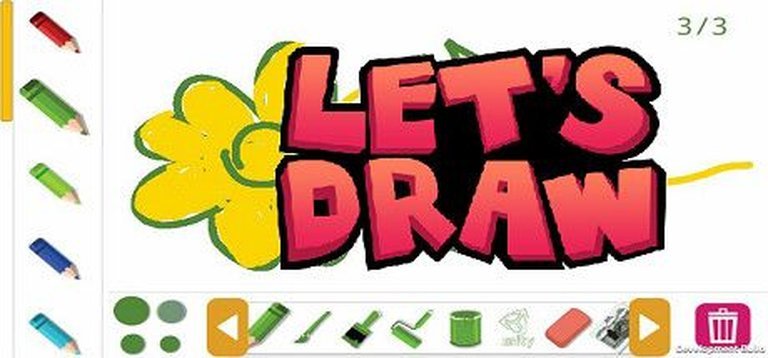
Let’s Draw is an educational video game developed by Indie Game Group and released in 2016 for Windows. It focuses on teaching graphics and art skills through a meditative, zen-paced experience, utilizing a point-and-select interface with mouse controls in a fixed or flip-screen visual style. Designed for single-player offline sessions, the game provides a calming environment for artistic expression and learning without a traditional narrative setting.
Where to Buy Let’s Draw
PC
Let’s Draw Reviews & Reception
honestgamers.com : The folks who made the game clearly knew their audience and worked to keep them happy and engaged.
Let’s Draw (2016): A Digital Sketchpad’s Quiet Existential Review
Introduction: The Unassuming Canvas
In an era where video games strive for cinematic spectacle, sprawling open worlds, and emotionally wrenching narratives, the very existence of Let’s Draw feels like an act of quiet rebellion. Released on December 30, 2016, by the cryptic Indie Game Group, this Windows application does not quest, it does not combat, and it narrates not a single story. It is, in its own words, “a drawing game for everyone especially children.” This review posits that Let’s Draw is not a failure of ambition, but a deliberate, almost Zen-like exercise in minimalist design. It represents a steadfast adherence to a pure, process-oriented interactive experience, standing as a curious footnote in the medium’s history—a testament to the idea that a “game” can be nothing more (and nothing less) than a digital tool for creation, divorced from the conventional trappings of challenge, progression, and narrative that define its more celebrated cousins.
Development History & Context: Shadows of a Studio
The development history of Let’s Draw is, much like the game itself, sparse and obscure. The developer and publisher, Indie Game Group, leaves a negligible digital footprint. There are no known interviews with its creators, no design documents, and no public-facing vision statement beyond the functional store descriptions. This anonymity forces us to infer context from the product itself and its place in the 2016 market.
The game emerged during a peculiar boom for “educational” or “creative” software on digital storefronts like Steam. Platforms were increasingly saturated with low-cost, often simple, applications targeting niche audiences—from piano trainers to typing tutors. Let’s Draw entered this space, directly competing with a proliferation of drawing applications, from the robust (like Krita or Clip Studio Paint) to the absurdly simple (countless “virtual coloring book” apps). Its positioning as a “game” rather than a “tool” is telling; it frames the act of drawing as an activity with playful, gamified feedback (congratulatory messages, as noted in the DS version’s review), yet it shuns any semblance of traditional game mechanics.
Technologically, it is a product of its time: a lightweight, 2D Windows application built with “2D Sprites Used,” requiring only a modest dual-core CPU and 1GB of RAM. Its “Fixed / flip-screen” perspective and “Menu structures” interface speak to a design prioritizing straightforward access over immersive environments. There is no evidence of cutting-edge graphics or physics; its constraint is its feature set, not computational power. The 2016 landscape was also seeing the continued success of narrative-driven “interactive movie” games like Life is Strange and Until Dawn (as discussed in the provided academic essay). Against this tide of complex storytelling, Let’s Draw’s total lack of narrative is a deliberate, counter-cultural statement.
Narrative & Thematic Deep Dive: The Story of No Story
To analyze the “narrative” of Let’s Draw is to engage with its most radical design choice: its complete absence of one. There is no plot, no characters, no dialogue, and no world. This removes it entirely from the narrative evolution outlined in the source essay from Game Developer, which traces the move from embedded narratives (like in Donkey Kong) to emergent, player-driven stories (like in Skyrim or Bloodborne).
Let’s Draw exists in a category prior to narrative. Its thematic core is not about representing events or character goals (per Marie-Laure Ryan’s narratology features), but about facilitating a meditative process. The game’s listed “Pacing” of “Meditative / Zen” is its only thematic descriptor. The experience is not about what is drawn, but the act of drawing itself. The player’s “goal” is self-defined and intrinsically motivated. The only “story” is the user’s own fleeting inspiration: “I will draw a tree,” followed by the sequence of strokes, the choice of brush, the adjustment of the zoom. The game provides no context for these actions, no reason why one should draw a tree. It is pure, unadulterated * ludic intentionality*—the joy found in the execution of a simple, rules-light activity.
This approach aligns with a subset of “art games” or “tool-games” that prioritize aesthetic experience over traditional game narratives. Unlike journey or Gone Home, which use minimalism to underscore a poignant narrative, Let’s Draw uses minimalism to remove narrative entirely. Its closest thematic relatives are not video games, but physical media: a blank sketchbook, a set of charcoal pencils, a quiet table. The “theme” is artistic autonomy in a frictionless digital space.
Gameplay Mechanics & Systems: The Architecture of a Tool
The gameplay of Let’s Draw is best understood not as a loop of “challenge-action-reward,” but as a * toolkit interface*. The core “loop” is simply: select tool -> modify canvas -> (optionally) save. There is no fail state, no win condition, no points, and no unlocks.
Core Toolset: The game provides a palette of eight primary instruments, as listed on its Steam page:
1. Pencil: For fine lines.
2. Brush: For broader strokes.
3. Paint: Presumably a filled shape tool.
4. Paint Roller: For rapid area coverage.
5. Paint Can: Likely a flood-fill bucket.
6. Stamp: For applying pre-made 2D sprites (14 per tool).
7. Easer: For correction.
8. Hand: For canvas navigation/panning.
Supporting features include Bezier Path for Smooth Lines, Zoom IN/OUT, a palette of 14 Colors, a Trash with Confirm Dialog, Scrollable Lists and a Scrollable shapes selector. The promise of “Screenshot Print & Export will be added with updates” suggests a trajectory toward utility, though its current state is purelycreational.
Interface & UI: The perspective is “3rd-person (Other),” meaning the player observes the canvas from an external, fixed viewpoint. The “Interface” is purely “Menu structures” and “Point and select.” This is a dashboard, not a world. The user does not inhabit a character; they are a disembodied operator. This reinforces the tool-like experience. The UI is likely functional and clear, prioritizing immediate access to tools over aesthetic flourish—a necessity for its intended audience of children and beginners.
Innovation & Flaws: Its innovation is its radical simplicity. In a market filled with over-engineered creative suites, it offers no tutorials (a point critiqued in the HonestGamers review of the DS version), no lessons, no progression. It is a blank slate. Its primary flaw is this same limitation. The DS version, Let’s Draw! (2010), included guided lessons with voice-over (“‘Now draw a circle for the face…'”), mini-games, and a sketchbook with save functionality. The 2016 Windows version, based on available specs, appears to be a stripped-down, feature-lite version of its predecessor, lacking the structured pedagogical framework. It offers the what (tools) but not the how or why. For a child with no intrinsic motivation, it is just a cursor on a screen. For an older user, it may feel like a regression from even basic paint programs.
World-Building, Art & Sound: The Aesthetics of Nothing
Since Let’s Draw has no diegetic world, “world-building” is an exercise in describing its non-diegetic interface and the implied space of the canvas.
Visual Direction: The game employs “2D Sprites Used” for its tools and stamps, and “14 Sprites per Tool.” This suggests a clean, vector-style or simple bitmap aesthetic for its instruments. The color palette is limited to 14 hues, enforcing a stylistic constraint. The overall look is likely bright, cheery, and utilitarian—akin to a children’s educational software from the early 2000s, but flatter and more modern. The “Fixed / flip-screen” perspective means the canvas occupies a static portion of the screen, surrounded by menus. There is no parallax, no lighting, no environmental art. The “world” is the void of the canvas and the menu panes. This visual minimalism perfectly serves its purpose: it does not distract from the act of drawing.
Sound Design: The source material is silent on audio. Given its “Meditative / Zen” pacing and target audience, one can infer a lack of intrusive sound. It may feature soft, looping ambient tracks or cheerful, simple melodies during use, and perhaps positive auditory feedback (a chime) upon saving or completing a shape, mirroring the DS version’s “congratulate you on your artistic prowess.” However, without explicit confirmation, its soundscape remains an assumed blank.
The atmosphere is one of focused solitude. It is the digital equivalent of a clean desk. The only “setting” is the user’s own imagination, projected onto a neutral, tool-filled plane. Its contribution to experience is to not contribute—to be a transparent medium.
Reception & Legacy: The Whisper in the Database
Let’s Draw exists in a state of near-total critical and commercial obscurity.
* Critical Reception: There are no critic reviews aggregated on MobyGames or Metacritic. The “Moby Score” is “n/a.” This is not unusual for a hyper-obscure indie release, but it places it outside all critical discourse.
* Commercial/User Reception: On Steam, it holds a “Mixed” rating based on 17 user reviews, with 64% positive. The low review count signals minuscule sales or player engagement. On MobyGames, it is “Collected By” only 22 players. On VideoGameGeek, it has 0 ratings and 0 comments. It is, for all intents and purposes, a ghost in the machine.
* Legacy & Influence: Its influence is effectively zero. It has not inspired clones, been cited in design talks, or become a cult classic. It does not appear in “best of” lists for educational games or art games. Its legacy is that of a digital artifact—a proof that such a thing can be sold on Steam. It exists in a lineage that includes:
* Precursors: The MS Paint ecosystem, The Art Academy series (which combined lessons with tools), and the aforementioned DS title Let’s Draw! (which was significantly more fleshed-out).
* Contemporaries/Niche Peers: Simple drawing apps like Paint.NET (free) or Krita (powerful, free). It is vastly outclassed by both.
* Spiritual Successors: The “toy” genre of games like Townsmen or Cook, Serve, Delicious! that focus on satisfying, repetitive tasks, but even those have more defined progression.
Its place in video game history is as a curio. It demonstrates the breadth of what is commercially labeled a “video game” on modern storefronts, stretching the definition to its breaking point. It is a cautionary tale about the “long tail” of digital distribution, where countless tiny projects live and die without notice. In the taxonomy of the provided academic essay, it is neither embedded nor emergent narrative—it is non-narrative. It is not a story-based game; it is a process-based application that happens to be distributed through game channels.
Conclusion: The Unclaimed Sketch
Let’s Draw (2016) is a paradox: a video game that is not really a game, an educational product that teaches nothing, a creative tool with the depth of a doodle pad. Its thesis is that the simplest interaction—making a mark on a screen—can be its own reward. In this, it is either profoundly insightful or woefully naive.
For the historian, it is a valuable data point. It marks a moment where the barriers to entry for game development were so low that a basic drawing utility could be packaged and sold alongside Elden Ring on the same platform. It highlights the vast, untouched ecosystem of non-narrative, non-challenging interactive软件 that thrives in the shadow of the AAA and indie narrative darlings that dominate scholarly discussion.
For the player, it is almost certainly not worth its asking price ($4.99, often discounted to $0.71) when superior, free alternatives exist. Its value is purely nostalgic or specific: for a parent wanting a locked-down, simple drawing environment for a very young child, isolated from the web and complex menus, it might serve a purpose. But the DS version from 2010, with its lessons and mini-games, is a far more compelling and complete product.
In the grand evolution of video games as a storytelling medium, Let’s Draw is a dead-end branch—a reaffirmation that not all interactive software aspires to narrative. It is a silent, functional object. Its verdict is not one of quality, but of existential niche. It is a digital sketchpad that few have picked up, leaving its pages forever blank. Its historical significance lies not in what it achieved, but in what it consciously, optimistically, or negligently refused to be. It is a game only in the broadest, most permissive taxonomy—a humble, forgotten testament to the power of doing absolutely nothing, except draw.