
- Release Year: 2004
- Platforms: Windows
- Publisher: ValuSoft, Inc.
- Developer: ImaginEngine Corp.
- Genre: Action, Sports
- Perspective: Third-person
- Game Mode: Single-player
- Gameplay: Barrel racing, Customization, Feeding, Grooming, Horse riding
- Setting: Horses, Open pasture
- Average Score: 45/100
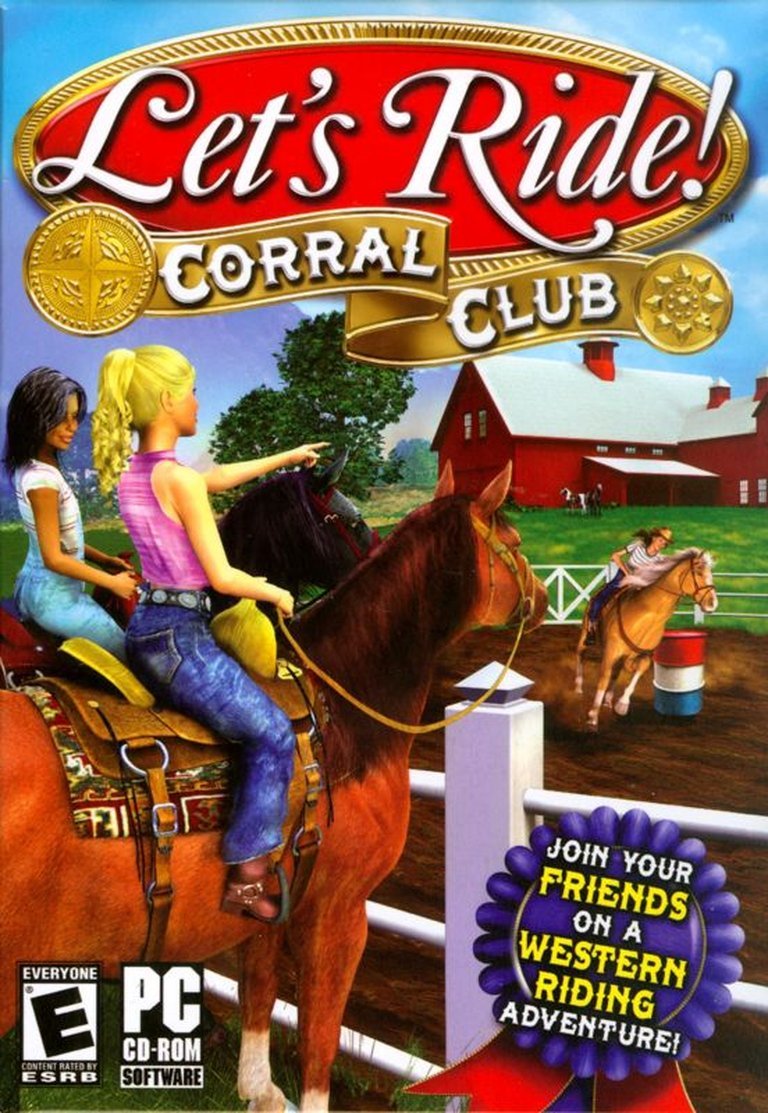
Description
Let’s Ride!: Corral Club is a 2004 Windows horseback‑riding simulation where players customize a female rider and her pony, groom and feed the horse, then compete in barrel‑racing events across practice fields, competitions and open pastures, progressing from local to national levels.
Gameplay Videos
Let’s Ride!: Corral Club Free Download
Let’s Ride!: Corral Club Reviews & Reception
mobygames.com (45/100): A customizable horseback riding experience with barrel racing and avatar customization.
retro-replay.com : A well‑rounded horseback riding game with intuitive controls and varied modes.
Let’s Ride!: Corral Club – Review
Introduction
When the early‑2000s saw a surge of “virtual pet” and “simulation” titles aimed at younger audiences, Let’s Ride!: Corral Club arrived as a modest, Windows‑only entry that promised a blend of horse‑care, fashion, and barrel‑racing competition. Released in October 2004 by ValuSoft and built by ImaginEngine Corp., the game positioned itself as a child‑friendly counterpart to more serious equestrian simulators. The premise is simple: dress a female rider, pick a pony, groom and feed it, then master a series of barrel‑racing challenges.
My thesis is that, while the concept holds genuine charm and a commendable emphasis on customization and animal care, the execution is hampered by dated graphics, shallow gameplay loops, and technical quirks that ultimately relegate the title to the realm of a nostalgic, niche curiosity rather than a benchmark in the horse‑racing genre.
Development History & Context
Studio & Publisher
- ImaginEngine Corp. – a small development house that, in the early‑2000s, focused on educational and family‑oriented titles. Their portfolio includes other “Let’s Ride!” entries (Sunshine Stables, Dreamer) and a handful of adventure games for handhelds.
- ValuSoft, Inc. – a publisher known for budget‑priced Windows games, often distributed through retail chains and later via digital abandonware sites. Their catalog leans heavily on low‑cost action and simulation titles targeting casual gamers.
Technological Constraints
- Engine & Graphics – The game runs on a proprietary 3‑D engine that renders semi‑realistic horses and environments at a low resolution, resulting in a pixelated look typical of budget titles of the era. DirectX 9.0b is the minimum graphics requirement, but the asset budget is modest (32 MB VRAM).
- Input & Platform – Designed for keyboard‑only control (arrow keys for steering, Up/Down for acceleration/braking). No gamepad support, which limited accessibility for younger players accustomed to console pads.
- System Requirements – Windows 95/98/ME/XP, Pentium III 700 MHz, 128 MB RAM, 500 MB storage—specifications that placed the title comfortably within the average home PC of 2004, but also meant the game could not leverage emerging GPU capabilities.
Market Landscape
In 2004 the PC market was dominated by high‑budget releases (e.g., Half‑Life 2), but there remained a thriving segment of low‑cost family titles. Simultaneously, the equestrian simulation niche was expanding with games such as Starters for Horses and My Little Pony spin‑offs. Let’s Ride!: Corral Club tried to capture a slice of this market by combining “dress‑up” mechanics with a modest competitive mode, aiming at a younger, predominantly female demographic.
Narrative & Thematic Deep Dive
Plot & Setting
The game offers no traditional narrative beyond the player’s personal journey as a barrel‑racer. The “story” is emergent: you start in a modest stable, customize your rider and pony, and work your way up through a ladder of competitions (local → city → county → sectional → regional → state → national). The only linear progression is the scrapbook, a virtual album that records certificates, photos, and printable achievements after each win.
Characters & Avatar
- Female Avatar – Fully customizable: hair color, outfit color, and accessories can be altered. This design choice reflects an early attempt to empower young girls with agency over appearance.
- The Pony – Players can change coat color, mane/tail style, saddle, and saddle pad. Two hidden textures (zebra and giraffe) exist in the game files, hinting at a playful Easter‑egg culture, though they cannot be unlocked through normal gameplay.
Themes
- Responsibility & Care – Grooming and feeding mechanics (apples, carrots) teach basic animal‑care concepts.
- Personal Expression – The extensive wardrobe and horse‑appearance options encourage creativity.
- Competition & Achievement – Progression through barrel‑racing tiers and the scrapbook reinforce a goal‑oriented mindset.
- Gender‑Targeted Design – By emphasizing fashion and a female rider, the game aligns with early‑2000s marketing strategies that aimed to attract girls to “sports” titles—a double‑edged sword that both broadened accessibility and reinforced gender stereotypes.
Gameplay Mechanics & Systems
Core Loop
- Customization – Choose rider outfit, hair, and horse aesthetic.
- Stable Management – Brush the horse, feed apples or carrots, and adjust tack.
- Practice – Navigate a barrel course marked by ground arrows, learning the timing of turns.
- Competition – Race against time, striving to beat “best times” of AI girl‑pony teams across increasingly larger circuits.
- Pasture Mode – Open‑field barrel layouts for experimentation without a strict time constraint.
- Scrapbook – Automatic saving of certificates and screenshots; printable for wall‑hangings or bragging rights.
Controls & Gaits
- Steering – Left/Right arrow keys.
- Acceleration/Brake – Up/Down arrow keys.
- Gaits – Walk → Trot (automatically shifts to a slower canter when turning) → Gallop. The transition is linear, with no stamina or momentum management, simplifying the learning curve for younger players.
Progression & Difficulty
The competition ladder is linear, with each tier introducing slightly tighter barrel spacing and faster AI times. However, the difficulty curve is shallow; after a few practice runs, the AI’s “best times” become predictable, reducing the long‑term challenge.
UI & Feedback
- HUD – Minimalistic: a timer, lap counter, and a small map of the barrel layout.
- Audio Cues – Race theme intensifies during laps; winning triggers a short “Winner’s Theme”.
- Scrapbook UI – Simple list view with thumbnail certificates; a “Print” button allows physical copies (though the feature is often broken on modern systems).
Technical Issues
- Saving Crashes – Numerous community reports (e.g., MyAbandonware forums) describe crashes when attempting to save or finish a run, often requiring the user to run the executable directly from the ISO.
- Installer Instability – The setup program frequently aborts on modern Windows versions, prompting users to copy the game folder manually.
World‑Building, Art & Sound
Visual Direction
- Semi‑Realistic 3D – Horse models are low‑poly, with textures that appear pixelated at the default resolution. The environments (practice corral, competition arena, open pasture) rely on flat‑shaded terrain and simple, pastel‑toned skyboxes.
- Easter‑Egg Visuals – The CD icon depicts a Rainbow Dash‑style figure, and the default horse name is Rainbow. Hidden textures (zebra, giraffe) are stored in
horse/textures, accessible only by renaming files—an odd nod to developers’ sense of humor.
Audio Design
- Main Menu Theme – Light, upbeat melody that sets a cheerful tone.
- Pasture Theme – Ambient, relaxed music encouraging exploration.
- Race Theme – Faster tempo with percussive accents to heighten competition tension.
- Winner’s Theme – A short triumphant fanfare that plays after a victory, reinforcing the reward loop.
Overall, the sound palette is functional but unremarkable; it lacks dynamic layering that could differentiate between practice and high‑stakes races.
Reception & Legacy
Critical Reception
- 7Wolf Magazine (2004) – 45 % (4.5/10). The review praised the concept of a “horse‑racing” game for children but condemned the execution as a “weak children’s toy”.
- Player Feedback – A single user rating of 2.2 / 5 (on MobyGames) echoed the critic’s sentiment, citing repetitive gameplay and technical instability.
Commercial Performance
Exact sales figures are unavailable, but the game’s presence on MyAbandonware and its low‑price retail positioning suggest modest commercial success—typical for ValuSoft’s budget catalog.
Influence & Series Continuation
Let’s Ride! became a micro‑series:
| Year | Title | Platform |
|---|---|---|
| 2004 | Sunshine Stables | Game Boy Advance |
| 2004 | Corral Club | Windows |
| 2005 | Dreamer | Game Boy Advance |
| 2005 | Horse Racing Tycoon | Windows |
| 2007‑2008 | Multiple sequels (e.g., Friends Forever, Silver Buckle Stables) | Various |
While the series persisted for several years, it never broke into mainstream awareness. Its legacy lies in providing an early, accessible entry point for younger players interested in equestrian themes—a niche that later titles like Starters for Horses and My Riding Horse would refine.
Conclusion
Let’s Ride!: Corral Club is a well‑intentioned, family‑oriented title that succeeds at delivering a tidy package of customization, basic horse care, and barrel‑racing competition. Its strengths are the robust avatar/horse editor, the scrapbook achievement system, and a clear, child‑friendly progression path.
However, the game’s pixelated graphics, simplistic AI, and technical instability prevent it from delivering a compelling long‑term experience. In a market where more sophisticated equestrian simulators were emerging, Corral Club feels like a budget‑friendly sandbox rather than a definitive entry in the genre.
Verdict: A nostalgic curiosity for collectors and a modest diversion for younger audiences, but not a standout title in video‑game history. Its place is secured as a footnote in the early‑2000s wave of animal‑care simulations—a cute, if flawed, attempt at bringing the world of barrel racing to the living‑room PC.