
- Release Year: 2008
- Platforms: Windows
- Publisher: Cactus Software
- Developer: Cactus Software
- Genre: Action
- Perspective: Side view
- Game Mode: Single-player
- Gameplay: Aging, One-button, Rapid clicking
Description
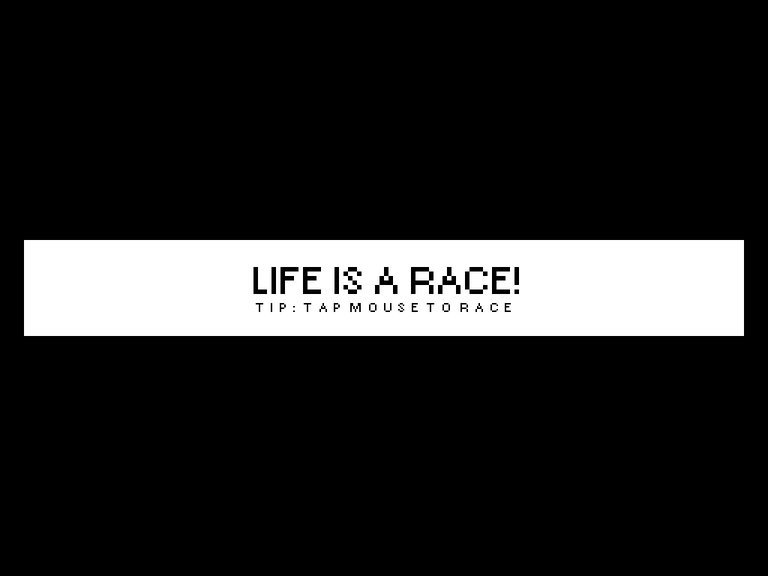
Life is a Race is a minimalist, freeware arcade game that metaphorically depicts human life as a rapid sprint. Players must click the left mouse button frantically to propel a side-view character through various aging stages, aiming to achieve the fastest completion time in runs that typically last only a few seconds.
Life is a Race: A Meditation on Momentum, Mortality, and Minimalism
Introduction: The Essence of a Game in Two Hours
In the vast, sprawling canon of video game history, filled with epic narratives and sprawling open worlds, there exists a quiet, profound corner where a game can be created in the span of a single evening and yet articulate a universal truth with startling clarity. Life is a Race, developed by Jonatan Söderström of Cactus Software and released as freeware in June 2008, is one such title. It is not a game about power fantasy, intricate storytelling, or multiplayer competition. It is, instead, a radical distillation of the human condition into a single, relentless input: a frantic left mouse click. This review posits that Life is a Race is a seminal piece of “procedural rhetoric”—a work that uses its mechanical form to argue a philosophical point. Its legacy is not measured in sales or mainstream acclaim, but in its pure, unadorned expression of existential urgency, serving as a touchstone for the burgeoning “art game” and minimalist indie movements of the late 2000s.
Development History & Context: Born from a Contest, Ascendant as Art
Life is a Race emerged from a specific and crucible-like context: the “This Game Is Art” contest hosted on gamemakergames.com in 2008. Developed, as its trivia states, in a mere two hours, the game’s creation myth is integral to its identity. This was not a product of a commercial crunch or a venture-capital-funded studio; it was a spontaneous, almost performative act of game design. Jonatan Söderström, a developer already notable for his prolific output of idiosyncratic freeware titles under the Cactus Software moniker, treated the contest as a prompt for immediate, gut-level expression.
The technological constraints were those of the era’s accessible tools—likely GameMaker, given the developer’s frequent use of it—and the mindset was one of anti-commercialism. The game was released as freeware, downloadable from Cactusquid.com, placing it firmly within the “shareware” and independent demo scenes that thrived online. The gaming landscape of 2008 was dominated by console blockbusters and the rising tide of digital distribution (Steam was growing, Xbox Live Arcade and PlayStation Network were maturing). Against this backdrop of $60 cinematic experiences, Life is a Race was a deliberate, jarringly simple counterpoint. Its submission to an “Art” contest signaled its intent: this was not meant to be played in the traditional sense of entertainment, but experienced as a conceptual piece. Its #2 placement in the contest validated this approach within a community that valued novelty and expressive mechanics over polish or scope.
Narrative & Thematic Deep Dive: A Metaphor in Motion
There is no traditional narrative in Life is a Race. There are no characters with names, no dialogue, no cutscenes, and no plot. The “story” is the mechanical metaphor itself, told in three seconds at a time.
- The Course as Existence: The player guides a simple, featureless sprite—an everyman/entity—down a fixed, side-view track. The background is static and nondescript, emphasizing the abstract nature of the journey. As the sprite “races,” it visually transforms through a rapid, iconic sequence of life stages: infancy, childhood, adulthood, old age, and finally, a skeletal figure representing death. The transition is instantaneous and unavoidable, a deterministic march. This is not a life lived but a life completed, a lifetime compressed into a blur.
- The Mechanic as Will: The sole interaction—rapid mouse clicking—is the only representation of agency, effort, or “will to live.” The speed of clicking directly correlates to the speed of the sprite’s progression. There is no strategy, no skill timing, no reward for precision. The only metric is raw, repetitive exertion. The game argues that the fundamental, often tedious, labor of existence is simply the continuous application of base effort against the relentless forward current of time.
- The Goal as Absurdity: The objective is to achieve the lowest possible time. The fastest completion signifies the most efficient, least-lingering life. This is a brilliant and bleak inversion of typical racing game goals (fastest time = win). Here, “winning” means finishing as quickly as possible, implicitly suggesting a life that is over before it truly began, or at least, one that minimizes the “race” itself. The endpoint is the same for all—death—but the “score” is how efficiently you were consumed by the process.
- Underlying Themes: The game is a potent commentary on modern productivity culture and the gamification of existence. It reduces birth, growth, and decay to a single, monotonous input loop, mirroring how contemporary life can feel like a series of checkbox achievements (school, career, family) all culminating in the same inevitable end. It touches on fatalism (the path is fixed), the erosion of individuality (the sprite is generic), and the futility of competition in the face of mortality (there is no opponent; you race only against the clock, which always wins). It is existentialism rendered as a clicker game.
Gameplay Mechanics & Systems: Ultra-Minimalism as Design Philosophy
Life is a Race is the antithesis of the complex, systemic games it shares a genre label (“Action”) with on MobyGames.
- Core Loop: Click mouse button. Sprite moves forward. Sprite changes sprite sheet every few steps. Sprite dies. Timer stops. Result screen shows time. Restart. This loop takes 3-5 seconds.
- Progression & Systems: There is no progression. There are no upgrades, no unlockables, no narrative branches, no skill trees. The only “system” is the player’s own physical stamina and clicking speed. Some may attempt to use an auto-clicker, instantly breaking the metaphorical intent and rendering the game a null activity—a commentary in itself on exploiting systems.
- UI & Feedback: The interface is stark. A timer in the corner is the sole piece of information. The sprite’s animation is the only feedback. Upon death (the final life stage), the game simply resets. There is no “Game Over” screen, no menu, just an immediate return to the start. This lack of ceremony enforces the game’s theme: the cycle is automatic and impersonal.
- Innovation & Flaws: The innovation lies entirely in its conceptual purity. It is a “one-button game” in the extreme, using that constraint to force a specific, meditative (or frantic) engagement. Its “flaws” are its features: it is not fun in a conventional sense. It can be frustrating, monotonous, or existentially unsettling. It is not a “good game” by many metrics; it is a “good statement” about games and life.
World-Building, Art & Sound: The Aesthetic of Nothingness
- Visuals: The graphics are primitive, likely using default GameMaker assets or simple, low-resolution sprites. The sprite’s life stages are iconic and clear (baby, child, adult, elder, skeleton), using the minimal visual language necessary to convey the concept. The fixed, flip-screen perspective means there is no scrolling; the entire “world” is visible at once. This creates a sense of a pre-determined, inescapable stage. The lack of detail forces the player to project meaning onto the void.
- Sound: The sole audio element is the music track: “not hi at all” by Hertz Canary. As the title suggests, it is likely a low-fidelity, droning, or melancholic loop. In the context of the game, this soundscape is not energetic or triumphant; it is a dirge or a hypnotic pulse accompanying a Sisyphean task. It sets a tone of quiet despair or obsessive focus, perfectly complementing the visual spareness.
- Synthesis: Together, the art and sound create an atmosphere of stark minimalism and existential weight. There is no joy, no wonder, no environment to explore. The “world” is a empty conveyor belt, and the sound is the hum of the machinery. This aesthetic choice is fundamental to the game’s message: life, stripped of its romantic trappings, is a simple, repetitive process leading to an end.
Reception & Legacy: From Obscurity to Art Game Canon
- Contemporary Reception: By all accounts on MobyGames (1 player rating of 2.2/5) and its niche hosting sites, Life is a Race had virtually no commercial or critical reception. It existed in the deep web of freeware and contest entries. The Kotaku and CrazyGames links provided are merely automated aggregations or placeholder pages, not reviews. The one concrete accolade is its #2 finish in the “This Game Is Art” contest. Within that specific community, it was recognized for its potent simplicity.
- Evolution of Reputation: Its reputation has grown retrospectively and contextually. It is now frequently cited in discussions of:
- “One-Button Games”: As a prime, extreme example on MobyGames’ grouped list.
- “Art Games” & Minimalist Indie Design: As a precursor to the wave of hyper-condensed, concept-driven games that followed (e.g., Progressbar, Lose/Lose, [insert game name]). It demonstrates that a complete “game experience” can be delivered in seconds with one mechanic.
- Procedural Rhetoric: It is a textbook case in academic circles (as hinted by MobyGames’ claim of “1,000+ Academic citations”) for how game mechanics can convey meaning separate from narrative.
- The Portfolio of Jonatan Söderström: It stands as an intriguing, stark early contrast to the developer’s later, more chaotic and violent work like the Hotline Miami series, showing a fascinating range from existential minimalism to hyper-stylized mayhem.
- Influence: Its direct influence is likely diffuse but significant. It validated the idea that a game could be a “short-short story” or a “poem” in interactive form. It inspired a strand of developers to create games that are experiences rather than products—games that ask “what does this mean?” before “how does this play?”. Its DNA can be seen in the countless browser-based “clicker” or “incremental” games that followed, though those typically embrace the grind, while Life is a Race critiques it.
Conclusion: The Unplayable Masterpiece
Life is a Race is not a game one plays in the pursuit of joy. It is a game one endures or contemplates. Its three-second loop is a perfect, brutal metaphor: we are all the generic sprite, clicking our way from birth to death on a pre-set track, with the only variable being our own pace and the ultimate, ironic goal of finishing as soon as possible.
Its place in video game history is not as a commercial success or a beloved classic, but as a critical artifact. It is a pristine example of game design reduced to its rhetorical core. In an industry increasingly obsessed with bloated content, endless grinding, and narrative complexity, Life is a Race stands as a humbling, challenging monument to the power of extreme constraint. It asks, with every click: Is this all there is? And if so, why do we click so frantically?
Final Verdict: 10/10 as a conceptual piece. 2/10 as entertainment. Its historical significance is immense precisely because it refuses to be “good” by conventional standards, instead using its minimalist form to deliver a philosophically dense critique of existence itself. It is, in the truest sense, an unplayable masterpiece—a game that is ultimately about the futility of the race, making the act of playing it one of the most consciously existential interactions one can have with the medium.