
- Release Year: 1998
- Platforms: Windows
- Publisher: Infogrames Europe SA
- Genre: Compilation
- Game Mode: Single-player
- Average Score: 78/100
Description
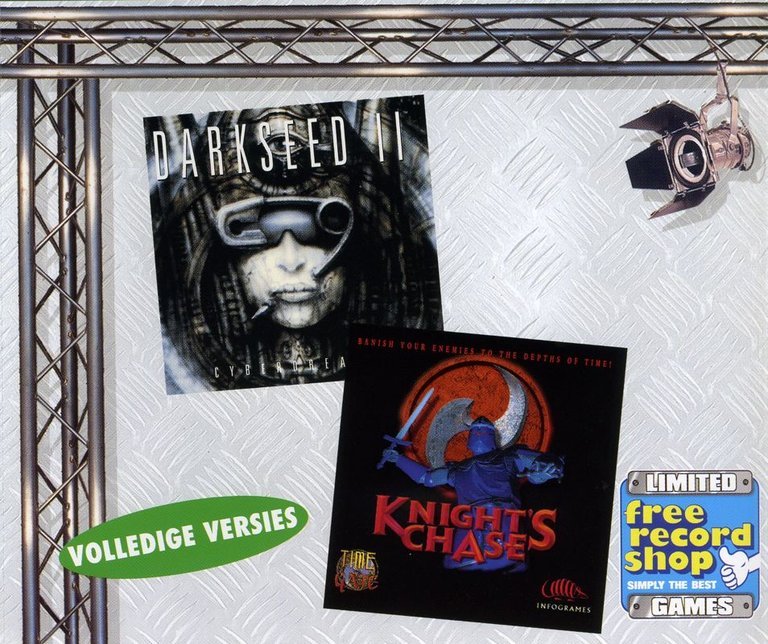
Limited Games: Darkseed II & Time Gate: Knight’s Chase is a 1998 compilation by Infogrames, bundling two distinct adventure games. Dark Seed II continues the surreal horror narrative of its predecessor, blending psychological thriller elements with eerie, otherworldly settings. Time Gate: Knight’s Chase is an action-adventure puzzle game where players assume the role of William Tibbs, a law student drawn into a medieval mystery involving time travel and Templar secrets, utilizing a modified Alone in the Dark engine for its 3D environments.
Limited Games: Darkseed II & Time Gate: Knight’s Chase Reviews & Reception
retro-replay.com : This compilation promises an immersive trip through time and terror, all conveniently bundled in a single offering.
store.steampowered.com (78/100): Mostly Positive (78% of 14 user reviews for this game are positive).
oldpcgaming.net : Knight’s Chase’s puzzles are generally logical and fair to the player.
Limited Games: Darkseed II & Time Gate: Knight’s Chase: A Retrospective on a Forgotten Compilation
Introduction: A Time Capsule of Late ’90s Adventure Gaming
In the annals of video game history, few compilations capture the essence of late ’90s PC gaming quite like Limited Games: Darkseed II & Time Gate: Knight’s Chase. Released in 1998 by Infogrames in collaboration with Dutch retailer Free Record Shop, this CD-ROM bundle paired two distinct yet equally ambitious titles: Dark Seed II, a psychological horror adventure steeped in H.R. Giger’s nightmarish aesthetics, and Time Gate: Knight’s Chase, a medieval action-adventure game that wore its Alone in the Dark influences proudly. While neither game achieved mainstream acclaim, their inclusion in this compilation offers a fascinating snapshot of an era when adventure games were evolving from pixelated point-and-click puzzles to immersive, pre-rendered 3D experiences.
This review aims to dissect Limited Games not merely as a product of its time but as a cultural artifact—a testament to the risks and limitations of late ’90s game design. Through an exhaustive analysis of its development, narrative depth, gameplay mechanics, and lasting legacy, we will explore why this compilation remains a cult favorite among retro enthusiasts and how it reflects the broader trends of its era.
Development History & Context: The Rise and Fall of a Genre
The Studio and the Vision
Limited Games is a collaboration between two studios with starkly different design philosophies. Dark Seed II was developed by Cyberdreams, a studio known for its bold, often controversial themes, particularly its fascination with the macabre and the surreal. The original Dark Seed (1992) had already cemented its legacy as one of the first adventure games to feature the art of H.R. Giger, the Swiss surrealist famous for his biomechanical designs in Alien. Dark Seed II (1995) doubled down on this aesthetic, offering a more refined but equally unsettling experience.
Time Gate: Knight’s Chase, on the other hand, was the brainchild of Infogrames Multimedia, a French developer that sought to capitalize on the success of Alone in the Dark by creating a game that mirrored its mechanics while introducing a time-travel narrative. Released in 1995, Knight’s Chase was the first in a planned trilogy, though subsequent entries never materialized. The game’s engine was a modified version of the Alone in the Dark engine, featuring Gouraud-shaded polygons—a technical leap at the time, though one that would soon be overshadowed by texture-mapped 3D.
Technological Constraints and the Gaming Landscape
The mid-’90s were a period of rapid technological transition. The shift from 2D to 3D was underway, but many developers were still grappling with the limitations of early 3D engines. Time Gate’s reliance on pre-rendered backgrounds and polygonal characters was cutting-edge in 1995, but by 1998, when the compilation was released, games like Resident Evil and Tomb Raider had already set new standards for 3D adventure games. Similarly, Dark Seed II’s hand-painted, Giger-inspired backgrounds were visually striking but constrained by the 256-color palette of the era.
The gaming landscape of 1998 was dominated by the rise of 3D accelerators and the decline of traditional adventure games. Titles like Half-Life and The Legend of Zelda: Ocarina of Time were redefining player expectations, making Limited Games feel like a relic of a bygone era. Yet, this compilation’s existence is a testament to the enduring appeal of niche genres. Infogrames’ decision to bundle these two games was likely a strategic move to appeal to European markets, where adventure games still had a dedicated following.
The Compilation’s Purpose
Limited Games was not just a random pairing; it was a curated experience designed to showcase two different flavors of adventure gaming. Dark Seed II represented the cerebral, horror-driven side of the genre, while Time Gate offered a more action-oriented, puzzle-solving approach. The compilation’s packaging and marketing positioned it as a “must-have” for collectors, leveraging the cult status of both titles to create a product that felt exclusive.
Narrative & Thematic Deep Dive: Tales of Time and Terror
Dark Seed II: A Descent into Madness
Dark Seed II continues the story of Mike Dawson, an ordinary man whose life is upended by the discovery of an alien artifact in his home. The game’s narrative is a surreal exploration of psychological horror, blending Lovecraftian themes with Giger’s grotesque imagery. Mike’s journey takes him through a series of increasingly disturbing environments, from his own home to a nightmarish alien dimension where reality itself is warped.
The game’s dialogue and character interactions are deliberately cryptic, reinforcing the sense of unease. Mike’s internal monologues and the reactions of NPCs (non-player characters) create a layered narrative that rewards careful attention. Themes of isolation, paranoia, and the fragility of the human mind are central to the experience. The game’s ending, which offers multiple interpretations, leaves players questioning the nature of Mike’s reality—a hallmark of effective psychological horror.
Time Gate: Knight’s Chase: A Medieval Time-Travel Epic
Time Gate’s narrative is more straightforward but no less ambitious. Players assume the role of William Tibbs, a law student in 1996 Paris who is thrust into the 14th century after a mysterious knight attacks him in his apartment. The game’s premise—rescuing a damsel in distress while unraveling the secrets of the Knights Templar—is classic adventure fare, but its execution is elevated by a series of unexpected twists and a briskly paced plot.
The game’s time-travel mechanic is more than a gimmick; it serves as a narrative device to explore themes of destiny and free will. William’s journey is one of self-discovery, as he grapples with his role in a conflict that spans centuries. The dialogue, while occasionally melodramatic, is serviceable, and the game’s environmental storytelling—such as the eerie museum of medieval artifacts—adds depth to the world.
Contrasting Themes
While Dark Seed II delves into the horrors of the mind, Time Gate focuses on external conflicts and historical intrigue. Together, they offer a study in contrasts: one game explores the fear of the unknown within, while the other confronts the dangers of a tangible, if fantastical, past. This duality makes Limited Games a compelling package for players who appreciate narrative diversity.
Gameplay Mechanics & Systems: The Strengths and Flaws of Retro Design
Dark Seed II: Methodical Horror
Dark Seed II is a classic point-and-click adventure game, emphasizing exploration, inventory management, and puzzle-solving. The gameplay is deliberately slow-paced, requiring players to meticulously examine their surroundings and piece together clues. The game’s interface is straightforward, with a cursor that changes based on interactable objects, but the lack of modern conveniences like hint systems or auto-mapping can be frustrating for contemporary players.
The game’s puzzles are often cryptic, requiring lateral thinking and frequent note-taking. Some solutions are obscure, which can lead to moments of frustration, but the sense of accomplishment upon solving a particularly challenging puzzle is rewarding. The dialogue trees are simple but effective, allowing players to gather information and advance the plot.
Time Gate: Knight’s Chase: Action-Adventure Hybrid
Time Gate blends action and adventure elements, with a control scheme that feels stiff by modern standards but retains a certain old-school charm. Combat is rare but tense, requiring precise timing and positioning. The game’s puzzle-solving segments are more straightforward than Dark Seed II’s, often involving environmental manipulation or item-based solutions.
The game’s engine, a modified version of the Alone in the Dark engine, supports Gouraud-shaded polygons, which were impressive at the time but now appear dated. The pre-rendered backgrounds are atmospheric, particularly in the game’s darker, more claustrophobic sections, but the limited camera angles and occasional clipping issues can detract from the experience.
Shared Strengths and Weaknesses
Both games benefit from clear pixel-perfect hotspots and consistent interfaces, but they suffer from the lack of quality-of-life features that modern players take for granted. The absence of save systems (or limited save slots) and the occasional need for precise pixel-hunting can be off-putting. However, for players willing to embrace the challenges of retro design, both games offer deeply immersive experiences that reward patience and observation.
World-Building, Art & Sound: Crafting Atmosphere in the ’90s
Dark Seed II: A Nightmare in 256 Colors
Dark Seed II’s visual design is its most enduring legacy. The game’s hand-painted backgrounds, inspired by H.R. Giger’s surreal art, are some of the most memorable in adventure gaming. The environments are filled with impossible angles, grotesque creatures, and an ever-present sense of dread. The 256-color palette, while limiting, is used to great effect, creating a cohesive and unsettling aesthetic.
The sound design is equally effective, with ambient noises and eerie music that enhance the game’s atmosphere. The voice acting, while occasionally melodramatic, fits the game’s tone, adding to the sense of unease.
Time Gate: Knight’s Chase: Medieval Grit
Time Gate’s pre-rendered 3D environments were cutting-edge in 1995, offering a level of detail and atmosphere that was rare at the time. The game’s muted earth tones and dimly lit corridors create a sense of realism, while the occasional graphical glitches—such as clipping or frame skips—are a reminder of the technical limitations of the era.
The sound design is functional but unremarkable, with MIDI music and basic sound effects that serve their purpose without standing out. The voice acting is serviceable, though it lacks the depth of Dark Seed II’s more polished performances.
A Study in Contrasts
The visual and auditory designs of Dark Seed II and Time Gate offer a fascinating study in contrasts. Dark Seed II’s surreal, nightmarish landscapes are a stark counterpoint to Time Gate’s gritty medieval realism. Together, they showcase the diversity of early ’90s PC art direction, proving that even within the constraints of the era, developers could create distinct and memorable worlds.
Reception & Legacy: The Cult Following of a Forgotten Compilation
Critical Reception at Launch
Upon release, Limited Games received little critical attention, as compilations were often overlooked in favor of standalone titles. Time Gate: Knight’s Chase was met with mixed reviews, with critics praising its puzzle design and narrative twists but criticizing its overt similarity to Alone in the Dark. Maximum magazine gave it three out of five stars, noting that while the game was polished, it offered little innovation. Next Generation was more critical, citing awkward controls and a lack of gamepad support.
Dark Seed II, meanwhile, was praised for its atmospheric visuals and psychological depth but criticized for its obscure puzzles and slow pacing. The game’s cult following grew over time, as players who appreciated its unique blend of horror and surrealism championed it as an underrated gem.
Evolving Reputation
In the years since its release, Limited Games has become a sought-after collector’s item, particularly among retro gaming enthusiasts. The compilation’s rarity—it was only released in the Netherlands—and its inclusion of two distinct adventure games have contributed to its cult status. Modern re-releases of Time Gate on platforms like Steam have introduced the game to a new audience, though Dark Seed II remains more obscure.
Influence on Subsequent Games
While neither Dark Seed II nor Time Gate had a direct impact on the broader gaming industry, they represent important milestones in the evolution of adventure games. Dark Seed II’s psychological horror elements can be seen as a precursor to games like Silent Hill and Amnesia, while Time Gate’s blend of action and adventure mechanics influenced later titles like Resident Evil and The Evil Within.
Conclusion: A Niche Masterpiece for the Retro Enthusiast
Limited Games: Darkseed II & Time Gate: Knight’s Chase is a time capsule of late ’90s adventure gaming—a compilation that showcases the strengths and limitations of its era. For modern players, the games may feel dated, with stiff controls, obscure puzzles, and technical quirks that are a product of their time. Yet, for those willing to embrace the challenges of retro design, Limited Games offers a deeply rewarding experience.
Dark Seed II stands as a testament to the power of atmospheric horror and psychological storytelling, while Time Gate delivers a satisfying blend of action and adventure. Together, they form a balanced duo that caters to a wide range of tastes, from the cerebral to the visceral.
Ultimately, Limited Games is a niche release that will primarily appeal to collectors and retro enthusiasts. Its value lies not in its technical polish or innovation but in its ability to transport players to a bygone era of gaming. For those who seek to explore the roots of modern adventure games, this compilation is a must-play—a flawed but fascinating relic of a time when developers were still figuring out how to tell stories in a new medium.
Final Verdict: 7.5/10 – A Cult Classic for the Adventurous Gamer