
- Release Year: 2020
- Platforms: PlayStation 4, Windows
- Publisher: The Voices Games Ltd
- Developer: The Voices Games Ltd
- Genre: Action
- Perspective: Behind view
- Game Mode: Single-player
- Gameplay: Shooter
- Average Score: 40/100
Description
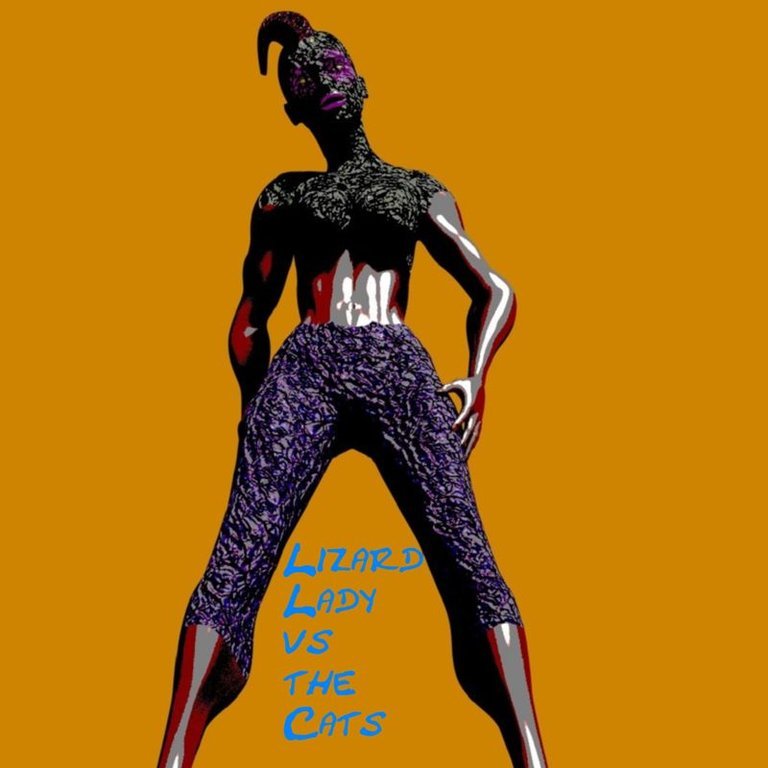
In a city overrun by a notorious cat gang, the masked vigilante Lizard Lady utilizes her powers of anonymity to wage a relentless campaign of justice in this action shooter. Players experience behind-the-view gameplay as they combat waves of feline foes, with the game also including the expansion ‘Lizard Lady vs Herself,’ where the protagonist battles manifestations of her own conscience in a psychological survival struggle after succumbing to genocidal tendencies.
Gameplay Videos
Lizard Lady vs the Cats Guides & Walkthroughs
Lizard Lady vs the Cats Reviews & Reception
metacritic.com (69/100): A shallow, poorly constructed and thoroughly unenjoyably third person shooter, Lizard Lady vs. The Cats is a cheap game.
fingerguns.net : It’s one of, if not the single worst game to hit the PS4 in 2021 so far.
backloggd.com (11/100): I genuinely don’t know which of the two this game was trying to be, because it fails at being either of the two, and it also doesn’t feel like it does enough to do a commentary on the little it has or is.
Lizard Lady vs the Cats: A Flawed Gem of Budget Ambition
Introduction
In the crowded landscape of indie gaming, where ambition often clashes with budget constraints, Lizard Lady vs the Cats stands as a perplexing monument to unyielding persistence. Released in January 2020 by The Voices Games Ltd, a single-developer studio, this PlayStation 4 and Windows title combines reptilian vigilantism, feline antagonism, and psychological turmoil into a package that is simultaneously baffling, technically janky, and strangely compelling. Its legacy lies not in polished execution, but in its unapologetic embrace of absurdity and its status as a cult curiosity. This review dissects the game’s intricate layers—from its fractured narrative to its chaotic gameplay—to argue that while Lizard Lady vs the Cats fails as a traditional third-person shooter, it succeeds as a flawed artifact of indie game development, where technical limitations breed unintentional charm.
Development History & Context
Lizard Lady vs the Cats emerged from the singular vision of The Voices Games Ltd, a microstudio operating at the intersection of ambition and extreme budget constraints. Built in Unity and featuring assets created in Blender, the game was developed by a lone creator, a fact evident in its inconsistent art direction and minimalist design choices. Its release on January 20, 2020, for Windows preceded a PlayStation 4 port on February 11, 2021, capitalizing on the growing market for ultra-low-budget digital titles. This timing positioned it alongside other niche indie experiments, yet its $0.49 price point on PSN (and inclusion in a $1.00 itch.io bundle) set it apart as an extreme outlier. The technological constraints were palpable: limited animation resources, reused textures, and reliance on royalty-free music (by Andrew Sitkov) underscored the developer’s struggle against resource scarcity. Within the 2020–2021 gaming landscape, the game became a symbol of accessibility—both financial and technical—attracting players curious to explore the boundaries of “how much can a game cost and still exist?”
Narrative & Thematic Deep Dive
The narrative operates on a dual axis of hyper-violent vigilantism and existential guilt. The primary campaign casts players as Lizard Lady, a masked heroine whose powers of “unaccountable anonymity” fuel her crusade against the “notorious cat gang.” The cats are portrayed as cartoonishly evil, having allegedly “slaughtered 1,000,000 puppies for no reason,” a premise that leans into absurdist melodrama. Cutscenes, described by critics as “malfunctioning Machinima” and “as compelling as malfunctioning Machinima made by an 11-year-old,” deliver the story with stilted dialogue and disjointed pacing. The sequel-like mode, Lizard Lady vs Herself, deepens the thematic core: after the genocide of the cats, Lizard Lady is “wracked with guilt” and trapped in her psyche, battling manifestations of her conscience in an endless survival loop. This duality—external violence vs. internal torment—explores themes of anonymity’s corrosive effects (the mask enabling atrocities) and the cyclical nature of trauma. The cats, though underdeveloped, serve as a foil to Lizard Lady’s humanity, their feline traits amplifying the narrative’s inherent absurdity. Ultimately, the story’s strength lies not in its coherence but in its raw, unfiltered ambition, turning technical limitations into thematic quirks.
Gameplay Mechanics & Systems
Core gameplay adheres to a third-person shooter framework riddled with idiosyncratic design choices. Players control Lizard Lady via direct control, navigating linear levels to eliminate all cat enemies before exiting through doors. The combat system, however, is defined by its constraints: Lizard wields only a silent pistol, with ammunition tied to a slowly recharging energy bar. This resource mechanic forces players to retreat during firefights, prioritizing conservation over aggression—a counterintuitive loop that critics decry as “breaking up firefights” artificially. Stealth is theoretically viable but practically unenforced, as enemies possess rudimentary AI. Fireball-shooting cats advance predictably, while “pouncers” glide erratically, resembling “speed skating” rather than feline agility. The game’s brevity is staggering: the main campaign concludes in under six minutes, emphasizing repetition over depth. A “Nightmare” mode offers endless survival challenges, though it inherits all gameplay flaws. Progression is absent; no upgrades or skill unlocks exist, contradicting promotional claims. The UI is minimal, featuring only health and energy bars, with no feedback for damage or actions. Despite its flaws, the mechanics foster a niche appeal: mastering the energy bar’s rhythm and enemy patterns becomes a perverse challenge, rewarding players with platinum trophies for flawless runs—a rare achievement for a game this short.
World-Building, Art & Sound
The visual aesthetic is a study in contradictions. Environments reuse low-resolution textures ad nauseam, with urban levels featuring non-perpendicular walls and repetitive corridors. A grainy, high-contrast filter dominates, intended to evoke a cyberpunk vibe but instead causing “migraine-inducing” visuals that obscure enemies in shadows. Character animations are jarringly stiff: Lizard Lady’s walk resembles “a catwalk strut with a cucumber between her butt cheeks,” while jumps are physics-defying. Enemy models—humanoid cats with mismatched proportions—range from laughable to grotesque, with one review noting the graphics are “simultaneously gross and oddly sexual.” Sound design is equally uneven: the royalty-free soundtrack delivers tight guitar riffs and speedy drums, but the pistol emits no firing sound, replaced only by a generic “hit” tone. Footsteps and damage lack audio cues, amplifying the game’s disconnect. Yet these flaws coalesce into a unique atmosphere—a gritty, lo-fi dreamscape where technical decay becomes part of the identity. The Lizard Lady vs Herself mode heightens this, with its “grainy pixelated shades of dark crimson” and “faint purple walls” evoking a surreal psychological space.
Reception & Legacy
Critical reception was polarized, mirroring the game’s polarizing nature. Finger Guns dismissed it as “a shallow, poorly constructed and thoroughly unenjoyable third-person shooter,” citing its “counter-intuitive” mechanics and “poorly designed” levels. Conversely, user reviews on platforms like Backloggd and Metacritic ranged from ironic praise (“Greatest game of all time”) to qualified appreciation (“For a game that costed me 49 cents I like the game”). Notably, a Backloggd user described it as a “deconstructed ham sandwich” where “rules of cooking” are ignored but creativity persists. Commercially, its micro-budget pricing ensured niche success, with players drawn by the novelty of its premise and trophy-hunting potential. Legacy-wise, it achieved cult status as a benchmark for “so bad it’s good” gaming, often compared to Life of Black Tiger. Its influence lies in its demonstration of how extreme constraints can spawn unconventional art, inspiring discussions about accessibility in game design. The developer’s follow-up, Newtonian Inversion, benefited from the notoriety, proving that even a flawed release can sustain a studio.
Conclusion
Lizard Lady vs the Cats is not a good game by conventional standards—it is technically janky, narratively incoherent, and brutally short. Yet its place in gaming history is secured by its unapologetic embrace of limitations. The Voices Games Ltd delivered a product that is, paradoxically, both broken and functional, ugly and mesmerizing. For 49 cents, players gain access to a world of lizard vigilantism, feline genocide, and psychological torment, where the line between failure and art is deliciously blurred. While it fails to innovate or entertain broadly, it succeeds as a testament to the indie spirit—a flawed gem that invites players to laugh, cringe, and ponder the nature of ambition. In an industry obsessed with polish, Lizard Lady vs the Cats stands as a reminder that sometimes, the most memorable experiences are the ones that dare to be gloriously, unapologetically broken. Verdict: A cult curiosity for masochists and trophy hunters, not for the faint of heart.