
- Release Year: 2022
- Platforms: Windows
- Publisher: SixSense Studios
- Developer: SixSense Studios
- Genre: Action
- Perspective: 1st-person
- Gameplay: Puzzle elements, Shooter
- Setting: Futuristic, Sci-fi
- Average Score: 60/100
Description
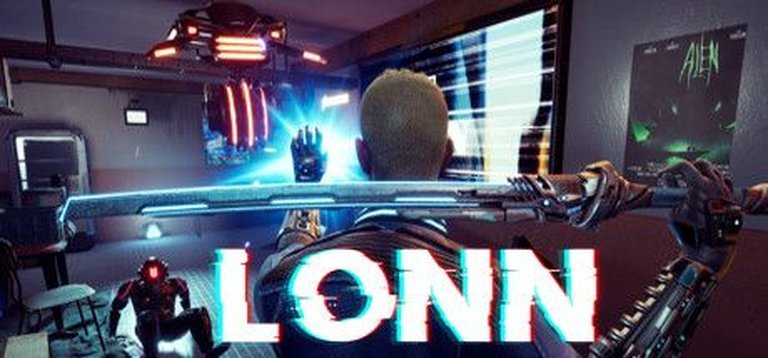
LONN is a physics-driven virtual reality action-adventure game set in a cyberpunk future. Players take on the role of Lonn, an elite bounty hunter tasked with dismantling the sinister WUX-n cult that practices mind-transfer experiments. Using telekinetic powers and a range of weapons from swords to guns, combat revolves around manipulating any object in the environment. The game features an 8+ hour story campaign, roguelike procedural missions, arena battles, and parkour challenges, all emphasizing creative, unrestricted gameplay in a sci-fi setting.
Gameplay Videos
Where to Buy LONN
PC
LONN Reviews & Reception
metacritic.com (60/100): The classic cyberpunk action-adventure Lonn looks clumsy and unpolished for long stretches, but with its balanced mix of fights and puzzles it can still be entertaining overall.
LONN Cheats & Codes
PC Version
Press F10 to open the console.
| Code | Effect |
|---|---|
| $game_player.actor.health += 9999 | Full HP |
| $game_player.actor.sta += 9999 | Max Stamina |
| $game_player.actor.sat += 9999 | Fill Hunger |
| $game_player.actor.mood += 9999 | Boost Mood |
| $game_player.actor.heal_wound >z | Heal Wound (1 per use) |
| $game_player.actor.preg_level = 5 | Instant Birth |
| $game_party.gain_gold(9999) | Add Barter Points (P) |
| $game_player.actor.trait_point += 9999 | Trait Points |
| $game_player.actor.change_exp(9999, false) | Set EXP (Replaces current EXP) |
| $game_player.actor.add_state(ID) | Add Trait |
| $game_player.actor.remove_state(ID) | Remove Trait |
| $game_party.gain_item($data_items[ID], 9999) | Get Item (9999 qty) |
| $game_player.actor.actStat.set_stat(“move_speed”,0,3) | Speed (change value of ‘0’ to adjust base movement speed) |
| $game_player.actor.arousal += ? | Increase arousal |
| $game_player.actor.dirt += ? | Increase dirtiness |
| $game_player.actor.morality_lona += ? | Change morality |
| $game_player.actor.level += ? | Increase level (may cause crash) |
| $game_player.actor.combat_trait += ? | Increase combat skill |
| $game_player.actor.scoutcraft_trait += ? | Increase scoutcraft |
| $game_player.actor.wisdom_trait += ? | Increase wisdom |
| $game_player.actor.survival_trait += ? | Increase survival |
| $game_player.actor.constitution_trait += ? | Increase constitution |
| $game_player.actor.semen_addiction_level += ? | Increase semen addiction |
| $game_player.actor.ograsm_addiction_level += ? | Increase ograsm addiction |
| $game_player.actor.drug_addiction_level += ? | Increase drug addiction |
| $game_player.moveto(X, Y) | Move Lona to coordinates |
| $game_player.actor.race = “?” | Set Lona’s race |
| $game_player.actor.stat[“Race”] = “?” | Set race states |
| $game_player.actor.record_lona_race = “?” | Set Lona’s race in game |
| $game_player.actor.preg_level += ? | Change pregnancy level |
| $game_player.actor.sensitivity_vag += ? | Increase vagina sensitivity |
| $game_player.actor.sensitivity_anal += ? | Increase anal sensitivity |
| $game_player.actor.sensitivity_mouth += ? | Increase mouth sensitivity |
| $game_player.actor.sensitivity_breast += ? | Increase breast sensitivity |
| $game_map.interpreter.get_character($game_player.get_followerID(0)).npc.stat.set_stat_m(“sta”,3000,[0]) | Set companion stamina to 3000 |
| $game_player.actor.gain_exp(?) | Add experience points |
| $story_stats[“WorldDifficulty”] += ? | Change world difficulty |
| $game_party.gain_item($data_weapons[?], ?) | Add weapons to inventory |
| $game_party.gain_item($data_armors[?], ?) | Add armors to inventory |
LONN: A Physics-Driven Ode to Cyberpunk Chaos – An In-Depth Historical Review
Introduction: The Unassuming Titan of VR Physics
In the crowded field of virtual reality (VR) gaming, where novelty often outstrips substance, LONN emerges as a curious and compelling artifact of its time. Released in November 2022 by the enigmatic three-person studio SixSense Studios, the game arrived not with a deafening marketing roar but with the quiet confidence of a lab experiment perfected in isolation. Its legacy is not one of blockbuster sales or universal critical acclaim, but of audacious mechanical ambition and a fiercely dedicated niche audience. LONN’s thesis is radical in its simplicity: what if every object in a cyberpunk dystopia was not just scenery, but a potential tool, weapon, or projectile? It is a game built from the physics up, asking players to unlearn traditional shooter paradigms and embrace a brutal, tactile, and deeply personal form of chaos. This review will argue that LONN is a significant, if deeply flawed, milestone in the evolution of immersive simulation and physics-based gameplay in VR—a game whose technical achievements in交互性和环境叙事 often collide with its underdeveloped narrative and uneven pacing, creating an experience that is as frustrating as it is revolutionary.
Development History & Context: The Indie Spirit in a Post-Boneworks World
The Studio and the Vision: SixSense Studios operated with the resources and profile of a classic indie startup. With a team size consistently reported as three people, the development of LONN represented a colossal undertaking. The project’s core was the proprietary Kinesis Physics System, a custom-built engine layer designed to handle consistent, realistic object interaction, grappling, and momentum transfer in a first-person VR space. This was not merely an adaptation of existing tools but a bespoke creation, speaking to a development philosophy where physics were the primary game mechanic, not an afterthought. The vision was clear from the earliest trailers (May 2022): a cyberpunk action-adventure where the player’s relationship with the environment would be the central gameplay loop.
Technological Constraints and The VR Landscape (2022): LONN’s release in late 2022 placed it in a fascinating moment for PC VR. The high-water mark for physics-driven VR had been set by Boneworks (2019) and its sequel Boneworks 2 (in early access), which popularized “full-body” physics and object manipulation but often at the cost of janky movement and inconsistent interaction. The community was hungry for a title that retained that raw, systemic physicality but polished it into a coherent game. Concurrently, the industry was seeing a shift towards more accessible, arcade-style VR titles (Superhot VR, Pistol Whip) and ambitious, story-driven AAA projects (Half-Life: Alyx). LONN staked a claim in the middle: a single-player, story-rich campaign built on the hardcore physics foundation of the “Boneworks-like” genre but with a more deliberate, mission-based structure. Its system requirements (GTX 1070/1660 Ti minimum, RTX 2060 recommended) were steep but not prohibitive, targeting the high-end enthusiast PC VR market still using Valve Indexes or high-end Vives.
Publishing and Release: As both developer and publisher, SixSense maintained complete creative control but likely faced significant distribution and marketing challenges. The game launched directly on Steam (November 17, 2022) with a $29.99 price point, relying entirely on word-of-mouth and coverage from VR-focused community figures and curators. The “Mixed” user review aggregate (64% positive) at launch suggests a game that deeply resonated with its target audience—players seeking a deep, systemic VR experience—while alienating others with its learning curve and technical roughness.
Narrative & Thematic Deep Dive: A Cyberpunk Pastoral in Need of Cultivation
Plot and Structure: LONN is set in the year 2058 in a dystopian cyberpunk metropolis. The player assumes the role of Lonn, an elite “S-rank” bounty hunter who has retired from the profession, only to be drawn back by the rising threat of the WUX-n cult. This organization is engaged in “sinister mind-transfer experiments,” seeking to replace human minds with cybernetic consciousnesses to create a “future of cybernetic beings.” The campaign, described as 8+ hours, is mission-based, taking Lonn through interconnected urban environments as he dismantles the cult’s operations.
The narrative premise taps directly into classic cyberpunk themes of identity, commodification of the human mind, and corporate/technological dystopia. The “mind-transfer” concept aligns with works ranging from Ghost in the Shell to Altered Carbon. However, this is where the game’s ambitious scope meets its most significant limitations. The story is primarily delivered through environmental storytelling (scattered logs, terminal readouts) and brief, functional dialogue interactions. The “unforgettable characters” and “forged friendships” touted in marketing are largely implied rather than deeply realized. Lonn’s personal conflict—being a “conflicted” former hunter trying to improve the city—is a compelling archetype but remains largely unexplored through meaningful character moments or introspective gameplay. The cult, WUX-n, functions more as a thematic and gameplay obstacle than a philosophically nuanced antagonist. The plot serves, ultimately, as a scaffolding for the gameplay, a justification to send the player into beautifully realized but emotionally sterile locales to solve puzzles and fight waves of enemies.
Themes: The game’s title and recurring tagline, “Face adversity, face disappointment, never lose your grip on reality!” is its most potent thematic statement. This operates on two levels: diegetically (Lonn literally fights mind-control devices like “Bombots” attached to his face, and enemies like “Megalo” who use psychic attacks) and meta-textually (the player must “grip” the physical controllers firmly to manipulate the virtual world, resisting the frustration of finicky physics). It’s a game about tactile persistence in a chaotic, mechanistic world. The cyberpunk setting—where “every neuron, synapse and receptor… is being taken away”—positions the human body and its physical agency as the last bastion of authenticity, a theme perfectly embodied by the game’s physics-centric mechanics. The player’s ability to grab, throw, and climb is not just a power fantasy; it is a literal assertion of physical reality against a cult seeking to erase it.
Gameplay Mechanics & Systems: The Kinesis Doctrine in Practice
The heart of LONN is its Kinesis Physics System, and every gameplay pillar is built to showcase it.
Core Loop and Environmental Interaction: The player is equipped from the outset with telekinetic gloves (the “Kinesis Glove”). This is not a silent, Force-like power but a physical, momentum-based tool. Objects can be grabbed, pulled, pushed, and thrown with realistic weight and physics. The system’s consistency is its greatest strength: a metal crate, a plastic chair, and a humanoid enemy all obey the same physical rules. This creates a profound sense of environmental agency. Climbing is not limited to designated ledges; with sufficient momentum and proper hand-placement, players can scale nearly any surface, a mechanic directly enabling the game’s parkour elements. “Grab, Push, Pull, Climb, Jump, Crouch and Fight” is not a marketing list but a complete verbset for interaction.
Combat: The Dance of Dismemberment: Combat is a brutal, improvisational ballet. The player has access to:
* Melee: Primarily a neon katana and other blades. Strikes are physics-based; a swing is an actual arm movement. The signature feature is dismemberment—limbs can be severed with repeated strikes, a key tactical tool as it immediately disables an enemy’s ability to shoot or use melee weapons.
* Firearms: A variety of pistols, rifles, and shotguns with gun customization (attachments found in lockers). Reloading is physically simulated (ejecting magazines, inserting new ones).
* Telekinetics: The glue that binds the system. Heavy objects can be hurled to stagger or crush enemies. Enemies themselves can be grabbed and used as shields, thrown off ledges, or slammed into walls. The iconic “Bombot”—an adhesive explosive that latches onto the player’s head—requires the player to physically reach up, grab it, and toss it away before detonation, a perfect encapsulation of the game’s demand for physical awareness.
The combat loop is: Assess (environmental objects, enemy types/positions) -> Improvise (weapon choice, object selection) -> Execute (physically perform the action) -> Adapt (enemy reactions are systemic; severed enemies crawl, shooters relocate). This creates immense creative freedom but also a high skill floor. New players often feel clumsy, as their expectations from traditional FPS or even other VR shooters fail. The game rewards spatial reasoning and environmental literacy over twitch reflexes alone.
Progression and Systems: Progression is split between the campaign and the Bounty Adventures (roguelike) mode.
* Campaign: Progression is linear-mission-based. Loot (digital currency) found in lockers is used at shop terminals between missions to buy weapons and attachments. There is no traditional RPG leveling; upgrades are permanent purchases that alter your loadout.
* Bounty Adventures: This is a procedurally generated, permadeath mode. Players choose a starting weapon, scavenge for ammo, health, and “kinetic energy” (likely a resource for telekinesis), and attempt to complete a bounty (objective) and escape. Death resets all progress, creating a high-stakes, repeatable experience focused on survival and efficient scavenging.
* Arena & Parkour: These are skill-testing side modes. Arena pits players against waves of enemies in a contained space with secrets to find. Parkour challenges test the climbing and movement mechanics in constrained puzzles, highlighting the joy of the traversal system.
* Replay Mode: Unlocked after completing campaign chapters, it allows returning to levels with any unlocked weapon, encouraging experimentation with different tools.
UI and Interface: The UI is diegetic and minimalist. Health and kinetic energy are displayed on the player’s virtual forearms (or a wrist-mounted device). Ammo counts are visible on the weapon itself. This reinforces immersion but can sacrifice clarity, especially during chaotic firefights where checking ammo requires physically looking at your gun—a design choice that prioritizes realism over convenience.
Innovations and Flaws: The innovation is the holistic, consistent physics sandbox. The flaw is that this sandbox sometimes feels under-policed. Enemy AI, while capable of using the environment to some degree (taking cover, throwing objects back), can feel passive or erratic. The “clumsy and unpolished for long stretches” observation from 4P.de is astute. Animation transitions, interaction hitboxes, and the sheer unpredictability of physics simulations can lead to moments where the player feels they are fighting the system rather than the game’s challenges. The learning curve is not just about skill, but about unlearning expectations and developing a new, tactile intuition.
World-Building, Art & Sound: Atmospheric Dystopia, Limited Detail
Setting and Atmosphere: The world is a dystopian cyberpunk city in 2058. The environment is a blend of grimy alleyways, towering neon-lit megastructures, industrial complexes, and cult strongholds. The aesthetic leans into a “used future”—concrete, rust, exposed wiring, and pervasive digital signage advertising the WUX-n ideology. The atmosphere is successfully oppressive and alienating, with a muted color palette punctuated by the cold glow of holograms and weapon fire. The setting’s primary function is as a physics playground, and it excels at this. The verticality and clutter provide endless opportunities for climbing and object manipulation.
Visual Direction: Powered by Unreal Engine, the game’s graphics are functional and atmospheric rather than cutting-edge. Textures are adequate, lighting is used effectively to set mood, but character models and some environmental assets lack detail. The visual storytelling—graffiti, propaganda posters, the contrast between corporate sleekness and street-level decay—is present but not deeply layered. It creates a believable backdrop but rarely invites the kind of close inspection that world-class environmental narratives (like BioShock or Deus Ex) demand.
Sound Design: This is a standout element. The sound design is diegetic, weighty, and crucial for gameplay. The thunk of a thrown pipe, the shing of the katana, the gritty crunch of a dismemberment, the distorted electronic shouts of enemies, and the deep, satisfying boom of a telekinetically launched explosive barrel all provide critical auditory feedback. The sound tells you if your throw was effective, if an enemy is crippled, if a Bombot is attached. The ambient soundtrack is a blend of low, throbbing electronic beats and industrial noise, perfectly complementing the cyberpunk setting without ever becoming intrusive or memorable in its own right. It is a soundscape built for tactical awareness and visceral impact.
Reception & Legacy: The Cult Classic in the Making
Critical and Commercial Reception: LONN received almost no mainstream critical coverage. The sole listed critic review on Metacritic is from 4P.de (60%), which accurately summarizes the divide: it finds the game “clumsy and unpolished” but acknowledges its “balanced mix of fights and puzzles” and overall entertainment value. Commercially, it is a niche title. With only 6 collectors listed on MobyGames and ~200 Steam reviews, it is a known entity primarily within dedicated VR circles. Its price point and “VR Only” tag inherently limit its audience.
Evolving Reputation: Within the hardcore VR community, LONN has earned a reputation as a “dark horse” or “cult classic.” User reviews on Steam and quoted by curators are intensely positive from those who persevere. Phrases like “one of the best PCVR only titles to come out in a while,” “AAA gaming from an indi dev of 3 people,” and the direct comparison to Boneworks (“VR Game of the Year is LONN and ironically it’s Cyberpunk Boneworks”) are common. This tells a clear story: the game is not for everyone. Its reputation has solidified around its unique, uncompromising physics sandbox. Players who value systemic interaction and tactile gameplay over narrative polish and graphical fidelity have adopted it as a benchmark.
Influence and Industry Impact: LONN’s direct influence is likely limited by its scale and reach. However, it contributes to a crucial thread in VR design: the pursuit of consistent, full-world physics interaction. It stands as a proof-of-concept that a full campaign can be built on such a system. It shares DNA with Boneworks, Blade & Sorcery, and later titles like Red Matter 2 (which uses physics for puzzles) and Solaris (which emphasizes environmental interaction). Its specific implementation—tying a telekinetic glove to a campaign narrative about mind control—is unique but may inspire future developers to consider how gameplay verbs can directly embody narrative themes. Its greatest impact may be as a template for a certain kind of hardcore VR experience that prioritizes player agency through systemic physics above all else.
Conclusion: A Flawed Gem of Tactile Storytelling
LONN is a game of profound contradictions. It is an Indie David that attempted to slay the Goliath of systemic game design with a custom physics engine, largely succeeding on those mechanical terms. Yet it is also a narrative lightweight, a game whose story and characters are thin vessels for its core gameplay experiment. It is brutally difficult to master but deeply satisfying to learn, rewarding patience and physical intuition in a way few games do. Its technical roughness is not a bug but a feature for some, a testament to the complexity of simulating a fully interactive world in real-time.
Final Verdict: As a piece of video game history, LONN deserves recognition as a significant, if niche, evolution in VR game design. It represents the maturation of the “physics sandbox” from a novelty into the foundation for a complete action-adventure structure. Its campaign, while narratively thin, provides a curated tour of its systemic possibilities that the procedural Bounty Adventures mode then unleashes in unpredictable ways. It is a flawed gem—a game where the act of throwing a radiator at a cyborg is a more powerful narrative moment than any line of dialogue. For historians of immersive gaming, LONN is an essential case study in ambition, constraint, and the enduring power of pure, physical gameplay. It may not have changed the industry, but it gave a clear, gloved hand to a specific vision of what VR could be, and for those who felt its grip, it was unforgettable. Score: 7.5/10 – A Masterclass in Physics, a Student in Story.