
- Release Year: 2006
- Platforms: Macintosh, Windows
- Publisher: Tandem Verlag GmbH
- Genre: Compilation, Licensed
- Game Mode: Single-player
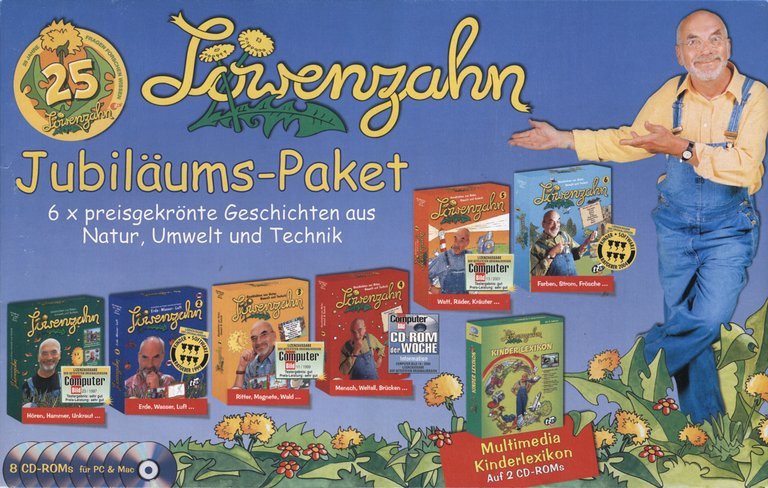
Description
The ‘Löwenzahn Jubiläums-Paket’ is a 25th-anniversary compilation celebrating the beloved German children’s TV show ‘Löwenzahn,’ featuring the first six educational games from the series along with a children’s encyclopedia. Designed for young learners, the games explore themes of nature, environment, and technology through interactive storytelling and activities, fostering curiosity and knowledge in an engaging, family-friendly format. Released in 2006 for Windows and Macintosh, this collection serves as both a nostalgic tribute and an educational tool for children.
Löwenzahn Jubiläums-Paket Reviews & Reception
gutefrage.net : Meine Kinder hatten ALLE CD’s von ihm, und es war unglaublich beliebt bei den Kindern. Sie haben unheimlich viel dadurch gelernt.
Löwenzahn Jubiläums-Paket: A Comprehensive Retrospective
Introduction
The Löwenzahn Jubiläums-Paket (2006) stands as a monumental tribute to one of Germany’s most beloved children’s television series, Löwenzahn (Dandelion), which aired from 1981 to 2005. This compilation, released to celebrate the show’s 25th anniversary, encapsulates the essence of its educational and exploratory spirit, translating it into an interactive digital experience. For those unfamiliar, Löwenzahn followed the adventures of Peter Lustig, a quirky handyman who lived in a blue construction trailer and explored the wonders of nature, technology, and everyday life with childlike curiosity. The Jubiläums-Paket is not merely a collection of games but a digital time capsule, preserving the show’s legacy for future generations.
This review will dissect the Löwenzahn Jubiläums-Paket in exhaustive detail, examining its development, narrative depth, gameplay mechanics, and cultural impact. By the end, we will determine whether this compilation is a nostalgic relic or a timeless educational tool that continues to resonate with audiences today.
Development History & Context
The Studio and Creators’ Vision
The Löwenzahn games were developed by Tivola Publishing, a German studio renowned for its educational software aimed at children. Tivola’s philosophy centered on blending entertainment with learning, a mission perfectly aligned with Löwenzahn’s ethos. The games were designed to extend the television series’ educational goals into an interactive medium, allowing children to engage with the subjects—nature, technology, and environmental science—in a hands-on manner.
The Jubiläums-Paket was published by Tandem Verlag GmbH, a company with a strong portfolio in educational media. The compilation was released in 2006, a year that saw the gaming industry transitioning into the seventh generation of consoles with the launch of the Nintendo Wii and PlayStation 3. However, the Löwenzahn games remained firmly rooted in the PC and Mac platforms, targeting a younger audience that was still largely engaged with desktop computing in educational settings.
Technological Constraints and Design Choices
The games in the Jubiläums-Paket were originally released between 1997 and 2001, a period when educational software was often limited by the hardware of the time. The technical specifications for the compilation reflect these constraints:
– Minimum System Requirements (Windows):
– CPU: Intel Pentium
– OS: Windows 98
– RAM: 64 MB
– Media: CD-ROM (24X speed)
– Resolution: 800×600
– Color Depth: 16-bit (High Color)
These requirements were modest even for 2006, ensuring accessibility for schools and households with older computers. The games were designed to run smoothly on systems that might struggle with more graphically intensive titles, prioritizing functionality and educational value over cutting-edge visuals.
The Gaming Landscape of the Era
In the late 1990s and early 2000s, educational games were a niche but vital part of the gaming ecosystem. Titles like The Oregon Trail, Reader Rabbit, and Math Blaster dominated the market in North America, while Europe saw a rise in locally produced educational software. Löwenzahn fit neatly into this landscape, offering a uniquely German perspective on interactive learning.
The Jubiläums-Paket arrived at a time when the gaming industry was increasingly focusing on immersive 3D experiences and online multiplayer. However, the Löwenzahn games remained 2D, point-and-click adventures, a deliberate choice to maintain accessibility and simplicity for younger players. This design philosophy ensured that the games were intuitive and engaging without overwhelming their target audience.
Narrative & Thematic Deep Dive
Plot and Structure
The Löwenzahn Jubiläums-Paket is not a single game but a compilation of six main titles and a children’s encyclopedia:
1. Löwenzahn 1: Geschichten aus Natur, Umwelt und Technik (1997)
2. Löwenzahn 2: Geschichten aus Natur, Umwelt und Technik (1997)
3. Löwenzahn 3: Geschichten aus Natur, Umwelt und Technik (1999)
4. Löwenzahn 4: Geschichten aus Natur, Umwelt und Technik (2000)
5. Löwenzahn 5: Geschichten aus Natur, Umwelt und Technik (2001)
6. Löwenzahn 6: Geschichten aus Natur, Umwelt und Technik (2001)
7. Löwenzahn Kinderlexikon
Each game is structured as a series of interactive stories and mini-games centered around themes explored in the television series. Players assume the role of a curious child (or Peter Lustig himself in some segments) and embark on adventures that teach them about biology, physics, ecology, and technology. The narratives are episodic, with each game focusing on a specific set of topics, such as:
– Löwenzahn 1: Introduction to basic natural phenomena (e.g., plant growth, weather).
– Löwenzahn 2: Exploration of simple machines and environmental conservation.
– Löwenzahn 3: Deep dive into ecosystems, particularly forests and fungi.
– Löwenzahn 4: Focus on water cycles, rivers, and marine life.
– Löwenzahn 5: Adventures in urban environments, recycling, and technology.
– Löwenzahn 6: Exploration of transportation, including ships and vehicles.
The Kinderlexikon serves as a digital encyclopedia, providing additional information on the topics covered in the games. It functions as a reference tool, allowing children to revisit concepts they encountered during gameplay.
Characters and Dialogue
The games feature a cast of characters drawn from the television series, with Peter Lustig serving as the primary guide and mentor. Peter’s role is to pose questions, provide hints, and explain complex ideas in a child-friendly manner. His dialogue is written in a conversational, encouraging tone, often breaking the fourth wall to address the player directly.
Other characters include:
– Fritz Fuchs: Peter’s animated fox companion, who often serves as a sidekick and comic relief.
– Various NPCs (Non-Player Characters): These include scientists, farmers, and other experts who provide additional information and challenges.
The dialogue is entirely in German, reflecting the show’s cultural roots. The writing is simple yet engaging, avoiding condescension while ensuring clarity. The games also incorporate voice acting, with Peter Lustig reprising his role, adding a layer of authenticity for fans of the series.
Themes and Educational Value
The overarching theme of the Löwenzahn games is exploration and discovery. The games encourage children to ask questions, experiment, and learn through trial and error. Key themes include:
1. Environmental Stewardship: Many mini-games focus on recycling, conservation, and the impact of human activity on nature.
2. Scientific Inquiry: Players are taught to observe, hypothesize, and test ideas, mirroring the scientific method.
3. Technological Literacy: The games introduce basic engineering concepts, such as simple machines and renewable energy.
4. Cultural and Historical Context: Some segments explore German traditions, historical inventions, and local ecosystems.
The educational value of the Jubiläums-Paket lies in its ability to make learning interactive and enjoyable. Unlike traditional textbooks, the games allow children to engage with concepts dynamically, reinforcing lessons through gameplay rather than rote memorization.
Gameplay Mechanics & Systems
Core Gameplay Loops
The Löwenzahn games follow a point-and-click adventure format, with gameplay divided into three primary loops:
1. Exploration: Players navigate through various environments (e.g., forests, cities, rivers) by clicking on objects and locations.
2. Problem-Solving: Each area contains puzzles or challenges that require the player to apply knowledge gained from the game’s educational content.
3. Mini-Games: These are bite-sized activities that reinforce specific concepts, such as sorting recyclables or assembling simple machines.
The games are non-linear, allowing players to tackle challenges in any order. This design encourages curiosity and self-directed learning, as children can explore topics that interest them most.
Combat and Character Progression
Unlike traditional adventure games, the Löwenzahn series does not feature combat. Instead, “conflict” is resolved through intellectual challenges and collaboration. For example:
– Puzzle-Solving: Players might need to figure out how to build a bridge using limited materials or solve a riddle about animal habitats.
– Resource Management: Some mini-games require players to allocate resources (e.g., water, energy) efficiently.
There is no traditional character progression system (e.g., leveling up). However, players can unlock new areas and mini-games as they complete tasks, providing a sense of accomplishment and encouraging further exploration.
User Interface and Accessibility
The UI is designed with young children in mind:
– Simple Navigation: The games use large, colorful buttons and icons that are easy to click.
– Visual Feedback: Actions are accompanied by animations and sound effects to reinforce cause-and-effect relationships.
– Text and Voiceovers: Instructions are provided both visually and aurally, accommodating different learning styles.
The games also include save features, allowing players to pause and resume their progress, which was a considerate addition for educational software often used in classroom settings.
Innovative and Flawed Systems
Innovations:
1. Seamless Integration of Education and Gameplay: The Löwenzahn games excel at making learning feel like play. For example, a mini-game about photosynthesis might involve dragging sunlight and water to a plant to watch it grow.
2. Real-World Applications: Many challenges encourage players to apply what they’ve learned outside the game, such as building a simple machine from household items.
3. Cultural Relevance: The games are deeply rooted in German culture, making them relatable and engaging for their primary audience.
Flaws:
1. Limited Replayability: Once a child has completed all the mini-games and explored all areas, there is little incentive to revisit the content.
2. Technical Limitations: The 2D graphics and simple animations, while charming, may feel dated to modern audiences accustomed to 3D environments.
3. Language Barrier: The games are exclusively in German, limiting their appeal to non-German-speaking audiences.
World-Building, Art & Sound
Setting and Atmosphere
The Löwenzahn games are set in a stylized, cartoonish version of Germany, blending real-world locations with fantastical elements. The environments are vibrant and detailed, with each game focusing on a specific biome or setting:
– Forests and Meadows: Lush greenery, animated wildlife, and hidden nooks to explore.
– Urban Areas: Streets, parks, and construction sites that reflect German towns.
– Waterways: Rivers, lakes, and ports that introduce concepts like hydrodynamics and marine biology.
The atmosphere is whimsical and inviting, designed to spark curiosity. The games avoid dark or scary themes, ensuring a safe and comforting experience for young players.
Visual Direction
The art style is hand-drawn and colorful, reminiscent of the television series. Characters and objects are exaggerated for comedic effect, and the animations are smooth and expressive. The games use a fixed camera perspective, with players navigating through static backgrounds that scroll as they move.
While the graphics are not technically advanced, they are charming and effective in conveying information. For example, a diagram of a plant’s root system might be animated to show how water is absorbed, making abstract concepts tangible.
Sound Design and Music
The sound design is minimalist but effective:
– Voice Acting: Peter Lustig’s voice is warm and engaging, making complex topics feel approachable.
– Sound Effects: Simple but clear, such as the rustling of leaves or the clanking of machinery.
– Music: The games feature a lighthearted, folk-inspired soundtrack that complements the exploratory tone. The music is unobtrusive, designed to enhance the atmosphere without distracting from the educational content.
Reception & Legacy
Critical and Commercial Reception
The Löwenzahn Jubiläums-Paket was released to positive reception in Germany, praised for its educational value and faithful adaptation of the television series. Critics highlighted:
– Engaging Content: The games were lauded for making learning fun and interactive.
– Cultural Significance: The compilation was seen as a valuable tool for preserving and extending the legacy of Löwenzahn.
– Accessibility: The low system requirements and simple controls made the games widely accessible.
Commercially, the Jubiläums-Paket performed well, particularly in educational markets. Schools and libraries often purchased the compilation as a supplementary teaching tool. However, it did not achieve the same level of mainstream success as commercial children’s games like Paw Patrol or Minecraft, largely due to its niche appeal and language barrier.
Evolution of Reputation
Over time, the Löwenzahn games have gained a cult following among those who grew up with them. Nostalgic adults often recall the games fondly, citing them as formative experiences that sparked their interest in science and nature. Online communities, such as those on Reddit and eBay, have kept the games alive, with collectors and retro gaming enthusiasts seeking out physical copies.
The games have also been recognized for their historical significance as examples of early educational software. They represent a time when digital learning was still in its infancy, and their design principles—such as interactive storytelling and gamified education—have influenced modern educational games.
Influence on Subsequent Games
The Löwenzahn series helped pave the way for future educational games by demonstrating that learning could be engaging and immersive. Its influence can be seen in:
– Modern Educational Titles: Games like Kerbal Space Program and Minecraft: Education Edition share Löwenzahn’s emphasis on exploration and discovery.
– German Educational Media: The success of Löwenzahn inspired other German producers to create interactive learning tools, such as Die Sendung mit der Maus games.
– Gamification of Learning: The Löwenzahn games were early examples of gamification, a concept now widely used in educational technology.
Conclusion
The Löwenzahn Jubiläums-Paket is a landmark compilation that successfully translates the magic of Löwenzahn into an interactive format. While its graphics and gameplay may feel dated by modern standards, its educational value and cultural significance remain undiminished. The games are a testament to the power of curiosity-driven learning, proving that education can be as engaging as entertainment.
For those who grew up with Löwenzahn, the Jubiläums-Paket is a nostalgic treasure trove, a digital artifact that captures the wonder of childhood discovery. For educators and parents, it remains a valuable tool for introducing children to science and nature in a fun, interactive way.
Final Verdict: The Löwenzahn Jubiläums-Paket is not just a collection of games but a cultural artifact that deserves recognition for its pioneering approach to educational gaming. While it may not appeal to those outside its target demographic, its impact on German educational media and its enduring legacy make it a worthy addition to the annals of video game history.
Rating: 8.5/10 – A timeless educational experience that continues to inspire curiosity and learning.