
- Release Year: 2009
- Platforms: Macintosh, Windows
- Publisher: LucasArts
- Developer: LucasArts
- Genre: Compilation
- Game Mode: Single-player
Description
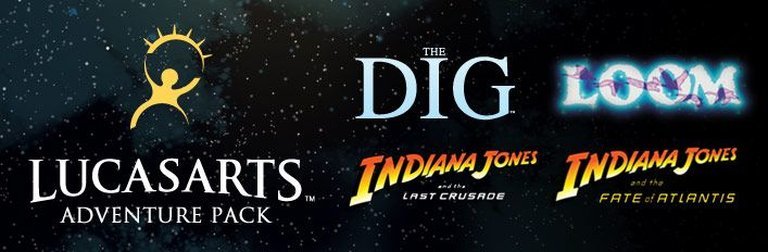
LucasArts Adventure Pack is a digital compilation featuring four classic point-and-click adventure games: Indiana Jones and the Fate of Atlantis, Indiana Jones and the Last Crusade: The Graphic Adventure, Loom, and The Dig. Originally released in the late 1980s and early 1990s, these games are renowned for their engaging storytelling, humorous and irreverent tones, and innovative gameplay mechanics, powered by the SCUMM engine.
Where to Buy LucasArts Adventure Pack
PC
LucasArts Adventure Pack Cracks & Fixes
LucasArts Adventure Pack Cheats & Codes
Full Throttle (PC DOS)
Type ‘matilda’ (or ‘swordfish’ for demo) at main menu, then hold Ctrl+Shift+D for debug mode.
| Code | Effect |
|---|---|
| matilda | Activates debug mode (after Ctrl+Shift+D) |
| Ctrl+V | Bypass Destruction Derby |
| Ctrl+F | Fast mode (debug) |
| Ctrl+G | Go to room (debug) |
| Ctrl+O | Pick up object in room x (debug) |
| Ctrl+E | Set variable (debug) |
| 121462 | Plays fart noise in Malcolm’s safe |
| Shift+V | Win bike fight instantly |
| Shift+W | View ending credits |
| Ctrl+V | View version status |
Full Throttle (MAC)
| Code | Effect |
|---|---|
| Shift+V | Knock opponent off bike |
| Shift+W | Automatically win the game |
Full Throttle Remastered (PC)
Press during bike/Destruction Derby battles.
| Code | Effect |
|---|---|
| Shift+V | Win the battle instantly |
Grim Fandango (PC)
Type during gameplay.
| Code | Effect |
|---|---|
| Blam | Manny explodes and reforms |
The Dig (PC)
Type in Tram Control room after viewing underwater tunnel.
| Code | Effect |
|---|---|
| SWANS | Unknown effect (game text is cut off) |
Indiana Jones and the Last Crusade: The Graphic Adventure (PC VGA)
Enter ‘whipitgood’ at main menu, then press F7 for debug.
| Code | Effect |
|---|---|
| whipitgood | Activates debug mode (after F7) |
| Shift+F | Fast mode (debug) |
| Shift+G | Go to room (debug) |
| Shift+S | Examine/Change SCUMM variables (debug) |
Indiana Jones and the Last Crusade: The Graphic Adventure (PC EGA)
Enter ‘coolwhiped’ at main menu, then press F7 for debug.
| Code | Effect |
|---|---|
| coolwhiped | Activates debug mode (after F7) |
| Shift+O | Activate object (debug) |
| Shift+Z | Display Z-Plane (debug) |
| Shift+L | Set object (debug) |
Indiana Jones and the Last Crusade: The Graphic Adventure (AMI)
Enter ‘iehovah’ at title screen.
| Code | Effect |
|---|---|
| iehovah | Activates cheat mode |
| L | Level skip |
| 1 | Jump to first part of current level |
| 2 | Jump to second part of current level |
Indiana Jones and the Last Crusade: The Graphic Adventure (High Score Screen)
Enter at high score screen.
| Code | Effect |
|---|---|
| SILLYNAM | Infinite continues |
Maniac Mansion (NES)
Input at password screen or during gameplay.
| Code | Effect |
|---|---|
| A + B + Select + Start | Reveal secret messages |
| Shi Ra To Ma Na Fu | Hidden message (password) |
| O Wa Hi | Hidden message (password) |
| Se Ta Ka Ya Ku Yo U Ka | Hidden message (password) |
| RESET | Resets game (password) |
| JALECO | See secret message (password) |
Indiana Jones and the Action Game (C64)
Enter during gameplay.
| Code | Effect |
|---|---|
| Hold F + I + S + H, then 1-5/6 | Level select or skip |
| POKE 32552,173 SYS 32092 | Unlimited lives (BASIC command) |
Indiana Jones and the Action Game (AMI)
Enter at high score screen.
| Code | Effect |
|---|---|
| SILLYNAM | Infinite lives |
Indiana Jones and the Action Game (GEN)
Input during Locusfilm logo.
| Code | Effect |
|---|---|
| A – B – C – B – C – A – C – A – B | Level select |
Indiana Jones and the Action Game (GG)
Pause and input sequence.
| Code | Effect |
|---|---|
| 1(5x), 2, 1(5x), 2 + D-Pad Direction | Skip current stage |
LucasArts Adventure Pack: Review
Introduction
The LucasArts Adventure Pack is less a mere compilation and more a time capsule of gaming’s golden age—a curated anthology of four seminal titles that defined the point-and-click adventure genre. Released in 2009, this digital bundle assembles Indiana Jones and the Fate of Atlantis (1992), Indiana Jones and the Last Crusade: The Graphic Adventure (1989), Loom (1990), and The Dig (1995), showcasing LucasArts’ unparalleled knack for storytelling, wit, and technical innovation. At a time when the industry was pivoting toward 3D action, this pack served as both a tribute and a reintroduction to an era where puzzles and dialogue trees reigned supreme. Thesis: The LucasArts Adventure Pack not only preserves the studio’s legacy but underscores its enduring influence on narrative-driven gaming, blending humor, ingenuity, and emotional depth into a masterclass of interactive storytelling.
Development History & Context
The Studio’s Vision
LucasArts emerged under the wing of George Lucas’ film empire, initially as Lucasfilm Games, with a mission to prioritize storytelling over mindless action. Unlike competitors like Sierra, who relished punishing players with unwinnable states, LucasArts adopted a philosophy articulated by designer Ron Gilbert: “The player should never die or feel cheated.” This ethos, codified in Gilbert’s seminal essay “Why Adventure Games Suck,” rejected frustration in favor of seamless immersion—a radical stance in the late ’80s.
Technological Constraints & Innovations
The Adventure Pack’s titles were built on the SCUMM engine (Script Creation Utility for Maniac Mansion), a revolutionary tool that democratized game development by separating narrative scripts from core programming. SCUMM’s evolution mirrored the studio’s ambition:
– Indiana Jones and the Last Crusade (1989) introduced the “Indy Quotient” system, allowing players to solve puzzles through brawling, stealth, or wit.
– Loom (1990) abandoned traditional verbs for a musical spellcasting interface—a risky deviation that showcased LucasArts’ willingness to experiment.
– By The Dig (1995), SCUMM had matured into a cinematic powerhouse, integrating digital voice acting and INSANE (Interactive Streaming Animation Engine) for fluid cutscenes.
The Gaming Landscape
The late ’80s and ’90s were a battleground for adventure games, dominated by Sierra’s grim challenges. LucasArts carved a niche with irreverent humor (Maniac Mansion) and genre-defining epics (Monkey Island). Yet by the mid-2000s, the genre collapsed under the weight of rising action titles. The 2009 Adventure Pack arrived as a nostalgic lifeline, coinciding with LucasArts’ short-lived revival of Monkey Island special editions—a poignant homage to its fading era.
Narrative & Thematic Deep Dive
Indiana Jones and the Last Crusade
A faithful adaptation of Spielberg’s film, The Last Crusade balances slapstick (punching Nazis) with cerebral puzzles (the iconic “Only the penitent man shall pass” trial). Its branching “Indy Quotient” system rewards creativity, letting players argue theology with a Gestapo agent or outsmart a zeppelin guard.
Indiana Jones and the Fate of Atlantis
This original tale pits Indy against Nazi occultists in a globetrotting hunt for Atlantis. Themes of hubris and mythmaking intertwine as Dr. Jones grapples with Sophia Hapgood, a psychic archaeologist whose skepticism clashes with his pragmatism. The narrative branches into tiga paths—Team, Wits, or Fists—each offering distinct puzzles and endings.
Loom
A stark departure, Loom trades laughs for lyrical melancholy. As Bobbin Threadbare, a “shepherd” of weaver-mages, players spin spells via musical notes (e.g., Dorian mirrors open doors). Its minimalist storytelling—delivered via haunting Tchaikovsky scores—explores legacy and entropy, asking: Can art survive industrialization?
The Dig
Conceived by Spielberg as an unfilmable sci-fi epic, The Dig follows astronauts stranded on a dead alien world. Its existential tone—enhanced by Wagnerian motifs—probes loneliness and the cost of curiosity. Unlike LucasArts’ usual levity, The Dig’s sparse dialogue and eerie locales (crystalline tombs, fossilized giants) evoke 2001: A Space Odyssey.
Gameplay Mechanics & Systems
Core Loops & Interfaces
- Verb Coins to Pie Menus: Early SCUMM games used verb grids (“Open,” “Give,” “Push”), but Fate of Atlantis streamlined this into a radial menu. Loom ditched verbs entirely, relying on melodic pattern recognition.
- Puzzle Design: Challenges range from Last Crusade’s crate-stacking slapstick to The Dig’s haunting alien glyph decryption. Solutions reward lateral thinking—e.g., using a rubber chicken as a pulley in Monkey Island.
- Fail States: True to its philosophy, the pack avoids unwinnable scenarios—except Fate of Atlantis, where Indy can fatally misstep, a rare concession to its pulp serial roots.
Modernization & Flaws
While the 2009 pack updated resolutions and compatibility, it omitted behind-the-scenes content (design docs, concept art). Purists lamented the lack of SCUMMVM’s granular tweaks, and Loom’s abridged CD audio voiceovers still irk audiophiles.
World-Building, Art & Sound
Visual Direction
- Last Crusade and Fate of Atlantis mimic hand-painted matte backdrops, blending Indiana Jones’ ’30s serial aesthetic with VGA-era vibrancy.
- Loom’s pastels and dithered shadows evoke Grimms’ fairy tales, while The Dig’s desolate alien vistas prefigure Myst’s photorealism.
Soundscapes
Michael Land’s jaunty Indiana Jones marches and Peter McConnell’s noir jazz (Grim Fandango) set benchmarks, but Loom’s loom-focused symphonies and The Dig’s Wagner snippets elevate environmental storytelling. Voice acting—pioneered in Day of the Tentacle (1993)—shines in Fate of Atlantis, where Indy’s snark rivals Harrison Ford’s.
Reception & Legacy
Critical & Commercial Impact
At launch, each title garnered acclaim: Fate of Atlantis (1992) sold 500,000 copies, while The Dig (1995) polarized fans with its somber tone but later cult status. The 2009 pack, however, flew under the radar—a victim of LucasArts’ waning reputation post-Star Wars pivot.
Industry Influence
LucasArts’ DNA thrives in studios like:
– Telltale Games (The Walking Dead), co-founded by ex-Lucas designers.
– Double Fine (Broken Age), headed by Tim Schafer.
ScummVM’s open-source emulation ensures these games survive, while remasters (Day of the Tentacle) reintroduce them to new audiences.
Conclusion
The LucasArts Adventure Pack is a monument to a bygone era—one where storytelling reigned, puzzles demanded wit over reflexes, and death was a narrative tool, not a reload screen. While its technical presentation feels dated, its creativity remains timeless. For historians, it’s a masterclass in design philosophy; for players, a gateway to gaming’s most imaginative decade. Final Verdict: A cornerstone of video game history, this pack is essential for understanding how LucasArts’ “golden guy” logo became synonymous with adventure.