
- Release Year: 2009
- Platforms: Windows
- Publisher: Mindscape SA
- Developer: MumboJumbo, LLC
- Genre: Compilation
- Perspective: First-person
- Game Mode: Single-player
- Gameplay: Mahjong, Match-3, Puzzle
- Average Score: 55/100
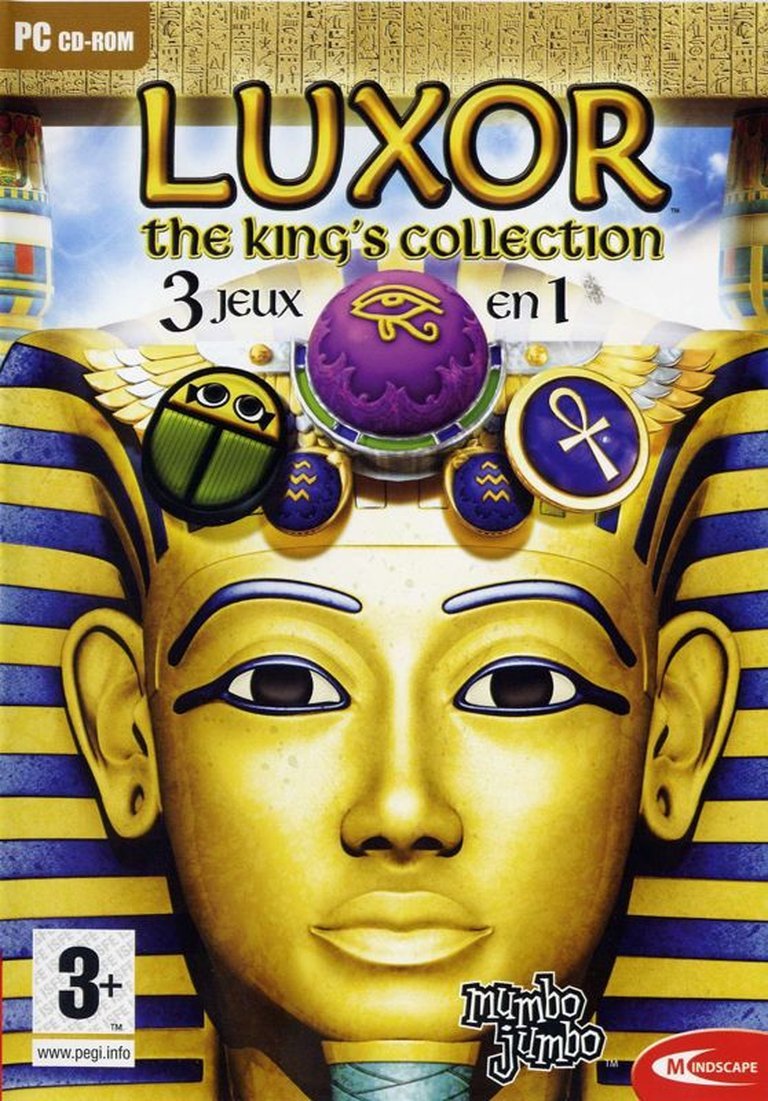
Description
Luxor: The King’s Collection (3 games in 1) is a puzzle game compilation set in ancient Egypt, featuring Luxor, Luxor: Amun Rising, and Luxor Mahjong. Players shoot colored spheres to match and eliminate chains before they reach the pyramid, with Luxor Mahjong offering a tile-matching variant. Developed by MumboJumbo and released in 2009 by Mindscape SA, this collection excludes Luxor 2 found in other bundles but delivers strategic challenges across three distinct games in the series.
Luxor: The King’s Collection (3 games in 1) Guides & Walkthroughs
Luxor: The King’s Collection (3 games in 1) Reviews & Reception
vgtimes.com (55/100): Luxor: The King’s Collection (3 games in 1) is a game from developers from the studio MumboJumbo, LLC. The main publisher of the game is Mindscape SA.
Luxor: The King’s Collection (3 games in 1) Cheats & Codes
PC
Type codes at the store or use console commands. For cheat mode, press Q + E + T, then enter codes. For developer mode, press Ctrl + Shift + ~, then type ‘Developer true’ in the console.
| Code | Effect |
|---|---|
| lotsankh | Grants 5,000,000,000 Ankh coins (type at the store) |
| Q + E + T (then I) | Enable invincibility |
| Q + E + T (then you) | Disable invincibility |
| Q + E + T (then N) | Skip to next level |
| Q + E + T (then W + are + Y) | Disable cheat mode |
| Ctrl + Shift + ~ (then ‘Developer true’) | Enable developer console |
| D (in developer console) | Kill all spheres on screen |
| F (in developer console) | Spawn Fireball |
| L (in developer console) | Spawn Lightning Bolt |
| R (in developer console) | Retry current stage |
| N (in developer console) | Skip to next stage |
Luxor: The King’s Collection (3 games in 1): A Monumental Puzzle Compilation Reviewed
Introduction
In an era when casual puzzle games dominated PC gaming, Luxor: The King’s Collection (3 games in 1) emerged as a time capsule of early 2000s design ethos. This compilation bundles Luxor (2005), Luxor: Amun Rising (2006), and Luxor Mahjong (2008) into a single package, offering a mix of kinetic ball-matching action and tile-based puzzles. While overshadowed by its four-game sibling (Luxor: The King’s Collection (4 Games in One)), this collection remains a fascinating artifact of MumboJumbo’s reign over the casual gaming market. This review explores how the trilogy balances accessibility with repetitive design, and its lasting impact on the puzzle genre.
Development History & Context
Studio Vision & Technological Constraints
Developed by MumboJumbo, LLC and published by Mindscape SA in 2009, this bundle arrived at the tail end of the studio’s dominance in low-spec, high-addiction puzzle games. MumboJumbo’s Luxor series borrowed heavily from Mitchell Corporation’s Puzz Loop (1998), refining its “marble shooter” mechanics into a polished, Egypt-themed juggernaut. The compilation’s release coincided with the rise of digital storefronts like Big Fish Games, targeting casual players who favored simplicity over graphical grandeur.
The 2009 Gaming Landscape
By the late 2000s, casual puzzle compilations were a crowded market. Titles like Peggle and Zuma had already cemented their place, but Luxor distinguished itself with its Ancient Egyptian aesthetic and methodical progression. However, the omission of Luxor 2 (2006)—a fan-favorite with improved visuals and power-ups—from this collection felt like a missed opportunity, especially compared to the more complete 4 Games in One edition.
Narrative & Thematic Deep Dive
Thematic Consistency vs. Narrative Absence
The Luxor series has never been a narrative-driven franchise. Instead, it relies on a loose thematic framework: players control a winged scarab tasked with defending Egyptian pyramids from advancing chains of colored spheres. Luxor Mahjong shifts the focus to tile-matching, but retains the aesthetic with Ankh keys and hieroglyphic motifs.
Symbolism & Tone
The games lean heavily on stereotypes of Ancient Egypt—golden sands, scarab beetles, and pyramid backdrops—to create a sense of exoticism. While hardly groundbreaking, this approach provided a cohesive visual identity that resonated with casual audiences. The absence of deeper storytelling, however, limits emotional engagement, reducing the experience to pure mechanics.
Gameplay Mechanics & Systems
Core Loop: Tension & Repetition
The Luxor games revolve around a simple premise: fire colored spheres from a moving shrine to match three or more identical orbs, preventing them from reaching the pyramid. The addition of power-ups—like lightning bolts that destroy entire rows—adds strategic depth. Luxor: Amun Rising introduced new orb types and faster chains, while Luxor Mahjong offered a slower-paced alternative with tile-clearing puzzles.
Strengths & Flaws
– Addictive Progression: With 264 total levels across the trilogy, the games reward persistence with gradual difficulty curves and occasional boss fights.
– Limited Innovation: Beyond surface-level tweaks, the mechanics rarely evolve, leading to fatigue over extended play sessions.
– UI & Controls: The mouse-driven aiming system is intuitive, though the lack of keyboard shortcuts feels archaic by modern standards.
World-Building, Art & Sound
Visual Design: Aesthetic Over Ambition
The Luxor series embraces a bright, cartoonish style, blending 2D sprites with pseudo-3D backdrops. While the graphics are dated by today’s standards, the vibrant color palettes and Egyptian motifs—ochre sands, lapis lazuli skies—create a whimsical atmosphere. The compilation’s CD-ROM origins are evident in its low-resolution textures, but the art direction remains charmingly cohesive.
Sound Design: Hypnotic Repetition
The soundtrack blends ambient flute melodies and rhythmic percussion, evoking a sense of ancient mystery. Sound effects—like the satisfying clink of matched orbs—are crisp but repetitive. While not revolutionary, the audio design complements the gameplay’s meditative flow.
Reception & Legacy
Commercial Success, Critical Silence
Upon release, Luxor: The King’s Collection garnered little critical attention—reflective of the era’s dismissive attitude toward casual games—but found an audience among budget-conscious players. User ratings like 5.5/10 (VG Times) highlight its divisive reception: praised for its accessibility, criticized for its lack of innovation.
Influence on the Genre
Though overshadowed by titans like Bejeweled, the Luxor series helped popularize the “marble shooter” subgenre. Its legacy lives on in mobile games like Toon Blast, which borrow its kinetic energy and bite-sized challenges. MumboJumbo’s emphasis on thematic consistency also set a template for casual games seeking to stand out in a saturated market.
Conclusion
Luxor: The King’s Collection (3 games in 1) is a relic of a bygone era—a compilation that embodies both the strengths and limitations of 2000s casual gaming. While its repetitive mechanics and dated presentation may deter modern players, its historical significance as a bridge between arcade-style puzzles and the mobile gaming boom cannot be ignored. For retro enthusiasts or casual gamers seeking a nostalgic trip, this collection offers a satisfying, if unambitious, experience.
Final Verdict: A competent but unremarkable anthology that underscores MumboJumbo’s knack for addictive design—yet falters in the shadow of its more complete sibling.