
- Release Year: 2020
- Platforms: Macintosh, Nintendo Switch, PlayStation 4, Windows, Xbox One, Xbox Series
- Publisher: Eggcode Games, Toplitz Productions GmbH
- Developer: Eggcode Games
- Genre: Simulation
- Perspective: Side view
- Game Mode: Single-player
- Gameplay: Business simulation, City building, construction simulation, Managerial
- Average Score: 72/100
Description
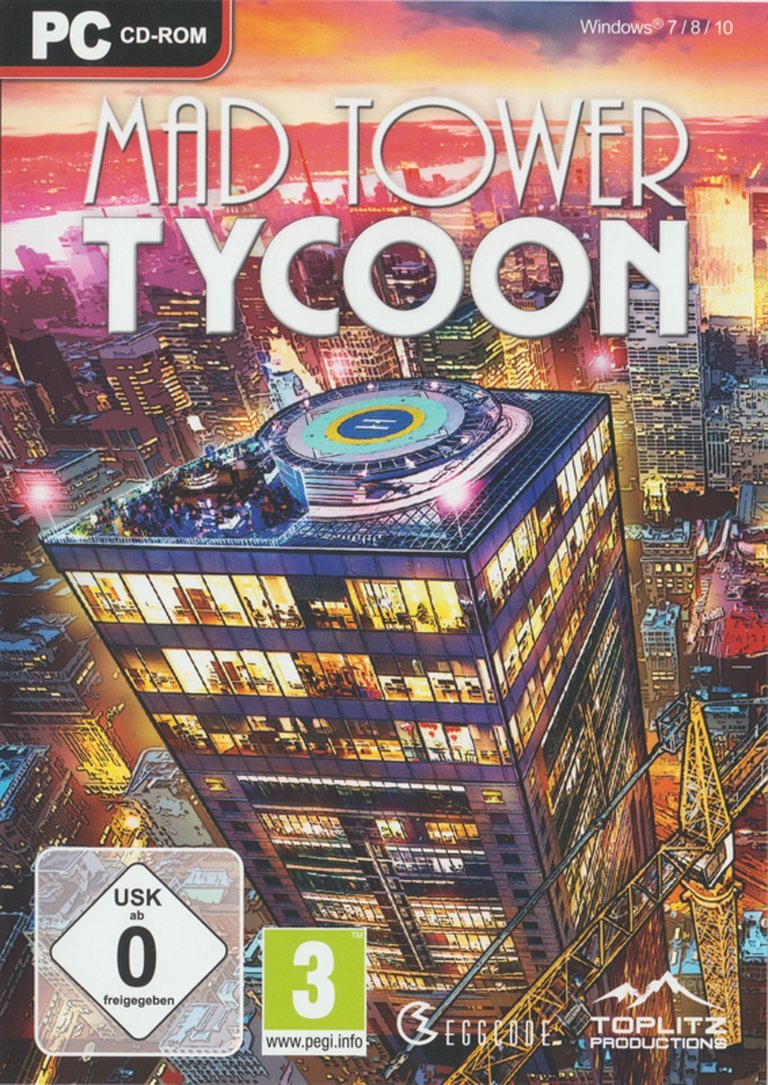
Mad Tower Tycoon is a simulation game where players take on the role of a developer to design, construct, and manage a towering skyscraper. Balancing architectural choices, tenant demands, and financial strategies in real-time, the goal is to build a profitable and iconic tower through careful city-building and business management.
Gameplay Videos
Where to Buy Mad Tower Tycoon
Mad Tower Tycoon Guides & Walkthroughs
Mad Tower Tycoon Reviews & Reception
opencritic.com (80/100): Mad Tower Tycoon is definitely a nice twist on the Tycoon building genre.
metacritic.com (60/100): I must strongly advise against playing this game, as I’ve found it, in the state it’s in right now, to be very much unplayable.
thexboxhub.com : I really like the added features you can work into the tower, like shops, hotel rooms, and even a zoo as more money comes in.
Mad Tower Tycoon: A Towering Ambition Forged in Early Access
Introduction: The Sky’s the Limit, But the Foundation is Shaky
In the bustling metropolis of city-building and management simulations, few subgenres capture the vertical ambition quite like the “tower tycoon.” Standing on the shoulders of classics like SimTower (1994) and the beloved modern revival Project Highrise (2016), Mad Tower Tycoon enters the arena not as a revolutionary, but as a bold, brash, and deeply iterative contender. Developed by the German indie studio Eggcode Games—creators of the Mad Games Tycoon series—this 2020 release represents a fascinating case study in the Early Access model. It is a game that launched to critical scorn for its broken state but fought its way to a “Mostly Positive” Steam reputation through relentless patching. This review will argue that Mad Tower Tycoon is a fundamentally sound and often charming simulation that distinguishes itself through a realistic elevator model and streamlined utility management, yet remains perpetually in the shadow of its more polished, micro-managerial predecessor. Its legacy is that of the passionate underdog: a game whose potential was nearly squandered by a disastrous launch but was ultimately salvaged by a dedicated developer willing to listen and iterate.
Development History & Context: The Long Ascent from Early Access
The Studio and the Vision: Eggcode Games, a small German team, carved its niche with the Mad Tycoon series. Mad Games Tycoon (2016) established their formula: accessible, cartoonish management sims with a focus on player freedom. With Mad Tower Tycoon, they set their sights on the tower-building genre, a space dominated by the minimalist elegance of Project Highrise. Their stated vision, per the Steam blurb, was to offer “countless ways” to achieve a “six-star award” in a skyscraper with “more than 100 floors,” emphasizing a “realistic” elevator system and chaotic random events like UFO abductions.
Technological Constraints & The Early Access Gauntlet: The game was built in Unity, a common engine for indie sims, but one that can present challenges for complex agent pathfinding—a core mechanic for any building sim. The timeline reveals the struggle: it spent over two years in Early Access (from late 2018 to January 2020). The sheer volume of patch notes from this period, meticulously documented on Steam, tells a story of a game in constant flux. Early versions were plagued by critical bugs: construction workers freezing in place, elevators malfunctioning, save file corruption, memory leaks causing crashes, and pathfinding AI that would strand visitors. The developer’s approach was hands-on and responsive, with patches addressing community-reported issues weekly, adding features (balconies, roof terraces, new room types like observatories and helipads), and rebalancing economics based on player feedback. This iterative process, while painful for initial adopters, forged the final product.
The 2020 Gaming Landscape: Mad Tower Tycoon launched in a crowded field. Project Highrise had already set a high bar for tactical utility management and tenant nuance. Meanwhile, the success of Planet Coaster (2018) and Two Point Hospital (2018) showed a appetite for deep, systems-driven sims with personality. MTT’s simultaneous release on Windows, macOS, PlayStation 4, Xbox One, and Nintendo Switch (with an Xbox Series port later) was ambitious for a small indie, but console ports, as noted in the XboxHub review, introduced new interface challenges.
Narrative & Thematic Deep Dive: Capitalism, Chaos, and the “Madness” in the Title
It is a testament to Mad Tower Tycoon‘s design that its “narrative” is wholly emergent, born from the systems themselves. There is no traditional plot, characters, or dialogue. Instead, the game’s themes are expressed through its mechanics and random events, creating a story of hubris, management, and urban absurdity.
- The Pure, Unadorned Drive of Capitalism: The core loop is a distillation of capitalist ambition. You start with a lobby and a bank loan, and your only goal is to expand upward, maximizing rental income from offices, apartments, and shops. The game’s “thesis” is simple: growth is good, efficiency is king, and tenant satisfaction is a means to an end (higher rent and prestige). The “six-star” award is the ultimate capitalist trophy.
- Order vs. Chaos: The central tension is between the player’s meticulous planning and the game’s injection of chaos. The “Mad” in the title manifests through random events detailed in the patch notes and official description: fires, earthquakes, and the surreal “UFOs kidnap your tenants.” These aren’t just cosmetic disasters; they actively disrupt your carefully tuned economy. An earthquake destroys power infrastructure, immediately angering tech-dependent tenants. A UFO abduction removes workers, potentially halting construction or service. These events force the player to be resilient, to build redundancies (extra generators, security), and to react to the unexpected—theming the experience as a battle against entropy.
- The Human Element as a Data Stream: Without a narrative, the tower’s inhabitants are pure statistics. Their needs (toilets, food, cleanliness, low noise), their stress levels, and their pathfinding routes are the only “story” you get. A cluttered, noisy floor with long elevator waits will manifest as red complaint icons and eventual tenant departure. The game mythologizes the invisible labor of maintenance crews, cleaners, and delivery workers—their efficient (or broken) movement is the lifeblood of your tower. The theme is one of invisible infrastructure; your success is measured in the seamless, stress-free flow of hundreds of tiny digital people.
Gameplay Mechanics & Systems: The Engine Room
Mad Tower Tycoon is a masterclass in layered, interconnected systems, though its initial implementation was fraught.
Core Gameplay Loop: The loop is satisfyingly sim-city-esque:
1. Plan & Build: Start with a lobby. Build floor-by-floor (you don’t place individual floor tiles; you directly select a room type like “Small Office” or “Apartment,” and the game constructs it). Connect floors with stairs and elevators.
2. Infrastructure: Ensure each floor has access to electricity, water, and multimedia (WiFi) via strategically placed utility rooms (Generator, Pump, Server Room). Here, MTT makes its first major divergence from Project Highrise: utilities are automatic and global. Once a generator is built, it connects to all eligible rooms on the same or adjacent floors via invisible lines. There is no need to manually run pipes or wires. This is a significant reduction in micro-management, making the game feel more “arcadey” and accessible.
3. Rent & Profit: As rooms are completed, tenants automatically move in (you cannot choose specific tenants). Rent is generated automatically. Profit is driven by balancing high-rent premium rooms (cinemas, zoos, ballrooms) with essential, lower-rent services.
4. Manage & Optimize: Use extensive statistics and filter menus to diagnose problems: noisy floors, dirty rooms, low visitor counts, high stress. Adjust elevator settings (wait times, floor restrictions, parking positions) and room opening hours. Complete daily missions and gain XP to unlock over 50 skills (e.g., increased room range, larger elevators, bonus rental income).
5. Survive Events: React to fires, earthquakes, and bizarre happenings like zombie outbreaks (a “fantasy event” toggleable in options).
The Elevator Heartbeat: This is MTT’s most celebrated and complex system. Unlike Project Highrise‘s “teleporter” elevators, MTT simulates physical elevator shafts. People walk to an elevator bank, wait, board a specific elevator car, and you see it travel floor-by-floor to its destination. If an elevator is at floor 50 responding to a call from floor 10, someone on floor 30 must wait. This creates a brilliant logistical puzzle. The patch notes show this system was heavily iterated: adding multi-shaft elevators, the ability to set movement patterns (e.g., “Only from top to bottom”), and parking positions for day/night cycles. Managing elevator traffic—balancing the number of elevators, their capacity, and their floor stops—becomes the primary transportation challenge.
Flaws and Fixes: The launch version was fundamentally broken in ways that made it, as critic Matt Sainsbury stated, “unplayable.” The patch history reads like a war against bugs:
* Pathfinding Apocalypse: Visitors and workers would get stuck, fail to find entrances, or walk through walls. “Construction workers’ pathfinding no longer worked correctly” was a recurring bug.
* Elevator Catastrophes: Elevators could be built on invalid objects (antennas, helipads) or simply stop working if built on map edges. Demolishing an elevator could leave “ghost” settings.
* Systemic Crashers: Memory leaks from “continuous material creation” or “visitor creation” would crash the game. Fires and room demolitions could trigger crashes.
* UI/UX Woes: Menus were buggy, scroll windows too small, tooltips in wrong languages, and buttons unresponsive. The XboxHub review specifically noted the controller interface was “awkward” and “not as responsive” as other console sims.
The developer’s response was exhaustive, fixing thousands of specific issues. By the end of Early Access, pathfinding was “optimized,” elevator logic was robust, and the UI was largely stabilized. The game that shipped in January 2020, while still rough, was at least functional.
World-Building, Art & Sound: A Vibrant, Functional Canvas
Visual Direction & Atmosphere: Mad Tower Tycoon employs a bright, colorful, slightly cartoonish art style. The isometric side-view allows for a clear view of the tower’s cross-section. The free camera can zoom from a macro view of the entire vertical city to a micro view of a single apartment. The visual design prioritizes clarity: different room types have distinct color coding and iconography (offices are cool blues, shops are warm oranges, attractions are vibrant purples). The backgrounds—options like “Fir River,” “Diamond Beach,” and “Mountains”—offer pleasant, if somewhat static, backdrops. The art is arguably more lively and less sterile than Project Highrise‘s minimalist kitsch, though some may find the character models “too cute” or unnatural, as the comparative blog post notes. The addition of decoration objects (statues, palms, fountains) and particle effects (pool water, casino lights) in later patches added visual variety.
Sound Design: The soundtrack is functional, chirpy, and easily forgettable—a common trait in management sims. More importantly, sound is functional and customizable. The patch notes repeatedly mention fixing balance sliders for elevator sounds, helicopter pads, and subways. The ability to disable the “tenant sound” or the subway noise is a crucial quality-of-life feature for players who prefer their own music, acknowledging that ambient noise can become grating during long sessions.
The overall atmosphere is one of busy, optimistic industry. The constant hum of generators, the ding of elevator arrivals, and the bustle of tiny visitors create a sense of a vertical city alive with (simulated) purpose. The “madness” events inject surreal humor—seeing a UFO beam hover over your penthouse is a memorable, game-breaking (in a good way) moment that breaks the capitalist monotony.
Reception & Legacy: From Unplayable to Niche Favorite
Critical Reception: The launch critical reception was abysmal and singularly damning. The sole critic review on MobyGames and Metacritic came from Digitally Downloaded‘s Matt Sainsbury, who awarded it 3/5 (60%) but prefaced it with a stark warning: the game was, in its submitted state, “very much unplayable.” His review is a fascinating document of the Early Access dilemma—he reviewed a bug-ridden version, assumed patches were coming, and based his score on that expectation. This review became a lightning rod, summed up by the headline: “I must strongly advise against playing this game.” On OpenCritic, it sits in the “-1st percentile,” a badge of honor for a game with a single negative review.
Commercial & User Reception: This is where the story pivots. According to Steambase, Mad Tower Tycoon has sold over 34,500 copies on Steam and maintains a “Mostly Positive” (78%) rating from 436 reviews. This stark contrast between one critic’s savage review and hundreds of positive user reviews reveals two things: 1) The post-launch patches did their job, fixing the game to a playable, enjoyable state. 2) The game found its niche audience. User tags (“Relaxing,” “Base Building,” “Management”) point to players who enjoy the loop and are tolerant of jank. The average playtime of 18 hours (from Raijin.gg) suggests it resonates with fans of the genre who want a shorter, focused experience compared to 100+ hour epics.
Comparative Legacy & Influence: Mad Tower Tycoon’s legacy is intrinsically tied to Project Highrise. As the comprehensive blog comparison highlights, they are sibling games with divergent design philosophies:
* Project Highrise is the simulation purist’s choice: deep micro-management (manual wiring/plumbing), direct tenant selection with specific needs, intricate noise propagation, and a cleaner, more systemic challenge. It has mod support and more DLC content.
* Mad Tower Tycoon is the accessible, event-driven simulator: streamlined utilities, realistic elevator logistics, random chaotic events, and no tenant control (all based on room type). It has no mod support or DLC, but a complete package out of the box.
MTT did not dethrone Project Highrise nor significantly influence the genre. Its primary contribution is proving that the tower sim formula can be successfully adapted to a more casual, event-driven model. It validated the desire for a “simpler” elevator simulation. Its legacy is that of a competent, Alternative A—a game that will be forever compared to its sibling and found wanting in depth by some, but cherished by others for its charm, color, and focus on vertical logistics over horizontal utility mazes.
Conclusion: A Flawed Foundation, But a Structure That Stands
Mad Tower Tycoon is a game defined by its metamorphosis. To judge it solely on its catastrophic Early Access launch is to ignore the monumental effort by Eggcode Games to resurrect it. The final product is a good, not great, simulation that succeeds on the strength of one brilliant core idea: making elevator traffic the central, tangible puzzle of tower management. The joy of designing a bank of elevators that perfectly services 80 floors, watching the little figures board and alight without congestion, is a uniquely satisfying achievement.
However, its simplifications—automatic utilities, lack of tenant selection—will feel like concessions to players who relish the systemic depth of Project Highrise. The art, while colorful, lacks the iconic clarity of its competitor. The random events, fun at first, can feel like arbitrary punishment rather than integrated challenge.
In the pantheon of business sims, Mad Tower Tycoon occupies a respectable middle ground. It is not an essential classic like RollerCoaster Tycoon or Prison Architect, nor is it a forgotten failure. It is a solid, niche-focused entry that delivers a specific fantasy: the chaotic, colorful, elevator-logistics challenge of building a colossal, profitable skyscraper. For players who want that experience without the wiring diagrams, it is a worthy 18-hour diversion. For the historian, it stands as a testament to the power of post-launch support and a reminder that in the world of Early Access, a game’s true character is often revealed not in its debut, but in its long, hard climb to stability.
Final Verdict: 7/10 – A Flawed but Ultimately Rewarding Vertical Challenge.