
- Release Year: 2004
- Platforms: GameCube, PlayStation 2, Windows, Xbox
- Publisher: Electronic Arts, Inc.
- Developer: EA Tiburon
- Genre: Sports
- Perspective: Diagonal-down
- Game Mode: Online PVP, Single-player
- Gameplay: Create-A-Fan, Custom playbook, Defensive hot routes, Draft system, Formation shifts, Franchise mode, Hit Stick, Online leagues, Player morale, Roster management, Trading
- Setting: American Football
- Average Score: 91/100
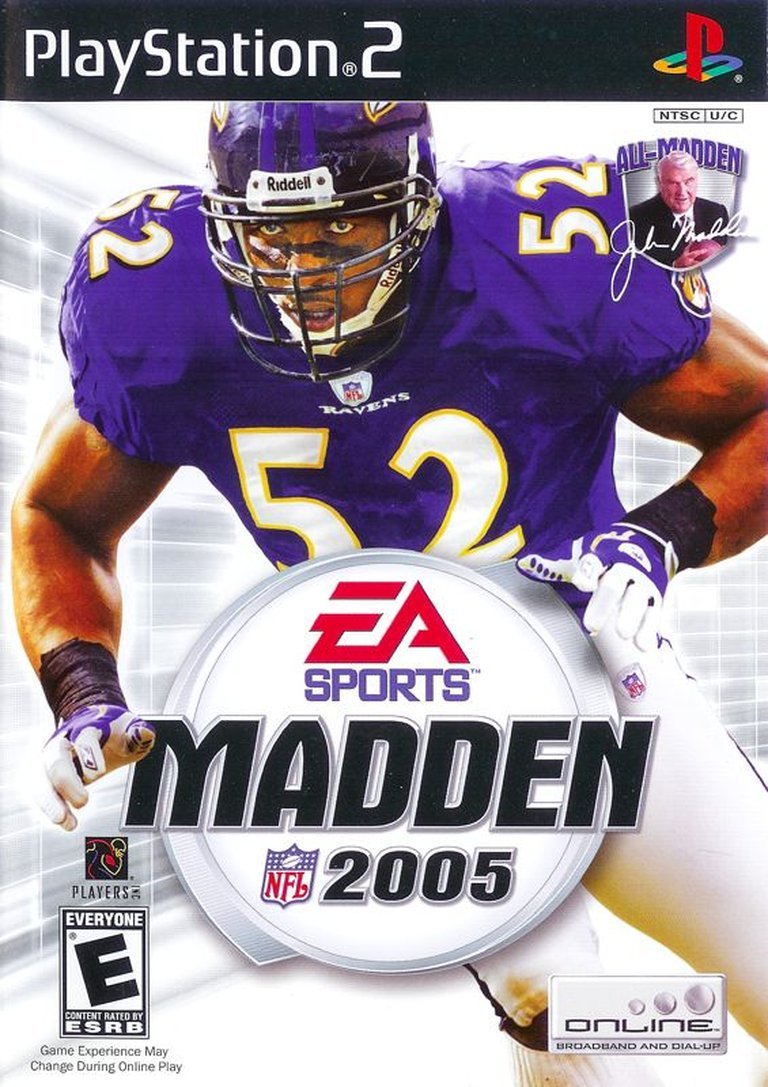
Description
Madden NFL 2005 is an American football simulation game set in the National Football League, featuring authentic licensed teams and players. It enhances defensive gameplay with the introduction of the Hit Stick for precise tackling and hot routes, while expanding franchise mode through Storyline Central—which includes EA Sports Radio broadcasts, newspaper articles, and player emails—along with a dynamic morale system that affects roster decisions, and introduces online league play for Xbox and PlayStation 2.
Gameplay Videos
Madden NFL 2005 Free Download
Madden NFL 2005 Guides & Walkthroughs
Madden NFL 2005 Reviews & Reception
metacritic.com (91/100): In its 15th year, this well-oiled machine enters the 2005 season with one of the finest football games ever crafted.
gamerevolution.com : few video games are as competent as Madden
Madden NFL 2005 Cheats & Codes
PlayStation 2
Select the ‘My Madden’ option at the main menu. Select the ‘Madden Cards’ option, then choose ‘Madden Codes’ to enter a code.
| Code | Effect |
|---|---|
| J95K1J | Aaron Brooks Gold Card |
| Q48E9G | Aaron Glenn Gold Card |
| C12E9E | Adewale Ogunleye Gold Card |
| T86L4C | Ahman Green Gold Card |
| G72G2R | Al Wilson Gold Card |
| U32S9C | Alan Faneca Gold Card |
| Z75G6M | Amani Toomer Gold Card |
| V76E2Q | Andre Carter Gold Card |
| E34S1M | Andre Johnson Gold Card |
| N44K1L | Andy Reid Gold Card |
| S32F7K | Anquan Boldin Gold Card |
| A12V7Z | Antoine Winfield Gold Card |
| S54T6U | Bill Cowher Gold Card |
| P44A8B | Brad Hopkins Gold Card |
| L61D7B | Bret Favre Gold Card |
| L27C4K | Brian Billick Gold Card |
| Y47B8Y | Brian Dawkins Gold Card |
| S22M6A | Brian Simmons Gold Card |
| Z34J4U | Brian Urlacher Gold Card |
| V46I2I | Brian Westbrook Gold Card |
| U77F2W | Bubba Franks Gold Card |
| G77L6F | Butch Davis Gold Card |
| C55V5C | Byron Leftwich Gold Card |
| O36V2H | Carson Palmer Gold Card |
| Z11P9T | Casey Hampton Gold Card |
| R85S2A | Chad Johnson Gold Card |
| B64L2F | Chad Pennington Gold Card |
| K89O9E | Champ Bailey Gold Card |
| E57K9Y | Charles Rogers Gold Card |
| F95N9J | Charles Woodson Gold Card |
| F14C6J | Chris Hovan Gold Card |
| R66V6J | Clinton Portis Gold Card |
| R11D7K | Corey Simon Gold Card |
| R42R75 | Courtney Brown Gold Card |
| K47X3G | Curtis Martin Gold Card |
| O24U1Q | Dallas Coach Gold Card |
| F78I1I | Damien Woody Gold Card |
| B23P8D | Dante Hall Gold Card |
| Q86I2S | Dat Nguyen Gold Card |
| O62O9K | Daunte Culpepper Gold Card |
| W73D7D | Dave Wannstedt Gold Card |
| A25I9F | David Boston Gold Card |
| C16E2Q | David Carr Gold Card |
| J83E3T | Dennis Erickson Gold Card |
| C18J7T | Dennis Green Gold Card |
| P93I9Q | Derrick Brooks Gold Card |
| S98P3T | Derrick Mason Gold Card |
| D11H4J | Deuce Mcallister Gold Card |
| L35K1A | Dexter Coakley Gold Card |
| G16B2I | Dexter Jackson Gold Card |
| F68V1W | Dick Vermeil Gold Card |
| B97I6R | Dom Capers Gold Card |
| L58S3J | Domanick Davis Gold Card |
| E18Y5Z | Donnie Edwards Gold Card |
| Q11T7T | Donovin Darius Gold Card |
| T98J1I | Donovon Mcnabb Gold Card |
| R75W3M | Donte Stallworth Gold Card |
| H19Q2O | Dre’ Bly Gold Card |
| W73M3E | Drew Bledsoe Gold Card |
| G76U2L | Dwight Freeney Gold Card |
| G18Q2B | Ed Reed Gold Card |
| A75D7X | Edgerrin James Gold Card |
| H34Z8K | Eric Moulds Gold Card |
| R54T1O | Flozell Adams Gold Card |
| I87X9Y | Fred Taylor Gold Card |
| E46M4Y | Grant Wistrom Gold Card |
| O19T2T | Herman Edwards Gold Card |
| M12B8F | Hines Ward Gold Card |
| J22P9I | Jack Del Rio Gold Card |
| M86N9F | Jake Delhomme Gold Card |
| N74P8X | Jake Plummer Gold Card |
| W27I7G | Jamie Sharper Gold Card |
| O33S6I | Jason Taylor Gold Card |
| M74B3E | Jason Webster Gold Card |
| N62B6J | Jeff Fisher Gold Card |
| H32H7B | Jeff Garcia Gold Card |
| J77Y8C | Jeremy Newberry Gold Card |
| R34X5T | Jeremy Shocky Gold Card |
| F71Q9Z | Jerry Porter Gold Card |
| K34F8S | Jerry Rice Gold Card |
| A78B1C | Jevon Kearse Gold Card |
| G78R3W | Jim Haslett Gold Card |
| N46C3M | Jim Mora Jr. Gold Card |
| I22J5W | Jimmy Smith Gold Card |
| P91A1Q | Joe Horn Gold Card |
| Z68W8J | Joey Harrington Gold Card |
| Q98R7Y | John Fox Gold Card |
| H61I8A | Jon Gruden Gold Card |
| O33Y4X | Josh Mccown Gold Card |
| M89J8A | Julian Peterson Gold Card |
| X54O4Z | Julius Peppers Gold Card |
| W26K6Q | Junior Seau Gold Card |
| U16I9Y | Kabeer Gbaja-Biamala Gold Card |
| E12P4S | Keith Brooking Gold Card |
| M63N6V | Keith Bulluck Gold Card |
| T96C7J | Kendrell Bell Gold Card |
| A23T5E | Kevan Barlow Gold Card |
| L76E6S | Kevin Mawee Gold Card |
| W63O3K | Kris Jenkins Gold Card |
| A72F9X | Kyle Boller Gold Card |
| Y46A8V | Kyle Turley Gold Card |
| M64D4E | Ladainian Tomlinson Gold Card |
| K24L9K | La’roi Glover Gold Card |
| F19Q8W | Lavar Arrington Gold Card |
| R98I5S | Laveranues Coles Gold Card |
| M37Y5B | Lawyer Milloy Gold Card |
| Z94X6Q | Lee Suggs Gold Card |
| H14M2V | Leonard Davis Gold Card |
| L38V3A | Lovie Smith Gold Card |
| U66B4S | Marc Bulger Gold Card |
| R42X2L | Marcel Shipp Gold Card |
| E56I5O | Marcus Stroud Gold Card |
| R46T5U | Marcus Trufant Gold Card |
| B66D9J | Mark Brunell Gold Card |
| U76G1U | Marshell Faulk Gold Card |
| P51U4B | Marty Booker Gold Card |
| D96A7S | Marty Shottenheimer Gold Card |
| C46P2A | GOLD REX GROSSMAN |
| F12J8N | GOLD MIKE BROWN |
| R17R2O | GOLD OLIN KREUTZ |
| D86P8O | GOLD PETER WARRICK |
| W26J6H | GOLD RUDI JOHNSON |
| F36M2Q | GOLD TRAVIS HENRY |
| B83A6C | GOLD TAKEO SPIKES |
| V22C4L | GOLD ROD SMITH |
| J76C6F | GOLD ROY WILLIAMS |
| Z87T5C | GOLD SAM MADISON |
| U63I3H | GOLD ZACH THOMAS |
| H58T9X | GOLD PATRICK SURTAIN |
| P19V1N | GOLD RICKY WILLIAMS |
| J97X8M | GOLD SHAUN ROGERS |
| X95I7S | GOLD NICK BERNETT |
| K89O6S | GOLD MIKE RUCKER |
| E39X9L | GOLD STEPHEN DAVIS |
| F13W1Z | GOLD TY LAW |
| X22V7E | GOLD TOM BRADY |
| K28Q3P | GOLD TEDY BRUSCHI |
| O84I3J | GOLD RODNEY HARRISON |
| L69T4T | GOLD RICHARD SEYMORE |
| Q69I1Y | GOLD RICH GANNON |
| P67E1I | T.J. Duckett Gold Card |
| A49H6R | Michael Vick Gold Card |
| B61A8M | Da Bomb Gold Card (unlimited pass Range) |
| I76X3T | Da Boot Gold Card(unlimited field goal range) |
| V34L6D | Tight Fit Gold Card (opponents uprights will be narrow) |
| P74X8J | ’58 Colts |
| G49P7W | ’66 Packers |
| C24W2A | ’68 Jets |
| G12N1I | ’70 Browns |
| R79W6W | ’72 Dolphins |
| R12D9B | ’74 Steelers |
| P96Q8M | ’76 Raiders |
| O18T2A | ’77 Broncos |
| G97U5X | ’78 Dolphins |
| K71K4E | ’80 Raiders |
| Y27N9A | ’81 Chargers |
| F56D6V | ’82 Redskins |
| D23T8S | ’83 Raiders |
| X23Z8H | ’84 Dolphins |
| F92M8M | ’85 Bears |
| K44F2Y | ’86 Giants |
| F77R8H | ’88 49ers |
| G95F2Q | ’90 Eagles |
| I89F4I | ’91 Lions |
PC
Select the ‘My Madden’ option at the main menu. Select the ‘Madden Cards’ option, then choose ‘Madden Codes’ to enter a code.
| Code | Effect |
|---|---|
| J95K1J | Aaron Brooks Gold Card |
| Q48E9G | Aaron Glenn Gold Card |
| C12E9E | Adewale Ogunleye Gold Card |
| T86L4C | Ahman Green Gold Card |
| G72G2R | Al Wilson Gold Card |
| U32S9C | Alan Faneca Gold Card |
| Z75G6M | Amani Toomer Gold Card |
| V76E2Q | Andre Carter Gold Card |
| E34S1M | Andre Johnson Gold Card |
| N44K1L | Andy Reid Gold Card |
| S32F7K | Anquan Boldin Gold Card |
| A12V7Z | Antoine Winfield Gold Card |
| S54T6U | Bill Cowher Gold Card |
| P44A8B | Brad Hopkins Gold Card |
| L61D7B | Bret Favre Gold Card |
| L27C4K | Brian Billick Gold Card |
| Y47B8Y | Brian Dawkins Gold Card |
| S22M6A | Brian Simmons Gold Card |
| Z34J4U | Brian Urlacher Gold Card |
| V46I2I | Brian Westbrook Gold Card |
| U77F2W | Bubba Franks Gold Card |
| G77L6F | Butch Davis Gold Card |
| C55V5C | Byron Leftwich Gold Card |
| O36V2H | Carson Palmer Gold Card |
| Z11P9T | Casey Hampton Gold Card |
| R85S2A | Chad Johnson Gold Card |
| B64L2F | Chad Pennington Gold Card |
| K89O9E | Champ Bailey Gold Card |
| E57K9Y | Charles Rogers Gold Card |
| F95N9J | Charles Woodson Gold Card |
| F14C6J | Chris Hovan Gold Card |
| R66V6J | Clinton Portis Gold Card |
| R11D7K | Corey Simon Gold Card |
| R42R75 | Courtney Brown Gold Card |
| K47X3G | Curtis Martin Gold Card |
| O24U1Q | Dallas Coach Gold Card |
| F78I1I | Damien Woody Gold Card |
| B23P8D | Dante Hall Gold Card |
| Q86I2S | Dat Nguyen Gold Card |
| O62O9K | Daunte Culpepper Gold Card |
| W73D7D | Dave Wannstedt Gold Card |
| A25I9F | David Boston Gold Card |
| C16E2Q | David Carr Gold Card |
| J83E3T | Dennis Erickson Gold Card |
| C18J7T | Dennis Green Gold Card |
| P93I9Q | Derrick Brooks Gold Card |
| S98P3T | Derrick Mason Gold Card |
| D11H4J | Deuce Mcallister Gold Card |
| L35K1A | Dexter Coakley Gold Card |
| G16B2I | Dexter Jackson Gold Card |
| F68V1W | Dick Vermeil Gold Card |
| B97I6R | Dom Capers Gold Card |
| L58S3J | Domanick Davis Gold Card |
| E18Y5Z | Donnie Edwards Gold Card |
| Q11T7T | Donovin Darius Gold Card |
| T98J1I | Donovon Mcnabb Gold Card |
| R75W3M | Donte Stallworth Gold Card |
| H19Q2O | Dre’ Bly Gold Card |
| W73M3E | Drew Bledsoe Gold Card |
| G76U2L | Dwight Freeney Gold Card |
| G18Q2B | Ed Reed Gold Card |
| A75D7X | Edgerrin James Gold Card |
| H34Z8K | Eric Moulds Gold Card |
| R54T1O | Flozell Adams Gold Card |
| I87X9Y | Fred Taylor Gold Card |
| E46M4Y | Grant Wistrom Gold Card |
| O19T2T | Herman Edwards Gold Card |
| M12B8F | Hines Ward Gold Card |
| J22P9I | Jack Del Rio Gold Card |
| M86N9F | Jake Delhomme Gold Card |
| N74P8X | Jake Plummer Gold Card |
| W27I7G | Jamie Sharper Gold Card |
| O33S6I | Jason Taylor Gold Card |
| M74B3E | Jason Webster Gold Card |
| N62B6J | Jeff Fisher Gold Card |
| H32H7B | Jeff Garcia Gold Card |
| J77Y8C | Jeremy Newberry Gold Card |
| R34X5T | Jeremy Shocky Gold Card |
| F71Q9Z | Jerry Porter Gold Card |
| K34F8S | Jerry Rice Gold Card |
| A78B1C | Jevon Kearse Gold Card |
| G78R3W | Jim Haslett Gold Card |
| N46C3M | Jim Mora Jr. Gold Card |
| I22J5W | Jimmy Smith Gold Card |
| P91A1Q | Joe Horn Gold Card |
| Z68W8J | Joey Harrington Gold Card |
| Q98R7Y | John Fox Gold Card |
| H61I8A | Jon Gruden Gold Card |
| O33Y4X | Josh Mccown Gold Card |
| M89J8A | Julian Peterson Gold Card |
| X54O4Z | Julius Peppers Gold Card |
| W26K6Q | Junior Seau Gold Card |
| U16I9Y | Kabeer Gbaja-Biamala Gold Card |
| E12P4S | Keith Brooking Gold Card |
| M63N6V | Keith Bulluck Gold Card |
| T96C7J | Kendrell Bell Gold Card |
| A23T5E | Kevan Barlow Gold Card |
| L76E6S | Kevin Mawee Gold Card |
| W63O3K | Kris Jenkins Gold Card |
| A72F9X | Kyle Boller Gold Card |
| Y46A8V | Kyle Turley Gold Card |
| M64D4E | Ladainian Tomlinson Gold Card |
| K24L9K | La’roi Glover Gold Card |
| F19Q8W | Lavar Arrington Gold Card |
| R98I5S | Laveranues Coles Gold Card |
| M37Y5B | Lawyer Milloy Gold Card |
| Z94X6Q | Lee Suggs Gold Card |
| H14M2V | Leonard Davis Gold Card |
| L38V3A | Lovie Smith Gold Card |
| U66B4S | Marc Bulger Gold Card |
| R42X2L | Marcel Shipp Gold Card |
| E56I5O | Marcus Stroud Gold Card |
| R46T5U | Marcus Trufant Gold Card |
| B66D9J | Mark Brunell Gold Card |
| U76G1U | Marshell Faulk Gold Card |
| P51U4B | Marty Booker Gold Card |
| D96A7S | Marty Shottenheimer Gold Card |
| A49H6R | Michael Vick Gold Card |
| P67E1I | T.J. Duckett Gold Card |
| Z28X8K | 3rd Down (Opponent has 3 downs to get a 1st) |
| P66C4L | 5th Down (Get 5 downs to get a 1st) |
| J33I8F | Bingo! (+75% defensive interceptions) |
| B61A8M | Da Bomb (unlimited pass range) |
| I76X3T | Da Boot (unlimited field goal range) |
| M89S8G | Extra Credit (Points for interceptions and sacks) |
| V65J8P | First and Fifteen (Opponent must get 15 yards for 1st down) |
| O72E9B | First and Five (1st down yards set to 5) |
| R14B8Z | Fumbilitis (Opponents fumbles +75%) |
| L96J7P | Human Plow (Break tackle +75%) |
| D57R5S | Lame Duck (Opponent lobs passes) |
| X78P9Z | Mistake Free (No fumbles or interceptions) |
| Y59R8R | Mr. Mobility (QB cannot be sacked) |
| D59K3Y | Super Dive (Diving distance +75%) |
| V34L6D | Tight Fit (Opponents uprights narrow) |
| L48G1E | Unforced Errors (Opponent fumbles when jukes) |
Madden NFL 2005: The Pivot Point—A Definitive Analysis of EA’s Defensive Revolution
Introduction: The Dynasty Under Pressure
In the annals of sports gaming, few titles carry the weight of expectation commensurate with a Madden release. By 2004, Electronic Arts’ flagship football simulation was not merely a game but a cultural institution, a yearly ritual for millions. Yet, the lead-up to Madden NFL 2005 was uniquely fraught. Sega’s ESPN NFL 2K5 had launched two weeks early, at the revolutionary price of $19.99, delivering a slick, deep, and critically adored challenge to EA’s throne. The playoff analogy writes itself: the perennial champion, perhaps complacent, was forced onto the ropes by a hungry, innovative upstart. Madden NFL 2005 was EA’s response—a game not of radical reinvention, but of focused, surgical correction. Its thesis was simple and aggressive: “Fear the D.” This review argues that Madden NFL 2005 represents a pivotal, transitional masterpiece. It successfully rebalanced a series increasingly criticized for offensive dominance by injecting unprecedented defensive agency, while simultaneously laying the robust, if flawed, groundwork for the modern franchise and online modes that would define the series for a decade. It is a game of immense contradictions: celebrated for its gameplay depth yet critiqued for its presentation; hailed for its management simulation while harboring exploitable systems; and ultimately, a product that solidified EA’s dominance not through sheer innovation, but through the shrewd refinement of its core loop and the strategic acquisition of an NFL monopoly that would echo for decades.
Development History & Context: The “Trip’s Folly” Matures in a Time of Crisis
The story of Madden is the story of Electronic Arts itself, born from Trip Hawkins’ desire to computerized Strat-O-Matic. By 2004, the series was a behemoth, developed primarily by EA Tiburon. The studio had steadily evolved the franchise since taking over with Madden NFL ’97, moving from arcade sensibilities to a complex, simulation-oriented experience. The technological context was the PlayStation 2/Xbox era, where 3D modeling, detailed animations, and online console networking (via Xbox Live) were becoming table stakes.
However, the immediate context was a crisis of competition and price. ESPN NFL 2K5, developed by Visual Concepts, was a revelation. Its $19.99 price point, superb presentation (hosted by Chris Berman), and innovative systems like the “VIP” and “Weekly Prep” directly challenged Madden’s $49.99 premium. Industry reports, cited in Wikipedia, note that one EA developer recalled it “scared the hell out of us.” This pressure catalyzed Madden NFL 2005‘s development. The team at Tiburon, led by producers like Ryotaro Hoshi and Yoichiro Furusawa (as per MobyGames credits), chose a specific battlefield: the defensive side of the ball. The goal was not to out-sparkle Sega’s TV-style presentation, but to out-play them. This era also coincided with EA’s aggressive business move. Just months after Madden 2005‘s release in December 2004, EA signed an exclusive, multi-billion dollar licensing agreement with the NFL and NFLPA, effectively killing the NFL 2K series and establishing a monopoly that persists today. Thus, Madden 2005 is both a high watermark of competitive pressure and the herald of a closed marketplace.
Narrative & Thematic Deep Dive: “Fear the D” and the Simulated Life of a Franchise
Madden NFL 2005 lacks a traditional narrative, but its thematic core is twofold: the glorification of defensive mastery and the simulation of an NFL executive’s lifecycle.
The “Fear the D” Campaign: The marketing and in-game emphasis on defense was a deliberate thematic shift. For years, Madden had been lambasted for “arcade” offense—where “pinball running” and unstoppable deep passes ruled. The theme “Fear the D” was a direct rebuttal. This wasn’t just a gameplay patch; it was a design philosophy. The introduction of the Hit Stick—using the right analog stick for context-sensitive, punishing tackles—was a visceral, narrative-feeling tool. It made the user feel like a defensive hawk, a Ron Jaworski-esque coordinator striking fear. Critic reviews consistently highlighted this. IGN’s statement that “it’s not just fun, it’s actually meaningful to D-up” gets to the heart of this new narrative: defense was now a skill-based, rewarding chess match, not a helpless reactive stance.
Storyline Central & The PDA Frontier: The other major narrative thrust was in Franchise Mode, with the introduction of Storyline Central. This was EA’s attempt to weave a persistent, reactive narrative around the user’s franchise. Hosted by the fictional radio host Tony Bruno, it featured newspaper clippings (from real US papers like USA Today), player emails, and coach memos accessed through a sleek, PDA-like interface. Thematically, this aimed to simulate the 24/7 news cycle of the NFL. The player’s decisions—trades, benching, winning/losing—would generate stories. A disgruntled backup QB would “whine to the media,” as one player review detailed, creating a narrative of locker-room dissent. The introduction of player morale was intended as a systemic driver of these stories. However, as the same player review astutely noted, this narrative often became “formulaic and annoying,” a repetitive loop of player complaints with little tangible impact on on-field performance (“Team morale seems to have very little impact on the game anyhow”). The theme here was simulated drama, but the execution often felt like checkbox-driven noise rather than emergent storytelling.
The Micro-Management Fantasy: For the hardcore franchise player, as captured in the passionate player review, the narrative was one of eternal, satisfying optimization. The story was written in salary cap space, in the development of a 99-speed 3rd-string cornerback into a shutdown star, in the cycle of dumping aging veterans for draft picks. This was the “fantasy” text overriding the licensed NFL reality—a narrative of endless, personal dynasty-building. The game’s systems (draft, free agency, trades) supported this narrative, even when flawed (see the exploitable trade loophole).
Gameplay Mechanics & Systems: The Defensive Renaissance and Its Discontents
This is where Madden 2005 earned its legendary status. The gameplay changes were concentrated, deep, and transformative.
Offensive Stability, Defensive Revolution:
* Offense: The core playbook and quarterback mechanics remained largely from Madden 2004, which was already highly refined. A key addition was Formation Shifts. This allowed users to change the look of a play (e.g., from a goal-line formation to a four-wide set) without changing the play itself, offering a new layer of pre-snap disguise. However, as the Wikipedia entry on the series notes, this came with a fatigue penalty for the defense, leading to exploitative strategies that could only be fixed by turning fatigue off—a significant flaw.
* Defense: This was the groundbreaking sector. Three tools defined the new defensive era:
1. The Hit Stick: A mechanical revelation. The right analog stick now controlled the type and direction of a tackle. A quick flick for a wrap-up, a downward slam for a punishing hit with increased fumble chance. It made defense active, skill-based, and spectacular. Reviews from IGN, GameSpot, and Stuff Magazine all singled this out as a game-changer.
2. Defensive Playmaker/Protection: Borrowing from the offensive Playmaker tool of Madden 2004, this allowed pre-snap adjustments. You could move a safety into the box, shade a corner, or blitz a specific linebacker. This addressed the chronic issue of defensive mismatches.
3. Defensive Hot Routes: The ability to change a defender’s assignment on the fly. If you saw a tight end about to run a slant, you could Hot Route your linebacker to cover him. This was the other half of the rebalancing equation, giving the human player the tools to counter offensive tendencies that had dominated for years.
The aggregated critic score of 88% and specific praise for the “All-Madden engine” (IGN) and “best gameplay ever seen in a football game” (GameSpy) point directly to this defensive overhaul as the game’s core triumph. For the first time, playing defense felt as creative and engaging as playing offense.
Franchise Mode Deep Dive: A Double-Edged Sword:
The revamped Franchise Mode, accessed via a “PDA” menu, was ambitiously layered:
* Storyline Central (discussed above).
* Morale System: Players had happiness ratings affected by wins, losses, playing time, and contracts. It was a noble attempt to simulate the human element of a locker room.
* Draft System Revisions: The draft felt more like the real event, with player rankings and crowd reactions. Progressions occurred multiple times a season (Weeks 5, 11, 17) based on performance, not just year-end.
* Create-A-Fan: A quirky, charming side-mode where users could design obnoxious or hilarious fans to populate the stadiums.
However, the player review from MobyGames highlights crippling flaws that exposed the system’s artificiality:
* Offseason Sequence Lockstep: The forced order of roster decisions (re-sign players) before seeing the draft class made for nonsensical management. You couldn’t make an informed decision on a left tackle without knowing your draft prospects.
* Trade System Exploits & Illogic: The game allowed trading a winning team’s late first-round pick for a winless team’s early pick straight up—a glaring, exploitable glitch. More broadly, the AI was criticized as “ridiculously unfair,” refusing reasonable trades for star players even with cap space, breaking the simulation illusion.
* Morale Fatigue: The morality system became a “nuisance,” triggering endless, low-impact complaints that forced users into suboptimal trades just for peace.
* Audible Save Oversight: A bizarre, infamous UI flaw: while custom playbooks could be saved, the audibles assigned to them could not. Users had to manually overwrite default audibles for every single Franchise game—a maddening oversight.
These flaws reveal a mode expanding in breadth (more systems, more news, more depth) but sometimes at the expense of coherence, polish, and logical consistency.
UI, Controls, and Online Pioneering:
The control scheme, now standard for the series, was robust but complex. The new defensive tools required significant investment, which 4Players.de noted would “overwhelm beginners.” The interface for the PDA-style Franchise menu was clean but added layers of navigation. Most significantly, Madden 2005 was the first Madden with official Xbox Live support (for Xbox) and introduced online league play for PS2 and Xbox. This was a monumental step for the series, moving it from a local or split-screen pastime to a connected, persistent competitive hobby. It directly answered one of ESPN NFL 2K5‘s key advantages.
World-Building, Art & Sound: The Reliable, If Unspectacular, Broadcast
Visually, Madden 2005 was a refinement, not a revolution. Player models were sharp, animations (especially tackling) were vastly improved thanks to the new physics and Hit Stick, and stadiums were filled with recognizable detail. However, as 4Players.de and others noted, the presentation still lagged behind ESPN NFL 2K5‘s then-revolutionary “telestrator” overlays, dynamic replays, and overall TV polish. The game looked fantastic for its time, but it lacked the cinematic flair of its competitor.
The sound design was a major point of contention. The soundtrack, featuring Green Day’s “American Idiot” (notably before its single release), Hoobastank, and Franz Ferdinand, was a typical mid-2000s EA mix of alternative rock and nu-metal. It was divisive even then. More damning was the commentary. John Madden and Al Michaels’ lines were widely criticized as “repetitive, annoying, and meaningless” (player review). They lacked the context-sensitive flair of later iterations or the smooth presentation of ESPN‘s Berman andJackson. Many reviewers and players muted it in favor of the soundtrack, a severe blow for a game so focused on authenticity. The sound design’s failure was in its inability to make the user feel like they were watching a real NFL broadcast, a core tenet of the Madden promise.
Reception & Legacy: A Critical Darling That Forged an Empire
Contemporary Reception: Madden NFL 2005 was met with near-universal critical acclaim on its primary platforms (PS2, Xbox, GameCube), with Metacritic/GameRankings scores in the high 80s and low 90s. Review aggregate pages show 50 critic reviews with an 88% average. The praise was unanimous on its gameplay, specifically the defensive changes. GameSpy gave it perfect scores, calling it the winner in the battle with 2K5. IGN’s 9.5/10 hailed the defensive hot routes and All-Madden AI as groundbreaking. Even less enthusiastic reviews (like Game Revolution‘s 91/100) conceded its gameplay consistency was superior to 2K5.
The commercial story, however, was nuanced. Wikipedia states it sold over 4 million copies, which is enormous. But the ESPN NFL 2K5 price war forced EA to discount Madden 2005 to $29.95, a direct hit to their revenue model. This financial pressure is almost certainly the catalyst for the exclusive NFL deal signed in December 2004. The legacy of Madden 2005 is therefore twofold: it won the critical battle for 2004, but its business victory was secured by eliminating the competition entirely for the next 15 years.
Evolving Reputation and Industry Influence:
Over time, Madden 2005‘s reputation has solidified into that of a classic—a favorite among franchise模式的 devotees. The player review from 2015, detailing a 17-year franchise, is not an anomaly; a dedicated subset of fans still consider this the pinnacle of franchise depth and “feel.” Its influence is profound:
1. Defensive Mechanics as Standard: The Hit Stick and defensive hot routes became permanent fixtures. Every subsequent Madden built upon this defensive foundation. The idea that the user should have equal, granular control on both sides of the ball was cemented here.
2. Franchise Mode Blueprint: Storyline Central, despite its flaws, pioneered the idea of a living, breathing league narrative external to the game. The weekly progression system and deeper morale/contract interactions became the baseline for what a franchise mode should contain.
3. Online Play as Core: Its status as the first Madden with official Xbox Live support signaled the irreversible shift to online console gaming as a primary mode for sports titles.
4. The Monopoly Era: Its release marks the absolute peak of Madden as a competitive product. From 2005 onward, the absence of an NFL 2K competitor meant EA could iterate more cautiously. Many fans look back at 2005 as the last year where “they had to try,” a sentiment echoed in reviews comparing it favorably to later, more incremental updates.
Conclusion: The Last Great Challenge
Madden NFL 2005 is a landmark title. It stands as the most successful, focused correction of a core flaw in a major sports franchise. By transferring the creative agency and excitement from the offense to the defense via the Hit Stick and Playmaker tools, it achieved a gameplay balance that felt more tactically rich and less exploitative than any predecessor. Its Franchise Mode, for all its narrative stumbles and systemic exploits, ambitiously tried to simulate the full lifecycle of an NFL organization, setting a template that would take years to polish.
Its flaws are inseparable from its context. The presentation lagged behind 2K5. The commentary was subpar. Certain systems (offseason logic, trade AI, audible saving) were either broken or mind-bogglingly overlooked. Yet, the weight of its accomplishments—a deeper, more satisfying on-field product and the dawn of reliable online league play—overshadows these blemishes for most. It was the game that proved Madden could meaningfully respond to serious competition. And in a tragic, ironic twist, its success helped procure the exclusive NFL license that removed that very competition, arguably leading to a stagnation in innovation for years to come.
Therefore, Madden NFL 2005‘s place in history is paradoxical: it is remembered as the last truly great, necessary Madden, a game that had to be excellent to save a dynasty, and succeeded so well it inadvertently ended the dynasty’s necessity. For the historian, it is the apex of the pre-monopoly era—a simulation of football both thrillingly interactive and ambitiously managerial, forever captured in the moment before the shield became an exclusive, and perhaps less creatively pressured, property. It is not just a great Madden; it is the last great challenge to the idea that a Madden game could ever be anything less than the undisputed, and ultimately unchallenged, king of the virtual gridiron.