
- Release Year: 2003
- Platforms: Windows, Xbox
- Publisher: Atari Europe S.A.S.U., Atari, Inc.
- Developer: Secret Level Inc.
- Genre: Action
- Perspective: Diagonal-down
- Game Mode: Hotseat, LAN, Online PVP, Single-player
- Gameplay: Collectible card, Fighting, Strategy, Trading
- Setting: Fantasy
Description
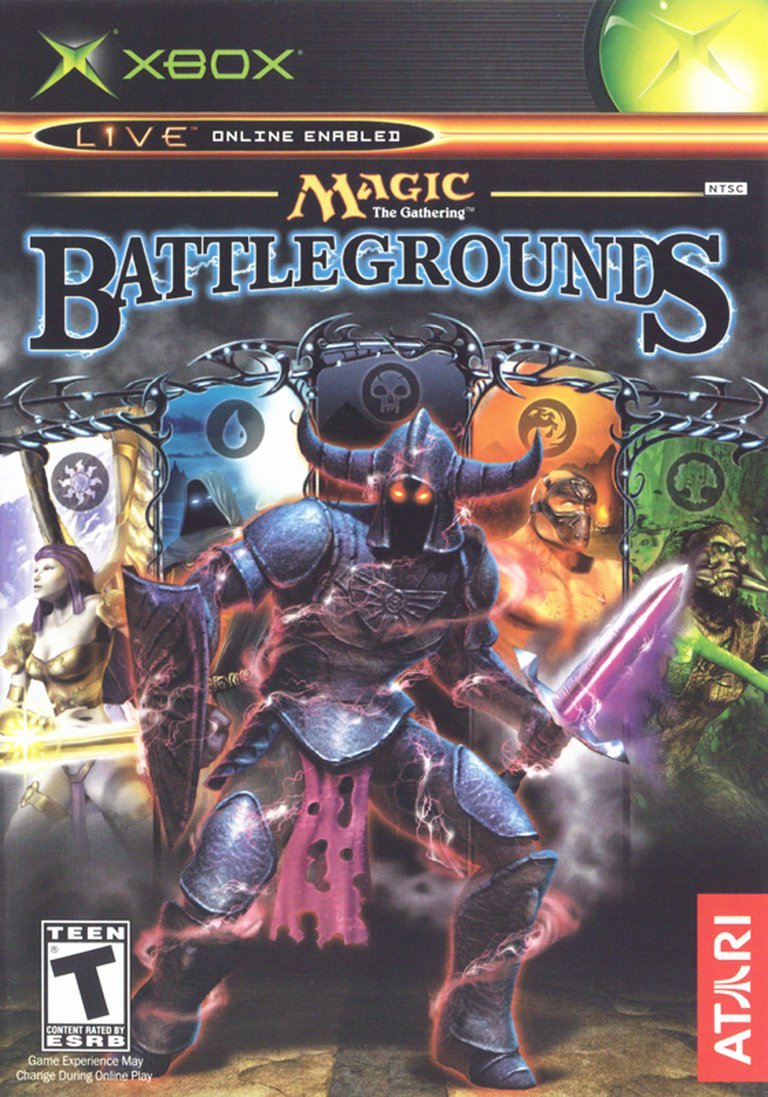
Magic: The Gathering – Battlegrounds is a real-time fighting and strategy game set in a fantasy world where players wield spells from the popular Magic: The Gathering card game to combat opponents. Utilizing three core spell types—creatures, sorceries, and enchantments—players engage in dynamic battles across fantasy arenas, with support for single-player quests and multiplayer modes including online, LAN, and split-screen options.
Gameplay Videos
Magic: The Gathering – Battlegrounds Free Download
Magic: The Gathering – Battlegrounds Cracks & Fixes
Magic: The Gathering – Battlegrounds Patches & Updates
Magic: The Gathering – Battlegrounds Mods
Magic: The Gathering – Battlegrounds Reviews & Reception
ign.com : Battlegrounds brings key elements of these totally distinct genres together –without one getting in the way of the other– and this is the game’s greatest appeal even for PC gamers who live and die for RTS games.
Magic: The Gathering – Battlegrounds Cheats & Codes
PC
Enter codes at the main menu.
| Code | Effect |
|---|---|
| [Comma] + [Period], Left, [Up], X, [Up], Right, Y, [Comma] + [Period] | Bonus level |
| [Comma] + [Period], [Down], [Up], X, M, [Up], X, N, [Up], X, [Comma] + [Period] | All duelists |
| [Comma] + [Period], [Down], [Up], C, M, [Up], Right, Left, [Down], [Comma] + [Period] | Mishra, all chapters, all spells |
Xbox
Enter codes at the main menu.
| Code | Effect |
|---|---|
| L + R, Left, Up, X, Up, Right, Y, L + R | Bonus level |
| L + R, Down, Up, click the Left Analog-stick, press White, Up, Right, Left, Down, L + R | All quests |
| L + R, Down, Up, X, White, Up, X, Black, Up, X, L + R | All duelists |
Magic: The Gathering – Battlegrounds: Review
Introduction
Magic: The Gathering – Battlegrounds emerges as one of the most ambitious yet divisive adaptations of Richard Garfield’s seminal card game. Released in November 2003 by Atari for Windows and Xbox, this real-time fighting/strategy hybrid sought to distill the intricate mechanics of mana, creatures, and spells into visceral, arena-based duels. While it promised to translate the Magic experience into a dynamic, action-packed format, it ultimately became a fascinating case study in the perils of license adaptation. This review argues that Battlegrounds succeeded in capturing the tactical essence of Magic through its real-time spell-slinging mechanics but faltered in execution, leaving it as a flawed yet curiously compelling footnote in video game history.
Development History & Context
Developed by Secret Level Inc. (a studio known for Enter the Matrix and Terminator 3: Rise of the Machines) and published by Atari, Battlegrounds was a product of its era. The early 2000s saw a surge in Magic video games, but most were faithful digital recreations of the card game. Secret Level’s vision was radically different: to transform Magic into a real-time strategy-fighter hybrid, leveraging the burgeoning power of the Xbox and Unreal Engine 2. The release timeline (November 18–28, 2003) coincided with the Xbox’s Live launch, positioning the game as a showcase for online multiplayer.
Technologically, the game’s constraints were evident. The Unreal Engine 2, while capable, struggled with creature visibility and animation fluidity. As one critic lamented, the graphics were “total chaos: the lighting, the movement” (Todd Bello, MobyGames). The design team, led by director Jeffrey Tseng and lead designer Peter Clark, aimed for accessibility—streamlining Magic’s complex mana system into a real-time resource loop—but struggled to balance depth with console limitations. The result was a game that felt like a prototype for a Magic universe that never fully materialized.
Narrative & Thematic Deep Dive
Battlegrounds’ narrative is a thin veneer over its gameplay. Players take on the role of an unnamed duelist collecting “color gems” to master the five mana colors (white, blue, black, red, green) and defeat iconic Magic bosses like Mishra and Tsabo Tavoc. The plot—centered on an artifact that unlocks magical power—serves as a pretext for unlocking new spells and arenas. Characterizations are broad: Akroma, the angelic warrior, is reduced to a “slave” who departs upon defeat (TVTropes), while Arcanis the Omnipotent is cast as a smug cipher stripped of his lore complexity.
Thematic fidelity to Magic is inconsistent. The five colors’ identities persist—white’s protection, blue’s counterspells, black’s life drain—but the game’s real-time format erodes the strategic nuance that defines the card game. The “quest” mode’s disjointed chapters (players restart progression for each color) and lack of narrative cohesion (e.g., Mishra’s role as a “rogue sleeper agent,” per TVTropes) betray a missed opportunity to weave Magic’s rich multiverse lore into a cohesive adventure. As one player noted, the story “made little sense and also had no effect on gameplay” (Qlberts, MobyGames).
Gameplay Mechanics & Systems
Battlegrounds’ core innovation lies in its real-time spellcasting system. Players duel in split arenas, collecting mana crystals and shards to cast spells from a customizable 10-spell “spellbook” (max two colors). Mana generation mimics the card game’s land mechanic—crystals regenerate faster when fully charged—but the real-time focus shifts strategy from deck-building to reactive play. Combat involves three spell types:
– Creatures: Summoned automatically to engage enemies (e.g., Blue’s Air Elemental, Green’s Avatar of Might).
– Sorceries: One-time effects (e.g., Red’s Inferno, White’s Wrath of God).
– Enchantments: Persistent buffs (e.g., Blue’s Cowardice, which counters targeted spells).
Duelists can physically attack once per second and deploy shields (draining mana), positioning tactics around arena boundaries. Cross-territory incursions incur life penalties, adding spatial risk. Multiplayer is the game’s strength, with Xbox Live/PC matches emphasizing spellbook customization. Yet the single-player “Quest” mode is criticized for repetitive AI and unfair difficulty spikes (e.g., “Arcade Duels become virtually impossible to win near the end,” Qlberts). Dual-color spellbooks, while theoretically flexible, are hampered by mana-splitting mechanics, rendering high-cost spells impractical.
World-Building, Art & Sound
The game’s arenas—e.g., Mestidin College, Shiv—are aesthetic nods to Magic’s multiverse but lack environmental interaction. Creature designs borrow faithfully from cards (e.g., Sengir Vampire, Mahamoti Djinn), but duelist models are rudimentary. As IGN noted, “The main caster characters aren’t nearly as detailed and spiffy looking as we’d like” (Aaron Boulding). Lighting and textures are functional but dated, with frame rates holding stability during chaotic battles.
Sound design is sparse. Voice acting is minimal, with duelist taunts (“I hunger for blood!”—Maraxus) feeling perfunctory. Spell effects are serviceable but unmemorable, and the absence of Magic’s signature card-shuffling sounds is a thematic disconnect. The soundtrack, composed by Stephen Geering, is unremarkable, failing to capture the grandeur of Magic’s planes. As one player summarized, “graphics were awesome even though there wasn’t really any talking” (Qlberts).
Reception & Legacy
Battlegrounds received mixed reviews, with a 66% Metacritic average for both platforms. Critics praised its real-time innovation—GamePro called it “deep, challenging, and filled with replayability” (Dunjin Master)—while lamenting its shallow single-player and technical flaws. IGN lauded its genre-blending potential but noted it “barely offers enough to get the attention of serious gamers” (Aaron Boulding). Player reviews were polarized: some celebrated the “fast action and strategy” (Qlberts), others derided it as a “piece of junk” (Todd Bello) with “terrible 3D graphics” (Indra was here).
Commercially, the game underperformed, partly due to Atari’s lukewarm post-launch support. The Xbox Live DLC (10 spells, two per color) is now inaccessible, and no sequel materialized. Its legacy is one of “what could have been”: Battlegrounds pioneered real-time Magic combat but failed to evolve beyond a niche curiosity. Subsequent Magic games (Duels of the Planeswalkers, Arena) returned to turn-based or digital card formats, implicitly acknowledging Battlegrounds’ missteps. Yet for a small community, it remains a cult favorite—a “great game for all MtG fans” (Qlberts) who value its chaotic spell-slinging over tactical fidelity.
Conclusion
Magic: The Gathering – Battlegrounds stands as a bold, flawed experiment that bridged Magic’s strategic depth with real-time action. Its core mechanics—mana gathering, spellbook customization, and wizard duels—capture the card game’s essence in a visceral format, but technical limitations and narrative thinness prevent it from reaching its potential. For Magic purists, it remains a cautionary tale of adaptation; for genre enthusiasts, it offers a unique, if uneven, hybrid experience. In the pantheon of Magic video games, Battlegrounds is neither a masterpiece nor a failure, but an essential artifact of a franchise’s ongoing journey between cardboard and code. As the game’s tagline might have said: “It’s not Magic, but it’s something.” And for 2003, that was enough to warrant a look.