
- Release Year: 2014
- Platforms: Android, Windows
- Publisher: Slitherine Ltd.
- Developer: Mixel
- Genre: Strategy, Tactics
- Perspective: Top-down
- Game Mode: Single-player
- Gameplay: Board game
- Average Score: 73/100
Description
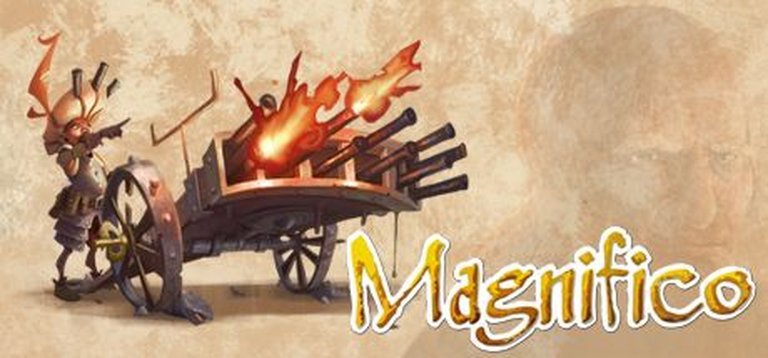
Magnifico: Da Vinci’s Art of War is a strategy board game set in an alternate 16th-century Europe, where players compete for dominance through territorial conquest, economic management, and auctions for Leonardo da Vinci’s steampunk-inspired inventions like tanks, flying machines, cannons, and bombards. Blending Risk-like area control with victory points earned from owning castles, building projects, constructing perfect cities, and invading regions, players must balance military tactics, fortifications, and shrewd bidding to outmaneuver AI opponents.
Where to Buy Magnifico
PC
Magnifico Reviews & Reception
steambase.io (62/100): Player Score of 62 / 100… giving it a rating of Mixed.
store.steampowered.com (77/100): Mostly Positive (77% of the 75 user reviews for this game are positive.)
gamesreviews2010.com (80/100): Magnifico is a complex and challenging game that requires careful planning and strategy. It is also a lot of fun to play.
Magnifico: Review
Introduction
In an era where digital board game adaptations flood app stores and Steam with streamlined ports of classics like Risk or Catan, Magnifico (2014) stands out as a curious artifact—a steampunk-tinged conquest game that thrusts Leonardo da Vinci’s fantastical war machines into the powder-keg politics of 16th-century Europe. Developed by the modest studio Mixel and published by strategy specialists Slitherine Ltd., this adaptation of Spartaco Alberatrelli’s board game “Da Vinci’s Art of War – Magnifico” promised a fresh twist on territorial dominance, blending auction-house bidding wars with precarious proto-technology. Yet, for all its inventive flair, Magnifico remains a game trapped between analog charm and digital potential, delivering tense strategic duels against AI but yearning for human opponents. My thesis: Magnifico excels as a solo-friendly digital board game that elevates area control through risky Da Vinci tech auctions, cementing its niche legacy as a thoughtful, if underdeveloped, homage to Renaissance ingenuity amid the 2010s mobile strategy boom.
Development History & Context
Magnifico emerged from the board game scene, adapting Alberatrelli’s 2010 physical release into a digital format amid the mid-2010s explosion of tablet and PC strategy titles. Mixel, a small developer with limited portfolio visibility (primarily this title), handled the porting, while Slitherine Ltd.—known for deep strategy fare like Order of Battle and grand ops sims—provided publishing muscle, releasing it first on Android (March 7, 2014), followed by iOS/iPad and Windows via Steam (December 2, 2014). The vision was clear: capitalize on the board-to-digital trend popularized by apps like XCOM: Enemy Unknown or Ticket to Ride, but infuse it with an alternate-history hook. Da Vinci’s inventions—tanks, flying machines, bombards—weren’t just flavor; they were core mechanics, reflecting a “steampunk Renaissance” ethos that critiqued the era’s humanism through weaponized genius.
Technological constraints shaped its modest scope. Built for mobile-first (Android/iOS specs demand only DirectX 9.0c, Core 2 Duo, 2GB RAM), it prioritized touch-friendly UI over graphical spectacle, using top-down 2D maps and simple animations. The 2014 gaming landscape was saturated: mobile free-to-play (F2P) giants like Clash of Clans dominated casual strategy, while PC saw Civilization V expansions and Europa Universalis IV (2013) offering grander historical depth. Magnifico‘s F2P model—free tutorial, $5 unlock for full game, IAP for maps (e.g., China, Germany) and upgrade cards—mirrored this, but lacked online leaderboards or Google Play integration. No local/online multiplayer was a glaring omission, especially as competitors like Hearthstone (2014) nailed digital social play. Slitherine’s involvement hinted at ambitions for tactical depth, yet the final product feels like a proof-of-concept, constrained by mobile hardware and a tiny team, prioritizing fidelity to the board game over expansive features.
Narrative & Thematic Deep Dive
Don’t expect a cinematic epic; Magnifico is pure abstracted strategy, its “narrative” woven into thematic layers rather than scripted plot. Players embody faceless Renaissance warlords vying for European supremacy in a fictional 16th-century milieu, where Da Vinci’s blueprints fuel conquest. The core theme—the perversion of genius—is poignant: as one source quips, “The genius is not happy in seeing his inventions put to such non humanistic use.” Inventions like exploding tanks or unreliable flying machines underscore hubris, forcing players to balance innovation’s promise against catastrophic risk (e.g., tanks can literally detonate mid-battle). Victory Points (VPs) accrue not just from conquest but “perfect cities,” castles, and tech milestones, thematizing multifaceted dominance: military might, economic savvy, and technological edge.
Characters are minimal: 10 AI opponents with distinct playstyles (aggressive conquerors, cautious builders), evoking archetypal lords without voiced dialogue or backstories. No branching plots or dialogue trees exist; interaction is turn-based bidding and invasion. Yet, this sparsity amplifies themes of calculated betrayal and fragile alliances—implicit in auctions where outbidding foes for a bombard feels like diplomatic intrigue. The alternate history critiques real Renaissance warfare (e.g., Italian Wars), imagining Da Vinci as arms dealer amid territorial grabs. Subtle motifs like “forget about Switzerland” (neutrality humor) add levity, but the lack of overt storytelling limits emotional investment. Compared to narrative-heavy strategies like Crusader Kings, Magnifico‘s themes shine in mechanics, probing risk vs. reward in a world where brilliance breeds volatility.
Gameplay Mechanics & Systems
At its heart, Magnifico refines Risk-style area control into a multi-faceted loop: earn VPs via territories, castles, projects, and special actions to hit 10 first. Turns unfold on a top-down European map (extra IAP maps expand to China/Germany), blending placement, auctions, upgrades, and combat.
Core loop:
– Resource Management & Placement: Spend coins to deploy/fortify troops in regions, earning VPs for majority control (most castles/territories).
– Da Vinci Auctions: The star innovation—bid blindly on inventions (cannons, tanks, aircraft, Great Cannon, submarines, armored ships, paratroopers). Winners upgrade units for combat bonuses, but tech has reliability risks (e.g., tanks explode on failure).
– Combat & Invasion: Attack adjacent regions; battles factor troop numbers, upgrades, and dice-like resolution with tech modifiers. Victories yield control/VPs; losses risk tech backfire.
– Progression: Accumulate “perfect cities” (balanced development) and tech trees for infantry/tanks/aircraft buffs.
UI shines with a toggleable floating menu, streamlining actions without cluttering the map—ideal for tablets. Tutorial is “in-depth,” guiding noobs through complexity. 10 AI personalities vary difficulty (sedate to aggressive), supporting 1-4 players (solo vs. 1-3 bots). Flaws: No multiplayer (local/online) hampers replayability; battles feel binary without deep tactics; IAP for content feels nickel-and-dimey. Strengths: Auction tension creates “gotcha” moments, and VP diversity (not pure conquest) encourages hybrid strategies—build castles early or blitz with bombards? Combat’s risk (exploding tanks) adds steampunk peril, making victories earned. Overall, mechanics deconstruct Risk‘s tedium into brisk, thematic elegance.
| Mechanic | Innovation | Flaw |
|---|---|---|
| Auctions | Blind bidding for asymmetric tech | Can snowball if AI outbids consistently |
| Tech Upgrades | Reliability vs. power trade-off | Limited variety without IAP |
| VP System | Multi-path victory (castles/tech/territories) | Opaque scoring mid-game |
| UI | Floating menu for clarity | No achievements/leaderboards |
World-Building, Art & Sound
The world is a stylized 16th-century Europe: ~16 regions (expandable), top-down map evoking parchment charts with Da Vinci sketches as UI flourishes. Atmosphere blends steampunk whimsy (gears, ornithopters) and historical grit (castles, bombards), fostering immersion without photorealism—perfect for mobile. Visuals are functional 2D: clean icons, subtle animations (tank explosions pop), color-coded territories. No 3D flair, but art direction ties inventions to Da Vinci’s real sketches, enhancing thematic cohesion.
Sound design is sparse but effective: orchestral Renaissance motifs (lutes, horns) underscore turns, metallic clanks for auctions, explosive booms for battles. No voice acting; SFX are punchy, amplifying tech peril. These elements synergize—map’s detail invites strategic scrutiny, sounds cue tension (auction bids ticking up)—creating a “sedate” couch vibe for “aggravated loungers.” Drawbacks: Repetitive audio loops during long AI turns; visuals lack modern polish (no dynamic weather/lighting).
Reception & Legacy
Launch reception was muted: No MobyGames critic reviews; VideoGameGeek averages 6.30/10 (4 ratings); Steam sits at “Mostly Positive” (77% of 75 reviews, 62/100 player score from 168—mixed due to AI repetitiveness, no multiplayer). Blogs like Sofa Tactics praised its Risk-superiority and UI but lamented multiplayer absence; GamesReviews2010 gave 8/10, misattributing alliances/dice (likely board game bleed). Commercial estimates: ~4K units sold (GameRebellion), niche appeal on Steam ($4.99).
Legacy endures as a faithful board game port, influencing minor digital adaptations by proving auctions + tech risk in area control. It prefigured steampunk strategies like Hearts of Iron IV mods or Grey Eminence, but obscurity limits impact—no genre-defining ripples. Cult status among board game fans persists via BGG links; Steam trading cards/family sharing extend life. Evolved rep: From overlooked mobile curio to retro gem for AI skirmishes, undervalued amid 2014’s giants.
Conclusion
Magnifico masterfully distills a clever board game into digital strategy, where Da Vinci’s volatile inventions inject peril into European conquest, outshining Risk through auctions and diverse VPs. Mixel and Slitherine delivered tense, tutorial-guided loops with intuitive UI, but no multiplayer and IAP gating hobble its potential. In video game history, it occupies a quirky footnote: a steampunk Renaissance simulator that rewards clever play over brute force, earning a solid 7.5/10. Ideal for solo tacticians craving historical what-ifs, but multiplayer mods could elevate it to essential. Play it for the exploding tanks alone—Europe’s fate hangs on one bold bid.