
- Release Year: 2012
- Platforms: Nintendo 3DS, Windows
- Publisher: cerasus.media GmbH, rondomedia Marketing & Vertriebs GmbH
- Developer: cerasus.media GmbH
- Genre: Simulation
- Perspective: 1st-person
- Game Mode: Single-player
- Gameplay: Board game, Cards, Tiles
- Setting: Classical antiquity
- Average Score: 67/100
Description
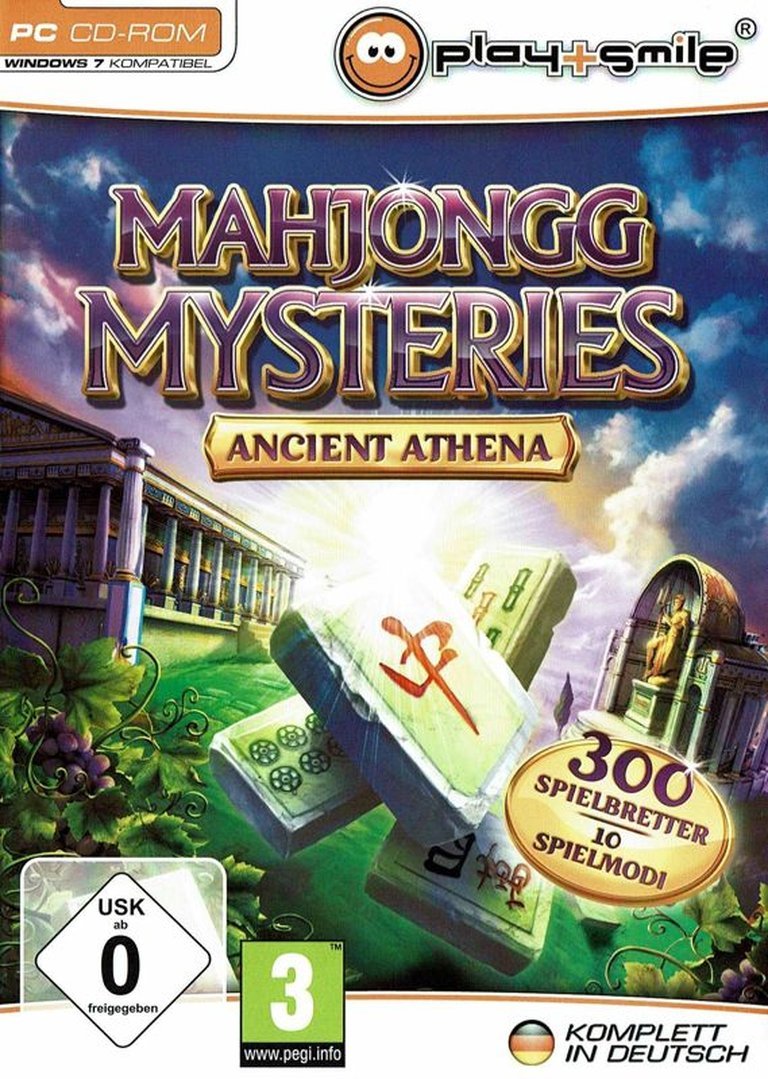
Mahjong Mysteries: Ancient Athena is a solitaire Mahjong simulation game set in classical antiquity, where players match tiles featuring ancient Greek iconography against backdrops like the Oracle of Delphi and the Theatre of Dionysus. The game includes an Adventure Mode that loosely ties the tile-matching to a mystery involving the goddess Athena and the Gods of Olympus, but the narrative is superficial and repetitive, focusing on the core puzzle-solving gameplay.
Gameplay Videos
Where to Buy Mahjong Mysteries: Ancient Athena
PC
Mahjong Mysteries: Ancient Athena Free Download
Mahjong Mysteries: Ancient Athena Guides & Walkthroughs
Mahjong Mysteries: Ancient Athena Reviews & Reception
outcyders.net (67/100): I cannot in good conscience recommend this one.
Mahjong Mysteries: Ancient Athena: A Scholarly Dissection of a Casually Ambitious Anachronism
Introduction: The Unlikely Odyssey of a Tile-Matched Titan
In the vast and often contradictory museum of video game history, few artifacts are as puzzlingly specific as Mahjong Mysteries: Ancient Athena. Here is a game that brandishes the weighty, millennia-old iconography of Classical Greece—the wise goddess Athena, the Oracle of Delphi, the revered Theatre of Dionysus—only to submerge it all in the serene, abstract logic of Mahjong solitaire, a digital pastime born in the late 20th century and built upon the tile sets of 19th-century China. This is not merely a thematic dressing; it is a full-throated, if bewildering, narrative framing. Released in 2012 by the German studio Cerasus Media for Windows, and later ported to the Nintendo 3DS in 2013, the game presents itself as an “adventure-packed” treasure hunt for the lost shield of Athena, yet its core is a relentlessly repetitive, clockwork puzzle engine. As a game historian, my thesis is this: Mahjong Mysteries: Ancient Athena is a fascinating, deeply flawed case study in the early-2010s casual gaming boom. It represents the apex of a certain kind of budget-conscious, content-stuffed design philosophy, yet its failure to harmonize its grandiose historical fantasy with its sterile mechanical heart, compounded by fundamental interface flaws on its handheld port, rendered it a critically overlooked and thematically schizophrenic entry—a monument to quantity over qualitative integration.
Development History & Context: The Cerasus Conundrum and the Casual Tsunami
To understand Ancient Athena, one must first understand its creator, Cerasus Media GmbH. A small German developer active from approximately 2007 to the mid-2010s, Cerasus operated primarily in the lucrative “casual” and “mobile-to-PC” space, a sector dominated by distributors like Big Fish Games, Avanquest, and rondomedia. Their output, including the Jewel Master series and other Mahjong Mysteries titles (Ancient Egypt preceded this one in 2010), was characterized by low production costs, rapid iteration, and a focus on delivering sheer volume of gameplay for a budget price point (often under £13/$5). The technological constraints of the era were telling: the game lists DirectX 9 and a 1.0GHz processor as requirements, with graphics described simply as “3D.” This was not an attempt to push technical boundaries but to create a presentable, immersive backdrop for its core loop using the affordable tools of the time.
The gaming landscape of 2012 waspeak “casual” proliferation. The success of Bejeweled, Bookworm, and Zuma had birthed a thousand descendants. For PC, platforms like Big Fish Games and GameHouse were thriving subscription-based services. For handhelds, the Nintendo DS and 3DS eShops were filled with puzzle and “touch” titles. Mahjong Mysteries: Ancient Athena was a product of this ecosystem: designed for short, intermittent play sessions, aiming to hook players with the promise of hundreds of levels and variations. Its lineage is clear—it directly competes with and resembles titles like Jewel Link: Legend of Athena and the broader Mahjong Escape series, all of which used exotic settings (Egypt, Japan, China) as skins for familiar mechanics. Its ambition, then, was not in innovation but in scope and packaging: to create the most comprehensive, mythology-themed Mahjong solitaire package available.
Narrative & Thematic Deep Dive: A Story Told in Tile Sets
The game’s narrative premise, as gleaned from store descriptions and the WWGDB summary, is a classic B-movie考古ological thriller. The plot revolves around the lost shield of Athena, gifted to warriors in ancient times, now sought by a heroic adventurer, David Deanfield, and his team. They are racing against a “no-good pseudoscientist” named MacMurdoch across historical sites like the Oracle of Delphi and the Theatre of Dionysus. This framing is exclusively present in the Adventure Mode (100 linear levels), where a map screen shows a dot moving between locations, implying progression.
However, a profound dissonance defines this narrative effort:
1. Thematic Absurdity: Mahjong tiles are intrinsically East Asian, depicting characters, circles, bamboo, and seasonal symbols. Their use to represent “ancient Greece” is a full-scale act of symbolic substitution. The game attempts to bridge this by creating new tile “families”—the Torch and Trident—supposedly representing Greek motifs. Yet, these are minuscule additions to a set overwhelmingly composed of traditional Mahjong imagery. The narrative of uncovering Greek treasures is constantly undermined by the player’s action of matching “Five of Circles” or “Red Dragon” tiles.
2. Narrative Vacuum: The so-called “adventure-packed story” exists solely as window-dressing. There is no dialogue, no character interaction, no plot development beyond the map advancing. The “race against time” with MacMurdoch is never visualized or mechanized; it is a line of text in an ad blurb. The eShopperReviews critic astutely notes this as a “story… that doesn’t exist in any meaningful way.” The atmosphere is not one of archaeological mystery but of liminal, placeless puzzle-solving.
3. Symbolic Reduction: Ancient Greek culture, with its complex pantheon, philosophy, and history, is reduced to a series of background images (lovingly described in the Outcyders review as “absolutely lovely”) and a few proprietary tile designs. The game’s title, Ancient Athena, suggests a focus on the goddess, but she is merely a namesake; the “Athena” in the title functions purely as a brand identifier within the Mahjong Mysteries series, not as an active thematic element. The deeper themes of wisdom, strategy, and civic patronage associated with the goddess are completely ignored, replaced by the flat goal of “finding treasures.”
The narrative is, therefore, a functional veneer—a contractual obligation to make the game marketable beyond the “puzzle” section. It reveals the era’s tendency to use exoticism and historical mystique as a superficial coat for generic gameplay, predating more culturally sensitive approaches.
Gameplay Mechanics & Systems: The Engine of Obsession
Beneath the thematic dissonance lies a robust, if conventional, engine for Mahjong solitaire (often called “Shanghai” or ” Turtle” solitaire). The core rule is immutable: players must match pairs of free tiles (tiles with no tile directly to their left, right, or immediately above). The game’s primary innovation lies in scale, variation, and assistance tools.
A. Core Loops and Modes:
* Adventure Mode: A linear path of 100 levels. As noted by Outcyders, this mode provides a clear progression, a rare feature that mitigates the “which levels have I done?” problem plaguing other modes.
* Classic/Relax Mode: This is where the game’s true scale is revealed. It offers 300 additional layouts grouped into three difficulty tiers (Easy, Medium, Hard) and, most crucially, 11 distinct game variations. These are not mere reskins but meaningful mechanical twists:
* Shuffle: Forces a board reshuffle every 20 seconds unless a match is made, adding time pressure.
* Match (I Spy): Displays a single tile on screen; the player must find and match its pair.
* Freecell-Style: Incorporates a “holding cell” to temporarily store a tile, allowing access to buried pieces.
* And others, including memory-based variants.
This variety is the game’s strongest suit, as acknowledged by eShopperReviews (“a good selection of game modes”) and Outcyders (“plenty of interesting special tiles”). It transforms Ancient Athena from a single game into a compilation of Mahjong solitaire sub-genres.
B. Power-Ups and the “Golden Tile” System:
A significant layer of complexity is added via seven types of special golden tiles, a common feature in modern casual Mahjong games:
* Exchange: Swap any two non-golden tiles.
* Joker: Matches with any tile.
* Magnet: Pulls the next clicked tile to a new position.
* Card Stack Icon: Unlocks new tile sets/backgrounds (a meta-progression hook).
* Lightning: Instantly clears the board if matched (rare, buried deep).
* Eye: Highlights all matchable tiles for 25 seconds.
* Sun Burst: Deletes all visible tiles of the type you click next.
These tools are double-edged. They provide crucial relief on complex layouts, as Outcyders notes, “often help free up the board when you start to run out of eligible matches.” However, they also introduce a layer of randomness and tactical decision-making beyond pure observation. Do you use the powerful Sun Burst now, or save it for a stacked family of tiles? This adds a light strategy layer, but also makes some layouts feel “solved” by these crutches.
C. Assistive Systems and Flaws:
The game includes a hint system, an undo function, and a reshuffle option. Critically, as per Outcyders, “should you run out of eligible matches, you’re given the option to either restart, skip, or shuffle.” This is a player-friendly design choice that prevents total deadlocks, a common flaw in poorly designed Mahjong solitaire layouts. However, the need to shuffle “three or four times” on some levels, as reported by Outcyders, indicates poor layout design in the harder puzzles, undermining the satisfaction of a “clean” solve.
D. The Critical Handicap: Progression Tracking
A fatal flaw, especially in Classic Mode, is the lack of a completion tracker. As Outcyders laments, “there’s nothing that keeps track of which levels you’ve completed.” This destroys the incentive to work through the 300-level library, turning it into a repetitive, mentally taxing chore with no visual feedback of accomplishment. It’s a baffling omission for a game built on completionism.
E. The Level Editor: A Beacon of Promise
The inclusion of a full layout editor is a standout feature, allowing players to create and play custom boards. As Outcyders states, “The best part… is definitely its layout editor.” This grants the game infinite potential replay value, a feature that places it above many of its peers. Its tragic limitation is the inability to share creations online (unlike Mahjong Towers Eternity), confining this potential to personal use.
In summary, the gameplay is a study in contradictions: expansive in scope but inconsistent in layout quality; generous with assists but frugal with meta-progression; creatively varied in modes but marred by a critical interface flaw in tracking. It provides the raw material for a superb puzzle compendium but fails to fully organize it.
World-Building, Art & Sound: Aesthetic Aspiration vs. Functional Clarity
The presentation of Mahjong Mysteries: Ancient Athena aims for a cohesive “ancient Greek” atmosphere, with mixed results.
Visuals:
* Tile Design: This is the most criticized element. The default tile set uses traditional Mahjong symbols (dragons, winds, circles, characters). While authentic to the game’s roots, it creates the thematic dissonance noted earlier. Furthermore, as eShopperReviews sharply observes, the “tile set designs can be a bit tricky to get used to and some may dislike its rather complicated patterns.” Distinguishing between similar bamboo or character tiles on a small screen (especially the 3DS) is a persistent challenge. The solution—unlocking alternative sets—requires playtime, creating a Catch-22.
* Backgrounds & Environments: Universally praised. The game features nine epic backgrounds depicting classical sites: columns, theatres, the iconic Oracle. Outcyders calls them “absolutely lovely,” and the GameHouse description specifically mentions the “Oracle of Delphi and the Theatre of Dionysus.” They are rendered in a pleasant, slightly stylized 3D that provides calm contrast to the busy tile grids. The customization of these backgrounds is a strong plus.
* Layout & Perspective: The game uses a first-person perspective (looking down at the tile pyramid), with the camera placed at a fixed, slightly elevated angle on the 3DS version. This is where disaster strikes.
Sound:
* Music: A split personality. The main menu features “epic and inspirational” orchestral tracks (as per WWGDB), fitting the “adventure” premise. Once a level loads, the music switches to a “middle-eastern-type” track, which Outcyders finds “catchy to some extent.” The jarring shift from “epic adventure” to “relaxed market ambiance” is tonally confusing.
* Sound Effects: The tile-matching sounds are highlighted as a negative. Outcyders notes that the “sound effects from collecting tiles will turn the music into a discordant jumble of sounds.” This suggests a lack of audio mixing finesse; the celebratory chimes for each match are too prominent and repetitive, breaking the intended atmospheric immersion.
The 3DS Interface Catastrophe:
The Nintendo 3DS port exposes the game’s fundamental design flaws. eShopperReviews’ critique is devastating:
1. Camera Control: The default angle hides back tiles. While the circle pad can move the camera, “the game… will slowly tilt the camera back to its default position the moment you release the circle pad.” This makes precise, sustained viewing of the board a physical struggle against the game itself.
2. Selection Mechanism: Tiles are selected via a cursor on the top screen controlled by the touchscreen. Crucially, “you release the touch screen to select” whatever is under the cursor. This inverse-tap system is unintuitive and imprecise, especially when scrolling through a crowded board. It forces a deliberate, hesitant style of play that breaks flow.
3. Lack of Zoom: The absence of a zoom function exacerbates the small-tile visibility problem on the 3DS’s top screen.
On PC (Mouse/Keyboard), these issues are largely absent. The 3DS port thus becomes a cautionary tale about non-native port design, where control schemes optimized for mouse clicks are clumsily mapped to a stylus/touchpad hybrid, breaking the player-game contract.
Reception & Legacy: A Quiet Failure in a Noisy Genre
Upon release, Mahjong Mysteries: Ancient Athena received universally mediocre reviews, primarily from the few outlets that covered it. Its MobyGames critic average is 42% (based on 2 reviews). The Nintendo Life 3DS review (5/10) called it “a slog through the same activity over and over again,” finding the Adventure Mode “hollow.” The eShopperReviews (33/100) was harsher, assigning a D+ grade and stating the game’s “terrible” control and camera problems outweigh its creative modes. The PC version seems to have attracted even less critical attention.
Its commercial performance was likely modest, fitting the “budget title” profile. It has been collected by only two players on MobyGames (as of the source data), indicating negligible cult following. Its legacy is threefold:
1. As a Culmination: It represents the height of the “quantity-over-quality” approach in casual puzzle games. Its 400+ levels, 11 variations, and editor were a feature checklist meant to justify purchase.
2. As a Cautionary Tale: The 3DS port’s failures are a textbook example of how a game’s core mechanics can be utterly broken by a poor control scheme, dooming it on a platform where polish is paramount.
3. As a Historical Footnote: It is a prime example of the “themed puzzle game” subgenre popular in the 2000s-2010s (alongside Jewel Quest, * puzzle). These games used historical or exotic settings to lend an air of discovery to mechanics that were, at their heart, abstract and repetitive. *Ancient Athena did this less successfully than many, due to the extreme dissonance of its theme.
It had no discernible influence on the broader industry. The casual puzzle market moved toward mobile-first design, hyper-casual simplicity, and match-3 innovations (like those in Candy Crush Saga). The complex, menu-driven structure of Ancient Athena felt dated even at its release. It is a dead-end branch on the evolutionary tree—a game that expanded the breadth of its niche but failed to improve its depth or accessibility.
Conclusion: The Schizophrenic Sphinx of Solitaire
Mahjong Mysteries: Ancient Athena is a游戏 of profound contradictions. It is a mechanically generous game—offering hundreds of levels, a dozen variations, helpful power-ups, and a full editor—yet a structurally flawed one, with no progression tracking and layouts that often force tedious shuffling. It is a game aspiring to epic adventure yet delivering purely abstract puzzle-solving. It is technically competent on PC but fundamentally broken on 3DS due to a catastrophic control scheme.
Historically, it is emblematic of a特定 era: the era of the “boxed casual game” for PC and the “impulse-buy eShop title” for handhelds. It was designed for a player who wanted “just one more level” of a familiar, comforting mechanic, wrapped in a pretty, historically evocative package. For that player, on PC, it may have served its purpose adequately. For anyone expecting a coherent narrative experience, a polished interface, or a thematically integrated puzzle game, it is a frustrating anachronism.
Final Verdict: Mahjong Mysteries: Ancient Athena is not a great game. It is not even a consistently good game. It is, however, a fascinatingly representative artifact of its time—a game whose ambition to be a “complete package” was ultimately scuttled by a failure of execution, particularly on its secondary platform. It stands as a monument to the idea that volume and variety cannot compensate for poor user experience and thematic incoherence. In the grand halls of video game history, it is a curious, dusty shelf-filler: impressive in its scope, immediately forgettable in its impact, and a vital case study for any historian examining the rise and plateau of the digital puzzle genre. It earns its place not as a classic, but as a compelling cautionary exhibit.