
- Release Year: 2006
- Platforms: PlayStation 3, PS Vita, PSP, Windows
- Publisher: Alawar Entertainment, Inc., G5 Entertainment AB, S.A.D. Software Vertriebs- und Produktions GmbH
- Developer: Shape Games Inc.
- Genre: Puzzle
- Perspective: Top-down
- Game Mode: Single-player
- Gameplay: Cards, Tile matching puzzle, Tiles
- Average Score: 74/100
Description
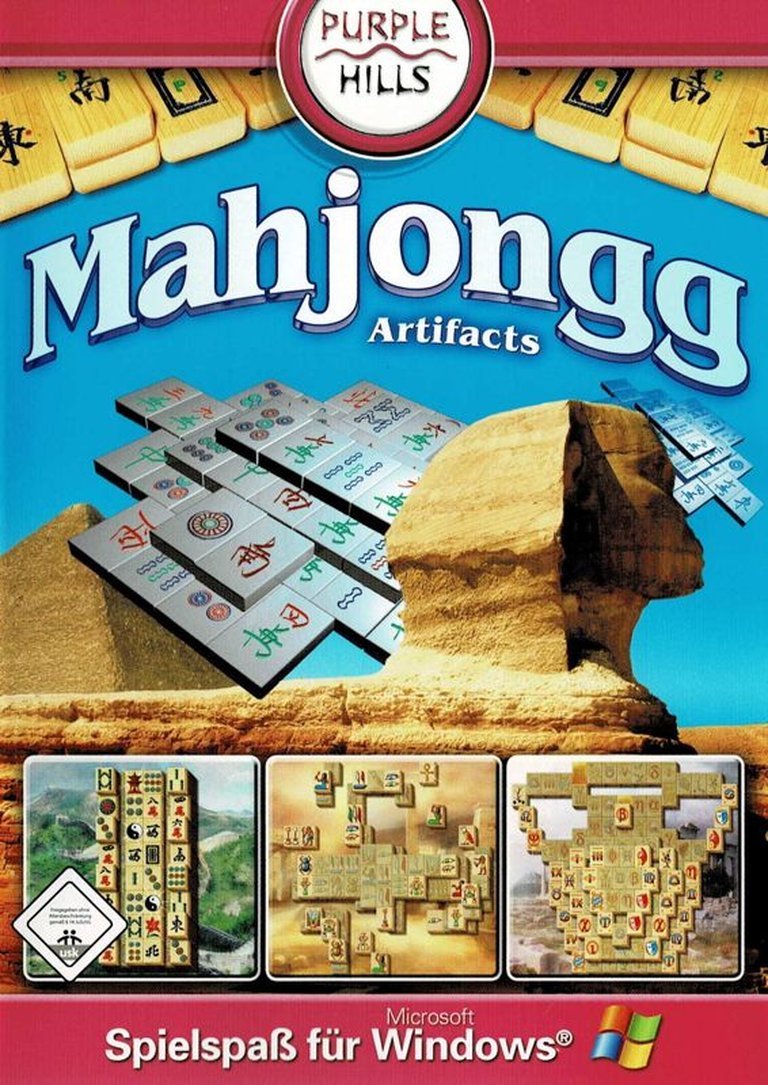
Mahjongg Artifacts is a tile-matching puzzle game that immerses players in an ancient atmosphere across five exotic cultures. It offers three gameplay modes, including a Story Mode with an epic quest for lost relics and a Classic Mode for custom layout selection, enhanced by innovative features like Special Tiles, Bonuses, and Trophies for a engaging solitaire experience.
Gameplay Videos
Where to Buy Mahjongg Artifacts
PC
Mahjongg Artifacts Free Download
Mahjongg Artifacts Reviews & Reception
metacritic.com (60/100): Overall this is a competent, attractive version of mahjong solitaire, though not without its flaws.
psillustrated.com (78/100): We played Mahjongg Artifacts out of order, but that didn’t hurt our appreciation of this first entry in G5’s puzzle series.
Mahjongg Artifacts Cheats & Codes
PlayStation Portable (PSP) [EU]
| Code | Effect |
|---|---|
| _L 0x202B4258 0x05F5E0FF | Max Score |
Mahjongg Artifacts: A Pinnacle of Casual Puzzle Design or Just Another Tile-Matching Diversion?
Introduction: The Serene Allure of the Tile Stack
In the mid-2000s, the digital puzzle landscape was dominated by two titans: the cerebral, match-three chaos of Bejeweled and the timeless, patience-testing solitaire suites. Into this arena stepped Mahjongg Artifacts, a 2006 release from Shape Games, promising not just another iteration of the ancient tile-matching pastime, but a fully-realized, aesthetically-rich journey through exotic cultures. It arrived at a moment when “casual games” were shedding their reputation as mere time-killers and beginning to be recognized for their sophisticated design and broad appeal. Mahjongg Artifacts boldly sought to elevate the Western conception of Mahjong solitaire from a simple desktop distraction to an immersive, quasi-adventurous experience. This review will argue that while the game’s narrative aspirations remain largely superficial, its masterful synthesis of multiple gameplay modes, stunningly diverse visual presentation, and accessible yet deep systemic design cemented its status as a high-water mark for the genre—a title that prioritized player choice and aesthetic pleasure over narrative complexity, ultimately finding its legacy not in storytelling, but in perfecting a loop of tranquil engagement.
Development History & Context: A Russian Studio’s Casual Masterpiece
The Studio and the Vision: Mahjongg Artifacts was developed by Shape Games Inc., a Russian studio whose name appears in the credits alongside key figures like producer Anton Yudintsev and game designer Vadim Kumerov (alias “Ergeal”). The studio’s pedigree, as seen on MobyGames, is firmly rooted in the casual and puzzle space, with team members later credited on series entries (Mahjongg Artifacts: Chapter 2), and other casual titles like Stand O’Food and Mystery Cookbook. This specialization is evident in Artifacts‘ design: it is a game built from the ground up for a specific, relaxed playstyle. The vision, as per the official ad blurb, was to create an “immersive ancient atmosphere,” translating the tactile satisfaction of physical tiles into a digital format with “innovative gameplay twists.” The core innovation was not in changing the fundamental rules of Mahjong solitaire, but in surrounding that core with a wealth of aesthetic and structural options.
Technological Constraints and Engines: The game’s technical foundation is noteworthy. It utilizes the Dagor Engine Casual Edition, a proprietary engine from Dagor Technologies. This was not a powerhouse 3D engine but a tool optimized for 2D, fixed-perspective layouts, allowing for crisp tile rendering and smooth, scalable graphics even on modest hardware of the era. The use of FMOD Sound System for audio and libjpeg for image handling points to a pragmatic, middleware-driven approach common in mid-2000s casual development, focusing on reliability and cross-platform potential over cutting-edge visuals. This technical choice ensured the game could be easily ported to a wide array of systems, a prediction borne out by its subsequent releases on PSP (2010), PlayStation 3 (2010), and PS Vita (2012), in addition to the original Windows (2006) and later iOS/mobile versions.
The Gaming Landscape of 2006: The title launched during the golden age of PC casual gaming, a period dominated by publishers like Big Fish Games, Oberon Media, and, pertinently, Alawar Entertainment and G5 Entertainment (both listed as publishers). It was an era of digital storefronts (like G5’s own portal and Alawar’s distribution) selling downloadable games. Mahjongg Artifacts competed directly with other Mahjong solitaire titles like MahJongg Master (1999) and 7 Artifacts (2007), but its distinguishing features were its three distinct game modes, the promise of over 125 unique layouts (25 in Story, 100 in Classic), five themed tilesets, and 27 backgrounds. In a market often saturated with single-mode, single-layout games, this volume was a major selling point.
Narrative & Thematic Deep Dive: The Quest as Framing Device
The narrative of Mahjongg Artifacts is best understood not as a traditional plot but as a thematic framing device for the puzzle gameplay. The game is explicitly a prequel to Mahjongg Artifacts: Chapter 2, and its “Story Mode” is presented through static, graphic novel-style comic panels (as noted on Backloggd). Players are cast as an explorer embarking on an “epic quest for lost relics” across five exotic cultures.
Plot and Characters: There is a profound lack of detailed narrative information in the source material. No specific characters are named in the credits (only “Scenario” writers Grigory Sitnin and Vadim Kumerov). The story is minimalist: a generic adventurer seeks artifacts. The “cultures” are implied through the visual design—Asian, Egyptian, and “far-out alien” (per the GameVortex review) themes are mentioned. The narrative serves one primary function: to sequence the layouts. Completing a series of increasingly complex tile arrangements in a specific cultural theme (e.g., Egyptian hieroglyphic-style tiles against a pyramid backdrop) is equated to “exploring a territory” or “defeating enemies” to “gain access to stashed treasure.” The plot is a numbered checklist; the treasure is the next layout.
Dialogue and Themes: Dialogue appears to be minimal or absent, relegated to the comic panels. The underlying theme is one of cultural tourism and artifact collection, reducing diverse civilizations to a series of aesthetic motifs for puzzle backgrounds and tile graphics. This is a common, and often criticized, trope in casual games of the period—using “exotic” settings as window dressing. The thematic depth is surface-level; there is no exploration of the cultures themselves, only their visual signifiers. The “innovative gameplay twists” like Special Tiles are narratively justified as “magical tiles” or “powers,” tying the mechanics to a very loose theme of magical adventure. Ultimately, the narrative succeeds if its goal is to provide a light, progression-based incentive to move from one beautiful puzzle to the next. It fails utterly if one seeks a compelling story with character arcs or meaningful conflict. It is, in essence, a skin-deep adventure.
Gameplay Mechanics & Systems: Perfecting the Core Loop
At its heart, Mahjongg Artifacts is a Western-style Mahjong solitaire game, a far cry from the four-player, tile-drawing competitive game of the same name. The mechanic is simple: a stack of tiles (often arranged in elaborate, fixed shapes) is presented. Only tiles that are not covered by another tile and have at least one long side (left or right) free are “active” and can be selected. The goal is to match and remove all pairs (or sometimes groups) of identical tiles. Two special gold tiles at the bottom can be matched to win, even if other tiles remain, providing an escape hatch for impossible boards.
Core Gameplay Loops: The genius of the game lies in its three-mode structure, which caters to different play sessions and player psychologies:
- Story Mode (Quest Mode): A linear campaign of 25 curated layouts, organized into five cultural “chapters.” Completing a layout unlocks the next, providing a clear, short-term goal and a sense of narrative progression. This mode introduces the special tiles and bonus mechanics gradually.
- Classic Mode: The sandbox heart of the game. Players can select from 100 pre-made layouts (including the Story Mode ones) and choose any of the five tilesets and 27 backgrounds. This allows for endless aesthetic experimentation—playing an Egyptian-themed layout with a futuristic “alien” tileset against a jungle background. It respects the player’s desire for control and variety.
- Endless Mode: The pure skill test. Here, tiles are generated continuously from a central “well,” creating a tower that rises indefinitely. The player must manage the ever-increasing stack, making it a truly limitless challenge. This mode is for the player who has mastered the static layouts and seeks a no-end-game experience.
Innovative Systems:
* Special Tiles: These are the primary “innovation.” They include wildcards, shuffle tiles, time-stoppers, and others that provide strategic options when the player is stuck. They are not game-breaking but offer tactical relief, aligning with the game’s “accessible” philosophy.
* Bonuses & Trophies: Skillful play (fast matches, large consecutive clears) awards bonus points and earns trophies for specific achievements (e.g., “Clear a board in under 2 minutes”). These provide extrinsic goals beyond simple completion.
* UI and Controls: The interface is clean and functional. A key feature, praised by Metacritic’s GamingXP review, is the essential “Undo” function, a critical quality-of-life feature in a game where a single misclick can doom a board. Manual and auto-zoom allow players to inspect details or see the whole board.
Flaws and Limitations:
* The “Stuck” Problem: Like all Mahjong solitaire, some layouts are, by their very design, unwinnable if tiles are not paired correctly from the start. The Special Tiles and shuffle mechanic are solutions, but they can feel like bandaids on a flawed probabilistic system.
* Lack of Depth: As GameVortex notes, “nobody really wants a mahjongg mash-up.” The game does not fundamentally alter the 20-year-old Western Mahjong solitaire formula. It packages it perfectly but does not revolutionize it. The comparison to what Puzzle Quest did for gem-matching (adding RPG elements) highlights this conservatism.
* No Multiplayer/Editor: Both GameVortex and the general design point to missed opportunities. A competitive or cooperative mode, or a level editor to share user-created layouts, could have exponentially increased the game’s longevity and community engagement. Its absence is a significant oversight for a game so focused on layout variety.
* Porting Issues: The PSP port, as reviewed by GameVortex, suffered from awkward directional pad navigation due to the non-grid tile layouts. Mapping navigation to the analog stick instead of the camera was a baffling decision that introduced frustration, proving the core design was tailored for mouse/keyboard first.
World-Building, Art & Sound: A Feast for the Senses
This is unequivocally Mahjongg Artifacts‘ strongest and most defining pillar. Where the narrative is thin, the aesthetic presentation is lavish.
Visual Direction:
* Five Tilesets: The game moves far beyond the standard bamboo/character/circle suits. Each tileset is a fully realized graphical theme: Classic Chinese, Egyptian (hieroglyphs), Medieval European ( shields, crests), Astral/Aliens (geometric, sci-fi), and Nature (animals, plants). They are not mere reskins; they are distinct artistic works that change the visual language of the game entirely.
* 27 Backgrounds: These are high-quality, static images that serve as the “wallpaper” behind the tile stacks. They range from ancient ruins and mystical landscapes to abstract patterns. The combination of a tileset with a background can create a completely different mood—playing the “Alien” tileset against a starry nebula background is a different experience from the same tileset against a stone corridor.
* Layout Design: The 100+ layouts are themselves visual art. Many are representational, forming shapes of animals, objects (like the famous “99” layout, a pretzel, or the Death Star, as per GameVortex), or cultural symbols. This transforms the puzzle from an abstract grid into a form of top-down sculptural art. The fixed flip-screen perspective emphasizes this, framing each layout as a diorama.
Sound Design:
* Music: Composed by Strategic Music Studio and The Sands, the soundtrack features “music tracks inspired by ancient cultures.” It is consistently described as “very mellow,” with acoustic guitar and flute dominating. It avoids being intrusive, instead providing a calm, contemplative backdrop that reinforces the “escape from the rush of modern life” tagline. Each cultural theme likely has its own musical motif.
* Sound Effects: Tile clicks are crisp and satisfying. Special tiles have unique activation sounds. The audio design is functional and pleasant, neverjarring, perfectly in service of the relaxed gameplay.
The cumulative effect is of a lifestyle game. It’s not about adrenaline but ambiance. The player isn’t just matching icons; they are curating a small, beautiful, tranquil scene on their screen, board by board.
Reception & Legacy: A Niche Success with Lasting Influence
Critical and Commercial Reception at Launch: Data is sparse, but what exists points to positive, if not spectacular, reception. MobyGames lists a single critic score of 85% (from PSP Minis). The Metacritic aggregated scores for the PSP port show a wider range (60-72), suggesting the transition to handheld controls exposed some of the game’s friction points. The lone user review on MobyGames is a catastrophic 1.0, but with only one data point, it is meaningless. The GameVortex review (78%) and the Metacritic score of 72 from My Gamer indicate a consensus: it’s a competent, attractive, but simple package.
The commercial model was that of a premium casual download (typically $4.99-$9.99 on PC portals, later on PSN and mobile). Its inclusion in compilations like Mahjongg Artifacts 1 & 2 (2010) and Mahjongg Collection (2011) suggests steady, modest sales over time, enough to justify a sequel and re-releases. Its presence on platforms like GOG.com (via a user dreamlist) and MyAbandonware (as a freely downloadable “abandonware” title) indicates it has achieved a sort of preservation status within the casual gaming canon.
Evolution of Reputation and Influence: Mahjongg Artifacts has not gained a significant cult following or critical reappraisal. It exists in a comfortable, respected niche. Its true legacy is twofold:
- The “G5 Mahjong” Template: It established the formula that G5 Entertainment would refine and reuse for years. The company became a powerhouse in mobile casual puzzles (Mahjong Journey, Hidden City, etc.), and the Mahjongg Artifacts structure—multiple themed modes, huge layout libraries, strong visual identity—became their blueprint. It proved that a Mahjong solitaire game could be a premium product with real content volume, not just a free ad-supported time-waster.
- Elevating the “Artifact” in the Title: The game’s name and presentation subtly shifted player expectations. By calling the tiles “Artifacts” and framing the play as a “quest,” it invested the simple act of tile-matching with a sense of collection and discovery. This narrative-light, art-heavy approach influenced later casual games that prioritize aesthetic cohesion and collection mechanics (e.g., Pokémon Shuffle‘s collection focus, though its core is different).
It did not spawn a “mahjongg mash-up” genre like Puzzle Quest did for match-three, but it did solidify the “premium Mahjong solitaire” sub-genre. Games like Mahjong Trails and Mahjong Adventures follow in its footsteps, emphasizing beautiful boards, cultural themes, and progression systems.
Conclusion: A Masterclass in Accessible Design, Not Narrative Ambition
Mahjongg Artifacts is not a game that will be discussed in histories for its story or its mechanical revolution. Its plot is a flimsy pretext, and its core rules are a three-decade-old pastime. Yet, to dismiss it on those grounds is to miss its profound achievement. In the mid-2000s, it assembled the most comprehensive, aesthetically stunning, and player-friendly package for Western Mahjong solitaire ever created up to that point.
Its legacy is that of a perfectly calibrated casual experience. It understands its audience: players seeking a low-stress, visually engaging way to pass time. It provides immense variety (125+ layouts, 5 tilesets, 27 backgrounds) to prevent boredom. It respects the player with an undo function and multiple difficulty modes via its three primary game types. Its artistic direction, treating each tileset and background as a piece of craft, elevates the mundane act of clicking tiles into something resembling digital Zen gardening.
The flaws are inherent to its nature: the narrative is negligible, the core puzzle can feel random, and the lack of community features (multiplayer, editor) limits modern sensibilities. The PSP port’s control issues also highlight that its first love is the mouse-and-keyboard interface.
As a historical artifact itself, Mahjongg Artifacts stands as a touchstone for the casual puzzle boom. It represents the moment when developers began to treat simple mechanics not as limitations but as foundations upon which to build worlds of taste and choice. It is not the ancestor of deep, systemic puzzle games, but the distant cousin of the modern “chill game” phenomenon—titles like Unpacking or PowerWash Simulator that find profound satisfaction in simple, repetitive, aesthetically rich tasks. For that reason, if for no other, Mahjongg Artifacts earns its place not in the pantheon of revolutionary games, but in the respected library of games that absolutely, perfectly, and serene**ly achieved what they set out to do.
Final Verdict: 8/10 – A meticulously crafted, abundantly rich entry in the Mahjong solitaire canon. Its narrative is paper-thin, but its gameplay variety and stunning visual presentation make it a enduring benchmark for accessible, aesthetic puzzle design. A must-play for enthusiasts of the genre and a fascinating case study in packaging simplicity with profound variety.