
- Release Year: 2011
- Platforms: Windows
- Publisher: Koch Media GmbH (Austria), Paradox Interactive AB
- Genre: Compilation
- Game Mode: Online Co-op, Single-player
- Average Score: 77/100
Description
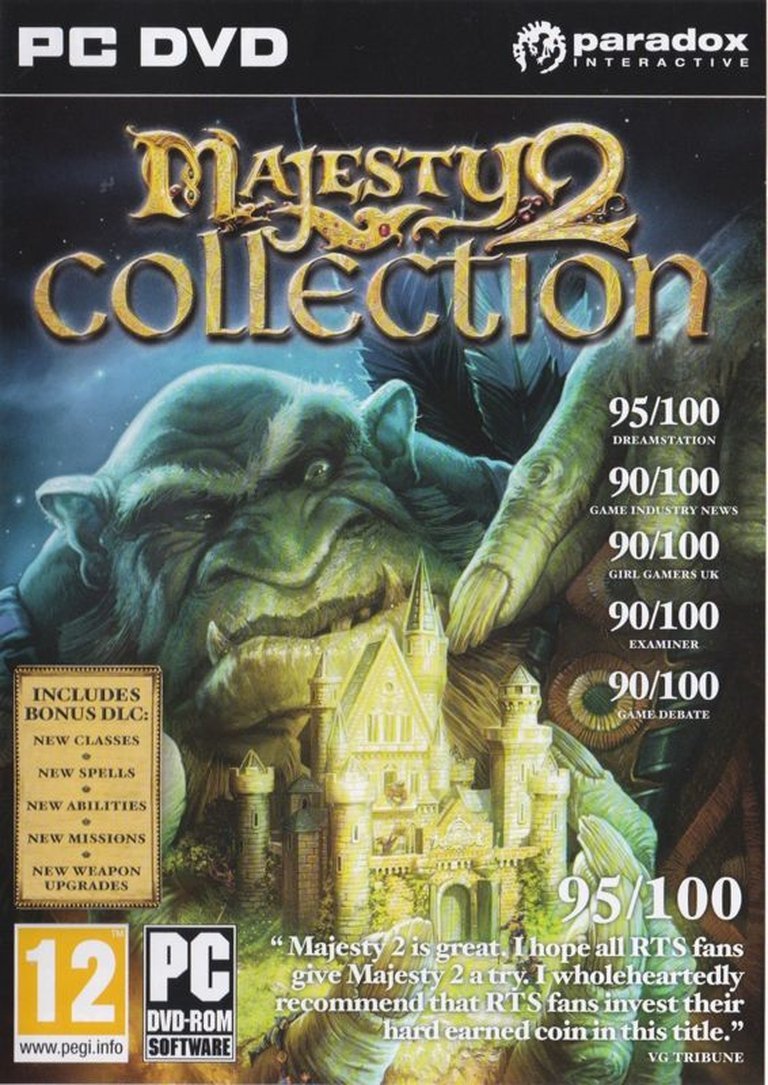
Majesty 2: Collection is a compilation of the fantasy kingdom simulation game Majesty 2: The Fantasy Kingdom Sim and its three expansions—Kingmaker, Monster Kingdom, and Battles of Ardania. Set in the whimsical realm of Ardania, players assume the role of a sovereign ruler, overseeing a kingdom by constructing buildings, recruiting semi-autonomous hero units, and issuing bounties to influence their actions. Unlike traditional real-time strategy games, heroes act independently, exploring, battling monsters, and completing quests based on their unique AI behaviors. The game blends strategy, simulation, and light RPG elements, offering a mix of single-player campaigns and multiplayer modes, all rendered in 3D graphics.
Gameplay Videos
Where to Buy Majesty 2: Collection
Majesty 2: Collection Patches & Updates
Majesty 2: Collection Mods
Majesty 2: Collection Guides & Walkthroughs
Majesty 2: Collection Reviews & Reception
steambase.io (74/100): Majesty 2 Collection has earned a Player Score of 74 / 100.
metacritic.com (86/100): User Score: Generally Favorable Based on 13 User Ratings.
niklasnotes.com (73/100): Overall, players appreciate the challenging gameplay and unique mechanics of Majesty 2 Collection, while many express frustration with technical issues, difficulty spikes, and a perceived lack of content compared to the original game.
Majesty 2: Collection Cheats & Codes
PC
Press [Enter] while playing the game and then type one of the following codes to activate the corresponding cheat function.
| Code | Effect |
|---|---|
| revelation | Full map |
| victory is mine | Win game |
| i’m a loser baby | Lose game |
| frame it | View frame rate |
| fill this bag | Additional 10,000 gold |
| build anything | All buildings available |
| give me power | All spells available |
| cheezy towers | Infinite spell range |
| restoration | Restore hit points |
| grow up | Highlighted hero gains five levels |
| now you die | Kill opponent |
Majesty 2: Collection – A Comprehensive Retrospective
Introduction: The Legacy of Indirect Control
Majesty 2: Collection stands as a fascinating artifact in the real-time strategy (RTS) genre—a game that dared to subvert conventions by stripping players of direct control over their units. Released in 2011, this compilation bundles the base game Majesty 2: The Fantasy Kingdom Sim (2009) with its three expansions—Kingmaker, Monster Kingdom, and Battles of Ardania—alongside additional DLC. At its core, Majesty 2 is a fantasy kingdom simulator where players assume the role of a monarch tasked with rebuilding the crumbling realm of Ardania. The twist? Your heroes—warriors, mages, and rogues—are autonomous, mercenary-minded individuals who only act when sufficiently bribed. This “indirect control” mechanic, inherited from the 2000 cult classic Majesty: The Fantasy Kingdom Sim, remains the series’ defining feature.
The Collection serves as both a celebration and a swan song for this unique approach to strategy gaming. While the original Majesty was a quirky, flawed gem, Majesty 2 refined its systems with 3D graphics, streamlined gameplay, and expanded content. Yet, it also faced criticism for diluting the charm of its predecessor. This review explores whether the Collection succeeds as a definitive edition, how its mechanics hold up over a decade later, and what lessons it offers for modern strategy games.
Development History & Context: A Russian Revival
The Studio and Vision
Majesty 2 was developed by 1C:Ino-Co, a Russian studio founded in 2004 and part of the larger 1C Company. The original Majesty (2000) was created by Cyberlore Studios, a now-defunct American developer. After Cyberlore’s dissolution, the Majesty IP was acquired by Paradox Interactive, who partnered with 1C:Ino-Co to revive the franchise. This collaboration was significant—Paradox was (and remains) a publisher known for deep, niche strategy games like Europa Universalis and Crusader Kings, while 1C:Ino-Co had experience with fantasy RTS titles like Fantasy Wars.
The developers faced a daunting task: modernize Majesty for a new generation while preserving its core identity. Lead developer Alexey Kozyrev emphasized the importance of retaining the indirect control system, which he described as the “soul” of the series. The team aimed to refine the original’s quirks—such as heroes wandering aimlessly—by making them more responsive to player incentives. However, they also introduced optional direct control features, a controversial decision among purists.
Technological Constraints and Design Challenges
Majesty 2 was built using the GEM 3 engine, licensed from Best Way (known for Soldiers: Heroes of World War II). This engine enabled 3D graphics, a significant upgrade from the original’s 2D isometric view. However, the transition to 3D introduced technical hurdles:
– Performance Issues: Early builds suffered from frame rate drops during large battles, requiring optimization.
– AI Pathfinding: Heroes frequently got stuck on terrain or failed to navigate complex maps, a persistent issue even post-launch.
– Multiplayer Instability: The GameSpy-powered online multiplayer was plagued by disconnections, limiting its appeal.
The most contentious design choice was the removal of the “freestyle” mode—a sandbox feature in the original Majesty that allowed players to generate random maps. The GEM 3 engine lacked procedural generation capabilities, forcing the developers to rely on fixed scenarios. This decision alienated fans who cherished the original’s replayability.
The Gaming Landscape in 2009–2011
Majesty 2 launched into a crowded RTS market dominated by:
– Blizzard’s Warcraft III and StarCraft II (2010), which set the gold standard for polished, competitive RTS gameplay.
– Relic’s Dawn of War II (2009), which blended RTS with RPG elements.
– Paradox’s own Europa Universalis III (2007), catering to grand strategy enthusiasts.
Against this backdrop, Majesty 2 was a niche product—a fantasy kingdom sim with humor and indirect control, appealing more to fans of Dungeon Keeper or The Settlers than traditional RTS players. Its expansions attempted to broaden its appeal:
– Kingmaker (2010) introduced a mission editor and randomized map elements.
– Monster Kingdom (2011) allowed players to command monster factions, a radical departure.
– Battles of Ardania (2010) focused on large-scale battles.
The Collection (2011) arrived as a value proposition, bundling all content at a discounted price—a common practice in the era of digital distribution.
Narrative & Thematic Deep Dive: Satire and Sovereignty
Plot Overview
Majesty 2 is set in Ardania, a high-fantasy realm steeped in satire. The backstory reveals that Ardania was once united under a great king, but his successor, King Leonard, grew desperate for glory. In a catastrophic miscalculation, Leonard summoned a Demonlord to prove his valor—only for the demon to slaughter him and usurp the throne. The kingdom descended into chaos, overrun by monsters and warring factions.
Players assume the role of Leonard’s heir, the “true sovereign,” tasked with reclaiming Ardania. The campaign unfolds across 16 missions, divided into four chapters:
1. Reclamation: Securing initial territories and recruiting basic heroes (warriors, rangers).
2. Alliances: Gaining the trust of elves, dwarves, and other factions.
3. Artifacts: Collecting legendary relics to bolster the kingdom’s power.
4. Confrontation: Battling the Demonlord’s lieutenants and ultimately defeating him.
The narrative is delivered through mission briefings and the Royal Advisor, a witty, sarcastic narrator who guides the player with dry humor. The tone is lighthearted, mocking fantasy tropes—heroes are greedy, guilds are corrupt, and even the gods are petty.
Themes: Leadership and Autonomy
Majesty 2 explores themes of indirect leadership and the illusion of control:
– The Sovereign as a Puppeteer: Unlike traditional RTS games where players micromanage units, Majesty 2 forces players to influence rather than command. Heroes act based on bounties, personal gain, and whims—mirroring real-world leadership challenges.
– Satire of Heroism: Heroes are not noble knights but mercenaries who demand payment for every task. A warrior might ignore a life-or-death battle if the bounty is too low, while a rogue might steal from the treasury.
– Chaos vs. Order: The game’s world is inherently chaotic—monsters respawn endlessly, heroes bicker, and disasters strike randomly. The player’s role is to impose order through economic and social systems (guilds, temples, markets).
Characterization and Dialogue
The game’s humor shines in its character interactions:
– The Royal Advisor: Voiced with a mix of pomp and exasperation, the Advisor serves as the player’s guide, often mocking their failures (“Your Majesty, perhaps you should consider not sending rookies to fight a dragon?”).
– Hero Personalities: Each class has distinct traits:
– Dwarves are gruff and materialistic, hoarding gold.
– Elves are aloof and disdainful of other races.
– Rogues are cowardly but effective when bribed.
– Paladins are zealous but slow to act without divine favor.
– Monsters: Even enemies have personality—goblins cackle maniacally, while vampires taunt heroes with theatrical flair.
Expansion Narratives
The expansions introduce new storylines:
– Kingmaker: Focuses on Grum-Gog, the God of Plague, and his goblin horde. The campaign explores themes of betrayal and civil unrest, with the player uncovering a conspiracy.
– Monster Kingdom: A radical shift—players are deposed monarchs who ally with monsters to reclaim their throne. This expansion inverts the game’s morality, casting humans as villains.
– Battles of Ardania: A series of large-scale battles, emphasizing tactical depth over narrative.
Gameplay Mechanics & Systems: The Art of Persuasion
Core Gameplay Loop
Majesty 2 revolves around three pillars:
1. Kingdom Building: Constructing and upgrading structures (guilds, markets, temples).
2. Hero Management: Recruiting, equipping, and motivating heroes.
3. Monster Slaying: Clearing lairs and defending against sieges.
The indirect control system is the game’s defining feature:
– Flags: Players place attack, defend, explore, and fear flags on the map, each with an attached bounty. Heroes decide whether to accept based on:
– Reward: Higher gold attracts more heroes.
– Risk: Heroes avoid flags near powerful enemies unless the bounty is substantial.
– Class Preferences: Warriors prefer attack flags, while rangers favor exploration.
– Hero Autonomy: Heroes have personal AI routines:
– They rest at inns when injured.
– They visit blacksmiths to upgrade gear.
– They may ignore flags if they’re busy or uninterested.
Economy and Resource Management
Gold is the lifeblood of Ardania, earned through:
– Taxes: Generated by houses, markets, and mills.
– Bounties: Heroes pay a percentage of their earnings to the crown.
– Trading Posts: Caravans deliver gold at regular intervals.
Players must balance income and expenditure:
– Building Costs: Guilds and defenses are expensive.
– Bounties: Overpaying drains the treasury; underpaying leaves flags ignored.
– Upgrades: Heroes demand better gear, which costs gold but improves effectiveness.
Combat and Hero Progression
Combat is real-time but hands-off:
– Heroes engage enemies automatically based on proximity and aggression levels.
– Party System: Heroes can form parties at taverns, combining strengths (e.g., a warrior tanking while a mage casts spells).
– Leveling: Heroes gain XP from kills and completed bounties, unlocking unique abilities:
– Warriors: Taunt, Whirlwind.
– Mages: Fireball, Healing Wave.
– Rogues: Backstab, Invisibility.
Monster Lairs are the primary threat:
– Respawn Mechanics: Lairs continuously spawn monsters until destroyed.
– Variety: From wolves and goblins to dragons and liches, each requires different strategies.
– Boss Fights: Major enemies like the Demonlord or Grum-Gog’s Avatar have unique abilities.
Multiplayer: A Flawed Experiment
Multiplayer supports 2–4 players via LAN or online (originally GameSpy, now defunct). Modes include:
– Cooperative: Players share a kingdom and resources.
– Competitive: Players race to complete objectives or destroy each other’s castles.
Issues:
– Instability: Early multiplayer was plagued by crashes and desyncs.
– Limited Maps: Only eight preset maps, lacking variety.
– AI Absence: No computer opponents in PvP modes.
Expansion Additions
- Kingmaker:
- Randomized Maps: Monster dens and trading posts spawn in different locations.
- Mission Editor: Allows custom scenario creation (though underutilized).
- Monster Kingdom:
- Monster Faction: Play as goblins, minotaurs, and undead.
- New Buildings: Goblin mines, vampire castles.
- Battles of Ardania:
- Large-Scale Battles: Focus on tactical combat with fewer kingdom-building elements.
UI and Accessibility
The UI is functional but dated:
– Flag System: Intuitive but can become cluttered.
– Hero Management: Lack of direct control can be frustrating when heroes ignore critical tasks.
– Camera Controls: 3D navigation is stiff, making it hard to track battles.
World-Building, Art & Sound: A Fantasy Realm with Character
Setting: Ardania’s Vivid Landscapes
Ardania is a living, breathing world with diverse biomes:
– Forests: Home to elven rangers and treants.
– Mountains: Dwarven strongholds and dragon lairs.
– Swamps: Infested with goblins and undead.
– Deserts: Sandstorms and nomadic raiders.
The art direction blends whimsy and grit:
– Cartoonish Heroes: Exaggerated proportions and bright colors.
– Detailed Environments: Lairs and dungeons are intricately designed.
– Monster Designs: Creatures like the Koatl (a feathered serpent) and Bearmen are visually distinct.
Sound Design and Music
- Voice Acting: The Royal Advisor’s dry, sarcastic delivery is a highlight. Heroes have class-specific taunts (“For gold and glory!” – Warrior).
- Ambient Sounds: Forests rustle, markets bustle, and monsters growl.
- Music: Composed by Andreas Waldetoft, the soundtrack is orchestral and thematic, shifting between majestic fanfares and ominous dungeon crawls.
Atmosphere: Humor and Horror
Majesty 2 strikes a balance between comedy and tension:
– Humor: Heroes bicker, guilds demand bribes, and the Advisor mocks your failures.
– Horror: Monster sieges are chaotic and overwhelming, especially when multiple lairs attack simultaneously.
Reception & Legacy: A Cult Classic’s Journey
Critical Reception
Majesty 2 received mixed but generally positive reviews:
– Metacritic: 72/100 (PC).
– IGN: 7.5/10 – “A solid sequel that refines the original’s quirks.”
– GameSpot: 6.5/10 – “Fun but flawed, with repetitive missions.”
– PC Gamer: “An intriguing spanner in the strategy genre, but too many malfunctions.”
Praised Aspects:
– Unique Gameplay: The indirect control system was lauded as innovative.
– Humor and Charm: The satirical tone and voice acting were highlights.
– Expansions: Monster Kingdom was praised for its bold premise.
Criticized Aspects:
– Repetitive Missions: Many felt the campaign lacked variety.
– AI Issues: Heroes often ignored flags or acted illogically.
– Multiplayer Problems: Instability and lack of content.
Commercial Performance
- Steam Sales: ~81,000 copies sold, generating ~$510,000 (per Steambase).
- Bundles: Frequently included in Paradox strategy bundles.
- Legacy: The Collection remains available on GOG and Steam, often discounted.
Influence and Modern Relevance
Majesty 2‘s indirect control mechanics have inspired modern games:
– Lessaria: Fantasy Kingdom Sim (in development): A spiritual successor with updated graphics.
– Crown of Greed (2024 demo): Borrows the bounty system.
– Modding Community: The Rebirth mod (2019–2025) overhauls balance, fixes bugs, and adds content.
Conclusion: A Flawed but Essential Strategy Experience
Majesty 2: Collection is a time capsule of innovative design—a game that dared to challenge RTS conventions by making players persuade rather than command. Its indirect control system remains unmatched in depth and humor, offering a unique blend of strategy, simulation, and satire. However, its technical flaws, repetitive missions, and underwhelming multiplayer prevent it from achieving greatness.
Final Verdict:
– For Fans of the Original: A worthy successor with refined mechanics.
– For New Players: A fascinating but niche experience—best enjoyed with mods like Rebirth.
– For Strategy Purists: A refreshing alternative to traditional RTS games.
Score: 7.5/10 – A cult classic that deserves recognition for its bold ideas, even if its execution is uneven.
Majesty 2: Collection is more than a game—it’s a testament to the power of emergent gameplay, where chaos and player ingenuity create unforgettable moments. In an era of hyper-polished strategy games, its rough edges and rebellious design philosophy make it a standout.