
- Release Year: 2001
- Platforms: Windows
- Publisher: Take-Two Interactive Software, Inc.
- Genre: Compilation
- Perspective: Top-down
- Game Mode: Single-player
- Gameplay: Management, Simulation
- Setting: Aviation, business, Corporate
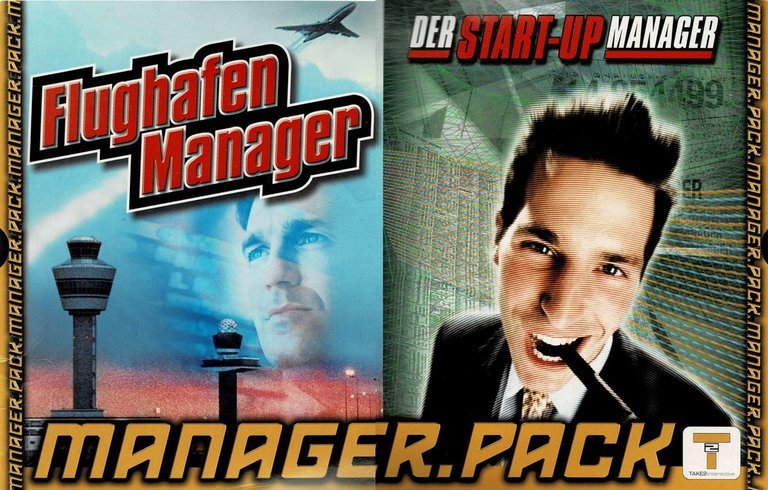
Description
Manager.Pack is a business simulation compilation released in 2001 for Windows, published by Take-Two Interactive Software, Inc. This bundle features two strategic management games: Airport Tycoon, where players design and operate airport infrastructure, and The Corporate Machine, which challenges users to build and run corporate empires. The collection offers dual experiences in logistics and corporate strategy through a mouse-driven interface on CD-ROM.
Manager.Pack Cheats & Codes
PlayStation
Enter codes as your name at the start screen.
| Code | Effect |
|---|---|
| FILTHY RICH | Gives £500 million |
| AMPHETAMINE | Makes players faster |
| BLIND REF | No bookings |
| EASY LIFE | Best team and tactics |
| HARD AS NAILS | Aggressive players |
| LUCKY STREAK | Win every game |
| NO CONSTRUCTION | Quick stadium building |
| POTIONS | Quick injury healing |
| SUPERSTARS | Increase player ratings to 90% |
| YOU THE DADDY | Free transfers |
| HEATWAVE | Always sunny |
| WHITE CHRISTMAS | Always snowing |
| SWIMMING | Always raining |
Manager.Pack: A Curated Curio of Corporate Simulation
Introduction
In the early 2000s, as the PC gaming landscape flourished with genre experimentation, compilation packages offered players budget-friendly access to multiple titles. Among these, Manager.Pack—released in 2001 by Take-Two Interactive—stands as a fascinating artifact of the era. Bundling Airport Tycoon (2000) and The Corporate Machine (2001), this collection provides a dual perspective on business simulation, one focused on infrastructure and the other on corporate strategy. While overshadowed by contemporaries like Championship Manager or Football Manager 2001, Manager.Pack occupies a unique niche. Its enduring appeal lies not in polished execution but in its unfiltered representation of two distinct yet complementary management philosophies. This review examines how Manager.Pack captures the era’s fascination with tycoon mechanics, its strengths and limitations, and its place in the evolution of simulation gaming.
Development History & Context
The Studio and Vision
Manager.Pack emerged from the burgeoning PC simulation scene, where titles like RollerCoaster Tycoon (1999) demonstrated market demand for accessible yet complex management experiences. Take-Two Interactive, leveraging its publishing infrastructure (notably known for the Grand Theft Auto series), positioned the compilation as a value proposition. The included games reflected divergent developer philosophies:
– Airport Tycoon (developed by unknown studios, released 2000) aimed to capitalize on the “tycoon” craze by focusing on aviation logistics.
– The Corporate Machine (released 2001) embraced corporate warfare, emphasizing strategic competition over infrastructure building.
The compilation’s design was pragmatic: bundle two newer titles (Airport Tycoon) and a contemporary release (The Corporate Machine) to maximize shelf appeal. With no unified vision beyond “business simulation,” the package offered a thematic cohesion more than a cohesive experience.
Technological Constraints
Both titles operated within the technical limits of early 2000s Windows gaming:
– Airport Tycoon relied on sprite-based 2D graphics, typical for 2000 releases, with minimal 3D elements for terminals.
– The Corporate Machine featured isometric 3D visuals but suffered from low-resolution textures and stiff animations.
Performance was further constrained by era-specific anti-piracy measures (like SafeDisc DRM), which hampered compatibility with modern systems.
Gaming Landscape at Release
2001 saw the peak of “tycoon mania,” with Theme Park World (1999) and SimCity 3000 (2000) dominating the genre. Manager.Pack, however, occupied a secondary tier. Its direct competitors were Transport Tycoon Deluxe (re-released in 2000) and Capitalism II (2001), which offered deeper gameplay. Football management games like LMA Manager 2001 (featuring Alex Ferguson) dominated sales charts, highlighting Manager.Pack’s niche appeal. The compilation’s release on CD-ROM—a format waning in favor of DVD—reflected its budget positioning.
Narrative & Thematic Deep Dive
Plot and Characterization
Both games eschew traditional narratives in favor of emergent storytelling:
– Airport Tycoon frames the player as a “tycoon” building an aviation empire. The narrative emerges from balancing airline contracts, passenger demands, and disasters (e.g., weather delays). Characters are archetypes: rigid CEOs, demanding passengers, and unionized workers, represented through text-based interactions and stat blocks.
– The Corporate Machine adopts a cutthroat corporate rivalry theme. Players face rival CEOs in a boardroom battle for market dominance. Dialogue is sparse, limited to negotiation offers and hostile takeovers, with no character development beyond corporate personas.
Dialogue and Themes
- Airport Tycoon explores themes of globalization and infrastructure decay. Text snippets from airline executives (“Expand the runway or lose our contract!”) underscore economic pressures, while passenger complaints reveal class tensions (“First-class service is abysmal!”).
- The Corporate Machine focuses on capitalism’s ethical ambiguities. Deals with arms manufacturers (“Profit margins are 300%!”) contrast with philanthropic ventures (“Charity boosts stock prices!”). The absence of moral consequences highlights the era’s unapologetic embrace of corporate triumphalism.
Both titles lack narrative depth, instead prioritizing systems as storytelling devices. This minimalist approach, while thematically resonant, leaves emotional engagement to player imagination.
Gameplay Mechanics & Systems
Core Gameplay Loops
-
Airport Tycoon:
- Infrastructure Building: Players design terminals, runways, and gates, with limited real-time adjustments.
- Economic Management: Balancing ticket prices, fuel costs, and bribes for contracts creates tense resource allocation.
- Disaster Handling: Crashes or strikes force reactive decision-making, but outcomes feel random due to opaque AI logic.
Flaws include repetitive tasks (e.g., endlessly assigning baggage handlers) and a punishing difficulty curve where bankruptcy strikes early.
-
The Corporate Machine:
- Strategic Competition: Players research technologies, hire CEOs with unique traits (e.g., “Ruthless” or “Innovative”), and launch hostile takeovers.
- Resource Allocation: Budgeting for R&D, marketing, and espionage creates a satisfying risk-reward dynamic.
- Turn-Based Combat: Corporate “battles” unfold via dice-roll mechanics, lacking visual feedback.
Strengths include deep interdepartmental synergy (e.g., marketing boosts R&D efficiency), while weaknesses stem from slow pacing and repetitive AI strategies.
Innovation and Flaws
- Airport Tycoon’s “real-time” management is illusory; gameplay pauses during critical events, breaking immersion.
- The Corporate Machine’s CEO system is innovative but underutilized, with traits having minimal impact on outcomes.
- Both games suffer from clunky UIs: spreadsheet-like menus in Airport Tycoon and cluttered corporate dashboards in The Corporate Machine.
World-Building, Art & Sound
Setting and Atmosphere
- Airport Tycoon’s world is a sterile recreation of aviation bureaucracy. Airports feel impersonal, with passengers reduced to numbers. The absence of cultural diversity (all passengers are Western) limits immersion.
- The Corporate Machine’s setting is a fictional boardroom battlefield. Skyscrapers and stock tickers create a Wall Street-meets-Board Game vibe, but the lack of real-world locales (e.g., Tokyo, London) grounds it in abstraction.
Visual Direction
- Airport Tycoon uses top-down 2D sprites for terminals and vehicles. Sprites are low-resolution, with animations limited to rotating planes.
- The Corporate Machine’s isometric 3D is ambitious but dated. Textures are blurry, and character models are identical “suits.” The corporate headquarters, however, features dynamic lighting that enhances tension during negotiations.
Sound Design
- Airport Tycoon’s audio is minimal: repetitive engine sounds and muffled PA announcements.
- The Corporate Machine features more nuanced effects: tense piano during negotiations and satisfying cash-register “cha-chings” for deals. Voice acting is absent, relying on text-to-speech for announcements.
Reception & Legacy
Critical and Commercial Reception
Manager.Pack received muted attention at launch. MobyGames lists no critic scores, and online archives (e.g., GameArchives) note it as a “curio” rather than a landmark. Commercial performance is unrecorded, but its budget price point ($19.99) likely limited revenue. Unlike LMA Manager 2001 (praised for its Alex Ferguson branding), Manager.Pack lacked a marquee feature to drive sales.
Evolution of Reputation
In retro-gaming circles, Manager.Pack is remembered for its juxtaposition of management styles. Airport Tycoon is seen as a flawed but charming precursor to Airport CEO (2019), while The Corporate Machine is a forgotten relic before titles like Capitalism II refined the genre. Its DRM issues (SafeDisc) have cemented its reputation as a “hassle classic,” requiring fan patches for modern play.
Influence on Subsequent Games
- The compilation’s bundling model foreshadowed digital collections like EA’s Double Packs (e.g., Grand Theft Auto Double Pack).
- Airport Tycoon’s focus on infrastructure influenced Cities: Skylines (2015) by emphasizing zoning and resource flow.
- The Corporate Machine’s CEO system presaged deeper character customization in Football Manager’s staff recruitment.
Conclusion
Manager.Pack is a time capsule of early 2000s simulation gaming, offering a duality of infrastructure and corporate management that few compilations dared. While Airport Tycoon and The Corporate Machine are individually unpolished—marred by clunky interfaces and repetitive loops—their juxtaposition creates a compelling contrast between logistical realism and strategic abstraction.
As a product, Manager.Pack embodies the era’s ambition over execution. Its legacy lies not in revolutionizing the genre but in preserving two distinct approaches to business simulation, now artifacts of a time when tycoon games thrived on concept as much as polish. For historians, it’s a vital piece of the management simulation puzzle; for players, it’s a challenging but rewarding curiosity.
Final Verdict: 6.10
A flawed but historically significant compilation, Manager.Pack offers a dual lens into the tycoon genre’s evolution. Its strengths lie in thematic diversity, while its weaknesses—dated mechanics and technical limitations—reflect the growing pains of 2001 PC gaming. Essential for simulation enthusiasts, but niche for modern audiences.