
- Release Year: 2012
- Platforms: Windows
- Publisher: Suits & Sandals
- Developer: Suits & Sandals
- Genre: Action
- Perspective: Side view
- Game Mode: Single-player
- Gameplay: Platform
- Setting: Fantasy
- Average Score: 90/100
Description
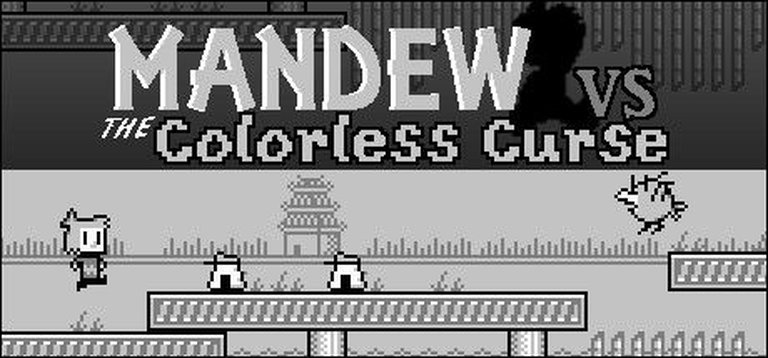
Mandew vs the Colorless Curse is a Super Mario Bros.-style platformer mimicking the original Game Boy aesthetic, particularly Super Mario Land, where protagonist Mandew awakens in a strange colorless fantasy world and, guided by a spirit, must navigate 17 levels across four themed worlds to collect four golden consoles guarded by bosses, using classic run-and-jump controls, enemy-stomping mechanics, and power-ups like fireballs and floating abilities to break the curse and return home.
Gameplay Videos
Where to Buy Mandew vs the Colorless Curse
PC
Mandew vs the Colorless Curse Guides & Walkthroughs
Mandew vs the Colorless Curse Reviews & Reception
steambase.io (90/100): Very Positive (90 / 100 from 62 total reviews)
Mandew vs the Colorless Curse: Review
Introduction
In an era dominated by hyper-realistic blockbusters and sprawling open worlds, few games dare to strip everything back to the bare essentials of pixelated purity—yet Mandew vs the Colorless Curse does just that, emerging from the monochrome shadows of indie obscurity like a long-lost Game Boy cartridge unearthed from a forgotten drawer. Released in 2012 as freeware and later resurrected on Steam in 2020, this unassuming platformer from solo developer Suits & Sandals channels the spirit of Super Mario Land with unflinching fidelity, challenging players to navigate a desaturated dimension in search of salvation. As a historian of gaming’s underbelly, I’ve pored over its sparse but evocative documentation, and my thesis is clear: Mandew vs the Colorless Curse is a masterful exercise in restraint, proving that nostalgia, tight design, and personal passion can forge a timeless gem amid the freeware flood of the early 2010s.
Development History & Context
Suits & Sandals, the one-person studio helmed by programmer and designer Syaxamaphone (often stylized as such in dev notes), birthed Mandew vs the Colorless Curse on June 26, 2012, as Windows freeware—public domain in spirit, downloadable from obscure corners of the early indie web. This was the seventh title under the Suits & Sandals banner and the second installment in the nascent Mandew vs series, starring Syaxamaphone’s real-life friend and fellow coder, Mandew, as the pixelated protagonist. Crafted in GameMaker—a ubiquitous engine for bedroom developers constrained by budgets and hardware—this game arrived during a transitional epoch for indie gaming.
The early 2010s marked the twilight of Flash portals like Newgrounds and the dawn of Steam Greenlight, where solo devs like Syaxamaphone bootstrapped projects for friends before dreaming of commercial viability. Technological limits were self-imposed: emulating the original Game Boy’s 160×144 monochrome LCD (four shades of green-gray), the game rejected modern flourishes for authenticity. The gaming landscape buzzed with Super Meat Boy‘s precision platforming and Braid‘s artistic introspection, but Mandew leaned into unpretentious homage. Syaxamaphone’s own words on Steam reveal its intimate origins: “very personal projects designed first and foremost for my close friends… a little rough around the edges,” set in “the ribcage”—a cryptic nod to personal lore. Revived on Steam in 2020 with XInput gamepad support, 21 achievements, and leaderboards, it bridged freeware nostalgia with modern accessibility, its minimal specs (35MB RAM, DirectX 8 graphics) ensuring playability on toasters from the last decade.
Narrative & Thematic Deep Dive
At its core, Mandew vs the Colorless Curse unfolds a deceptively simple parable: Mandew awakens in a “strange colorless world,” a grayscale purgatory drained of vibrancy, guided by an ethereal spirit toward four “golden consoles”—artifacts that promise escape to his chromatic home. Spanning 17 levels across four worlds, the plot advances linearly through environmental storytelling, with bosses hoarding each console as the curse’s sentinels. Dialogue is sparse, delivered via spirit whispers or on-screen text, evoking Super Mario Land‘s minimalist charm—no verbose cutscenes, just imperative nudges like “Find the consoles!” to propel the hop ‘n’ bop rhythm.
Thematically, the “colorless curse” resonates as a meta-allegory for indie drudgery: Mandew, a everyman proxy for Syaxamaphone’s coder buddy, embodies the grind of navigating life’s gray factories, barren deserts, hostile bamboo thickets, and whatever lurks in the fourth world (inferred as a climactic void). Collecting golden consoles—a cheeky wink at gaming’s holy grail—satirizes console wars while symbolizing breakthroughs from monotony. Power-ups (fireballs for offense, floaters for traversal, block-breakers for secrets) mirror personal growth, lost on a single hit sans protection, underscoring vulnerability in a cursed realm. Subtle secrets, like hidden “hamburger power-ups” (hinted in Steam forums), reward exploration, tying into themes of discovery amid despair. Characters are archetypal: Mandew’s silent determination, the spirit’s cryptic guidance, bosses as territorial guardians. Yet, the narrative’s true depth lies in its restraint—echoing Game Boy’s portable ephemerality, it critiques saturation overload, inviting players to cherish simplicity in a polychromatic age.
Gameplay Mechanics & Systems
Mandew vs the Colorless Curse distills platforming to its Platonic ideal: direct-control side-scrolling action where run, jump, and stomp form the trinity. Mandew mirrors Mario’s physics—variable jump arcs for precision, speed ramps for momentum—letting players squash foes from above while dodging hazards like spikes or patrolling enemies. Core loop: traverse levels, collect power-ups from ? blocks, uncover secrets for score multipliers, and culminate in boss fights exploiting elemental weaknesses (e.g., fireballs vs. a desert behemoth?).
Power-ups elevate the formula: fireball hurling adds ranged combat; air-floaters enable mid-air corrections and high reaches; block-smashers unlock shortcuts or 1-ups. Vulnerability shines—one hit reverts to base form (or kills outright), enforcing risk-reward. Levels brim with secrets: most hide collectibles boosting scores, teased in Steam descriptions as “a myriad,” with forum queries like “hamburger power-up in 1-1?” hinting at obtuse placements demanding pixel-perfect exploration.
Three modes deepen replayability:
– Story Mode: Linear progression, plot-gated by bosses.
– Trial Mode: Stage replays for high scores, leaderboards fueling competition.
– Race Mode: Full-game speedruns, timing the 17-level gauntlet.
UI is spartan—health via power-up icon, score/counter at top, pause for controls (customizable, per forum gripes like remapping “run to A” breaking menus). Flaws emerge: GameMaker jank in hitboxes or input lag on non-XInput pads, but innovations like boss-weakness experimentation reward experimentation. At ~1-2 hours core play, it’s a tight loop, masterful in brevity.
World-Building, Art & Sound
The grayscale pocket dimension is a triumph of aesthetic evangelism, faithfully aping Game Boy’s duochrome palette (blacks, whites, two grays) for a hazy, LCD-veiled nostalgia. Four worlds paint vivid contrasts despite monochromacy:
– Frantic Factories: Clanging machinery, conveyor belts, piston hazards—industrial claustrophobia.
– Destitute Deserts: Shifting sands, bottomless pits, skeletal cacti—arid isolation.
– Belligerent Bamboo Forests: Spiky thickets, swinging vines, ambush enemies—overgrown aggression.
– Fourth World (Inferred Climax): Abstract void, escalating curses toward console sanctum.
Atmosphere permeates: dimmed visuals evoke entrapment, secrets shimmering faintly to lure the observant. Art direction prioritizes readability—crisp sprites, layered parallax scrolling—contributing to hypnotic flow.
Sound design, though undocumented, aligns chiptune orthodoxy: plucky jumps, squashy enemy deaths, boss stingers likely synth-driven, with sparse spirit SFX for narrative beats. No full soundtrack details, but GameMaker norms suggest looping motifs per world, enhancing immersion without distraction. Collectively, these forge an oppressive yet inviting tone—colorless curse as both gimmick and glue.
Reception & Legacy
Launch reception was ghostly: no MobyGames or Metacritic critic scores, zero player reviews on Moby, reflecting freeware’s niche 2012 ecosystem. Steam’s 2020 port ignited sparks—Very Positive (90% of 62 reviews, 56 positive), ~150,000 owners via grey markets/giveaways. Forums buzz with achievement hunts (“Stiff Knees” bugs), control tweaks, secret queries—cult fervor minus mainstream splash. Curators praise its charm; user tags (2D Platformer, Funny, Score Attack) cement retro appeal.
Legacy endures in indie’s golden age revival: predating Celeste or Pizza Tower, it influenced Game Boy demakes amid Shovel Knight‘s pixel renaissance. As Mandew series precursor, it humanizes Suits & Sandals’ oeuvre, inspiring freeware platformers emphasizing modes over bloat. No industry-shaking ripples, but in historiography, it’s a footnote to passion-driven design—preserved by MobyGames (added 2022) and Steam, a beacon for “rough around the edges” authenticity.
Conclusion
Mandew vs the Colorless Curse is no revolutionary titan but a pitch-perfect paean to platforming’s roots—a free, faithful Super Mario Land tribute where grayscale grit belies gleeful design. Syaxamaphone’s personal touch elevates its 17 levels into a compelling escape saga, bolstered by modes ensuring longevity. Rough edges (input quirks, opacity) pale against tight mechanics, evocative worlds, and nostalgic haze. In video game history, it claims a hallowed niche: exemplar of 2010s freeware ingenuity, proving small scopes yield big joys. Verdict: Essential for platformer purists—download free on Steam, embrace the curse, and rediscover color through absence. 9/10.