
- Release Year: 2023
- Platforms: Nintendo Switch, PlayStation 4, Windows, Xbox One
- Publisher: 4J Studios Ltd., Curve Games Limited
- Developer: 4J Studios Ltd.
- Genre: Action, Party game
- Perspective: Diagonal-down
- Game Mode: Co-op, Online Co-op, Single-player
- Gameplay: Crafting, Minigames, Teamwork, Time management
- Setting: Futuristic, Sci-fi
- Average Score: 73/100
Description
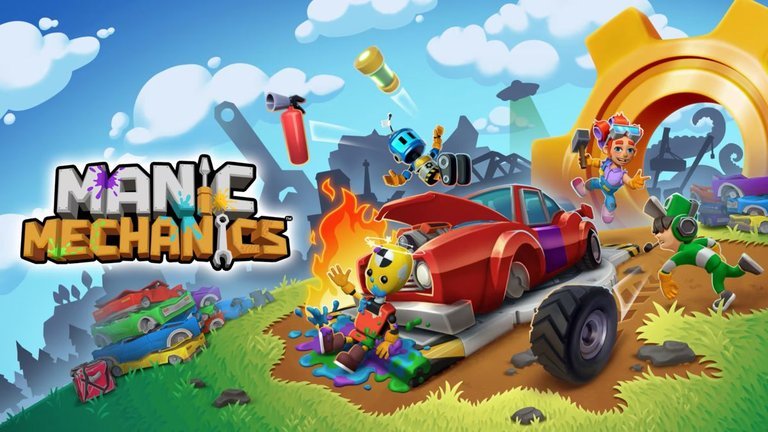
Manic Mechanics is a chaotic couch co-op or online party game set in the sci-fi/futuristic world of Octane Isle, where up to four players take on the role of amateur mechanics. The goal is to fix as many cars as possible within a time limit by completing mini-games at various stations, such as painting doors or repairing engines, while navigating hazards like oil fires and electrified water. Players progress through different regions, each culminating in a boss challenge, earning cogs to unlock new levels and prove themselves as true ‘Manic Mechanics.’
Gameplay Videos
Where to Buy Manic Mechanics
PC
Manic Mechanics Free Download
Manic Mechanics Patches & Updates
Manic Mechanics Guides & Walkthroughs
Manic Mechanics Reviews & Reception
metacritic.com (71/100): Manic Mechanics is a fun party game with friends. Solo adventures can grow dull, but the gameplay is still chaotic with solid controls and unique levels.
opencritic.com (69/100): Manic Mechanics is a charming party game that takes a lot of inspiration from Overcooked, yet manages to stand on its own.
techradar.com (80/100): Manic Mechanics is the perfect game to sit down and play after a long day, that is, if you need an adrenaline boost. The couch co-op’s simple premise is equally exhilarating and frustrating, resulting in a game you just can’t put down.
gamesasylum.com : Similar in style to Overcooked, you navigate your mighty mechanic around the yards, overseeing the production lines, grabbing rusty parts from the conveyor, reviving them at the relevant stations, and reassembling them into vehicles for points.
Manic Mechanics: A Chaotic Masterpiece of Cooperative Mayhem
Introduction
In the ever-expanding pantheon of cooperative party games, Manic Mechanics emerges as a vibrant, oil-stained love letter to the genre, blending the frantic energy of Overcooked with the mechanical charm of a grease-stained garage. Developed by 4J Studios—a team best known for their work on Minecraft‘s console ports—this 2023 release is a bold foray into original IP, marking the studio’s first self-published title in nearly 15 years. Set on the whimsical Octane Isle, Manic Mechanics tasks players with repairing an absurd menagerie of vehicles, from rusted-out sedans to UFOs, under increasingly ludicrous conditions. But does it stand tall among the giants of the genre, or is it merely a retread of familiar ground? This review dissects the game’s design, legacy, and place in the annals of cooperative gaming.
Development History & Context
The Studio Behind the Wrench
4J Studios, founded in 2005, cut its teeth on ports and remasters, most notably bringing Minecraft to consoles and revitalizing classics like Banjo-Kazooie and Perfect Dark for Xbox Live Arcade. However, Manic Mechanics represents a departure—a return to original game development after years of technical adaptation. The studio’s shift into publishing, announced in 2022, began with Skye Tales but found its most ambitious expression in this chaotic repair simulator.
The game’s development was a labor of love, with a team of 151 contributors (including programmers, designers, and artists) led by veterans like Creative Director Brian Gomez and Head of Art David Keningale. The project’s scope was modest but polished, reflecting 4J’s meticulous attention to detail honed through years of porting complex games.
Technological Constraints & Design Philosophy
Manic Mechanics was built in Unreal Engine 4/5, leveraging the engine’s robust physics and animation systems to create its signature brand of controlled chaos. The game’s fixed, diagonal-down perspective and flip-screen visuals evoke classic arcade titles, while its direct-control interface ensures accessibility for players of all skill levels.
The design philosophy was clear: prioritize couch co-op above all else. While solo play is supported (with dynamic difficulty scaling), the game’s soul lies in its multiplayer mayhem. This focus is evident in the game’s structure, which encourages teamwork through shared objectives, overlapping tasks, and environmental hazards that demand coordination.
The Gaming Landscape at Launch
Released on July 13, 2023, for Nintendo Switch (with subsequent ports to Windows, PlayStation 4, and Xbox One in 2024), Manic Mechanics entered a market saturated with cooperative party games. Titles like Overcooked, Moving Out, and Speed Crew had already carved out niches in the genre, making differentiation a challenge. Yet, 4J Studios leaned into the game’s automotive theme, swapping kitchens for garages and chefs’ hats for grease-stained overalls.
The timing was strategic. The Nintendo Direct presentation in June 2023 gave the game a high-profile showcase, positioning it as a must-play for Switch owners craving local multiplayer experiences. The game’s $9.99 price point (later adjusted to $24.99 on Steam) also made it an accessible impulse buy for groups looking for a quick, chaotic fix.
Narrative & Thematic Deep Dive
Plot: A Journey Through Octane Isle
Manic Mechanics’s narrative is lightweight but effective, serving as a framework for its gameplay. Players assume the role of amateur mechanics striving to prove their worth on Octane Isle, a vibrant, cartoonish archipelago divided into five themed neighborhoods, each ruled by a “Master Mechanic” boss. The premise is simple: repair vehicles to earn cogs, unlock new regions, and ultimately challenge the island’s mechanical elite.
The story unfolds through a hub world where players drive between garages, interacting with quirky NPCs and uncovering secrets. While the plot lacks depth, its charm lies in its absurdity. From stampeding cows to alien abductions, the game embraces a Looney Tunes-esque sensibility, where physics and logic take a backseat to comedic timing.
Characters & Dialogue
The game’s cast is a motley crew of eccentric mechanics, each with their own garages and challenges. Characters like Roz, the alien garage owner (voiced by developer Laura Molnar), add personality to the world, though their roles are largely functional. Dialogue is minimal but punchy, leaning into the game’s comedic tone without overstaying its welcome.
Themes: Teamwork, Chaos, and the Joy of Failure
At its core, Manic Mechanics is a celebration of cooperative play—both its triumphs and its hilarious failures. The game’s themes revolve around:
– Teamwork Under Pressure: Success hinges on communication and role assignment, mirroring real-world collaborative problem-solving.
– Controlled Chaos: The game thrives on the tension between order and disorder, rewarding players who can adapt to unpredictability.
– The Joy of Failure: Like Overcooked, Manic Mechanics turns mistakes into comedic gold, whether it’s slipping on oil or accidentally launching a car part into the void.
The game’s humor is derived from its embrace of absurdity. Hazards like electrified floors, exploding batteries, and UFO abductions aren’t just obstacles—they’re opportunities for emergent storytelling. A well-timed throw of a polished propeller or a last-second engine repair can turn defeat into victory, creating moments of shared elation.
Gameplay Mechanics & Systems
Core Gameplay Loop
Manic Mechanics’s gameplay is deceptively simple: repair as many vehicles as possible within a time limit. Each level introduces a new garage with unique layouts, hazards, and vehicle types. The loop follows a clear structure:
1. Vehicle Arrival: A car (or submarine, tractor, or UFO) rolls in, missing parts.
2. Part Retrieval: Players grab components from conveyor belts.
3. Repair Minigames: Parts are taken to stations where minigames (e.g., hammering engines, painting doors) must be completed.
4. Assembly: Fixed parts are attached to the vehicle.
5. Completion: The vehicle drives off, and points are awarded.
This loop is repeated ad nauseam, with increasing complexity as players progress. Later levels introduce assembly lines, multi-step repairs, and environmental hazards that disrupt workflow.
Progression & Difficulty
Progression is tied to a cog-based system. Players earn cogs by hitting target scores, which unlock new garages and regions. Each of the five neighborhoods culminates in a “Manic Mechanic Challenge,” a boss-level gauntlet that tests everything learned in that area.
Difficulty scales dynamically based on the number of players, ensuring solo play is challenging but not punishing. However, the game’s true depth emerges in multiplayer, where coordination (or lack thereof) becomes the defining factor.
Innovative Systems
- Golden Parts: Pre-fixed components that grant bonus points, encouraging risk-taking.
- Hazard Variety: Oil spills, fires, and rotating platforms add unpredictability.
- Versus Mode: A post-launch addition that introduces sabotage mechanics, allowing players to lock stations or deploy traps.
Flaws & Frustrations
While Manic Mechanics excels in its core design, it’s not without issues:
– Repetition: With only 25 levels, the game can feel shallow for solo players.
– Loading Times: Particularly on Switch, load times between levels can disrupt the flow.
– Limited Replayability: Outside of high-score chasing, there’s little incentive to revisit levels.
World-Building, Art & Sound
Setting: Octane Isle’s Eclectic Neighborhoods
Octane Isle is a feast for the senses, with each of its five neighborhoods boasting distinct visual and auditory identities:
– Rustbucket Ridge: A dusty, rural setting with banjo-heavy soundtracks.
– Gearhead Gulch: A neon-lit urban sprawl with synthwave beats.
– Banshee Bay: A coastal garage with nautical themes and eerie undertones.
The art style is vibrant and cartoonish, with exaggerated animations that amplify the game’s comedic tone. The fixed, diagonal-down perspective gives the game a retro arcade feel, while the flip-screen transitions between areas maintain a sense of continuity.
Sound Design: A Symphony of Chaos
The game’s soundtrack is a standout, blending upbeat melodies with context-sensitive cues. The music shifts dynamically based on the player’s performance, ratcheting up the tension as the timer winds down. Sound effects—from the clang of a hammer to the sizzle of an electrical hazard—are crisp and satisfying, reinforcing the game’s tactile feedback.
Reception & Legacy
Critical Reception
Manic Mechanics received a mixed but generally positive reception, with a Metacritic score of 71 (based on 9 reviews) and a MobyGames aggregate of 74%. Critics praised its chaotic multiplayer fun, accessible controls, and charming presentation but noted its lack of originality and limited content.
Highlights from Reviews:
– Pure Nintendo (8/10): “A fun party game with friends. Solo adventures can grow dull, but the gameplay is still chaotic with solid controls and unique levels.”
– TechRadar (80%): “The perfect game to sit down and play after a long day, that is, if you need an adrenaline boost.”
– TheSixthAxis (5/10): “Lacks the magic that made Overcooked a classic. Entirely disposable fun for a weekend.”
Commercial Performance & Player Feedback
The game’s commercial performance was modest, with limited player reviews (only 1 rating on MobyGames at the time of writing). However, its niche appeal as a party game ensured a dedicated fanbase, particularly among groups seeking a fresh alternative to Overcooked.
Influence & Future Prospects
While Manic Mechanics didn’t redefine the genre, it demonstrated 4J Studios’ ability to craft polished, multiplayer-focused experiences. Its success (or lack thereof) may influence the studio’s future projects, potentially paving the way for sequels or spiritual successors with deeper mechanics and more content.
Conclusion: A Worthy Addition to the Co-Op Canon
Manic Mechanics is a game that knows exactly what it is: a chaotic, laughter-inducing party experience that thrives on teamwork and controlled anarchy. While it doesn’t break new ground, it refines the Overcooked formula with a fresh coat of grease and a healthy dose of automotive absurdity. Its shortcomings—repetition, loading times, and limited replayability—are outweighed by its strengths: tight controls, vibrant presentation, and moments of pure, unscripted hilarity.
Final Verdict: 7.5/10 – A chaotic delight for co-op enthusiasts, but solo players may find it lacking in longevity.
For fans of the genre, Manic Mechanics is a must-play. For everyone else, it’s a reminder that sometimes, the best games are the ones that turn failure into fun. Grab some friends, don your overalls, and prepare for mechanical mayhem—just don’t blame us if your living room ends up covered in (metaphorical) oil.