
- Release Year: 2024
- Platforms: Windows
- Genre: Strategy, Tactics
- Perspective: Free camera
- Game Mode: Single-player
- Gameplay: Tower defense
- Average Score: 99/100
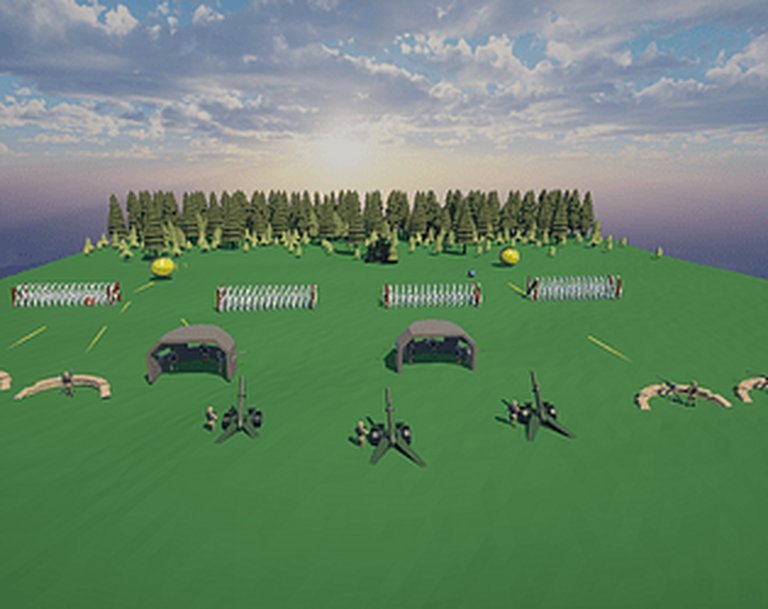
Description
In ‘Marble Defence: Age of the Ball Bearing’, players are tasked with defending their marble against waves of invaders in a wave-based tower defense game. Set in a strategic and tactical environment, the game allows players to use a free camera view and a point-and-select interface to strategically place defenses and fend off the onslaught. The game was released on September 22, 2024, for Windows and is available for free on itch.io.
Marble Defence: Age of the Ball Bearing Patches & Updates
Marble Defence: Age of the Ball Bearing Reviews & Reception
cameronbaker.itch.io (100/100): Rated 5.0 out of 5 stars
marble-defense.en.softonic.com (98/100): Marble Defense: A New Brick Game for Endless Fun
Marble Defence: Age of the Ball Bearing: Review
Introduction
In the crowded landscape of indie tower defense games, Marble Defence: Age of the Ball Bearing stakes its claim not through grandeur, but through minimalist charm and the scrappy ingenuity of its game jam roots. Developed during the GDS Game Jam 2024 by a small team led by Cameron Baker and Oliver Coates, this free Windows title asks players to defend a marble from relentless waves of invaders—a premise as absurd as it is oddly compelling. This review argues that while the game stumbles under the weight of its constraints, it exemplifies the creative spirit of rapid prototyping, offering flashes of brilliance amid its rough edges.
Development History & Context
A Game Jam Crucible
Born from the GDS Game Jam 2024—a 48-hour development sprint—Marble Defence adopted the theme “one of us” and the modifier “keep doubling it.” The team, including Kevin Kang, James Anderson, and Ryan Schaare, leveraged Unity’s accessibility to cobble together a functional prototype. However, the jam’s time constraints are evident: assets like skyboxes and sound effects were sourced from free repositories (e.g., Unity Asset Store, Freesound), resulting in a patchwork aesthetic.
Indie Pragmatism
With no budget and a skeleton crew, the developers prioritized core mechanics over polish. This pragmatism is both a strength and a weakness. The reliance on free assets (e.g., Evan Boyerman’s sound effects, Richard Whitelock’s skyboxes) speaks to the indie scene’s resourcefulness but also limits the game’s visual and auditory identity.
Narrative & Thematic Deep Dive
A Bare-Bones Premise
Narrative depth is nonexistent—players defend a marble from an abstract “invasion” with no context or lore. The title’s absurdist flair (Age of the Ball Bearing) hints at a tongue-in-cheek tone, but this potential is untapped. The game’s lack of storytelling mirrors its jam origins: functional, not florid.
Themes of Isolation and Pressure
Thematically, the game inadvertently explores isolation. The marble, alone against escalating waves, becomes a metaphor for resilience—or futility. The “keep doubling it” modifier manifests in increasingly overwhelming odds, evoking the Sisyphean grind of survival games.
Gameplay Mechanics & Systems
Core Loop: Simplicity with Hiccups
As a tower defense game, Marble Defence tasks players with placing turrets (machine guns, etc.) along enemy paths. Controls are functional:
– Movement: WASD/arrow keys, with SHIFT for speed boosts.
– Placement: Rotate objects via scroll wheel, cancel with Q.
The systems shine in theory but falter in execution. A player review notes that marbles can glitch behind turrets, soft-locking progress—a critical flaw in a precision-dependent genre.
Innovation Amid Jank
The “doubling” modifier likely applies to enemy waves, escalating tension. However, without scaling tools for players, the difficulty curve feels punitive rather than rewarding.
World-Building, Art & Sound
Asset-Flip Aesthetics
The visual design relies on stock Unity assets: generic sci-fi turrets and bland skyboxes. While functional, this approach lacks cohesion. The marble itself, ostensibly the game’s heart, is visually undistinguished.
Sound: A Salvage Yard Symphony
Audio is cobbled from Freesound contributors like SuperPhat and Mitchel Kniss Jr. Effects are serviceable but forgettable, with no original score to elevate the experience.
Reception & Legacy
Mixed First Impressions
The lone user review praises wave animations and placement mechanics but criticizes game-breaking bugs. As a free title, it escapes harsh scrutiny, but its lack of polish limits appeal beyond curiosity-seekers.
A Footnote in Tower Defense History
Marble Defence’s legacy lies in its embodiment of game jam culture—a proof-of-concept rather than a finished product. It joins a lineage of indie TD games like Random Defence (2008) but lacks the refinement to stand out.
Conclusion
Marble Defence: Age of the Ball Bearing is a fascinating artifact of constrained creativity—a game jam experiment that prioritizes ideas over execution. While its bugs and asset-flip aesthetics prevent it from greatness, it offers a raw glimpse into indie development’s challenges and charms. For tower defense completists, it’s a curious diversion; for others, a reminder that not all diamonds emerge polished. In the annals of video game history, it will likely remain a footnote—but one that speaks volumes about the beauty and chaos of game jams.
Final Verdict: A flawed but earnest prototype, best appreciated as a case study in rapid game development.