
- Release Year: 1997
- Platforms: Windows 16-bit, Windows
- Publisher: Maxis Software Inc.
- Developer: Maxis South
- Genre: Puzzle
- Perspective: 3rd-person
- Game Mode: Single-player
- Gameplay: Puzzle elements
- Average Score: 57/100
Description
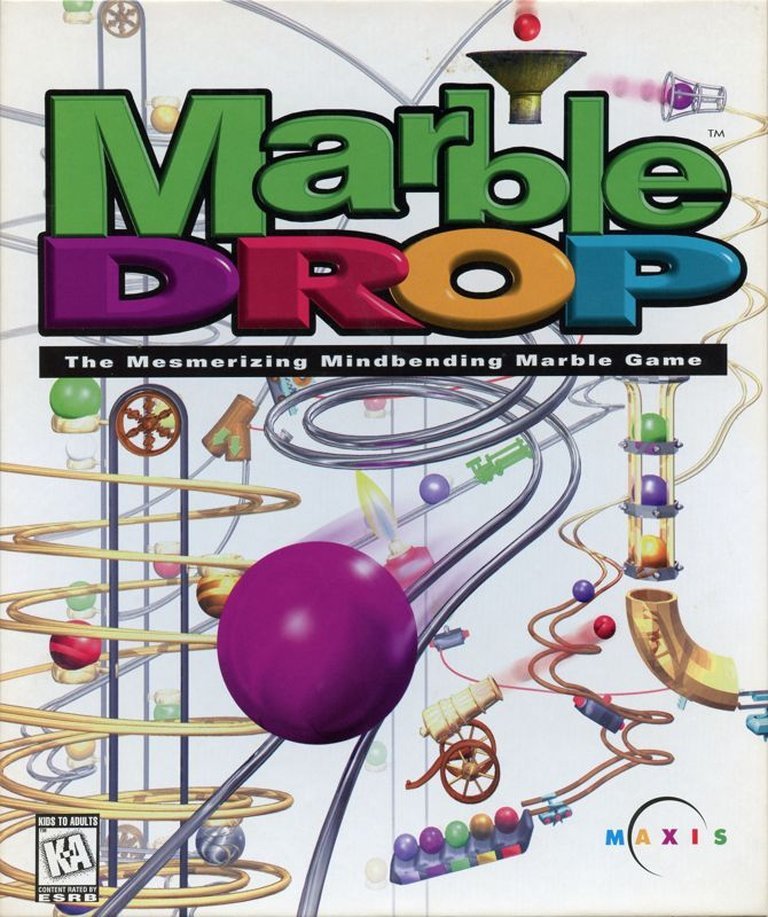
Marble Drop is an object-based puzzle game from Maxis, blending The Incredible Machine’s contraption-building with Pachinko-style marble mechanics. Players drop colored marbles into funnels at the top of elaborate, Rube Goldberg-esque tracks equipped with springs, cannons, and twisting paths, maneuvering them through obstacles and triggers to sort them into matching color bins across 50 levels named after scientists, mathematicians, and philosophers.
Gameplay Videos
Where to Buy Marble Drop
PC
Marble Drop Free Download
Marble Drop Patches & Updates
Marble Drop Reviews & Reception
gamespot.com (52/100): Marble Drop may succeed as an interactive screen saver, but it fails to engage attention as a game.
en.wikipedia.org (52/100): considering it dull
maxlaumeister.com : It is my favorite underrated puzzle game.
Marble Drop: Review
Introduction
Imagine a Renaissance workshop alive with the clatter of gears, the ping of springs, and the satisfying thunk of a perfectly routed marble landing in its color-matched bin—except this isn’t Leonardo da Vinci’s sketchbook, but a 1997 Windows puzzle game that turns physics and foresight into hypnotic addiction. Marble Drop, developed by Maxis South and published by Maxis, emerged from the studio famed for SimCity and The Sims as their first foray into pure puzzle design, blending the contraption-crafting chaos of The Incredible Machine with the probabilistic peril of Pachinko. Despite its modest footprint in gaming history, Marble Drop has endured as a cult classic among puzzle aficionados, preserved on abandonware sites and emulated in virtual machines decades later. Its legacy lies in its elegant simplicity: a testament to how a single core mechanic—dropping marbles into evolving Rube Goldberg-esque mazes—can deliver profound intellectual satisfaction. My thesis is unequivocal: Marble Drop is a masterful, underappreciated puzzle game that exemplifies Maxis’s inventive spirit, rewarding spatial reasoning and prediction with moments of pure Eureka! joy, even as its limited scope and trial-and-error frustrations prevent it from ascending to all-time greatness.
Development History & Context
Maxis South, a satellite studio of the pioneering Maxis Software Inc. (founded by Will Wright and Jeff Braun), took the helm for Marble Drop, marking a departure from the simulation-heavy titles like SimCity 2000 and SimCopter that defined the company’s mid-90s output. Released on February 28, 1997, for Windows (both 16-bit and 32-bit variants), the game was helmed by technical director and original concept creator Michael Sandige, whose vision crystallized into a puzzle paradigm where player actions dynamically altered the environment. Game design credits went to Kevin Gliner (also publishing director) and Monty Kerr, with Kerr and Case Melton handling the intricate puzzle layout for all 50 levels (plus five bonus ones). A compact team of 49 contributors—including programmers John Taylor and Mark Kness, 3D artists Paul Effinger, John Frantz Jr., and Larry Vela, sound producer Matt Ridgeway, and voice talent Martha Merriell—crafted the game under producer Lisa Acton in Austin.
The era’s technological constraints shaped Marble Drop profoundly: running on Windows 3.x/95 with CD-ROM distribution, mouse/keyboard input, and 3rd-person perspective, it prioritized lightweight 2D/3D hybrid visuals over cutting-edge graphics. Physics simulation was rudimentary—relying on scripted paths, triggers, and animations rather than real-time engines like those emerging in 3D accelerators—but this suited the puzzle format perfectly, ensuring buttery-smooth marble rolls on era-appropriate hardware. The 1997 gaming landscape was dominated by first-person shooters (Quake II), sprawling RPGs (Final Fantasy VII), and strategy epics (StarCraft), with puzzle games occupying a niche led by Tetris clones and The Incredible Machine sequels. Maxis, riding high post-SimCity success, experimented here to diversify beyond simulations, bundling Marble Drop with Full Tilt! Pinball on disc and later including it in EA’s 2001 Top Ten Family Fun Pack. This context positioned it as accessible “family fun” amid a maturing PC market shifting toward 3D, yet its object-based puzzles echoed the era’s love for emergent systems, prefiguring physics sandboxes like Crazy Machines.
Narrative & Thematic Deep Dive
Marble Drop eschews traditional plotting for an immersive, environmental storytelling approach, framing its 50 levels (each named after a historical scientist, mathematician, or philosopher—from Thales of Miletus to Copernicus) as inventions from Leonardo da Vinci’s workshop. The default player name, “Leonardo,” sets the stage, with da Vinci-style sketches, notes, and scribbles adorning every puzzle’s background. These aren’t mere set dressing; they form a loose, epistolary “narrative” chronicling Leonardo’s creative struggles, patron woes, and daily absurdities under the Medici family’s patronage.
The “plot” unfolds through Leonardo’s handwritten lore: early notes celebrate his burgeoning ideas (“Designing these puzzles has brought my creativity to full vigor”), introducing apprentice Gino (a mischievous houseboy who sees animals in geometries and eats glue). Tensions rise with Medici’s demands—his hubris swells after a biographer arrives, feelings bruise when he fails puzzles at his birthday, and obsessions shift to thermodynamics after Gino’s burn mishap. Themes of invention vs. patronage dominate: Leonardo laments “more ideas than hands,” hides “blunders” like the invisible Copernicus finale, and muses philosophically (“Thinking defines man but a man should not be defined by a thought”). Satire peppers the text—rants against “daft patrons” rattling brains in stiff necks evoke Renaissance artist-patron dynamics, while Egyptian pyramid puzzles nod to Medici’s ego.
No voiced characters or dialogue exist beyond Martha Merriell’s sparse audio cues, but the levels themselves “speak”: bonus locks (Galileo, Christiaan Huygens, etc.) reward pattern-spotting, mirroring scientific discovery. Underlying themes—determinism and chaos, foresight in complexity, waste as progress (sacrificing marbles to unlock paths)—resonate deeply. Black marbles “adapt” colors like alchemical transmutation; steel ones enable cheap experimentation. This meta-narrative elevates puzzles beyond mechanics, theming play as Leonardo’s tormented genius: frustration yields enlightenment, trial spawns triumph.
Gameplay Mechanics & Systems
At its core, Marble Drop distills puzzling to a hypnotic loop: select from six colored marbles (red, orange, yellow, green, blue, purple; starting with seven each), drop into one of several funnels, and predict trajectories through contraptions of rails, switches, traps, springs, cannons, curlers, splitters, transporters, and marble-makers. Success demands routing each to its matching bin; failures deduct from stock, purchasable via score (steel at 20% colored cost for testing, pricey black auto-matches). Crucially, marbles mutate the machine—buttons flip diverters, traps reset paths, temporary changes decay—turning single drops into cascading simulations where order and timing matter.
Progression is linear across 50 levels, escalating from simple toggles (Level 1: Thales) to perpetual-motion chaos (post-Level 20: space-age gizmos). Five bonus puzzles unlock via combo locks, adding meta-challenges. UI is intuitive: mouse-drag marbles, click funnels; pause/restart anytime; hints (English-only, per critics) explain novelties. Scoring favors efficiency—5000-point bonus for optimal solutions (minimal marbles/waste)—but permits “cheating” via buys, diluting purity (a common gripe). No combat, but “progression” via retained survivors encourages replay for perfection.
Innovations shine: stateful persistence creates chess-like foresight (visualize sequences 5+ drops deep); physics-lite sim (gravity, bounces) feels tactile; black/steel add strategy (sacrifice cheap to probe). Flaws mar: trial-and-error dominates complex levels (critics decry “suck it and see”); 50 levels exhaust quickly (2-10 hours); no editor/level-builder (missed Incredible Machine potential); repetitive observation (drop, watch, repeat). Replayability stems from forgetting solutions or chasing optima, but lacks highs cores/multiplayer. Controls are flawless for 1997—precise, forgiving pauses—but modern ports need tweaks (e.g., Wine fixes).
World-Building, Art & Sound
Marble Drop‘s “world” is a single-screen Renaissance laboratory writ large: parchment-yellow backdrops host intricate, hand-sketched da Vincian machines—cogs, levers, bellows—annotated with Italianate scrawl explaining mechanics (“This puzzle requires the quickness of the Nile valley’s revered feline”). Atmosphere evokes invention’s thrill: cluttered, organic, alive with potential chaos. Levels homage history (pyramids for Egyptian nods, thermodynamics burners), building immersion without expanses.
Visuals dazzle for 1997: witty 2D animations (bouncing springs, curling ques) blend seamless 3D-modeled marbles; colors pop vibrantly; trajectories legible despite occasional clutter. Screenshots reveal genius diversity—Brunelleschi’s simplicity masks depth; Copernicus invisibility trolls visually. Sound design complements: satisfying plinks/plunks/boings (Matt Ridgeway’s production) punctuate rolls/triggers; sparse voice (Merriell) adds charm; no music, letting clatter hypnotize. These elements forge ASMR-like zen—marbles’ journeys mesmerize, lore deepens investment, turning puzzles into symphonies of cause-effect.
Reception & Legacy
Launch reception was lukewarm: MobyGames aggregates 67% critics (Gamezilla 92%: “easily replayable”; Adrenaline Vault 90%: “addicting”; PC Player 80%: “eye and brain candy”; but PC Action 52%: “trial-and-error afternoon diversion”; GameSpot 5.2/10: “dull screen saver”). Players averaged 3.3/5 (10 ratings), praising logic-training but lamenting repetition/short length. Commercially modest—bundled for value (~$50)—it sold steadily via Maxis’s family appeal (ESRB Kids to Adults), later in EA packs.
Reputation evolved to cult reverence: abandonware thrives (MyAbandonware 4.65/5 from 46 votes; fan VMs/patches for Win10+); sites like ClassicReload hail physics-strategy blend. Influence ripples subtly—inspiring marble clones (Marble Blast, Marble Skies, Marble Adventures) and Rube Goldberg heirs (Crazy Machines, Contraption Maker); echoes in World of Goo-like physics puzzles. No sequel/level editor (fans begged), but 2020s nostalgia (e.g., Max Laumeister’s tribute, speedruns) cements niche immortality. In puzzle history, it bridges 90s object-puzzles to modern procedural sims, proving Maxis’s versatility amid Sim-dominance.
Conclusion
Marble Drop masterfully weaves prediction, physics, and historical whimsy into 50 brain-bending contraptions, its da Vinci lore and tactile drops delivering addictive highs that outshine flaws like brevity and guesswork. From Maxis South’s ingenious debut to its enduring fan-preservation, it captures gaming’s joy in emergent discovery—frustrating yet fulfilling, simple yet profound. Verdict: A must-play relic (8.5/10) securing mid-tier in puzzle pantheon, beside The Incredible Machine. Seek emulations; lose your marbles rediscovering it. In video game history, Marble Drop endures as Maxis’s hidden gem: proof small ideas spark eternal play.