
- Release Year: 2015
- Platforms: Windows
- Publisher: Isotx, Inc.
- Developer: Isotx, Inc.
- Genre: Strategy, Tactics
- Perspective: Isometric
- Game Mode: Online PVP, Single-player
- Gameplay: Airstrikes, Artillery, Buffs, Card Abilities, Debuffs, Grid Tactics, Resource Management
- Average Score: 74/100
Description
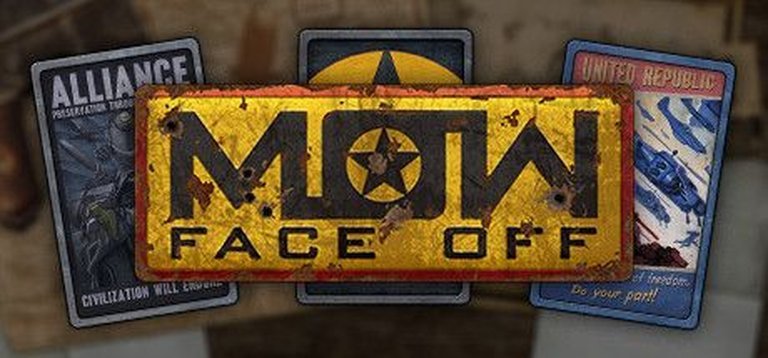
March of War: Face Off is a free-to-play spin-off collectible card game set in a geopolitical conflict between three factions: the United Republic (representing the USA and Canada), the European Alliance (representing Europe, Australia, and New Zealand), and the Shogun Empire (representing Japan, Korea, China, and Southeast Asia). Players engage in tactical battles on a 3×7 grid, using cards to deploy units, cast abilities like airstrikes, and manage a manpower system to destroy the opponent’s command center, with matches against AI at varying difficulties or other players, complemented by daily quests and a card-collecting economy.
Gameplay Videos
March of War: Face Off Guides & Walkthroughs
March of War: Face Off Reviews & Reception
mmohuts.com : March of War: Face Off blends the accessibility of a digital card battler with the positioning decisions of a compact, turn-based tactics game.
March of War: Face Off: A Post-Mortem for a Fallen Hybrid CCG
In the crowded annals of digital card games, few titles occupy as curious and tragically short-lived a niche as March of War: Face Off. Released into the simmering cauldron of the mid-2010s CCG boom, it arrived not as a purebred like Hearthstone or Magic: The Gathering Arena, but as a bold, awkward hybrid—a tactical war game grafted onto a card-drawing skeleton. Its sudden, unceremonious shutdown in early 2016 after less than a year of live service cemented its status as a ghost, a “what-if” whispered about in niche forums and preserved in the digital archives of a devoted, dwindling community. This review is not merely an assessment of a game that was, but an autopsy of a promising experiment undone by the harsh economics of the free-to-play era, based on a synthesis of its official documentation, critical reception, and the poignant recollections of its players.
Development History & Context: The ISOTX Gambit
March of War: Face Off was the brainchild of ISOTX, Inc., a Dutch independent studio previously known for the multiplayer shooter Iron Grip: Warlord. The studio’s larger ambition was the MMO turn-based strategy game March of War (2014), a sprawling, asynchronous strategy title set in an alt-history World War II/early Cold War conflict with a distinctive steampunk aesthetic. Face Off was conceived as a spin-off, a more accessible, faster-paced side-project designed to leverage the growing popularity of collectible card games (CCGs) while remaining true to the parent franchise’s setting and factions.
Built in Unity, the game entered Steam Early Access on April 10, 2015, and achieved a full release on July 16, 2015. The development context is crucial: this was a period of intense experimentation in the CCG space. While Hearthstone dominated with its streamlined, hero-centric design, other titles like Duelyst and Scrolls were exploring the “cards on a board” hybrid model. March of War: Face Off firmly planted its flag in this latter camp, aiming for a quicker, more tactical experience than its tabletop-inspired peers.
The technological constraints were those of a small indie studio. The visual style, while cohesive, was budget-conscious, relying on a limited set of isometric battlefield tiles, a small pool of unit sprites, and a UI that betrays its design for potential mobile ports (more on this later). The free-to-play business model was non-negotiable for visibility on Steam, but it would become the very chain that pulled the project under. ISOTX, a small company without the financial backing of a major publisher, was playing a high-stakes game. According to community post-mortems from the official (now defunct) Steam discussions, the studio filed for bankruptcy in late 2015/early 2016. The servers for both the main March of War and Face Off were permanently shut down on March 29, 2016, with no formal announcement, erasing the game’s progression data and online functionality overnight. The stated reason was an inability to pay for infrastructure, a cruel epitaph for a game whose entire reward loop was predicated on online persistence.
Narrative & Thematic Deep Dive: Where Depth Should Have Been
To call the narrative in March of War: Face Off “light” would be generous. The game is purely mechanics-driven; its story exists only in the lore fragments of its card text, the thematic names of its units, and its distinctive alt-history steampunk aesthetic. There is no campaign, no voice-acted dialogue, no overarching plot experienced by the player. The “narrative” is the cold calculus of the 3×7 grid.
Thematically, the game’s design philosophy evokes a specific historical and tactical mindset: Blitzkrieg. The core mechanic of winning via Domination Points—damage dealt each turn based on how far your units have penetrated into enemy territory—perfectly mirrors the doctrine of rapid, deep penetration to break an opponent’s will and rear areas. The resource system, Manpower, ramping from 1 to 12, mirrors an economy of escalation from skirmishes to armored divisions. The unit roster, featuring fast infantry, slow heavy tanks (with the “Slow” and “Fast” attributes directly impacting movement cost), artillery, and medics, creates a meta-narrative of combined arms warfare.
However, the game fails to build a compelling world around this framework. The factions—the United Republic (USA/Canada), European Alliance (Europe/Australasia), and Shogun Empire (Japan/Asia)—are geopolitical archetypes with no distinguishing lore presented in-game. They are deck-building choices, not narrative identities. The steampunk element is visually present in the art of certain units and the general aesthetic of “brass and gears” but is not integrated into the mechanics or storytelling. It is a thematic veneer, not a lived-in world. The absence of a single-player campaign or even flavor text-rich card descriptions means the game has no soul to speak of; it is a pure, sterile conflict of abstracted military units on a nondescript board.
Gameplay Mechanics & Systems: The Brilliant Core and the Rusty Gears
This is where March of War: Face Off achieves its only real greatness. The core gameplay loop is a masterclass in elegant, fast-paced design.
The Battlefield & Domination: The entire match occurs on a 3-row by 7-column grid. Each player’s Command Center (CC) sits at one end. The key innovation is the Domination Point (DP) system. Columns 2-7 from your perspective are numbered. At the start of your turn, every unit you have in a column inflicts damage on the enemy CC equal to that column’s number. A unit in column 7 (the enemy’s home row) deals 7 damage. Therefore, the primary objective is not to destroy enemy units (though that helps), but to push your army as deep as possible into the enemy’s backfield as quickly as possible. This reframes every decision: is it better to trade a weakened unit for an enemy blocker, or to spend a turn moving a fresh unit forward to secure another DP? It creates a game of tempo, positioning, and sacrificial pressure, more akin to a racing game than a traditional battle simulator. Matches are consistently 10-15 minutes.
Resources and Card Play: The resource is Manpower (MP), which resets each turn and increases by 1, capping at 12. The second player receives an “Extra Manpower” card for one turn, a standard but effective catch-up mechanic. Cards are played from a hand, costing MP. They fall into two main categories:
1. Unit Cards: Deployed in your front row (column 1) unless they have “Advance Deploy.” They can then move and attack. Movement (one tile) costs 1 MP for most units, but units have the Fast (free move) or Slow (requires extra MP to move) traits, which drastically alter their effective cost and strategic value. Attack does not cost MP. Units have Attack (damage dealt), Health, and a direction/range icon (cards in March of War are very chess-like in their attack cones).
2. Command Cards: Instant-effect support cards like Airstrikes, Artillery Barrages, Healing, Buffs, and Debuffs. These are the game’s “spells,” often used for cleanup after a push or to swing a key engagement.
Deckbuilding & Rarity: Decks contain exactly 30 cards, built from a single faction’s cards and a shared neutral pool. Card rarity dictates deck limits: Iron (common, 3 per deck), Bronze/Silver (uncommon, 2 per deck), Gold (rare, 1 per deck). According to the Steam store description, there were over 220-400 cards across three factions (the sources vary, suggesting ongoing addition). The crafting system (“Disintegrate” excess cards into Tokens to buy specific cards) was a direct response to the slow, duplicate-heavy pack economy.
The Fatal Flaws in the System:
* Tactical Narrowing: Despite the card pool, early gameplay is extremely homogenous. Starter decks for both available factions (the game planned 6 but only delivered 3) shared a massive overlap of generic “common” cards—basic infantry, light vehicles, medics. The initial dozen hours feel samey. While higher-tier cards add nuance, the core loop of “play unit, move unit forward, use Command card” remains stubbornly static. As the MMOs.com review astutely notes, it sits in an “awkward place”: not complex like Magic, not streamlined/skip-deckbuilding like Hero Academy, leaving it with “little variation in both factions and tactics.”
* The Medic Snowball: The Medic unit is a game-warping design. It cannot attack but contributes to DPs and, most importantly, can heal a friendly unit by a fixed amount each turn, stacking beyond the unit’s base health. This creates brutal, durable “anchor” units that define the mid-game, making Medic elimination a primary objective. While strategically deep, it also creates a dominant, repetitive meta.
* Progression & Economy: This is the game’s Achilles’ heel. As meticulously documented by MMOHuts and MMOs.com, the progression is opaque and unrewarding. The initial quest to unlock the second faction was generous, but afterward, objectives were “hidden,” appearing randomly as you played rather than as a clear list. You were left hoping you’d accidentally complete an unknown goal for a small gold payout. The card pack economy was brutal: early gold earnings bought cheap “Common” packs that vomited duplicates, many from the starter deck already owned. The coveted Bronze/Silver/Gold cards were locked behind packs costing 3,000 gold—a sum that took dedicated play to earn, creating a stark, discouraging power gap. The user review on RAWG bluntly calls it “pure P2W,” highlighting that a core design rule (at one point) prevented using a single card copy in multiple decks, artificially bloating the collection grind.
World-Building, Art & Sound: A Battlefield of Monotony
The presentation of March of War: Face Off is its most consistently criticized aspect, a serviceable but soul-crushing grind of sameness.
Visual Direction: The game is set on a single, static, isometric battlefield tile for all matches. It’s a clear, grey-brown “board” with minimal terrain features. The steampunk aesthetic is present in unit and card art—gritty, mechanical designs with brass and steam—but this is not reflected in the battlefield itself. There are no weather effects, no changing scenery, no interactive terrain. The two (later three) faction Command Centers are the only structural variation. This creates an immediate sense of repetition. The UI, as noted, feels designed for mobile (oversized buttons, “tap/click” tutorial text, reliance on click-and-drag), making PC navigation feel clunky and unpolished.
Sound Design: The audio is consistently labeled as “lackluster” and “inconsistent.” The soundtrack is generic military/industrial fodder that often drops out completely during matches, leaving only sparse sound effects. Unit voice lines are short, repetitive, and often accented grunts or single words (“Fire!”, “Advance!”). Critically, some actions lack sound feedback entirely, creating a flat, unresponsive feel. For a game about explosive pushes and barrages, the soundscape fails to generate excitement or impact.
The Faction Divide: The game’s biggest visual differentiator is faction. The United Republic uses more olive-drab, conventional Western gear. The European Alliance features distinct European and Commonwealth vehicle designs. The Shogun Empire (added later) brings in more angular, Japanese-inspired technology. However, with only three factions and a shared neutral pool, the overall deck-building identity is less pronounced than in games with deeper faction splits. The card backs are simply faction-colored with a logo, with no earned variations or customizations—a small but meaningful absence in an era where even Hearthstone used card backs as status symbols.
Reception & Legacy: A Fleeting Spark in a Crowded Market
Critical Reception was tepid and minimal. MobyGames records a 60% average from a single critic (Softpedia), which called it a “decent game with a good casual feel and average looks.” The more detailed reviews from MMOs.com and MMOHuts are tellingly mixed. Both praise the core gameplay loop as “fast-paced and fun” and an “easy to learn, hard to master mix.” MMOs.com even draws an apt comparison: it is “to Scrolls what Hearthstone is to Magic,” albeit less feature-rich. But both immediately pivot to its failures: the directionless progression, the repetitive scenery, the narrow tactical space, and the disappointing card economy.
Commercial & Community Fate: The game never achieved significant traction. Its player base remained small and niche. The shutdown in March 2016 was silent and total, a victim of its parent company’s insolvency. For years, it existed only as a ghost in the Steam library, clients forever stuck at 25% loading, unable to connect to servers that no longer existed.
However, this is where its legacy takes a poignant turn. As documented in the detailed Steam community FAQ from 2020 (and updated as late as 2025), a dedicated core of former players refused to let it die. They congregated on an unofficial Discord server (still active with ~600 members as of 2025) that functions as a museum, a support group, and a revival hub. The FAQ meticulously details the presumed total loss of user data, the prohibitive cost ($100,000) and technical debt of buying the dead IP from ISOTX’s likely defunct assets, and the status of spiritual successor projects (like “Avant Guarde” by Solace Workshop) and individual archival efforts (like Ryder104’s 3D asset rigging).
Its influence is subtle but real. March of War: Face Off was an early, clear attempt to merge the card-drafting/collection meta of CCGs with the spatial tactics of a board game. It directly inspired a specific niche of players who wanted “more skill, less RNG” than Hearthstone. The community’s grief and ongoing efforts mirror those of other fallen online games like City of Heroes or Tabula Rasa, proving that a game’s worth is not solely in its active player count, but in the meaningful experiences it provides and the memories it creates. It is a cautionary tale about the fragility of live-service games under small studios and the importance of transparent, fair progression systems.
Conclusion: The Elegant Casualty
March of War: Face Off is a profound study in contrasts. At its heart, it has one of the most brilliantly focused core loops in the hybrid CCG genre. The Domination Point system transforms the standard “reduce opponent’s health” into a dynamic, positional race that feels like a continuous, miniature campaign. Its matches are crisp, decisive, and often thrilling. For a time, it offered a unique, chess-like strategic experience accessible to newcomers.
Yet, this brilliance is encircled by rot. Its progression systems are opaque and punitive, designed to frustrate rather than reward. Its visual and auditory presentation is monotonous and technically suspect, failing to elevate the experience beyond a functional utility. Its business model and faction depth were too shallow to retain players in a hyper-competitive market. And ultimately, it was doomed by the financial collapse of its creator, a stark reminder of how little corporate stewardship matters for a free-to-play title.
Its place in history is that of a cult classic fallen before its time. It was not a bad game; it was a good game with catastrophic flaws in its live-service architecture. It proved that a card game could be truly tactical without being overly complex, but it also proved that without a compelling long-term chase, a satisfying economy, and a stable operational platform, even the smartest mechanics cannot ensure survival. The continued efforts of its community to archive, analyze, and revive it—years after its silent death—are the most powerful testament to the solid, if flawed, foundation that March of War: Face Off managed to build in its brief, intense life. It is a ghost worth remembering, not for what it became, but for the thrilling, tactical specter of what it could have been.
Final Verdict: 6.5/10 – A deeply flawed but mechanically innovative hybrid. Its core gameplay is worthy of study and replication, but its包裹 in a toxic progression shell and its abrupt, unceremonious demise make it a tragic footnote rather than a landmark. Seek it out only in archival projects or fan revivals to experience its unique tactical heartbeat.