
- Release Year: 1997
- Platforms: Windows
- Publisher: CDV Software GmbH, Marlboro Music IDE GmbH
- Genre: Simulation
- Perspective: Fixed / flip-screen
- Game Mode: Single-player
- Gameplay: Business simulation, Managerial, Music, rhythm
Description
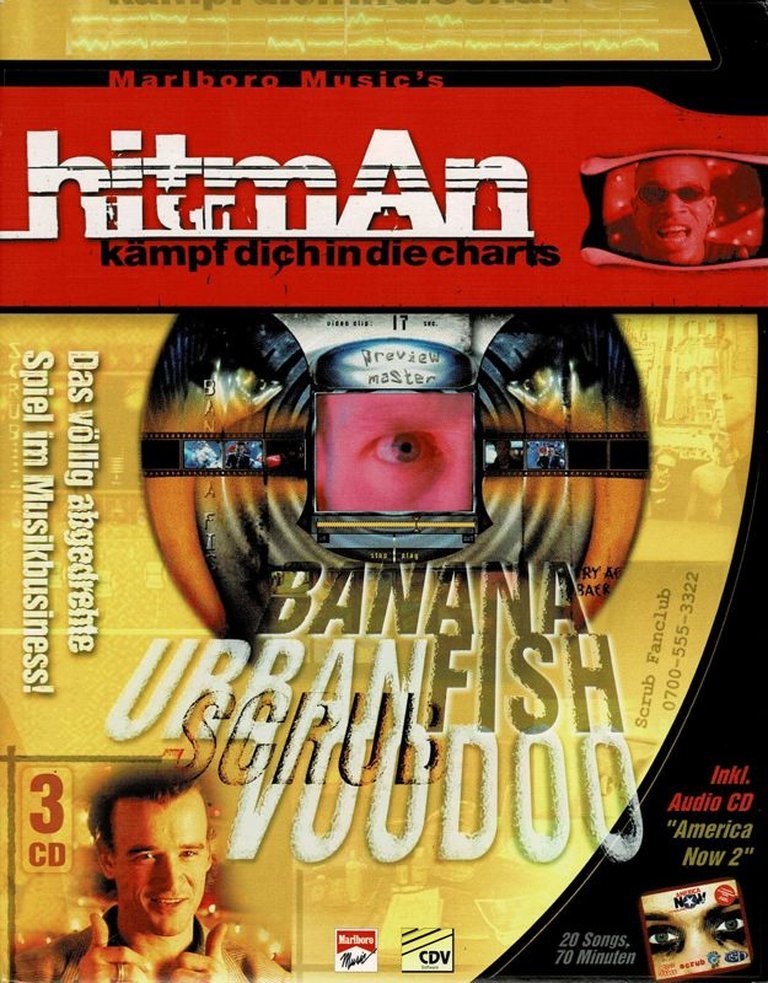
In Marlboro Music’s Hitman: Kämpf dich in die Charts, released in 1997 for Windows, players assume the role of a music manager overseeing three bands in the cutthroat music industry, organizing gigs, producing videos and demo tracks, and engaging in pivotal negotiations via interactive dialogs with three possible answers that shape the game’s outcome, accompanied by a bonus CD featuring 20 songs from bands like Scrub, Bananafish, Urban Voodoo, and Clockwise.
Marlboro Music’s Hitman: Kämpf dich in die Charts: Review
Introduction
Imagine stepping into the cutthroat world of 1990s rock ‘n’ roll management, where your sharp tongue in branching negotiations could launch unknown bands to stardom—or doom them to obscurity. Released in 1997 for Windows, Marlboro Music’s Hitman: Kämpf dich in die Charts (translated as “Fight Your Way to the Charts”) is a forgotten relic of the CD-ROM era, blending managerial simulation with interactive storytelling and real-world music licensing. As a music manager overseeing three up-and-coming bands, players navigate gigs, video productions, and demo tracks amid high-stakes deals. This obscure German title, developed and published by Marlboro Music IDE GmbH alongside CDV Software GmbH, captures the era’s optimism for multimedia simulations. My thesis: While technically primitive and narratively shallow by modern standards, Hitman stands as a pioneering, if flawed, experiment in music business tycoon games, deserving rediscovery for its authentic soundtrack and choice-driven progression that prefigures today’s indie management sims like Music Wars or Band Management.
Development History & Context
The Studios and Vision Behind the Beats
Marlboro Music’s Hitman emerged from Marlboro Music IDE GmbH, a niche German developer tied to the Marlboro brand’s music promotions, with co-publishing by CDV Software GmbH—a mid-90s powerhouse known for strategy titles. Added to MobyGames as recently as June 2024 (Moby ID: 225739), the game reflects a promotional vision: leveraging real bands (Scrub, Bananafish, Urban Voodoo, and Clockwise) via a bundled audio CD with 20 tracks. The “Hitman” moniker cleverly plays on “hit” songs rather than assassins, distancing it from IO Interactive’s later stealth series (despite algorithmic “related games” links on MobyGames to Hitman titles from 1984 onward).
Technological Constraints of 1997 PC Gaming
Developed for Windows on CD-ROM, the game adheres to era-specific specs: fixed/flip-screen visuals, point-and-click interface, and no age restriction (USK 0). This was peak CD-ROM hype—post-The 7th Guest multimedia boom but pre-3D acceleration dominance. Developers grappled with 640×480 resolutions, limited RAM (likely 8-16MB requirements), and DirectX precursors for basic animations. The included music CD suggests ambitious audio integration, using Red Book audio for full tracks playable outside the game, a luxury floppy-era sims lacked. Rhythm elements hint at early motion-capture or simple QTEs, constrained by non-accelerated 2D engines.
The Gaming Landscape: Simulations in a Strategy-Dominated Market
1997 saw Theme Hospital, Dungeon Keeper, and Fallout redefine management and RPGs, but music sims were rare—Music Maker tools existed, yet full tycoons like this were novelties. Germany’s scene (peaking with The Settlers II) favored sims, aligning with Hitman’s business focus. Amid Britpop and nu-metal rises (Blur vs. Oasis, early Korn), licensing real German/Euro acts positioned it as a cultural tie-in, though globalization favored US blockbusters like Quake II. Commercial release in Germany (EAN 4015756103277) targeted PC owners (booming at ~20% household penetration), but obscurity ensued—no patches, minimal ports.
Narrative & Thematic Deep Dive
Plot: From Garage Bands to Chart-Toppers
Players embody an unnamed music manager tasked with elevating three distinct bands: Scrub (punkish energy?), Bananafish (quirky pop?), Urban Voodoo (gritty urban rock?), and Clockwise (melodic alt-rock?). The story unfolds non-linearly via interactive dialogs—always three choices per negotiation—shaping band trajectories, finances, and rivalries. Success means sold-out gigs and video hits; failure invites bankruptcies or scandals. No overarching antagonist exists; tension stems from market volatility, echoing real 90s industry woes like label politics.
Characters: Archetypes with Branching Depth
- Your Bands: Scrub’s raw aggression demands aggressive deals; Bananafish’s whimsy suits creative risks; Urban Voodoo thrives on street cred; Clockwise needs polished production. Each has implied backstories via dialog trees, humanizing them beyond stats.
- NPCs: Promoters, label execs, and video directors populate encounters. Choices reveal personalities—e.g., bluffing a sleazy producer might unlock bonuses but risk blacklisting.
Dialogs, in German, emphasize rhetorical strategy: polite, aggressive, or cunning responses alter paths, prefiguring Papers, Please‘ moral dilemmas in a capitalist lens.
Themes: Capitalism, Creativity, and the Music Grind
At its core, Hitman satirizes the music biz as a zero-sum fight (“Kämpf dich in die Charts”). Themes include exploitation (bands as assets), luck vs. skill (random chart success), and negotiation as art—mirroring Ace Ventura or This Is Spinal Tap. Branching ensures replayability, with themes evolving: early optimism yields to burnout, critiquing fame’s hollowness. Subtle product placement (Marlboro branding) underscores commercialism, making it a time capsule of 90s tie-in gaming.
Gameplay Mechanics & Systems
Core Loops: Manage, Negotiate, Produce
The heartbeat is a managerial sim loop:
1. Band Oversight: Allocate resources to rehearsals, gigs, demos/videos.
2. Production Minigames: Simple rhythm-timed mixing? Produce tracks/videos via point-and-click interfaces.
3. Gigs: Book venues, balancing risk/reward (small club for safe cash vs. festival for fame).
Progression ties to chart positions, unlocking better deals.
Combat? No—Negotiation “Combat”
No literal fights; “Hitman” implies verbal battles. Dialog trees (3 options) form the crux:
– Option A: Safe, incremental gains.
– Option B: Risky, high rewards.
– Option C: Creative wildcard.
Outcomes branch the game world—bad choices tank morale/finances.
Progression, UI, and Flaws/Innovations
- Progression: Bands level via success (fame, skills); manage budget, contracts. Rhythm elements (sync beats?) add interactivity.
- UI: Point-and-select shines on fixed screens—intuitive menus for schedules, finances.
Innovations: Real audio CD integration for immersion; choice-driven sim predates The Movies.
Flaws: Repetitive loops, no saves mentioned, era-typical clunkiness (flip-screen navigation). No multiplayer or deep economy sim.
| Mechanic | Strengths | Weaknesses |
|---|---|---|
| Negotiations | Branching replayability | Limited depth (3 choices) |
| Production | Authentic music tie-in | Primitive minigames |
| Management | Balanced risk/reward | Shallow progression trees |
World-Building, Art & Sound
Setting: A Vibrant 90s Music Scene
The game’s world evokes gritty German clubs to glitzy studios—fixed/flip-screen views simulate offices, stages, charts. Atmosphere builds via progression: start in dives, ascend to arenas, fostering aspiration.
Visual Direction: Era-Appropriate Minimalism
2D art likely features static backgrounds with flip transitions, band portraits, and basic animations. Big box art (eBay glimpses: vibrant, chart-climbing motifs) promises flash unfulfilled by low-res sprites. No screenshots on MobyGames amplify mystique, but expect pixelated charisma akin to Lemmings.
Sound Design: The Star Feature
Bundled CD with 20 tracks from Scrub et al. elevates it—full songs for gigs/demos create radio-like immersion. In-game: MIDI overlays? Dialog voiceovers? Rhythm sync enhances production. Sound amplifies themes, turning management into a concert, though CD reliance risks skips on old drives.
These elements coalesce into a nostalgic haze: visuals constrain, but audio liberates, making Hitman feel alive.
Reception & Legacy
Launch: Commercial Obscurity, No Critical Wave
1997 release yielded zero critic/player reviews (MobyGames, GameFAQs, Metacritic blanks). Unrated Moby Score; collected by 1 player. German focus limited reach—no US/EU scores. eBay big boxes fetch €20-€100 (new/sealed rarities), signaling collector cult status.
Evolving Reputation: Cult Collector Curiosity
Post-2024 MobyGames entry sparked minor interest; OGDB lists as adventure/sim hybrid. No patches/influence claims, but ties to CDV’s legacy (later Praetorians). Modern lens: precursor to Rock Band management, Two Point Campus sims.
Industry Influence: Niche Footprint
Minimal direct impact—music sims evolved via Rockstar Games tools, not this. Yet, choice-based business sims echo in Stardew Valley contracts, Tyranny dialogs. As Marlboro promo, it exemplifies branded gaming pre-Fortnite collabs. Legacy: archival gem, urging preservation amid CD-ROM decay.
Conclusion
Marlboro Music’s Hitman: Kämpf dich in die Charts is no masterpiece—its sparse mechanics, dated tech, and absent reviews cement obscurity—but it carves a vital niche in sim history. Pioneering music management with real audio and branching negotiations, it distills 90s industry chaos into addictive loops, bolstered by era charm. For historians, it’s a collector’s white whale (hunt those €100 big boxes); for players, a quirky time machine. Verdict: 7/10—essential for sim enthusiasts, a footnote elsewhere, but undeniably Hitman material in video game history’s underbelly. Rediscover it; the charts await your fight.