
- Release Year: 2002
- Platforms: Windows
- Publisher: Planeta DeAgostini S.A.
- Developer: Sherwood Media S.L.
- Genre: Action
- Perspective: Side view
- Game Mode: Single-player
- Gameplay: Arcade, Shooter
- Setting: Futuristic, Sci-fi
- Average Score: 40/100
Description
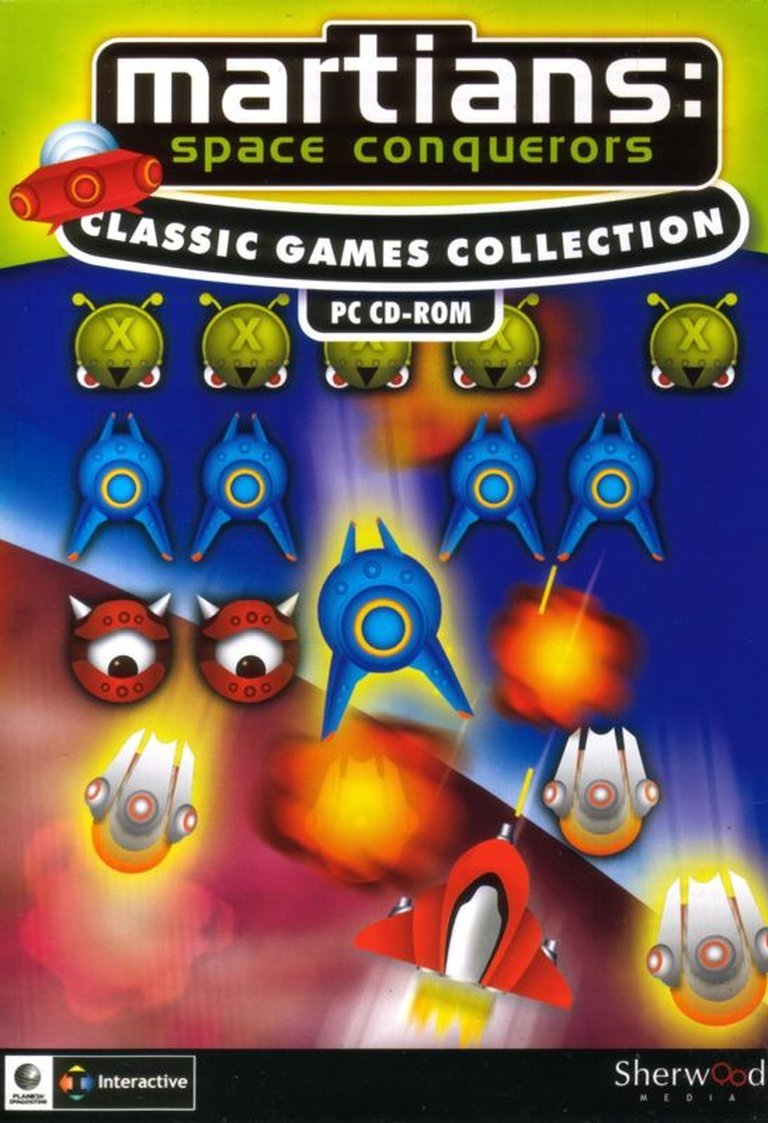
Martians: Space Conquerors is a sci-fi arcade shooter released in 2002, serving as a modernized take on the classic Space Invaders formula. Players control a starship defending against waves of Martian invaders, with key twists including upgradeable weapons by shooting UFOs and enemy ships that break formation to perform kamikaze attacks. The game features improved graphics and sound over its predecessors, along with a high-score table tracking the top seven players.
Martians: Space Conquerors Reviews & Reception
mobygames.com (40/100): Average score: 2.0 out of 5
windowsgamereviews.blogspot.com : Lo único que salva al programa es su jugabilidad directa, sobre todo para quién guste de los “matamarcianos” de este estilo, ya que Martians (al igual que “Space Invaders”) es harto repetitivo.
Martians: Space Conquerors – A Forgotten Relic of the Space Invaders Legacy
Introduction: The Clone That Couldn’t Escape the Shadow
In the vast cosmos of video game history, few titles are as simultaneously revered and overlooked as Martians: Space Conquerors. Released in 2002 by Spanish developer Sherwood Media and published by Planeta DeAgostini, this game is, at its core, a Space Invaders clone—one of countless attempts to recapture the magic of Taito’s 1978 masterpiece. Yet, buried beneath its derivative premise lies a curious artifact: a game that, despite its modest ambitions, offers a fascinating glimpse into early 2000s indie development, the limitations of Flash-based gaming, and the enduring appeal of arcade shooters.
This review will dissect Martians: Space Conquerors in exhaustive detail, examining its development context, mechanical tweaks, aesthetic choices, and the reasons behind its near-total obscurity. Was it a bold reinvention, a lazy cash-grab, or something in between? And why, despite its flaws, does it still hold a strange allure for retro enthusiasts?
Development History & Context: A Spanish Arcade Experiment
The Studio Behind the Game: Sherwood Media’s Obscure Legacy
Sherwood Media S.L., the Spanish studio responsible for Martians: Space Conquerors, remains one of the more enigmatic developers of the early 2000s. Little is known about their broader catalog, but their work on this title suggests a small team working within tight constraints. The game was published by Planeta DeAgostini, a company better known for educational software and magazine collections than groundbreaking video games. This partnership hints at Martians being a budget-friendly project, likely aimed at casual audiences rather than hardcore gamers.
Technological Constraints: The Flash-Based Curse
One of the most defining—and limiting—aspects of Martians: Space Conquerors is its engine: Macromedia Flash. By 2002, Flash was already a popular tool for web-based games, but it was rarely used for commercial retail releases. The choice of Flash imposed severe restrictions:
– Performance Issues: Animations were choppy, and sprite movement lacked the smoothness of native executables.
– Visual Fidelity: The game’s graphics, while colorful, suffered from a lack of integration between sprites and backgrounds, giving it an amateurish, “pasted-together” look.
– Sound Design: Audio was tinny and occasionally distorted, a common flaw in early Flash games.
This technical foundation ensured that Martians would never compete with contemporary arcade shooters like Ikaruga or Radiant Silvergun, but it also gave the game a distinct, almost handcrafted charm.
The Gaming Landscape of 2002: A Crowded Shooter Market
2002 was a golden year for shooters, but not for Space Invaders clones. The market was dominated by:
– Bullet-hell shooters (Ikaruga, Mushihimesama)
– 3D space combat (Freespace 2, Star Wars: Rogue Squadron II)
– Innovative indie experiments (Cave Story, Warning Forever)
In this environment, Martians: Space Conquerors was an anachronism—a throwback to an era when fixed-screen shooters ruled arcades. Its existence speaks to a niche audience that still craved simplicity over complexity.
Narrative & Thematic Deep Dive: The Minimalist Invasion
Plot: A Story Told in Three Words
Martians: Space Conquerors has no formal narrative. The title itself is the entire premise: Martians are invading, and you must stop them. There are no cutscenes, no dialogue, and no lore—just pure, unadulterated arcade action. This minimalism is both a strength and a weakness:
– Strength: The game wastes no time on exposition, diving straight into gameplay.
– Weakness: Without any context, the experience feels hollow compared to contemporaries like Stalin vs. Martians (2009), which at least attempted satire.
Themes: Cold War Paranoia Meets Retro Futurism
While the game lacks explicit storytelling, its themes are deeply embedded in its aesthetic:
– The Alien Threat: A classic sci-fi trope, evoking 1950s B-movies and War of the Worlds.
– Humanity’s Last Stand: The lone spaceship defending Earth is a recurring motif in arcade shooters, reinforcing the player’s role as the sole hero.
– Repetition as Survival: The endless waves of enemies mirror the cyclical nature of arcade gaming itself—survive, score, die, repeat.
Characters & Enemies: A Bestiary of Pixelated Invaders
The game features four types of Martian ships, each with distinct behaviors:
1. Standard Drones – Basic enemies that move in formation.
2. Kamikaze Attackers – Break from formation to dive-bomb the player.
3. UFOs – Appear at the top of the screen, offering weapon upgrades if destroyed.
4. Boss-Like Entities – Larger, faster enemies that emerge in later waves.
The player’s ship is a generic red fighter, devoid of personality but functional. The lack of character customization or progression reinforces the game’s arcade roots.
Gameplay Mechanics & Systems: A Clone with Minor Innovations
Core Gameplay Loop: Space Invaders, But Slightly Different
At its heart, Martians: Space Conquerors is a fixed-screen, horizontal shooter with the following mechanics:
– Movement: The player’s ship moves left and right along the bottom of the screen.
– Shooting: A single fire button, with no alternate weapons by default.
– Enemy Patterns: Martians move in a grid, descending incrementally as they reach the screen’s edge.
The Two “Innovations”
The game’s MobyGames entry highlights two key additions:
1. Weapon Upgrades via UFOs
– Destroying UFOs grants temporary power-ups, such as wider shots or rapid fire.
– This mechanic borrows from Galaga (1981), where bonus ships could enhance gameplay.
2. Kamikaze Enemies
– Some Martians break formation to charge directly at the player, adding unpredictability.
– This was already a staple in Galaxian (1979), making it less of an innovation and more of an homage.
Progression & Difficulty: A Punishing Curve
- No Levels, Just Waves: The game is a single, endless gauntlet with increasing enemy speed and aggression.
- Lives System: Players start with a set number of lives, and losing all of them ends the game.
- High Score Table: The only persistent progression is competing for the top seven scores.
Flaws in Design: Where the Clone Stumbles
- Repetition: Without level variety or boss fights, the game becomes monotonous quickly.
- Lack of Depth: No power-ups persist between lives, making long sessions feel unrewarding.
- Collisions Feel Unfair: Hitboxes are imprecise, leading to cheap deaths.
World-Building, Art & Sound: A Budget Sci-Fi Aesthetic
Visual Design: Flash’s Limitations on Display
- Sprites: The Martian ships are colorful but simplistic, with minimal animation.
- Backgrounds: A static starfield with a moon-like planet, offering no sense of depth.
- Explosions: Basic, repetitive particle effects that lack impact.
Sound & Music: The Tinny Soundtrack of War
- Sound Effects: Laser blasts and explosions are low-bit and repetitive.
- Music: A single, looping chiptune track that grows grating over time.
Atmosphere: A Lonely Battle in the Void
The game’s minimalist presentation creates an isolated, almost meditative experience. There’s no story, no distractions—just the player and the endless Martian horde. This purity is both its greatest strength and its biggest flaw.
Reception & Legacy: The Game That Time Forgot
Critical & Commercial Reception: A Non-Entity
- No Metacritic Reviews: The game was completely ignored by major critics.
- Player Score on MobyGames: 2.0/5 (based on a single rating).
- Obscurity: It was exclusively released in Spain, limiting its reach.
Why Did It Fail?
- Market Saturation: By 2002, Space Invaders clones were a dime a dozen.
- Technical Limitations: Flash was not ideal for a retail shooter.
- No Innovation: The “new” mechanics were already decades old.
Legacy: A Cult Curiosity
Despite its flaws, Martians: Space Conquerors has found a small but dedicated following among:
– Retro arcade enthusiasts who appreciate its simplicity.
– Flash game historians studying early 2000s indie development.
– Speedrunners (though the game’s lack of depth makes this niche).
Conclusion: A Relic Worth Preserving, But Not Celebrating
Martians: Space Conquerors is not a great game—it’s barely even a good one. It’s a flawed, forgettable clone that adds almost nothing to the Space Invaders formula. Yet, in its very mediocrity, it becomes fascinating. It’s a time capsule of an era when small studios could still release unpolished passion projects, when Flash was a viable (if flawed) game engine, and when the shadow of arcade classics loomed large over every shooter.
Final Verdict: 4/10 – “A Historical Footnote”
- For Hardcore Fans: A minor curiosity, worth a quick play for completionists.
- For Casual Gamers: Skip it—there are far better shooters from the era.
- For Historians: A case study in how not to modernize a classic.
Martians: Space Conquerors is not a lost masterpiece—it’s a reminder of how difficult it is to escape the gravity of gaming’s greatest icons. And sometimes, that’s enough.