
- Release Year: 2016
- Platforms: Windows
- Publisher: Awesome Enterprises
- Developer: Awesome Enterprises
- Genre: Action
- Perspective: Diagonal-down/Side view
- Game Mode: Single-player
- Gameplay: Shooter
Description
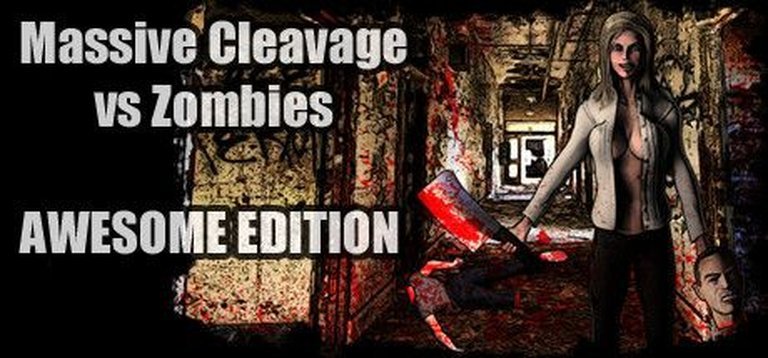
Massive Cleavage vs Zombies: Awesome Edition is an action shooter developed by Awesome Enterprises, featuring a female protagonist with exaggerated physical attributes battling hordes of zombies in a campy, B-movie-inspired setting. With a diagonal-down, side-view perspective and direct control, the game offers frantic, over-the-top combat in a zombie apocalypse scenario, emphasizing humor and parody within its indie action framework.
Gameplay Videos
Where to Buy Massive Cleavage vs Zombies: Awesome Edition
Massive Cleavage vs Zombies: Awesome Edition: A Case Study in Intentional Camp and the Limits of the Steam Greenlight Era
Introduction: The Unlikely Artifact
In the vast, often-forgotten archives of digital distribution, few titles embody the chaotic, anything-goes spirit of the early Steam Greenlight era with such unapologetic, chest-thumping fervor as Massive Cleavage vs Zombies: Awesome Edition (2016). Developed and published by the singular entity Awesome Enterprises, this game is not merely a product; it is a provocation, a minimalist manifesto scribbled in the margins of gaming’s mainstream. Its thesis, stated outright in its official description, is one of pure, unadulterated id: “Your mission is to find BBQ sauce for your people and bring it back to them. Fighting off thousands of zombies with only your massive cleaver and equally massive cleavage.” This review will argue that Massive Cleavage is a deliberately absurdist work, a game that weaponizes its own technical and creative shortcomings to create a unique, if deeply flawed, experience that serves as a perfect time capsule of a specific,不那么serious moment in indie game development. Its legacy is not one of influence on mechanics or narrative, but as a stark example of how low barriers to entry could yield works that existed purely for the sake of a概念—a concept built on hyperbole, bodily humor, and the relentless pursuit of “awesome.”
Development History & Context: The One-Man (or Entity) Band in the Greenlight Gold Rush
The development history of Massive Cleavage is, fittingly, as obscure as the game itself. The credits, per MobyGames and Steam, list only “Awesome Enterprises” as both developer and publisher. There is no lead designer, no programmer, no artist named. This monolithic branding suggests a solo developer or a very small collective operating under a deliberately generic, boastful pseudonym. The game was built in Unity, the engine that Democratized development but also enabled a tidal wave of asset-store-driven, rapidly produced titles.
The year 2016 was the tail end of the Steam Greenlight initiative (discontinued in 2017), a period marked by a flood of games with titles designed to shock, amuse, or simply capture traffic through sheer audacity. Games like Goat Simulator had proven that physics-based absurdity could find an audience, while the成功后 of low-budget “survival horror” and “zombie” titles on Steam created a saturated market. Into this milieu, Massive Cleavage launched on July 8, 2016, at a price point of $0.99, later dropping to $0.49. Its original version, simply Massive Cleavage vs Zombies, had released in 2014 on Xbox 360, Windows, and Ouya, suggesting Awesome Edition was a refinement or expansion for a broader PC audience.
The technological constraints were self-imposed. The game’s aesthetic is pure low-fidelity 2D, with a diagonal-down, side-view perspective that recalls 90s arcade brawlers like Final Fight but rendered with a crudeness that is either a budgetary necessity or a deliberate stylistic choice. The shift to 3D zombie models in later levels, as described by the developer in the Steam store blurb (“…in the later half of the game I added new levels where you hack and slash (or shoot) 3D zombies!! Pretty brilliant right? I think so.”), is not a technical showcase but a jarring, almost surreal, gameplay pivot that highlights the developer’s resourcefulness (or lack thereof) in cobbling together a “varied” experience from whatever assets were available.
Narrative & Thematic Deep Dive: BBQ Sauce, Bodily Autonomy, and Satirical Excess
The narrative of Massive Cleavage is a skeletal framework upon which to hang its mechanical and thematic hooks. The plot, such as it is: a female protagonist (never named, never fleshed out) must retrieve BBQ sauce for her “people.” Who these people are, why they require this specific condiment, and what world necessitates such a quest is never explained. This is not a story-driven game; it is a premise-driven one. The “people” are an abstract collective, and the BBQ sauce is a MacGuffin of monumental, almost existential importance.
Thematically, the game operates on a razor’s edge between satire and sincere titillation. The title itself—Massive Cleavage vs Zombies—is a formulaic mashup of two potent pop-culture anxieties: the undead apocalypse and female sexuality. The protagonist’s defining characteristic, her “massive cleavage,” is not a nuanced exploration of body image but a literalized game mechanic. The official description posits it as a weapon (“equally massive cleavage”), blending the objectification of the female form with the power fantasy of the zombie slayer. This can be read as a deliberately over-the-top parody of the hyper-sexualization prevalent in 2000s action games (e.g., Dead or Alive), pushing the trope to such a ridiculous extreme that it becomes a cartoon. Alternatively, it can be read as a crass, juvenile exploitation piece designed primarily for shock value and a specific niche audience.
The dialogue and flavor text, as glimpsed in achievement names like “Meet a Mexican (but dom’t tell president Trump)” and “Eat a Mexican,” reveal a further layer: a brand of dark, internet-era, intentionally offensive humor. This is not sophisticated satire; it is the humor of the anonymous imageboard, relying on stereotype and provocative non-sequiturs. Thematically, the game suggests a worldview of violent, absurdist Darwinism where survival depends on brute force and the only moral imperative is fetching a specific brand of barbecue condiment. It is a satire of the serious, self-important zombie survival genre, replacing heartfelt stories of loss and community with a quest for a tasty sauce.
Gameplay Mechanics & Systems: Arcade Repetition and a Flawed Pivot
Massive Cleavage presents its core loop with minimalist clarity. The player controls the protagonist from a diagonal-side perspective in 2D arenas. The controls are limited to move left/right, high attack, low attack, and presumably a jump or special function (the “cleaver-merang” emoticon suggests a thrown weapon). The official description states: “it starts you off with an easy amount of zombies to re-kill. But each level adds more and more zombies, and eventually dogs that will chew your face off in a couple seconds.”
This is the entire gameplay proposition: a horde survival test in the tradition of Smash TV or Left 4 Dead‘s “holdout” moments, but compressed into single-screen or scrolling arena bouts. Progression is purely about enduring escalating numbers and enemy types (standard zombies, faster dogs). The “Awesome Edition”’s notorious twist is its abrupt shift to 3D third-person shooter segments in the “later half.” Community discussions frequently reference “top down videos” and bugs in these sections (e.g., “Level 20,” “Level 23 bugged”). This pivot is the game’s most infamous mechanical decision—a jarring transition from a simple 2D brawler to a likely clunky, asset-store-quality 3D shooter. It was intended, per the developer, to “give them a break from the repetitiveness,” but for players, it often represented a leap into frustrating, poorly-executed new mechanics, a sudden spike in difficulty or confusion that broke the established flow.
The progression system is virtually non-existent. There is no skill tree, no meaningful weapon upgrades beyond the cleaver (and perhaps guns in 3D sections), no armor. The only progression is the player’s skill in pattern recognition and the game’s cruel escalation of enemy counts. The UI is functional, likely displaying score, health (if present—many such arcade-likes use a one-hit-kill model), and perhaps a counter for BBQ sauce collection. The innovative aspect is purely conceptual: the brazen, almost performance-art decision to blend 2D brawling with 3D shooter poorly. The flawed systems are legion: repetitive feedback (chopping the same zombie model hundreds of times), likely hitbox inconsistencies (achievement names like “You Missed” and “You Missed A LOT!” imply unreliable hit detection), erratic difficulty spikes, and the profoundly awkward transition between 2D and 3D perspectives. The game is a critique of its own simplicity by virtue of its own inability to sustain interest without resorting to a gimmicky format shift.
World-Building, Art & Sound: Low-Budget Aesthetic as Aesthetic
The world of Massive Cleavage is a series of nondescript, grimly rendered backdrops—alleyways, graveyards, city streets—that offer zero environmental storytelling. The visual direction is defined by its low-poly, minimal-detail character models and environmental assets, typical of a mid-2010s Unity project utilizing stock or basic models. The protagonist is a exaggerated female form, her “massive cleavage” a geometrically simplistic, cartoonish feature that dominates her sprite/model. The zombies are the standard shuffling, tattered-cloth models. The art does not aim for horror or beauty; it aims for a crude, comic-book readability that matches the game’s tone of absurdity.
The sound design is largely unremarked upon in the available sources, a common trait for ultra-budget titles. It likely consists of basic, repetitive sword-chopping sounds, zombie moans sampled from common sound libraries, and perhaps a looping, overly energetic rock or metal track that clashes with the on-screen carnage. The atmosphere is not one of dread or tension, but of chaotic, mindless action. The lack of polish in the art and sound paradoxically reinforces the game’s campy, ironic charm. It’s so visibly cheap that it disarms the player; you cannot expect fidelity, so you engage with it on the level of a juvenile doodle come to life. This aesthetic is the game’s strongest unifying element—everything looks and sounds like it was made by one person in a weekend, which, for the right audience, becomes part of the appeal.
Reception & Legacy: The Mixed Bag of a Curiosity
At launch and in the years since, Massive Cleavage has existed in a state of polarized obscurity. Steam reviews, as analyzed by aggregators like Steambase (Player Score 49/100 from 207 reviews), reveal a classic split. Positive reviews (approx. 49%) cite its campy charm, funny moments, and value for money at deep discount. Players who “get” the joke find it an entertaining, silly diversion. Negative reviews (approx. 51%) decry its repetitive gameplay, poor controls, bad graphics, and awkward humor. The achievement data (from completionist.me) shows very low unlock rates for grind-heavy achievements like “Animal Lover” (kill 1000 dogs – 6.8% global) and “This is now a kid free zone” (kill 1000 zombie kids – 6.7%), suggesting many players abandon it before the notorious end-game grind.
Its commercial performance is, like its development history, unrecorded but presumed minimal. It was likely bundled in “indie bundles” (a Steam forum post mentions “part of the indie gala bundle”), sold at rock-bottom prices, and existed primarily as a curiosity. Its legacy is not one of direct influence—no major studio has cited it as an inspiration. Instead, its legacy is as a textual artifact of the Steam Greenlight ecosystem. It represents the extreme end of the spectrum: a game whose entire identity is a provocative title and a simple, repetitive loop, sustained by a minuscule budget and a concept that could be explained in a single sentence. It is a descendant of the “bait” title—games designed to generate clicks, controversy, or simple bewilderment. It lives in the same conversation as *Big Rigs: Over the Road Racing or Where the Water Tastes Like Wine’s “The Shard” sequence—not for quality, but as a demonstration of what the platform’s open gates could let through.
Conclusion: An Awful, Brilliant, Utterly Forgotten Relic
Massive Cleavage vs Zombies: Awesome Edition is not a good game by any conventional metric. Its narrative is non-existent, its mechanics are rudimentary and repetitive, its technical execution is poor, and its humor is puerile and likely offensive to many. Yet, to dismiss it entirely is to miss its peculiar, accidental genius. It is a game that perfectly realizes a single, stupid idea: what if you fought zombies with a giant meat cleaver while your breasts were your secondary weapon? It executes this idea with the minimum viable product, then awkwardly grafts on a 3D section because the developer thought more was better, not realizing that coherence is a virtue.
Its place in video game history is not on a pedestal but in a cabinet of curiosities. It is a document of its time—a period when a person with basic Unity skills and a provocative concept could see their game on the world’s largest storefront. It embodies the double-edged sword of democratization: limitless creativity coupled with a flood of derivative, low-effort content. For the cultural historian, it is a fascinating data point, a conversation starter about taste, boundaries, and the economics of micro-pricing. For the player, it is a 50-cent lesson in managing expectations, a game to be consumed with the right mix of irony and forgiveness. In the end, Massive Cleavage vs Zombies: Awesome Edition achieves a strange kind of success: it is exactly what it set out to be, and in that absolute, unyielding commitment to its own awfulness, it becomes, against all odds, a little bit awesome.