
- Release Year: 2011
- Platforms: Windows
- Genre: Compilation
- Perspective: 2D
- Game Mode: Single-player
- Gameplay: Match-3, Puzzle
Description
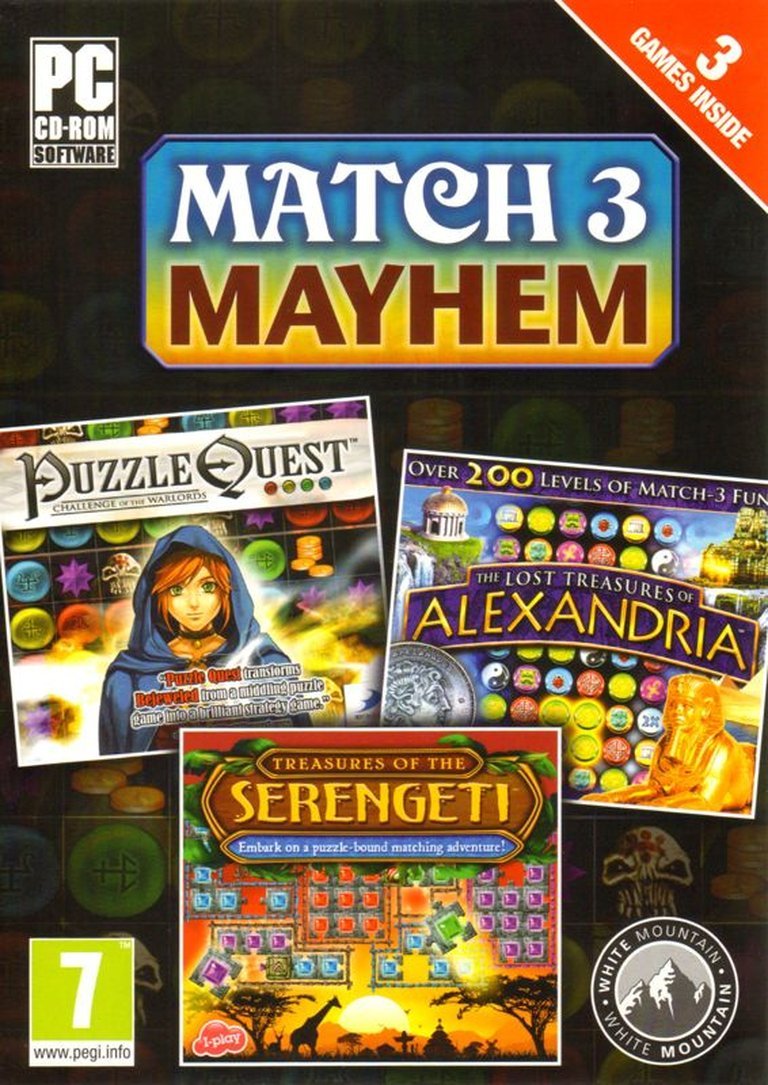
Match 3 Mayhem is a 2011 Windows compilation that bundles three match-3 puzzle games: The Lost Treasures of Alexandria, Puzzle Quest: Challenge of the Warlords, and Treasures of the Serengeti. Players install Puzzle Quest directly to their hard drive, while the other two games require playing from the disc, offering a diverse collection of tile-matching challenges across ancient, fantasy, and safari-themed settings.
Match 3 Mayhem: Review
Introduction
In the ever-evolving landscape of puzzle gaming, few genres have achieved the ubiquity and cultural saturation of the match-3. From its humble origins in the 1980s to the global phenomenon of Candy Crush Saga, the match-3 formula has proven remarkably resilient, adaptable, and profitable. Yet, while the genre often appears synonymous with casual mobile titles, its history is punctuated by ambitious experiments that transcended simple mechanics. One such artifact is Match 3 Mayhem, a 2011 compilation for Windows that bundled three distinct titles: The Lost Treasures of Alexandria, Puzzle Quest: Challenge of the Warlords, and Treasures of the Serengeti. More than a mere collection of games, Match 3 Mayhem serves as a microcosm of the match-3 genre’s evolution—from abstract puzzles to narrative-driven RPG hybrids and visually driven sagas. This review examines its significance through the lens of its historical context, thematic depth, mechanical innovation, and enduring legacy, arguing that while the compilation itself is a product of its time, its components collectively represent a critical juncture where match-3 games began their ascent toward mainstream dominance and artistic maturity.
Development History & Context
Match 3 Mayhem emerged in 2011, a year defined by seismic shifts in the gaming industry. The Nintendo 3DS had just launched, marking the dawn of the eighth generation of consoles, while mobile gaming was exploding into a $4B market dominated by match-3 titles like King’s Candy Crush Saga—released just months prior. Technologically, Windows PC gaming remained a stronghold for digital distribution, though CD-ROMs still persisted as a physical medium for niche compilations. The studio behind Match 3 Mayhem remains obscure in the public record, but its selection of titles reveals a deliberate curatorial vision: to showcase the genre’s versatility.
The compilation featured three games with distinct development histories:
– Puzzle Quest: Challenge of the Warlords (2007) by Infinite Interactive: This Australian-developed title revolutionized the genre by merging match-3 mechanics with RPG progression. Its success—inspired by Bejeweled and the Warlords series—pioneered the “match-3 combat” system, where grid-clearing actions fueled attacks and magic. Acquired by D3 Publisher, it laid groundwork for mobile giants like Puzzle & Dragons.
– The Lost Treasures of Alexandria and Treasures of the Serengeti: These titles, likely developed by smaller studios (e.g., Gamehouse for Alexandria), typified the era’s casual match-3 boom. Alexandria, an ancient Egypt-themed adventure, emphasized hidden-object puzzles and tile-matching, while Serengeti focused on African wildlife-themed matching with time-limited challenges. Both relied on the “swap-and-collapse” mechanics popularized by 1994’s Shariki, the undisputed “granddaddy of match-3,” which established the core swap-adjacent-tiles-to-form-lines-of-three template.
Technologically, Match 3 Mayhem reflected the era’s constraints. Only Puzzle Quest allowed full hard-drive installation, while the other two required disc-based play—a relic of pre-digital distribution norms. The compilation itself was an artifact of a transitional period, as the PC market shifted toward digital storefronts like Steam, and mobile platforms began to eclipse physical media. In 2011, the match-3 genre was already a titan, with Bejeweled (PopCap, 2001) having reached 500 million players and Puzzle & Dragons (GungHo, 2012) on the cusp of becoming the first mobile game to generate $1B in annual revenue. Match 3 Mayhem captured this moment of explosive growth, bundling past innovations and present trends into a single package.
Narrative & Thematic Deep Dive
While match-3 games are often dismissed as mechanically sterile, Match 3 Mayhem‘s titles reveal how narrative and theme can elevate the genre from distraction to storytelling medium. Each game employs its narrative differently, from broad adventure to intimate RPG quests.
-
The Lost Treasures of Alexandria: Framed as an archaeological adventure, the game follows a scholar uncovering artifacts across Egyptian ruins. Its narrative is light on dialogue but rich in thematic motifs: the allure of antiquity, the clash between preservation and exploitation, and the thrill of discovery. Levels are structured as “excavations,” where players match tiles to clear debris and uncover relics—a metaphor for piecing together history. The theme is educational yet escapist, reflecting the 2000s trend of casual games blending learning with entertainment.
-
Puzzle Quest: Challenge of the Warlords: This compilation’s centerpiece boasts the most ambitious narrative. Set in a high-fantasy realm, players assume the role of a hero battling demonic forces across a continent. The plot unfolds through dialogue-heavy quest hubs, branching storylines, and character-driven encounters. Its themes revolve around redemption, sacrifice, and the corrupting influence of power, with the match-3 combat serving as a tangible manifestation of magical duels. Characters like the fallen knight Valerius and the sorceress Areana add depth, while moral choices (e.g., sparing or executing enemies) tie player actions to narrative consequences—a rarity for the genre at the time.
-
Treasures of the Serengeti: Thematically, this title is the most grounded. It transports players to African savannas, where they help a researcher photograph endangered species by clearing tiles to create safe paths for wildlife. The narrative emphasizes environmental conservation, with levels featuring elephants, lions, and rhinos. Dialogue is minimal but purposeful, stressing the fragility of ecosystems. Its “saga” progression—unlocking new areas as players advance—mirrors the map-based storytelling that would define Candy Crush Saga and its successors.
Collectively, these games illustrate the genre’s thematic maturation. Alexandria uses history for atmosphere, Puzzle Quest for weighty fantasy, and Serengeti for ecological messaging. By 2011, match-3 was no longer just about matching gems; it was about weaving mechanics into meaningful experiences—a precursor to the story-driven hits like Gardenscapes (2016).
Gameplay Mechanics & Systems
Match 3 Mayhem encapsulates the mechanical diversity of the match-3 genre, from classic tile-swapping to RPG integration. Each title offers distinct systems, yet all share the foundational “swap adjacent tiles to form lines of three or more” rule pioneered by Shariki (1994).
-
The Lost Treasures of Alexandria: Adheres to traditional match-3 conventions. Players swap tiles to clear entire rows, with power-ups like “Lightning Bolts” (clearing a column) or “Bombs” (clearing a 3×3 area). Its innovation lies in level objectives: instead of just scoring points, players must collect specific artifacts (e.g., scarabs) within move limits. This introduced strategic depth, forcing players to prioritize matches over combos. The UI is utilitarian, with a bottom toolbar for power-ups and a progress bar tracking excavation goals.
-
Puzzle Quest: Challenge of the Warlords: This is the compilation’s mechanical crown jewel. It translates RPG progression into match-3 actions:
- Combat: Matching skulls damages enemies; mana gems cast spells; skulls and gems generate “turns” for special abilities.
- Character Progression: Players earn XP after battles, leveling up stats (e.g., attack, defense) and unlocking skills. Equipment (swords, armor) augments abilities, adding metagame depth.
- Quests & Exploration: A world map connects battles to NPC interactions, side quests (e.g., rescuing villagers), and resource gathering (e.g., alchemy for potions).
The system is seamless: a failed match still contributes to turn-based combat, creating tension between offensive and defensive plays. However, its complexity could overwhelm casual players, a flaw mitigated by its inclusion in a compilation alongside simpler titles.
-
Treasures of the Serengeti: Focuses on speed and precision. Timed challenges require players to clear tiles before wildlife reaches obstacles. Mechanics include “Animal Tokens” that unlock new species when matched, and “Photo Power-ups” that freeze the clock. Its level design emphasizes environmental storytelling—matching vines to clear a path for a lion, for instance. Unlike Alexandria, it lacks narrative depth but excels in bite-sized, replayable objectives.
Innovations and Flaws:
Match 3 Mayhem’s greatest strength is its mechanical breadth. Puzzle Quest’s RPG fusion was revolutionary, foreshadowing Puzzle & Dragons’ success. Its flaws, however, are equally telling. Alexandria and Serengeti suffer from repetitive level design, a genre-wide issue pre-dating the “saga” progression popularized by Candy Crush. The compilation’s disc-only restriction for two titles also highlights technological limitations, hindering accessibility in an era where digital downloads were ascendant.
World-Building, Art & Sound
The visual and audio design of Match 3 Mayhem’s titles reflects their thematic ambitions, transforming match-3 from a sterile exercise into a sensory experience.
-
The Lost Treasures of Alexandria: Its art leans into historical romance, with hieroglyph-adorned tiles and desert-themed backgrounds. Characters are rendered in a cartoonish style, evoking adventure films like The Mummy. Sound design is functional—clicks for tile swaps, triumphant fanfares for artifact completions—but lacks immersion. The world-building is superficial; Egypt serves as a backdrop rather than a lived space.
-
Puzzle Quest: Challenge of the Warlords: This title boasts the most cohesive art direction. Dark fantasy aesthetics dominate: gothic castles, fiery battlefields, and menacing creatures. Character sprites are detailed, with armor gleaming and magic pulsing during combat. The UI is RPG-inspired, with health bars and skill trees integrated into the match-3 grid. Sound design elevates tension: clash-metal for attacks, ethereal chimes for spells, and ominous ambient music for dungeons. Its world-building extends beyond visuals; lore entries in the codex flesh out the Warlords universe, making quests feel consequential.
-
Treasures of the Serengeti: Vibrant and organic, its art captures the Serengeti’s beauty: golden grasslands, acacia trees, and sun-drenched skies. Animals are stylized but recognizable, with elephants trumpeting and cheetahs sprinting between matches. Sound design emphasizes nature: birdsong, rustling leaves, and animal calls. The atmosphere is serene, contrasting with the frantic energy of timed modes.
Atmosphere and Cohesion:
While Puzzle Quest achieves the strongest thematic consistency, Match 3 Mayhem as a whole demonstrates how art and sound can ground abstract mechanics. Alexandria’s Egyptian motifs and Serengeti’s safari palette prove that match-3 need not be generic. Yet, the compilation’s lack of unifying branding—beyond the “Mayhem” title—highlights its role as a pragmatic bundle rather than a curated artistic statement.
Reception & Legacy
Match 3 Mayhem arrived in 2011 without fanfare. MobyGames records no critic reviews, and player contributions are sparse. This obscurity reflects its niche positioning: a PC compilation amid a mobile revolution. Yet, its components left an indelible mark on the genre.
- Puzzle Quest was already a cult classic by 2011, praised for blending genres. IGN called it “a brilliant fusion of puzzle and RPG,” while GameSpot lauded its “addictive combat.” Its legacy is undeniable: it inspired Puzzle & Dragons (2012), which grossed $1B in a single year, and paved the way for RPG hybrids like Empires & Puzzles (2017). Its inclusion in Match 3 Mayhem introduced it to a wider PC audience, pre-dating mobile’s dominance.
- The Lost Treasures of Alexandria and Treasures of the Serengeti exemplified the casual boom’s appeal but were quickly overshadowed by Candy Crush Saga’s social media blitz. Their significance lies in their accessibility: they proved match-3 could thrive on non-mobile platforms, a point often forgotten in mobile-centric histories.
Over time, Match 3 Mayhem’s reputation has evolved. It is now viewed as a historical artifact—a snapshot of the genre’s pre-mobile golden age. While it never achieved the commercial success of Bejeweled or Candy Crush, its preservation on platforms like MobyGames underscores its role in documenting match-3’s evolution. The compilation’s emphasis on mechanical diversity also foreshadowed the genre’s future: Playrix’s Gardenscapes (2016) would later combine match-3 with narrative and world-building, while Royal Match (2022) refined Puzzle Quest’s combat model.
Conclusion
Match 3 Mayhem is more than a curiosity; it is a time capsule of a genre in transition. Released in 2011, it bundled three titles that collectively illustrated match-3’s past, present, and future: The Lost Treasures of Alexandria represented the casual puzzle roots, Puzzle Quest the revolutionary RPG fusion, and Treasures of the Serengeti the accessible, visually driven approach that would define mobile hits. While the compilation itself was technologically constrained and commercially overshadowed, its components stand as testaments to the genre’s adaptability.
Puzzle Quest, in particular, was ahead of its time, proving that match-3 could carry narrative weight and strategic depth—a lesson the industry absorbed eagerly. Meanwhile, Alexandria and Serengeti demonstrated that even “simple” puzzles could be thematically resonant. Together, they encapsulate the genre’s journey from abstract diversions to culturally pervasive experiences.
In the grand tapestry of video game history, Match 3 Mayhem occupies a niche but vital thread. It lacks the polish of modern titles, yet its very existence reminds us that innovation often emerges from experimentation and curation. For historians, it is a valuable artifact; for players, it is a reminder of match-3’s enduring charm. Verdict: A flawed but fascinating compilation that captures a pivotal era for one of gaming’s most enduring genres.