
- Release Year: 2002
- Platforms: Macintosh, Windows
- Publisher: HEUREKA-Klett Softwareverlag GmbH
- Developer: Ruske & Pühretmaier Edutainment GmbH
- Genre: Adventure, Educational
- Perspective: 1st-person
- Game Mode: Single-player
- Gameplay: Graphic adventure, Puzzle elements
- Setting: Castle, Detective, Fictional Village, Mathematical World, Mystery, Stylized
Description
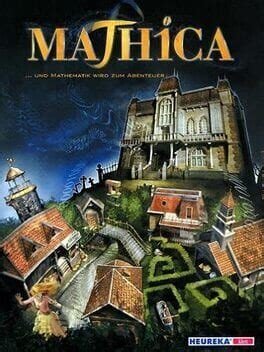
Mathica is an educational point-and-click adventure game set in the fictional village of Numberville, where players solve mathematical puzzles to lift a curse cast by the late Professor Alfons Numerus. The story revolves around freeing his stepdaughter Mathica, trapped in Number-Castle after the professor’s obsession with solving the ancient ‘squaring the circle’ problem. Players must locate a lost formula by Srinivasa Ramanujan to prove the problem’s impossibility, navigating through puzzles spanning geometry, algebra, number theory, and more. The game combines narrative-driven exploration with interactive problem-solving to teach and reinforce mathematical concepts in a stylized, first-person environment.
Mathica Free Download
Mathica Patches & Updates
Mathica Guides & Walkthroughs
Mathica: A Curious Equation of Gothic Pedagogy and Adventure
Introduction: The Alchemy of Numbers and Narrative
In the annals of educational gaming, few titles dare to weave arithmetic into the fabric of gothic mystery as boldly as Mathica (2002). Developed by Ruske & Pühretmaier Edutainment GmbH and published by HEUREKA-Klett, this point-and-click adventure dared to reframe mathematics not as a chore but as a quest—one steeped in tragedy, obsession, and the timeless allure of the unsolvable. This review posits that Mathica stands as a lost cult classic, a game that transcended its pedagogical aims to become a poignant meditation on the beauty of impossibility.
Development History & Context: A Formula Forged in Ambition
The Educational Gaming Landscape of the Early 2000s
The early 2000s saw educational games trapped in a dichotomy: either sterile drill simulators (Math Blaster!) or narrative-driven but mechanically shallow titles. Ruske & Pühretmaier, fresh from collaborations on science-focused titles like Bioscopia, sought to fuse rigorous academia with immersive storytelling. As Axel Ruske (Game Concept) and Anita Pühretmaier (Educational Project Lead) envisioned it, Mathica would be a “mathematical opera”—a game where quadratic equations held the keys to Gothic castles.
Technological Constraints as Creative Catalysts
Built on QuickTime-based engines with fixed first-person perspectives—common to budget-conscious EduSoft titles—Mathica’s limitations birthed ingenuity. The team compensated with painstaking hand-drawn 2D art (led by Susanne Schwalm) and pre-rendered 3D environments. Audio designer André Abshagen’s haunting harpsichord motifs elevated the moody ambiance, while voice acting (featuring Felix Hergenhahn and Susanne Reuter in the German release) lent gravitas to mathematical exposition.
A Studio Fueled by Pedagogical Zeal
The involvement of Dr. Thomas Sollich (Educational Content) and Prof. Albrecht Beutelspacher (Critique) ensured mathematical rigor. Their challenge: balance accessibility with depth. The result was a “knowledge compendium” integrated into the game—a proto-Wikipedia for players stranded by combinatorics.
Narrative & Thematic Deep Dive: Tragedy in the Realm of Pi
A Gothic Parable of Intellectual Hubris
The plot centers on Numberville, a village cursed by the late Professor Alfons Numerus, whose obsession with “squaring the circle”—a geometric impossibility—led him to imprison his stepdaughter Mathica in Number-Castle. Her task: endlessly pursue her father’s doomed work. Your role: liberate Mathica by proving the problem’s futility via a lost formula by Srinivasa Ramanujan.
Characters as Archetypes of Mathematical Drama
- Professor Numerus: A Faustian figure, his downfall mirrors humanity’s struggle with unsolvable truths.
- Mathica: Not a damsel but a symbol of intellectual emancipation, her dialogue (“Numbers are my jailers, yet also my keys”) echoes themes of knowledge-as-liberator.
- The Village Elders: Cryptic NPCs who communicate in riddles rooted in number theory, transforming mundane chats into pedagogical moments.
Themes: The Poetry of Impossibility
Mathica’s genius lies in framing mathematical dead ends not as failures but as romantic absolutes. The “squaring the circle” puzzle becomes a metaphor for accepting limits—a radical idea for an educational game. Ramanujan’s formula, hidden like a holy relic, embodies the thrill of pursuing the unknowable.
Gameplay Mechanics & Systems: Pedagogy as Progression
Core Loop: A Labyrinth of Logic
Players navigate fixed-screen environments (a bakery, library, castle) by solving context-sensitive puzzles:
– Geometry: Calculate the area of a stained-glass window to unlock a chapel.
– Probability: Deduce dice combinations to outwit a gambler blocking a bridge.
– Combinatorics: Crack a lock by enumerating possible prime-number sequences.
Each solution rewards a clue to Ramanujan’s formula’s location, threading progress through mathematical literacy.
Innovations and Flaws
- Integrated Knowledge System: A press-of-a-button glossary explains concepts (e.g., “transcendental numbers”) without breaking immersion. Critics lauded this as “EDUTainment perfected” (Berliner Zeitung).
- Friction Points: The difficulty curve—spiking abruptly in late-game combinatorics—alienated casual players. Puzzles often demanded external note-taking, clashing with the game’s snug aesthetic.
- UI Design: A minimalist point-and-click interface prioritized clarity but lacked tactile feedback, making inventory management a chore.
World-Building, Art & Sound: A Stylized Symphony of Numbers
Numberville: Where Euclid Meets Edgar Allan Poe
Art director Igor Posavec rendered Numberville as a Tim Burton-esque hamlet: crooked towers adorned with fractal patterns, cobblestones etched with Pascal’s Triangle. The castle’s interiors—designed by Hee-kyung Reimann—evoke M.C. Escher, with staircases twisting into geometric paradoxes.
Sound as Subtle Pedagogy
m.u.k.e’s soundtrack blended Baroque harpsichord with ambient drones, subtly reinforcing focus during puzzles. Voice acting—particularly Gisela Keiner’s narrator—delivered exposition with Gothic solemnity, framing algebra as incantations.
Localization Nuances
The 2004 Russian localization (Математикус) reimagined Mathica as a tsarevna, with Aleksey Kuznetsov’s narration leaning into Slavic folklore—a testament to the story’s adaptable emotional core.
Reception & Legacy: From Classroom Niche to Cult Curiosity
Critical Acclaim and Awards
Mathica swept Germany’s educational awards:
– 2002 TOMMI Award: Praised for “Tiefgang, Fachkenntnis und atemberaubende Grafik” (“depth, expertise, breathtaking visuals”).
– 2003 Comenius Siegel: Lauded for “competenzförderlichen Potenzialen” (“competence-building potential”).
– GIGA-Maus: Hailed as “Das beste Lernspiel” (“Best Learning Game”).
Sales surpassed 1 million as part of the Heureka Classics series, though its reach remained Eurocentric.
Influence and Long-Term Impact
While not a mainstream hit, Mathica pioneered techniques later seen in Professor Layton (narrative puzzles) and Return of the Obra Dinn (deduction-as-storytelling). Its legacy lives on in indie darlings like A Monster’s Expedition, which similarly masks pedagogy as exploration.
Conclusion: The Unseen Architect of Educational Elegance
Mathica remains a paradox: a game about impossibility that achieved the near-impossible. It transformed quadratic equations into emotional beats and calculus into catharsis. Though its steep challenges and niche appeal confined it to cult status, its vision of education as adventure remains timeless. For historians, Mathica is a vital artifact—proof that even the driest subjects can ignite passion when framed as gothic romance. In freeing Mathica, players unknowingly liberated themselves from the tyranny of “math as torment.” That, perhaps, is its greatest solution.
Final Verdict: A flawed yet visionary union of pedagogy and art—8/10 for ambition, 6/10 for accessibility. Essential for edutainment historians; bittersweet nostalgia for ’00s German classrooms.