
- Release Year: 2002
- Platforms: Windows
- Developer: Piotr Chodziński
- Genre: Action
- Perspective: Side view
- Game Mode: Single-player
- Gameplay: Hazards, Moving platforms, Platform, Shooter
- Setting: Futuristic, Sci-fi
- Average Score: 57/100
Description
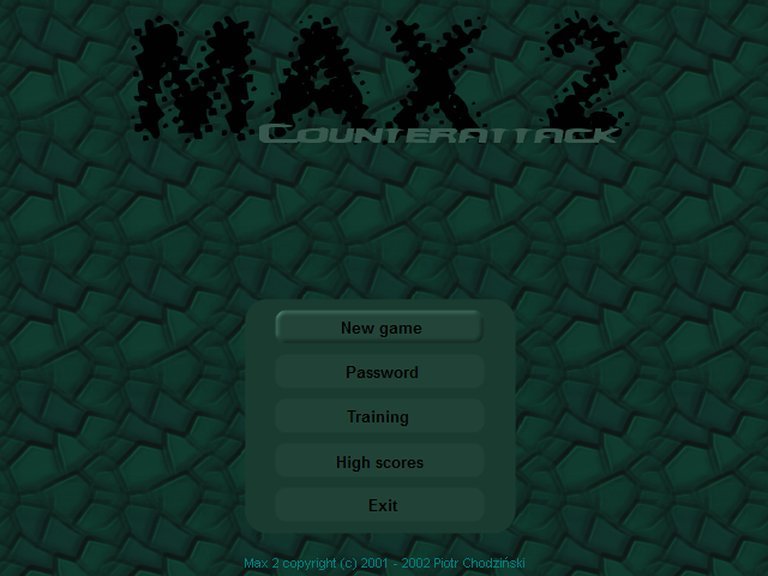
Max 2: Counterattack is a freeware 2D platform shooter set in a sci-fi universe where protagonist Max must rescue his kidnapped wife Jane from aliens within a strict one-hour limit. Players battle through levels filled with enemies, navigating hazards such as moving platforms and deadly electric obstacles that can instantly kill Max. The objective is straightforward: eliminate all foes and advance to the next stage while managing the time pressure.
Max 2: Counterattack Reviews & Reception
giveawayoftheday.com : The Game has huge playability so you won’t be disappointed!
Max 2: Counterattack Cheats & Codes
PC
Enter the cheat code, including the brackets, in the console or main menu while in single‑player mode.
| Code | Effect |
|---|---|
| [maxsuper] | Raises the level of the selected unit or building to maximum. |
| [maxsupply] | Fills all raw material storage. |
| [maxspy] | Shows positions of all enemy units/buildings and all neutral units/buildings. |
| [maxsurvey] | Displays all resource deposits on the map. |
| [maxstorage] | Fills all units and buildings with maximum material. |
Max 2: Counterattack: Review
In the annals of video game history, few titles stand out as starkly as “Max 2: Counterattack.” Released in 2002, this freeware 2D platform shooter is a testament to the ingenuity and passion of its sole creator, Piotr Chodziński. Despite its humble origins and the technological constraints of the era, “Max 2: Counterattack” offers a rich and engaging experience that deserves a closer look. This review will delve into the game’s development history, narrative depth, gameplay mechanics, world-building, and its enduring legacy.
Development History & Context
The Studio and Creators’ Vision
“Max 2: Counterattack” was developed by Piotr Chodziński, a lone developer who crafted the game using The Games Factory, a game development tool popular in the early 2000s. Chodziński’s vision was to create a simple yet challenging platform shooter that would captivate players with its fast-paced action and clever level design. The game’s development was a labor of love, reflecting Chodziński’s dedication to the craft of game design.
Technological Constraints of the Era
Released in 2002, “Max 2: Counterattack” was developed during a time when 2D platformers were beginning to fade from the mainstream. The gaming landscape was dominated by 3D graphics and more complex gameplay mechanics. Despite these challenges, Chodziński managed to create a game that stood out with its polished visuals and tight controls. The game’s use of 256-color sprites and high-resolution textures was a testament to the developer’s skill in maximizing the capabilities of the technology available at the time.
The Gaming Landscape
In 2002, the gaming industry was in a state of flux. The transition from 2D to 3D graphics was well underway, and many developers were experimenting with new genres and gameplay mechanics. “Max 2: Counterattack” stood out as a throwback to the classic platformers of the past, offering a nostalgic experience for players who had grown up with games like “Super Mario Bros.” and “Mega Man.” The game’s freeware model also made it accessible to a wide audience, further contributing to its appeal.
Narrative & Thematic Deep Dive
Plot
The narrative of “Max 2: Counterattack” is straightforward but effective. The protagonist, Max, is on a mission to rescue his wife, Jane, who has been kidnapped by aliens. Max has only one hour to complete his mission, adding a sense of urgency and tension to the gameplay. The plot serves as a backdrop for the game’s fast-paced action, allowing players to focus on the core mechanics without being bogged down by complex storytelling.
Characters
Max is the game’s sole playable character, and his design is simple yet effective. He is depicted as a determined and resourceful hero, willing to go to great lengths to save his wife. The game’s enemies are equally well-designed, ranging from standard alien grunts to more challenging bosses. Each enemy type requires a different strategy to defeat, adding depth to the gameplay.
Dialogue
The game features minimal dialogue, which is a wise choice given its platforming focus. The few lines of dialogue that are present are delivered in a straightforward manner, emphasizing the game’s action-oriented nature. The dialogue is also notable for its use of “pigeon English,” which adds a unique charm to the game’s presentation.
Themes
The primary theme of “Max 2: Counterattack” is the struggle against overwhelming odds. Max’s mission to rescue his wife is fraught with danger, and the game’s challenging levels and enemies serve to emphasize this theme. The game also explores the theme of perseverance, as players must continue to push forward despite the numerous obstacles they encounter.
Gameplay Mechanics & Systems
Core Gameplay Loops
The core gameplay loop of “Max 2: Counterattack” is simple but engaging. Players control Max as he navigates through a series of levels, each filled with enemies and hazards. The goal is to kill all the enemies and reach the next level within the one-hour time limit. The game’s fast-paced action and challenging level design keep players on their toes, ensuring that each playthrough is a thrilling experience.
Combat
Combat in “Max 2: Counterattack” is straightforward but effective. Max is equipped with a basic gun that can be upgraded by collecting money scattered throughout the levels. The game features a variety of enemy types, each requiring a different strategy to defeat. Boss battles are particularly challenging, requiring players to use all their skills and resources to emerge victorious.
Character Progression
Character progression in “Max 2: Counterattack” is tied to the collection of money. Players can use the money they collect to upgrade Max’s gun, gain access to secret levels, and unlock bonuses. This progression system encourages players to explore each level thoroughly, ensuring that they don’t miss any hidden items or secrets.
UI
The game’s user interface is clean and intuitive, with all necessary information displayed clearly on the screen. Health, ammo, and time remaining are all easily visible, allowing players to focus on the action without being distracted by cluttered menus.
Innovative or Flawed Systems
One of the game’s most innovative features is its use of moving and electric platforms. These platforms add an extra layer of challenge to the gameplay, requiring players to time their jumps and movements carefully to avoid being killed. The game’s use of secret levels and bonuses also adds replayability, encouraging players to explore each level thoroughly.
World-Building, Art & Sound
Setting
The game’s setting is a futuristic, sci-fi world filled with alien creatures and advanced technology. The levels are designed to be visually striking, with a mix of indoor and outdoor environments. Each level features unique hazards and enemies, ensuring that the gameplay remains fresh and engaging throughout.
Atmosphere
The game’s atmosphere is tense and urgent, reflecting the one-hour time limit imposed on Max’s mission. The fast-paced action and challenging level design contribute to this atmosphere, keeping players on the edge of their seats as they navigate through the game’s levels.
Visual Direction
The game’s visual direction is impressive, given its 2D platformer roots. The use of 256-color sprites and high-resolution textures gives the game a polished look, while the smooth animation of the characters and enemies adds to the overall presentation. The game’s backgrounds are particularly noteworthy, featuring detailed and visually striking designs.
Sound Design
The game’s sound design is equally impressive. The music is high-quality and complements the gameplay perfectly, while the sound effects are realistic and immersive. The game features a variety of sounds, from the ricochets of bullets to the explosions of enemies, all of which contribute to the overall atmosphere.
Reception & Legacy
Critical and Commercial Reception
“Max 2: Counterattack” received mixed reviews upon its release. Critics praised the game’s polished visuals and tight controls but noted that its simple gameplay and lack of innovation made it feel dated. The game’s freeware model also limited its commercial success, as it was not widely distributed or marketed.
Evolution of Reputation
Over time, “Max 2: Counterattack” has gained a cult following among retro gaming enthusiasts. The game’s challenging gameplay and nostalgic appeal have ensured its place in the annals of video game history. Today, it is remembered as a testament to the ingenuity and passion of its sole creator, Piotr Chodziński.
Influence on Subsequent Games and the Industry
While “Max 2: Counterattack” did not have a direct influence on subsequent games, it serves as an example of how a small, independent developer can create a polished and engaging experience. The game’s use of The Games Factory also highlights the potential of game development tools to democratize the industry, allowing anyone with the skill and dedication to create their own games.
Conclusion
“Max 2: Counterattack” is a hidden gem in the world of video games. Despite its humble origins and the technological constraints of the era, the game offers a rich and engaging experience that stands the test of time. Its challenging gameplay, polished visuals, and immersive sound design make it a must-play for fans of classic platformers. While it may not have achieved widespread commercial success, “Max 2: Counterattack” has earned its place in video game history as a testament to the power of passion and ingenuity. For those looking to experience a piece of gaming history, “Max 2: Counterattack” is a title that should not be missed.