
- Release Year: 1980
- Platforms: Atari 2600, Windows, Xbox 360
- Publisher: Atari, Inc., Microsoft Corporation
- Developer: Atari, Inc.
- Genre: Action, Labyrinth, Maze, Puzzle
- Perspective: Top-down
- Game Mode: Hotseat, Single-player
- Gameplay: Arcade, Blockade setting, Maze navigation, Randomly generated mazes
- Setting: Law enforcement, Urban
- Average Score: 71/100
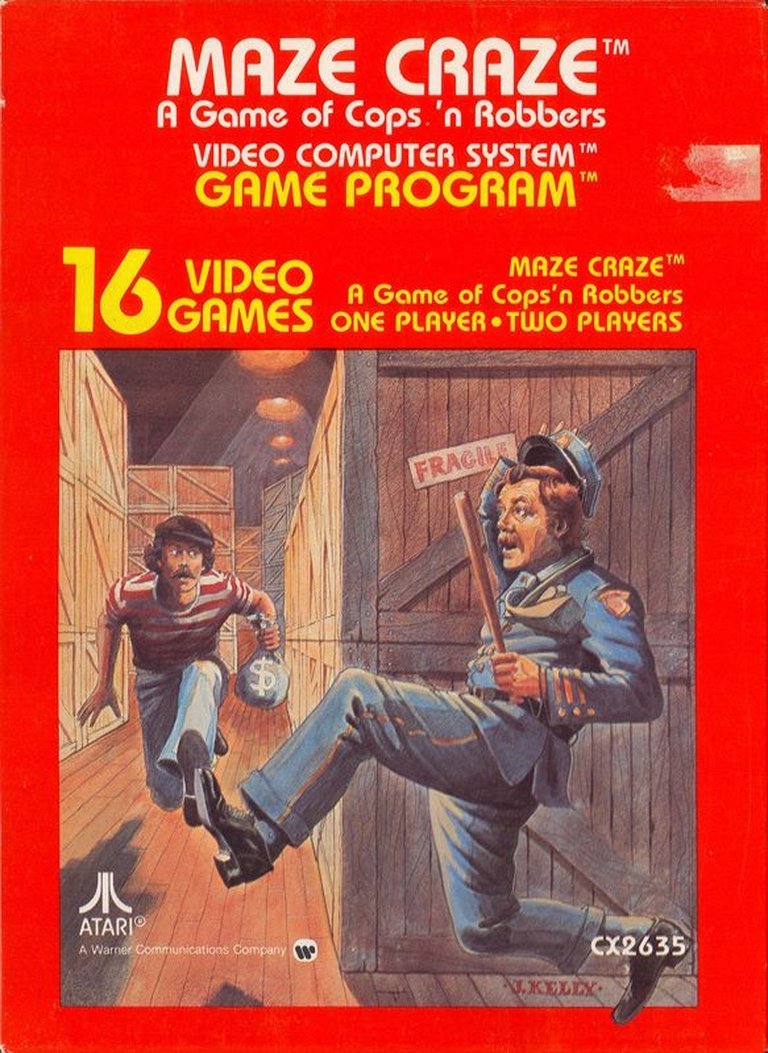
Description
Maze Craze: A Game of Cops ‘n Robbers is a classic 1980 Atari 2600 action-puzzle game where players compete as cops navigating a maze to reach the exit first. The game offers various challenges, including invisible mazes, robbers that stun players on contact, and the ability to set up blockades to hinder opponents. With adjustable speed settings and randomly generated mazes, it provides a mix of strategy and quick reflexes, making it a dynamic and replayable experience for one or two players.
Gameplay Videos
Maze Craze: A Game of Cops ‘n Robbers Free Download
Maze Craze: A Game of Cops ‘n Robbers Reviews & Reception
mobygames.com (71/100): A challenging maze game with lots of variation.
Maze Craze: A Game of Cops ‘n Robbers: A Retrospective Analysis
Introduction
In the annals of video game history, few titles capture the essence of early arcade competition as vividly as Maze Craze: A Game of Cops ‘n Robbers. Released in 1980 for the Atari 2600, this deceptively simple maze game transcended its minimalist design to become a cornerstone of competitive local multiplayer. At its core, Maze Craze is a race—a frantic dash through a labyrinthine cityscape where two players, cast as rival cops, vie to be the first to reach the exit. Yet beneath this straightforward premise lies a game of remarkable depth, offering a staggering 256 variations that transform each match into a unique tactical challenge.
This review aims to dissect Maze Craze in its entirety, exploring its development history, gameplay mechanics, narrative themes, and enduring legacy. By examining its place within the broader context of early video game design, we can appreciate how it not only reflected the technological constraints of its era but also pushed the boundaries of what a maze game could achieve. From its innovative use of procedural generation to its clever integration of competitive and cooperative elements, Maze Craze stands as a testament to the creativity of its developer, Rick Maurer, and the enduring appeal of simple yet profound gameplay.
Development History & Context
The Birth of a Classic
Maze Craze: A Game of Cops ‘n Robbers was developed by Rick Maurer and published by Atari, Inc. in 1980. Maurer, a programmer at Atari, initially worked on a Space Invaders clone for the Atari Video Computer System (VCS) in 1978. However, after the consumer division of Atari instructed him to cease development on the clone, Maurer shifted his focus to creating Maze Craze. This pivot was not merely a change in direction but a strategic move to hone his coding skills for the console, which was still in its infancy.
The Atari 2600, launched in 1977, was a revolutionary platform that brought arcade-quality gaming into the home. However, it came with significant technological constraints, including limited memory (a mere 4KB for Maze Craze), rudimentary graphics capabilities, and a simple sound chip. These limitations forced developers to be incredibly resourceful, and Maze Craze is a prime example of how creativity could overcome technical barriers.
The Gaming Landscape of 1980
The late 1970s and early 1980s were a formative period for video games. Arcade cabinets like Pong and Space Invaders had captivated audiences, and home consoles were beginning to gain traction. The Atari 2600 was at the forefront of this movement, offering a library of games that ranged from simple sports simulations to more complex arcade ports.
Maze Craze entered this landscape as a unique hybrid of action and puzzle genres. While maze games were not entirely new—Maze War (1974) and The Amazing Maze Game (1976) had already explored the concept—Maze Craze distinguished itself through its emphasis on competitive multiplayer and its extensive customization options. The game’s release in 1980 positioned it as a contemporary of other Atari classics like Adventure and Combat, but its focus on procedural generation and player-driven competition set it apart.
The Vision Behind the Game
Maurer’s vision for Maze Craze was to create a game that was both accessible and deeply replayable. The core concept—a race through a maze—was simple enough for anyone to grasp, but the inclusion of robbers, blockades, and varying visibility levels added layers of complexity. The game’s manual describes the setting as a “maze of city blocks,” framing the player as a cop patrolling a dangerous urban environment. This thematic choice not only provided a narrative context but also justified the game’s mechanics, such as the presence of robbers and the need to navigate treacherous alleyways.
The decision to include 256 variations was a stroke of genius. By allowing players to adjust the maze’s visibility, the number of robbers, and the speed of the game, Maze Craze ensured that no two matches would play out the same way. This level of customization was unprecedented at the time and demonstrated Maurer’s understanding of the importance of replayability in video games.
Narrative & Thematic Deep Dive
The Plot: A Simple Yet Effective Premise
Maze Craze does not boast a complex narrative. Instead, it relies on a straightforward premise: two cops are tasked with navigating a maze of city blocks to reach the exit. The first to escape wins. This simplicity is one of the game’s greatest strengths, as it allows players to focus on the core gameplay without being bogged down by convoluted storytelling.
However, the game’s manual and promotional materials provide a rich thematic backdrop. The maze is described as a “tough city beat,” evoking images of a sprawling metropolis filled with danger and intrigue. The presence of robbers adds a layer of tension, transforming the maze from a mere obstacle course into a battleground where players must outmaneuver both the environment and their adversaries.
Characters and Their Roles
The characters in Maze Craze are minimalist by design. The cops are represented as simple squares, color-coded to distinguish between players. The robbers, similarly, are depicted as blinking squares. While these visuals may seem rudimentary by modern standards, they serve a crucial function: clarity. In a fast-paced game where split-second decisions can determine the outcome, the ability to instantly recognize characters and obstacles is paramount.
The robbers play a dual role in the game’s narrative. In some variations, they are obstacles to be avoided, while in others, they must be captured. This duality adds depth to the gameplay, as players must adapt their strategies based on the specific rules of each match. The inclusion of robbers also reinforces the game’s thematic focus on law enforcement, framing the cops as heroes battling against crime.
Themes: Competition, Strategy, and Adaptability
At its heart, Maze Craze is a game about competition. The head-to-head nature of the gameplay fosters a sense of rivalry, as players vie to outsmart and outmaneuver each other. This competitive spirit is amplified by the game’s customization options, which allow players to tailor the experience to their preferred level of challenge.
Strategy is another central theme. The game rewards careful planning and quick thinking, as players must navigate the maze while avoiding or capturing robbers. The inclusion of blockades—a feature that allows players to create false walls—adds a layer of deception, encouraging players to think several steps ahead.
Adaptability is perhaps the most crucial theme in Maze Craze. The game’s procedural generation ensures that each maze is unique, forcing players to constantly adjust their strategies. The varying visibility levels further emphasize this theme, as players must rely on memory and spatial awareness to navigate invisible sections of the maze.
Gameplay Mechanics & Systems
Core Gameplay Loop
The core gameplay loop of Maze Craze is elegantly simple: navigate the maze, avoid or capture robbers, and reach the exit before your opponent. However, the game’s depth lies in its extensive customization options, which allow players to tailor the experience to their preferences.
The game begins with both players positioned on the left side of the maze. The goal is to reach the exit on the right side. Along the way, players may encounter robbers, which can either be avoided or captured, depending on the game variation. The maze itself can be fully visible, partially invisible, or completely invisible, adding an element of uncertainty and challenge.
Game Variations and Customization
Maze Craze offers a staggering 256 variations, each with its own unique set of rules and challenges. These variations are categorized based on three key parameters: speed, visibility, and game mode.
-
Speed: The game’s speed can be adjusted from “calculatingly slow” to “extremely fast.” This setting affects the movement speed of both the cops and the robbers, allowing players to tailor the pace of the game to their skill level.
-
Visibility: The maze can be fully visible, partially invisible, or completely invisible. In invisible mazes, players can optionally enable periodic “sneak peeks,” which briefly reveal the entire maze. This feature adds a layer of tension, as players must rely on memory and quick reflexes to navigate the labyrinth.
-
Game Mode: The game offers 16 distinct game modes, each with its own unique rules. These modes include variations where players must capture robbers, avoid robbers, or use blockades to confuse their opponents. Some modes also introduce additional mechanics, such as “wounds” (where players are temporarily stunned after being caught by a robber) and “terror” (where players cannot exit the maze until their opponent is knocked out by robbers).
Combat and Character Progression
While Maze Craze is not a traditional combat game, it does feature elements of conflict and strategy. The primary form of “combat” involves avoiding or capturing robbers. In some variations, players must capture a set number of robbers before they can exit the maze. In others, robbers are obstacles that must be avoided, as contact with them results in a temporary stun.
The game does not feature traditional character progression, such as leveling up or unlocking new abilities. Instead, progression is tied to the player’s skill and adaptability. As players become more familiar with the game’s mechanics, they can tackle more challenging variations, such as those with higher numbers of robbers or lower visibility levels.
User Interface and Controls
The user interface of Maze Craze is minimalist, reflecting the technological constraints of the Atari 2600. The game’s screen displays the maze, the players’ characters, and any robbers or blockades. The top of the screen features three numbers, representing the current settings for speed, visibility, and game mode.
Controls are straightforward, with players using the joystick to move their cop in four cardinal directions. The game also makes use of the Atari 2600’s single button, which can be used to activate features like “player peek” (revealing the maze in invisible modes) or “blockade” (creating a false wall).
Innovative and Flawed Systems
Maze Craze introduced several innovative systems that set it apart from other maze games of the era. The most notable of these is its extensive customization options, which allowed players to tailor the game to their preferences. The inclusion of procedural generation ensured that each maze was unique, adding to the game’s replayability.
However, the game is not without its flaws. The sound design, in particular, has been criticized for its simplicity. The game’s “beeps” can become repetitive and annoying, especially when players frequently collide with walls. Additionally, the game’s graphics, while functional, are rudimentary by modern standards. The cops and robbers are represented as simple squares, and the maze itself lacks the visual polish of later games.
World-Building, Art & Sound
Setting and Atmosphere
Maze Craze is set in a maze of city blocks, a thematic choice that reinforces the game’s focus on law enforcement and urban danger. The maze itself is a sprawling labyrinth of corridors and dead ends, designed to challenge players’ spatial awareness and memory. The game’s atmosphere is one of tension and urgency, as players race against each other and against the clock to reach the exit.
The game’s setting is further enhanced by its customization options. Invisible mazes, in particular, create a sense of uncertainty and suspense, as players must navigate the labyrinth without the aid of visual cues. The periodic “sneak peeks” add to this atmosphere, offering brief glimpses of the maze before plunging players back into darkness.
Visual Direction
The visual direction of Maze Craze is minimalist, reflecting the technological constraints of the Atari 2600. The maze is depicted as a series of solid lines, with walls represented in a single color. The cops and robbers are simple squares, color-coded to distinguish between players and enemies.
Despite its simplicity, the game’s visual design is effective. The clarity of the maze layout ensures that players can quickly identify exits, blockades, and robbers, even at high speeds. The use of color coding for the cops and robbers adds a layer of visual distinction, making it easy for players to track their progress and avoid obstacles.
Sound Design
The sound design of Maze Craze is rudimentary, consisting primarily of simple beeps and tones. These sounds serve functional purposes, such as indicating when a player has collided with a wall or been caught by a robber. However, the repetitive nature of these sounds can become grating over time, detracting from the overall experience.
Despite its limitations, the game’s sound design is not without merit. The use of audio cues helps to reinforce the game’s mechanics, providing players with immediate feedback on their actions. The simplicity of the sound design also reflects the technological constraints of the era, serving as a reminder of the challenges faced by early game developers.
Reception & Legacy
Critical and Commercial Reception
Maze Craze was released to a mixed but generally positive reception. Critics praised the game’s extensive customization options and replayability, highlighting its innovative use of procedural generation and competitive multiplayer. The game’s MobyGames score of 6.6 reflects this sentiment, with critics awarding it an average score of 71%.
However, the game’s reception was not universally positive. Some critics, such as those at Woodgrain Wonderland, found the game’s graphics and sound design to be lacking, describing the cops as “odd shapes resembling bugs” and the robbers as simple squares. Despite these criticisms, the game’s innovative gameplay and extensive variations were widely recognized as its strongest features.
Evolution of Reputation
Over the years, Maze Craze has gained a reputation as a cult classic among retro gaming enthusiasts. Its inclusion in various Atari compilations, such as Atari 50: The Anniversary Celebration and Atari Flashback Classics, has introduced the game to new generations of players. The game’s enduring appeal lies in its simplicity and depth, offering a challenging yet accessible experience that continues to resonate with players.
Influence on Subsequent Games
Maze Craze has had a lasting impact on the video game industry, influencing the design of subsequent maze and puzzle games. Its emphasis on competitive multiplayer and procedural generation can be seen in later titles, such as Pac-Man and Bomberman. The game’s innovative use of customization options also set a precedent for future games, demonstrating the importance of replayability and player choice.
Conclusion
Maze Craze: A Game of Cops ‘n Robbers is a testament to the creativity and ingenuity of early video game developers. Despite its technological constraints, the game offers a rich and engaging experience, blending competitive multiplayer with strategic depth. Its extensive customization options and procedural generation ensure that each match is unique, providing endless replayability.
While the game’s graphics and sound design may seem rudimentary by modern standards, they serve a crucial function, ensuring clarity and immediacy in a fast-paced environment. The game’s enduring legacy is a testament to its innovative gameplay and timeless appeal, making it a cornerstone of early video game history.
In the pantheon of classic Atari games, Maze Craze stands as a shining example of how simplicity and depth can coexist. Its influence can be seen in countless subsequent titles, and its reputation as a cult classic continues to grow. For anyone seeking a challenging yet accessible maze game, Maze Craze remains a timeless choice.