
- Release Year: 2005
- Platforms: Windows
- Publisher: Unbalance Corporation
- Developer: Telenet Japan Co., Ltd.
- Genre: Sports
- Perspective: Behind view
- Game Mode: Online PVP, Single-player
- Gameplay: Character customization, Online leaderboard, Online Multiplayer
- Setting: Plateau
Description
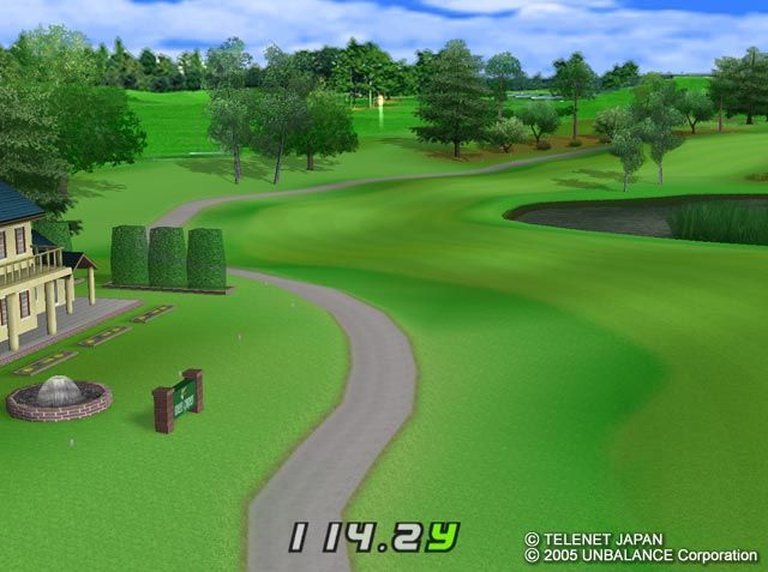
Meccha Golf: Kōgen de Nice Shot! is a 3D golf game featuring cartoony characters and vibrant, colorful courses set on a high plateau. Part of the Meccha Golf series, it offers character customization, online multiplayer, and leaderboard competition, delivering a lighthearted yet engaging golfing experience with a behind-view perspective.
Meccha Golf: Kōgen de Nice Shot!: A Whimsical Swing Through Time
Introduction
In the vast, often sterile landscape of sports simulations, Meccha Golf: Kōgen de Nice Shot! (2005) emerges as a vibrant anomaly—a golf game that dares to be fun first and a simulator second. Developed by Telenet Japan Co., Ltd. and published by Unbalance Corporation, this title is the second entry in the Meccha Golf series, a trilogy of standalone games that reimagined golf as a cartoonish, accessible, and socially engaging experience. While its peers in the mid-2000s were obsessing over hyper-realistic physics and licensed tournaments, Kōgen de Nice Shot! planted its flag on a plateau of whimsy, offering players a course set in a lush, high-altitude wonderland where the rules of golf bent to the laws of charm.
This review aims to dissect Meccha Golf: Kōgen de Nice Shot! not just as a game, but as a cultural artifact—a snapshot of a moment when Japanese developers were experimenting with how to make niche genres appeal to broader audiences. Through an analysis of its development, mechanics, aesthetic, and legacy, we’ll explore why this game remains a fascinating footnote in the history of sports games, and what its playful defiance of convention can teach us about the medium’s potential for joy.
Development History & Context
The Studio and the Vision
Telenet Japan Co., Ltd., the studio behind Meccha Golf, was no stranger to innovation. Founded in 1983, the company had cut its teeth on a diverse portfolio of games, from the Valis series of action-platformers to the Exile RPGs. By the mid-2000s, Telenet had developed a reputation for blending technical prowess with a distinctively Japanese sensibility—games that were mechanically sound but unafraid to embrace the absurd or the adorable.
The Meccha Golf series was conceived as an antidote to the growing seriousness of sports games. While titles like Tiger Woods PGA Tour and Links dominated the Western market with their emphasis on realism and professionalism, Telenet saw an opportunity to cater to a different audience: casual players, social gamers, and those who viewed golf not as a sport to master, but as a playground to explore. The series’ tagline—meccha, a Japanese slang term roughly translating to “super” or “extremely”—hinted at its over-the-top, exaggerated approach.
Kōgen de Nice Shot! was the second of three games released in quick succession, sandwiched between Kaigan de Nice Shot! (2005, set on a beach) and Las Vegas de Nice Shot! (2006, set in a neon-lit casino wonderland). Each game in the trilogy was designed as a standalone experience, sharing core mechanics but distinguished by its unique course and thematic flourishes. The plateau setting of Kōgen was chosen for its contrast to the beachside relaxation of its predecessor, offering a crisp, alpine aesthetic that evoked both challenge and tranquility.
Technological Constraints and Innovations
Released in November 2005 for Windows, Meccha Golf: Kōgen de Nice Shot! was a product of its time, both in terms of hardware limitations and the burgeoning possibilities of online play. The game’s minimum system requirements—a Pentium III processor, 128MB of RAM, and a DirectX 8.1-compatible graphics card—reflected the modest demands of mid-2000s PC gaming. Yet within these constraints, Telenet managed to craft a visually distinctive experience.
The game’s 3D engine, while not cutting-edge, was optimized for clarity and charm. Courses were rendered in bright, saturated colors, with exaggerated topography that made each hole feel like a miniature diorama. The “behind view” perspective, a staple of the series, placed the player’s golfer front and center, reinforcing the game’s focus on character and personality over pure simulation.
One of the most ambitious features of Kōgen de Nice Shot! was its online multiplayer and leaderboard system. In 2005, online gaming was still in its relative infancy, particularly in Japan, where broadband adoption was growing but not yet ubiquitous. The inclusion of online play was a gamble, but it paid off by fostering a small but dedicated community of players who relished the game’s social aspects. The leaderboards, meanwhile, added a layer of competition that extended the game’s lifespan beyond its single-player offerings.
The Gaming Landscape of 2005
To understand Meccha Golf’s place in history, it’s essential to contextualize the gaming environment of 2005. The mid-2000s were a transitional period for sports games. The Madden NFL and FIFA franchises were solidifying their dominance, while golf games were caught between two extremes: the hyper-realistic simulations like Links and the arcadey fun of Mario Golf. Into this gap stepped Meccha Golf, a game that refused to commit to either camp.
In Japan, the PC gaming market was niche but vibrant, with a particular affinity for games that blended accessibility with depth. The Meccha Golf series fit neatly into this ecosystem, offering a game that was easy to pick up but rewarding to master. Its cartoonish aesthetic and lighthearted tone also aligned with the broader kawaii culture that was permeating Japanese media, from anime to advertising.
Internationally, Meccha Golf remained a cult curiosity, overshadowed by bigger budgets and more aggressive marketing campaigns. Yet its existence is a testament to the diversity of the medium—a reminder that not every sports game needs to be a grim-faced simulation to find an audience.
Narrative & Thematic Deep Dive
Plot and Characters: The Golfers of the Plateau
Meccha Golf: Kōgen de Nice Shot! is not a game driven by narrative in the traditional sense. There is no epic quest, no villain to defeat, no world to save. Instead, the game’s “story” is woven into its presentation, its characters, and the very act of playing golf on a plateau that feels alive with personality.
The game’s cast is a roster of exaggerated archetypes, each designed to be instantly recognizable and endearing. There’s the brash, overconfident golfer who swings with reckless abandon; the stoic, disciplined player who calculates every shot; the cheerful novice who treats each hole like a new adventure. These characters are not just avatars but embodiments of different playstyles, encouraging players to experiment with their approach to the game.
The plateau itself is the true protagonist of Kōgen de Nice Shot!. Unlike the generic courses of many golf games, this high-altitude wonderland is a character in its own right. The rolling hills, the crisp air, the way the light filters through the trees—all of these elements combine to create a sense of place that is rare in sports games. The course is not just a challenge to overcome but a world to inhabit, if only for the duration of a round.
Dialogue and Tone: The Language of Play
The game’s dialogue, sparse as it is, reinforces its lighthearted tone. Characters quip and tease, celebrating good shots with exaggerated praise and commiserating over bad ones with playful lamentations. The writing is simple but effective, avoiding the pitfalls of either excessive silliness or dry instruction. Instead, it strikes a balance that feels welcoming to newcomers and amusing to veterans.
One of the most interesting aspects of Kōgen de Nice Shot!’s narrative approach is its use of humor to demystify golf. The sport, often perceived as elitist or intimidating, is reframed as a series of playful challenges. A poorly hit ball isn’t a failure but an opportunity for a character to deliver a self-deprecating joke. A perfect shot isn’t just a mechanical success but a moment of shared joy between player and avatar.
Themes: Golf as Play, Not Performance
At its core, Meccha Golf: Kōgen de Nice Shot! is a game about the joy of play. It rejects the notion that sports games must be about competition or mastery, instead embracing the idea that they can be about exploration, experimentation, and even failure. The plateau setting is symbolic of this philosophy—a place removed from the pressures of the professional circuit, where the only stakes are the ones the player chooses to impose.
The game also subtly critiques the seriousness of traditional sports culture. By presenting golf as a whimsical, almost surreal experience, Kōgen de Nice Shot! challenges the idea that sports must be treated with reverence. The exaggerated physics, the cartoonish characters, the bright colors—all of these elements serve to remind the player that golf, at its heart, is a game, and games are meant to be fun.
This thematic approach is particularly notable when contrasted with the broader sports game landscape of the 2000s. While titles like Madden and FIFA were increasingly focused on realism and authenticity, Meccha Golf dared to ask: what if sports games didn’t take themselves so seriously? The answer, as Kōgen de Nice Shot! demonstrates, is a game that feels fresh, inviting, and endlessly replayable.
Gameplay Mechanics & Systems
Core Gameplay Loop: Swinging with Style
Meccha Golf: Kōgen de Nice Shot!’s gameplay is built around a simple but satisfying core loop: aim, swing, and react. The controls are designed to be accessible, with a three-click system that governs aiming, power, and accuracy. Players first select their shot direction, then pull back a power meter, and finally time their release to determine the shot’s trajectory. It’s a system that will be familiar to anyone who has played Mario Golf or Hot Shots Golf, but Kōgen de Nice Shot! adds its own twists.
One of the most distinctive mechanics is the game’s handling of wind and terrain. The plateau setting isn’t just aesthetic—it’s a gameplay element. Gusts of wind can send balls veering off course, while the undulating terrain forces players to think carefully about their approach to each hole. These environmental factors are not punitive but playful, adding a layer of unpredictability that keeps each round feeling fresh.
The game also features a robust character customization system, allowing players to tweak their golfer’s appearance, equipment, and even personality traits. These customizations aren’t just cosmetic; they can affect gameplay, with certain outfits or accessories conferring bonuses to power, accuracy, or luck. This system encourages experimentation, as players mix and match gear to find the combination that best suits their playstyle.
Multiplayer and Online Features: Golf as a Social Experience
Meccha Golf’s online multiplayer was ahead of its time, offering a seamless way for players to compete against friends or strangers. The game supported both synchronous and asynchronous play, with players able to challenge each other in real-time or take turns at their own pace. The online leaderboards, meanwhile, added a persistent competitive element, allowing players to track their progress against a global community.
The multiplayer experience was designed to be as social as it was competitive. Players could chat, taunt, and celebrate with each other, fostering a sense of camaraderie that was rare in sports games of the era. The game’s lighthearted tone carried over into its online interactions, with players encouraged to embrace the silliness rather than the seriousness of competition.
Character Progression and Unlockables: Rewards for Play
Kōgen de Nice Shot! features a progression system that rewards players for their time and skill. As players complete holes, courses, and challenges, they earn in-game currency that can be spent on new equipment, outfits, and even additional courses. The game also includes a series of unlockable characters, each with their own unique abilities and quirks.
This progression system is carefully balanced to avoid feeling grindy. Rewards are dolled out at a steady pace, ensuring that players always have something to strive for without feeling overwhelmed. The unlockables, meanwhile, are designed to be meaningful—new clubs that change the way the game is played, or outfits that alter a character’s stats in subtle but noticeable ways.
UI and Accessibility: A Game for Everyone
The game’s user interface is a masterclass in accessibility. Menus are clear and intuitive, with large, colorful icons that make navigation a breeze. The game also includes a comprehensive tutorial system that walks players through the basics of golf, from swinging to putting, without ever feeling condescending or overly didactic.
One of the most impressive aspects of Kōgen de Nice Shot!’s UI is its adaptability. The game supports multiple input devices, including keyboard, mouse, and gamepad, ensuring that players can choose the control scheme that feels most comfortable. The game also includes a variety of difficulty settings, allowing players to tailor the experience to their skill level.
World-Building, Art & Sound
The Plateau: A Living, Breathing Course
The plateau setting of Kōgen de Nice Shot! is more than just a backdrop—it’s a fully realized world that feels alive and dynamic. The course is dotted with interactive elements, from windmills that spin lazily in the breeze to animals that scamper across the fairways. These details may not affect gameplay directly, but they contribute to the game’s immersive atmosphere, making the plateau feel like a place worth exploring.
The art style is a deliberate departure from the photorealism of other golf games. Instead of striving for accuracy, Kōgen de Nice Shot! embraces a cartoonish, almost storybook aesthetic. The characters are exaggerated and expressive, with oversized heads and comically proportioned bodies. The environments, meanwhile, are rendered in bright, saturated colors that evoke a sense of wonder and joy.
Sound Design: The Symphony of the Swing
The game’s sound design is equally playful, with a soundtrack that blends upbeat, jazzy tunes with more contemplative, ambient pieces. The music shifts dynamically to match the player’s performance—a perfect shot might be accompanied by a triumphant fanfare, while a missed putt could trigger a comical slide whistle.
The sound effects are equally expressive, with each swing, putt, and bounce accompanied by a satisfying thwack, clink, or boing. These auditory cues are not just functional but emotional, reinforcing the game’s lighthearted tone and making each moment on the course feel alive.
Atmosphere: Golf as a Joyful Escape
Perhaps the most impressive achievement of Kōgen de Nice Shot! is its atmosphere. The game manages to create a sense of place that is both inviting and exciting, a world where the pressures of real-life golf are replaced by the simple joy of play. The plateau is not just a course but a sanctuary, a place where players can escape the mundanity of everyday life and lose themselves in a whimsical, colorful world.
This atmosphere is reinforced by the game’s attention to detail. The way the light shifts as the sun moves across the sky, the way the wind rustles the leaves on the trees, the way the characters react to each shot—all of these elements combine to create a game that feels alive in a way that few sports titles do.
Reception & Legacy
Critical and Commercial Reception
Meccha Golf: Kōgen de Nice Shot! was released to a mixed but generally positive reception. Critics praised the game’s accessibility, charm, and innovative online features, though some lamented its lack of depth compared to more hardcore golf simulations. The game’s lighthearted tone and cartoonish aesthetic were particularly well-received, with many reviewers noting that it stood out in a crowded market dominated by more serious titles.
Commercially, the game performed modestly, finding a niche audience of casual players and golf enthusiasts who appreciated its unique approach. While it never achieved the mainstream success of titles like Tiger Woods PGA Tour, it developed a cult following that has endured in the years since its release.
Evolution of Reputation
In the years since its release, Meccha Golf: Kōgen de Nice Shot! has been reevaluated as a ahead-of-its-time experiment in sports game design. Its emphasis on accessibility, social play, and whimsy has been cited as an influence on later titles like Golf With Your Friends and Everybody’s Golf, which similarly prioritize fun over realism.
The game’s online features, in particular, have been recognized as pioneering. At a time when online multiplayer was still a novelty, Kōgen de Nice Shot! offered a seamless, social experience that foreshadowed the rise of online gaming communities. Its leaderboards and asynchronous play options were also innovative, providing a template for future sports games to follow.
Influence on the Industry
While Meccha Golf may not have been a commercial juggernaut, its influence can be seen in the growing diversity of sports games in the years since its release. Titles like Rocket League and NBA Playgrounds have embraced a similar philosophy of fun-over-realism, proving that there is a market for sports games that prioritize accessibility and playfulness.
The game’s legacy is also evident in the rise of indie sports titles, which often draw inspiration from Meccha Golf’s willingness to experiment with form and tone. Games like Golf Story and Disc Room owe a debt to Kōgen de Nice Shot!’s proof that sports games can be more than just simulations—they can be adventures, comedies, and even works of art.
Conclusion: A Nice Shot Indeed
Meccha Golf: Kōgen de Nice Shot! is a game that defies easy categorization. It is at once a sports game, a social experiment, and a work of interactive art. Its refusal to conform to the expectations of the genre is both its greatest strength and its most enduring legacy. In a world where sports games are often judged by their realism, Kōgen de Nice Shot! stands as a testament to the power of playfulness, charm, and joy.
The game’s plateau setting is more than just a course—it’s a metaphor for the game’s philosophy. Just as a plateau offers a vantage point from which to see the world differently, Meccha Golf offers a perspective on sports games that is refreshing and vital. It reminds us that games, at their best, are not about competition or mastery but about exploration, experimentation, and the simple pleasure of hitting a ball with a stick.
In the grand tapestry of video game history, Meccha Golf: Kōgen de Nice Shot! may be a small thread, but it is a thread that shines brightly. It is a game that dared to be different, and in doing so, it carved out a space for itself in the hearts of players who were looking for something more than just another simulation. For that, it deserves to be remembered—not just as a golf game, but as a celebration of what games can be when they embrace the joy of play.
Final Verdict: 8.5/10 – A delightful, whimsical take on golf that prioritizes fun over realism, and all the better for it.