
- Release Year: 2004
- Platforms: Windows
- Publisher: Electronic Arts, Inc.
- Genre: First-person shooter
- Perspective: First-person
- Game Mode: LAN, Online PVP, Single-player
- Gameplay: Mission-based, Shooting, Team-based
- Setting: Pacific, World War II
Description
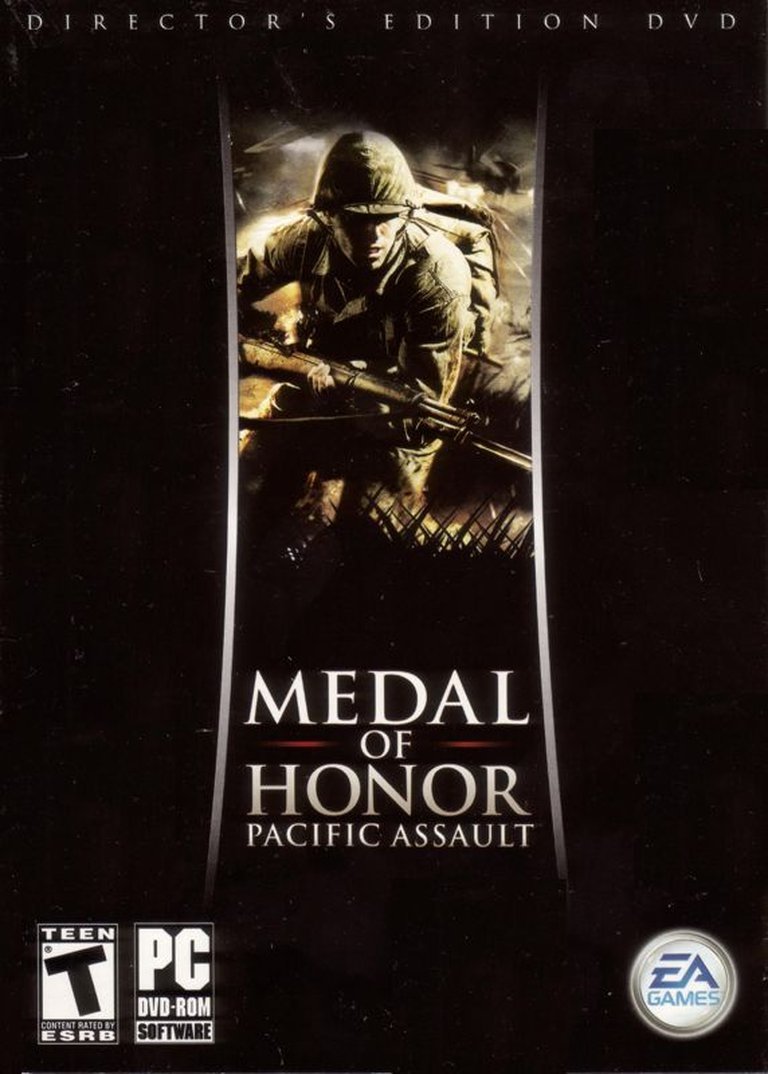
Medal of Honor: Pacific Assault (Director’s Edition) is a historically immersive first-person shooter set in the Pacific theater of World War II. Players engage in gripping single-player missions as U.S. Marines, experiencing key battles from Pearl Harbor to the Solomon Islands, with a strong emphasis on narrative depth and authentic warfare, all enhanced by the Director’s Edition’s exclusive extras like soldier interviews, documentaries, and behind-the-scenes content that enrich the historical context.
Medal of Honor: Pacific Assault (Director’s Edition DVD) Reviews & Reception
mobygames.com : I think the designers did a very good job of showing the humanity of warfare.
retro-replay.com : Powerful storytelling and immersive sound design bring you face-to-face with the chaos of war.
Medal of Honor: Pacific Assault (Director’s Edition DVD) Cheats & Codes
PC – Windows
Start the game with the ‘+set cheats 1 +set ui_console 1 +set developer 1’ command line parameter. Press ~ to display the console window.
| Code | Effect |
|---|---|
| dog | God mode |
| wuss | All Weapons |
| fullheal | Full health |
| notarget | Enemies ignore you |
| noclip | No clipping mode |
| fps 1 | Show FPS |
| maplist | Load any level (double-click map name) |
| map | Load specific map (use map names from maplist) |
| giveammo | Gives ammo |
| spawn weapons/JPN_44.hag | Japanese .44 |
| spawn weapons/landmine_allied.hag | Mine |
| spawn weapons/US45.hag | U.S. .45 |
| spawn weapons/JPN_Model96LMG.hag | Japanese machine gun |
| spawn weapons/type100_smg.hag | Sub machine gun |
| spawn weapons/US_Colt45.hag | Colt .45 |
| spawn items/binoculars.hag | Binoculars |
| spawn weapons/thompson.hag | Thompson with 50 round drum |
| spawn weapons/springfield_m1903_sniper.hag | Springfield sniper |
| spawn weapons/us_springfield.hag | Springfield |
| spawn weapons/us_riot.hag | Shotgun |
| spawn weapons/us_Garand.hag | Garand |
| spawn weapons/us_demolitionpack.hag | Demo pack |
| spawn weapons/us_colt45.hag | Colt .45 |
| spawn weapons/us_bar.hag | Bar |
| spawn weapons/us_axe.hag | Axe |
| spawn weapons/us45.hag | .45 |
| spawn weapons/sword.hag | Sword |
| spawn weapons/satchel_charge.hag | Satchel charge |
| spawn weapons/Reising.hag | Reising |
| spawn weapons/psyman.hag | Unknown |
| spawn weapons/nambu_pistol.hag | Nambu |
| spawn weapons/model97_sniper.hag | Model 97 sniper |
| spawn weapons/m38_arisaka.hag | Arisaka |
| spawn weapons/m2frag_grenade.hag | M2 grenade |
| spawn weapons/m1_carbine.hag | M1 carbine |
| spawn weapons/jpnfrag_grenade.hag | Japanese grenade |
| spawn weapons/Johnson.hag | Johnson LMG |
| spawn weapons/us_thompson_30.hag | Thompson with 30 round clip |
| spawn weapons/usthompson.hag | Thompson |
| spawn weapons/us_garand.hag | Garand |
| spawn statweapons/model99_mortar_carryable.hag | Portable mortar |
| spawn statweapons/uslewis_single_carryable.hag | Portable Lewis gun |
| spawn statweapons/usboys55_carryable.hag | Anti-Tank gun |
Medal of Honor: Pacific Assault (Director’s Edition DVD): A Historically Ambitious, Flawed Frontier in the WWII Shooter Canon
Introduction: The Weight of History on the Shoulder of a Marine
In the mid-2000s, the first-person shooter genre was grappling with a profound historical inflection point. The seismic impact of Steven Spielberg’s Saving Private Ryan (1998) had irrevocably altered the cultural perception of World War II, shifting the narrative from glorified action to stark, visceral human drama. Video games, eager to capture this maturity, were in a frantic race to translate that tone into interactivity. It was into this crucible that Medal of Honor: Pacific Assault (2004) and its ambitious Director’s Edition DVD were launched. This wasn’t merely another entry in a popular franchise; it was a deliberate, concerted effort by EA Los Angeles to confront the often-overlooked Pacific Theater with a level of narrative sincerity and supplemental educational context rarely seen before or since. This review argues that while Pacific Assault stumbles significantly under the weight of its own gameplay conventions and technical constraints, the Director’s Edition elevates it from a merely competent shooter to a fascinating, if contradictory, historical artifact—a game that prioritizes the why of war over the how, even when its mechanics frequently betray that noble intent.
Development History & Context: Forging a Pacific Identity
The Studio and the Vision: Developed by EA Los Angeles (formerly DreamWorks Interactive), the studio responsible for the genre-redefining Medal of Honor: Allied Assault (2002), Pacific Assault represented a conscious pivot. Moving from the European to the Pacific Theater was not just a change of scenery but a narrative challenge: how to depict a war defined by brutal jungle warfare, amphibious assaults, and a notoriously fierce and ideologically driven enemy without falling into the caricatured “Japanese banzai charge” tropes of earlier media. The developer’s vision, as outlined in the game’s promotional material and the extensive “Making of the Game” documentary included in the Director’s Edition, was to create an experience grounded in “historically accurate re-creation,” focusing on the individual Marine’s experience.
Technological Constraints & The Engine: Technologically, the game was built on a heavily modified id Tech 3 engine (the core of Quake III Arena), augmented with the Havok physics engine. This was a double-edged sword. The id Tech 3 base provided a stable, scalable framework for multiplayer and linear level design, but it was showing its age compared to the newer, more open-world-capable Unreal Engine 2.5 or the groundbreaking Half-Life 2‘s Source engine released the same year. The Havok integration allowed for some impressive physical interactions—barriers could be destroyed, objects toppled—but often felt scripted rather than systemic. The game’s system requirements were notoriously steep for the time; as player F R bluntly stated, “The min specs on the box are completely false, this game requires a very fast CPU and the most recent available video card!” This technical demand, coupled with the era’s burgeoning diversity in PC hardware, led to a frustratingly inconsistent experience for many.
The 2004 Gaming Landscape: Pacific Assault launched into a crowded field. It directly competed with Infinity Ward’s Call of Duty (2003), which had already set a new standard for cinematic, squad-based WWII shooting with its “crew-served” weapon mechanics and relentless pacing. It also stood in the shadow of Crytek’s Far Cry (2004), which showcased breathtaking open environments and advanced AI. EA’s marketing positioned Pacific Assault as the more “authentic” and “intense” experience, a claim supported by some critics like Game Informer‘s 8.5/10 review which hailed it as regaining the series’ role as “the most intense wartime FPS.”
Narrative & Thematic Deep Dive: The Human Cost of “Island Hopping”
Plot Structure and Protagonist: The single-player campaign follows Private Thomas “Tommy” Conlin, a U.S. Marine, from the catastrophic aftermath of the attack on Pearl Harbor through the bloody island campaigns of Makin, Guadalcanal, and Tarawa. The narrative is framed by a powerful, harrowing opening: Conlin is killed during the initial landing at Tarawa, only for the story to flashback to his basic training and subsequent deployment. This structure, while clever, contains a noted flaw pointed out by player agamer: after the prologue’s “scripted death,” the game later returns the player to a Tarawa beachhead scenario, creating a confusing narrative dissonance about which moment is “canon.”
The Heart of the Story: Squad camaraderie: Where Pacific Assault genuinely distinguishes itself is in its character writing and squad dynamics. Conlin is not a silent protagonist; he is embedded with a persistent, bantering fireteam: the pragmatic squad leader Frank Minoso, the folksy sniper William “Willie” Gaines, and the dignified corpsman James “Sully” Sullivan. Their dialogue, particularly the “realistic” flow of conversation noted by agamer—touching on home, fear, boredom, and crude humor—is the game’s greatest narrative strength. It mimics the “band of brothers” ethos of Band of Brothers more effectively than many of its contemporaries. The inclusion of the “Paths of Glory” documentary in the Director’s Edition, featuring interviews with real soldiers who fought in the Pacific, powerfully bridges this fiction with historical testimony, grounding the squad’s experiences in authentic trauma and recollection.
Themes and Problematic Representations: The core theme is the grinding, attritional horror of Pacific warfare—the suffocating jungle, the fanatical defense, the constant threat of ambush. The game attempts to show “the humanity of warfare,” as agamer observes, by focusing on the Marines’ relationships and the psychological toll. However, it largely fails to humanize the Japanese soldier. As agamer critically notes, “the game is pretty West-centric. I didn’t get much of a sense of the Japanese soldier… the grunt in the trench who is out of bullets and commanded to charge at the enemy with what amounts to a pointy stick.” This is a significant thematic failure. The Japanese enemy remains a faceless, often fanatical horde—a stark contrast to the nuanced, if brutal, portrayals emerging in contemporary films and literature. The “The Thought War” documentary on propaganda, while excellent contextually, exists in a vacuum within the game’s own narrative, highlighting this representational imbalance.
Gameplay Mechanics & Systems: Ambition Undermined by Friction
Core Loop and Squad Mechanics: Gameplay is a linear, objective-based march through meticulously designed (but often narrow) environments. The most significant innovation over Allied Assault is the squad command system. Using a simple radial menu, players can order Minoso, Gaines, and Sully to “Give Covering Fire,” “Regroup,” “Move Up,” or “Fall Back.” In theory, this encourages tactical play. In practice, as agamer experienced, the system can be frustratingly opaque. AI pathfinding and responsiveness were often inconsistent, leading to moments where squadmates would cheerfully charge into certain death or fail to provide effective suppression. The command to call the corpsman (Sully) for healing replaced health packs, a thematic touch that sometimes felt gimmicky amid chaotic firefights.
Mission Design: A Tale of Two Extremes: The mission design is where the game’s ambitions and flaws collide most dramatically.
* Strengths: Many missions are brilliantly crafted set-pieces. The defense of Henderson Field on Guadalcanal is a tense, sprawling battle against waves of attackers. The nocturnal Lunga River patrol is a masterclass in tension and sound design, where visibility is minimal and every rustle could be an ambush.
* Weaknesses and Frustrations: agamer‘s critique of “vague” objectives and “requirements for success [that] were just too specific” is astute. Several missions suffer from a lack of clear direction or fail-states that feel unfair. The most infamous example is the SBD Dauntless dive bomber level. This on-rails shooter segment, where Conlin must man the gunner’s position, is almost universally panned. The controls, as agamer described, are abysmal: “I eventually threw my mousepad on the floor to make more room to madly flail the mouse around trying to target enemies.” It represents a jarring departure from the grounded infantry combat and a clear design misstep.
* The Prologue Paradox: The opening Tarawa mission, designed to be a “you are dead” narrative device, is a poorly communicated tutorial that leads to confusion, as noted by agamer. It sets a frustrating precedent for unclear communication of goals.
Multiplayer: The Director’s Edition includes the “Invader” mode, praised by F R as “probably the most creative on-line mode since it really requires team work to complete the assigned objective.” This asymmetrical mode, where one team attacks and the other defends a structure, showcased a thoughtful, objective-based design years before it became standard. The inclusion of Punkbuster anti-cheat software was also a forward-thinking move for PC multiplayer integrity at the time.
World-Building, Art & Sound: Forging the Pacific’s Grime and Glory
Visuals and Environment: Graphically, Pacific Assault was a solid, not spectacular, 2004 title. As agamer succinctly put it, it was “about on par with the run-of-the-mill shooters for 2004. Not as good as Far Cry or HL2 perhaps, but pretty good.” Its strengths lay in atmospheric detail. The Havok physics allowed for believable destruction of wooden huts, crumbling coral fortifications, and swaying jungle foliage. The water effects, noted by Retro Replay, were particularly impressive, rendering realistic surf and reflections that sold the island setting. Character models, especially the Marines, were detailed with individualized faces and gear. The Japanese forces, however, suffered from repetition and a lack of distinguishing features, reinforcing the “faceless enemy” problem.
Sound Design: This is a triumph of the audio department. The cacophony of battle is immersive and terrifying: the crump of Japanese artillery, the distinct bark of the M1 Garand, the terrifying whoosh of an incoming mortar round, and the screams of wounded soldiers. The soundtrack by Christopher Lennertz is a major asset, as agamer notes: “The music was excellent.” It swells at appropriate moments without becoming intrusive, perfectly capturing the melancholic and heroic tone the narrative strives for. The “In-game music with commentary” feature in the Director’s Edition allows players to listen to the score with Lennertz’s insights, adding a layer of appreciation for the compositional craft.
The Director’s Edition as Curated History: This is where the package transcends being a mere game. The DVD extras are not throw-away bonuses but a cohesive, curated educational experience.
* WWII Timeline Presentation: A digital slideshow of historical photos and footage, contextualizing the game’s campaign within the broader Pacific War.
* Paths of Glory & The Thought War: The veteran interviews and propaganda documentary provide crucial, sobering perspectives that the game’s fiction cannot.
* Silent Drill Platoon: This narrated footage of the USMC’s precision drill team is atmospheric window-dressing, but it connects the game’s modern Marine Corps heritage to its WWII roots.
* Making of the Game: Offers valuable insight into the developers’ research trip to Hawaii and their attempts at authenticity.
Collectively, these features transform the product into a “comprehensive WWII anthology,” as Retro Replay states, worthy of inclusion in a university media studies or history curriculum alongside the gameplay itself.
Reception & Legacy: A Promising Bridge That Was Plowed Under
Contemporary Reception: Pacific Assault received “favorable” reviews (Metacritic: 80/100), but the consensus was mixed. Critics praised its atmosphere, storytelling, and audio but consistently criticized its frustrating mission design and technical issues. Edge magazine’s harsh 5/10 review highlighted the gameplay friction, while Eurogamer (8/10) and GameSpot (8.3/10) found the immersive experience worth the hurdles. The Director’s Edition was generally seen as a good value for the substantial extra content, though the core game remained unchanged.
Commercial Performance & Awards: The game was a commercial success, earning an ELSPA “Silver” award for sales of over 100,000 copies in the UK. It received a nomination for “Computer First-Person Action Game of the Year” at the 8th Annual Interactive Achievement Awards, though it lost to the titan that was Half-Life 2.
Legacy and Influence: Medal of Honor: Pacific Assault occupies a curious, transitional space in history. It was one of the last major WWII shooters before the genre’s decline post-Call of Duty 4: Modern Warfare (2007). Its most significant legacy is arguably in its narrative ambition and the model of the “Director’s Edition” as a platform for historical education. Few shooters since have so thoroughly integrated documentary materials into the core product. Its squad command system was a clear precursor to the deeper team mechanics of later games, but its execution was outclassed by the tighter, more responsive feel of Call of Duty. The game is now remembered more for its flawed but heartfelt attempt at gravitas than for its mechanical innovation. It represents the point where the Medal of Honor series’ focus on “authenticity” began to feel cumbersome compared to the cinematic, streamlined power fantasy of its rival.
Conclusion: A Flawed Testament to a Forgotten Theater
Medal of Honor: Pacific Assault (Director’s Edition DVD) is not the best WWII shooter of its era. It is not the most polished, the most fun, or the most influential. Its gameplay is peppered with frustrating design decisions, from the infuriating plane mission to the often-vague objective markers. Its portrayal of the enemy is a disappointing missed opportunity. Yet, its Director’s Edition cements its importance as a cultural artifact. Through its committed, character-driven narrative about Marine brotherhood and its invaluable trove of supplementary historical documentaries, it achieves a rare feat: a game that consistently asks the player to consider the human cost of the conflict it so viscerally depicts.
For the historian or student of media, the Director’s Edition is essential. It provides a direct line into the early-2000s mindset of how to respectfully (if imperfectly) adapt recent history into an interactive form. For the pure gamer, the base campaign is a dated, sometimes frustrating experience, but one with flashes of brilliance in its squad mechanics and atmosphere. Its place in history is secure not as a pinnacle of design, but as a passionate, problematic, and profoundly sincere bridge—a last major attempt by a flagship franchise to make the Pacific War feel personal, educational, and deeply human before the genre moved on. It is, in the end, a flawed testament to a theater of war that demanded to be remembered with more than just different scenery.