
- Release Year: 2007
- Platforms: Linux, Macintosh, Windows
- Publisher: ak tronic Software & Services GmbH, Feral Interactive Ltd., SEGA Corporation
- Genre: Compilation
- Game Mode: Hotseat, LAN, Online PVP, Single-player
- Average Score: 100/100
Description
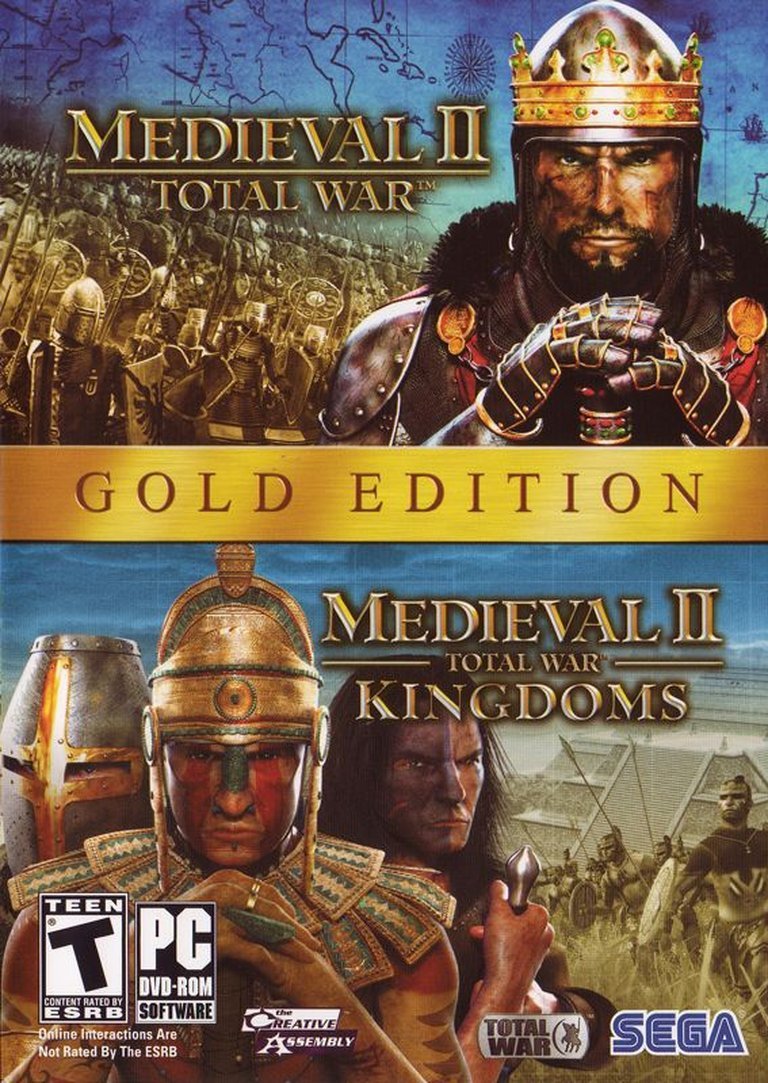
Medieval II: Total War – Gold Edition is a comprehensive strategy compilation featuring the base game and its Kingdoms expansion, set in the medieval era from 1080 to 1530. Players assume control of a faction across a vast map encompassing Europe, North Africa, parts of the Americas, and the Middle East, engaging in a turn-based strategic campaign to manage diplomacy, economy, religion, and military, while also commanding real-time tactical battles in the acclaimed Total War series formula.
Medieval II: Total War – Gold Edition Cracks & Fixes
Medieval II: Total War – Gold Edition Patches & Updates
Medieval II: Total War – Gold Edition Reviews & Reception
metacritic.com (100/100): The second best Total War game after Rome Total War and second best RTS game in my opinion. Everything worked, battles and politics, all made sense, and it captured the magic of medieval times.
Medieval II: Total War – Gold Edition Cheats & Codes
Medieval II: Total War – Gold Edition (PC)
Press ~ during gameplay to display the console window.
| Code | Effect |
|---|---|
| add_money | Adds the specified amount of money to your treasury. |
| add_population | Adds the specified population to the specified settlement. |
| adjust_sea_bed | Adjusts the height of the entire sea bed. |
| ai_turn_speed | Sets the maximum speed of AI turn processing. |
| amdb_max | Sets aerial map overlay depth bias for maximum zoom. |
| amdb_min | Sets aerial map overlay depth bias for minimum zoom. |
| amdb_offset | Sets aerial map overlay offset towards the camera. |
| auto_win | Automatically wins the next auto-resolved battle for attacker or defender. |
| bestbuy | Makes all items 10% cheaper. |
| bounds | Toggles the display of bounding objects. |
| burn_piggies_burn | Ignites all piggy winks (Easter egg). |
| capture_settlement | Transfers control of a settlement to the local player. |
| capabilities | Shows recruitment capabilities of a settlement. |
| character_reset | Resets a character to its start-of-turn settings. |
| clear_messages | Clears all currently stacked messages. |
| clear_password | Clears the password for a specified faction. |
| control | Switches player control to the specified faction. |
| create_building | Creates a building in a settlement. |
| create_mission | Attempts to create and add a mission to a faction. |
| create_unit | Creates one or more units of the specified type. |
| damage_wall | Damages walls of a settlement; can destroy gatehouses or breach walls. |
| date | Changes the campaign date to the given year. |
| diplomatic_stance | Sets the diplomatic stance between two factions. |
| diplomacy_mission | Creates a diplomacy mission. |
| disable_ai | Disables all or part of the AI for all factions. |
| disable_vnvs | Toggles whether the game applies traits and attributes. |
| event | Creates an event. |
| filter_coastlines | Applies a filter to world map coastlines. |
| force_battle_defeat | Forces the local player’s alliance to lose the battle. |
| force_battle_victory | Forces the local player’s alliance to win the battle. |
| give_ancillary | Gives an ancillary to a character. |
| give_trait | Gives a trait to a character. |
| george | Adds Mercenary Monster Ribault to selected city or unit. |
| houston | Adds Mercenary Rocket Launcher to selected city or unit. |
| istanbul | Adds Mercenary Monster Bombard to selected city or unit. |
| jericho | Causes walls to crumble in siege battles. |
| kill_character | Kills the specified character (may not work). |
| madras | Adds Elephants to selected city or unit. |
| move_character | Moves a character or army to specified coordinates. |
| process_cq | Completes all construction in a settlement’s queue. |
| process_rq | Completes all recruitment in a settlement’s queue. |
| recruitment_pool | Shows the recruitment pool of a settlement. |
| remove_ancillary | Removes an ancillary from a character. |
| remove_trait | Removes a trait from a character. |
| rogan | Adds Elephant Artillery to selected city or unit. |
| show_cursorstat | Shows the cursor coordinates on the campaign map. |
| surrender_regions | Surrenders all regions of a faction to rebels. |
| test_ancillary_localisation | Adds all ancillaries to the character info display. |
| toggle_fow | Toggles the fog of war on and off. |
| toggle_terrain | Changes the way map terrain is displayed. |
| vindaloo | Adds Elephant Rocketeer to selected city or unit. |
Medieval II: Total War – Gold Edition: The Apex of Ambition and Flaw
Introduction: The Crucible of History
To play Medieval II: Total War – Gold Edition is to step into a digital renaissance of medieval conflict, a game that simultaneously represents the zenith of its series’ ambitions and the cumulative weight of its technical compromises. Released in 2007 as the definitive package combining the 2006 base game with its 2007 Kingdoms expansion, this compilation is not merely a product but a sprawling historical simulation. It weaponizes the “Total War” moniker, demanding players wield absolute authority over thegrim, glorious, and grotesque tapestry of the High to Late Middle Ages, from the dawn of the Norman Conquest to the thunder of cannons in the Age of Discovery. This review argues that Medieval II: Gold Edition is a flawed masterpiece—a game whose revolutionary systems for faction depth, religious strife, and character legacy are perpetually at war with a battle engine crippled by infuriating AI pathfinding and control issues. Its legacy is one of profound influence hamstrung by persistent bugs, a passionate community’s modding sanctum, and the eternal debate over whether its strategic brilliance outweighs its tactical failings.
Development History & Context: Forging an Empire on Shaky Ground
Studio & Vision: Developed primarily by The Creative Assembly’s Australian studio (since disbanded) under director/lead designer Robert T. Smith, Medieval II was built upon the robust but aging “Warscape” engine of Rome: Total War. The vision was clear: to expand the franchise’s scope into the gunpowder age and the Americas while injecting unprecedented narrative depth through its character and religion systems. The team sought to move beyond the “tile-based” simplicity of earlier entries, aiming for a living world where generals aged, traits mutated, and the Pope’s whims could unravel a kingdom.
Technological Constraints & The 2006 Landscape: The mid-2000s PC strategy scene was dominated by giants. Civilization IV (2005) refined turn-based 4X, while Rome: Total War (2004) had already revolutionized the blend of campaign and real-time battles. Medieval II’s constraint was its engine. While it introduced motion-capture combat and individual soldier modeling (each troop with unique faces, shield heraldry, and visible armor upgrades), this technological leap strained the system. The infamous “spreading bug” during unit pursuits and chaotic pathfinding, particularly in dense forest and siege environments, were direct results of pushing the Warscape AI beyond its limits. The game’s high system requirements for its time (especially the 9GB install and need for Shader Model 2.0) were a barrier, yet also a badge of its visual ambition.
The Gaming Ecosystem: Releasing in late 2006, it entered a market hungry for historical strategy but wary of franchise fatigue. Its direct competitor was Empire: Total War‘s predecessor in spirit. The “Gold Edition” release in 2007, bundling the game with the substantial Kingdoms expansion, was a crucial move that transformed it from a flawed launch into a value-packed, enduring package. This bundling strategy, mirrored in other SEBA “Gold” titles, defined its long-term commercial life.
Narrative & Thematic Deep Dive: The Stories the System Wrote
Medieval II possesses no traditional scripted plot. Its “narrative” is emergent, a product of its intricate systems and the player’s actions—a true “history simulator.”
The Engine of Story: Characters & Traits: The heart of the game’s narrative depth lies in its character system. Each faction’s ruling family produces male heirs who become generals or governors. Their traits (Dread vs. Chivalry, Piety, Loyalty) are not cosmetic but directly impact gameplay. A brutal general who sacks cities and executes prisoners gains Dread, making his troops more intimidating but increasing unrest. A chivalrous leader who ransoms prisoners gains Chivalry, boosting his troops’ morale. Traits are inherited, perpetuated (alcoholism), or opposed (naivete vs. paranoia). Veterans earn scars, epithets (“the Brave,” “the Corrupt”), and retinues—a knightly tutor, a mercenary captain, a pagan magician. This creates biographical arcs: a young, naive prince scarred by battle at Agincourt might grow into “the Cunning,” his relationships with siblings souring into rivalry. Princesses (unique to Christian factions) become diplomatic tools for marriage alliances, their “Charm” stat determining success. The player doesn’t follow a story; they inhabit one, generation after generation.
The Theatres of Faith: Religion as Gameplay: The game’s central thematic conflict is theocratic vs. temporal power. Catholicism, Eastern Orthodoxy, and Islam are not just flavor; they are active, systemic forces.
* The Papacy: For Catholic factions, the Pope is a constant, reactive entity. He issues missions (build churches, cease inter-Catholic warfare, assassinate heretics). Failure risks excommunication, which triggers widespread unrest, invites Crusades against you, and spawns Inquisitors—agents who can accuse and execute your own generals or priests. Conversely, fulfilling missions grants favor, and a pious faction can stack the College of Cardinals to elect a friendly Pope. The political drama of a cardinal election, where you bribe other factions’ votes, is a miniature narrative of Renaissance realpolitik.
* Crusades & Jihads: These are not mere history lessons but game-altering mechanics. A Crusade, called by the Pope or a high-piety Imam for Jihad, targets a specific settlement (often Jerusalem). Factions of the faith can raise special “Crusader” or “Mujahideen” armies that move faster but suffer desertion if stagnant. Success grants immense prestige and traits; failure brands leaders as failures. These holy wars divert resources, create temporary alliances of convenience, and dramatically reshape the map, embodying the era’s defining ideological clash.
* Heresy & Paganism: Internal religious strife is managed by priests/imams converting populations. Heresy spawns heretic agents that inflame unrest, requiring denouncement—a mini-game of faith versus subterfuge. Paganism is the default in the New World, framing the Spanish conquest as a literal clash of cosmic cosmologies.
Historical Events as Narrative Beats: The campaign timeline is punctuated by two epochal, scripted events that radically alter gameplay and thus the player’s story:
1. The Black Death (c. 1347-1351): A plague mechanic sweeps the map, devastating population in cities and decimating armies. It’s an uncontrollable catastrophe that tests a kingdom’s resilience, mirroring the historical societal collapse.
2. The Gunpowder Revolution: Mid-campaign, research unlocks cannons and matchlock firearms (Janissaries, Arquebusiers). This isn’t just a new unit type; it’s a thematic and mechanical end to the age of knightly shock combat, forcing tactical adaptation and representing the irreversible march of technology.
The “What If” of Discovery: The late-game emergence of the Americas and the Aztecs through shipbuilding technology transforms the campaign. A European power’s narrative can shift from continental domination to transatlantic empire, clashing with a completely alien, unarmored but ferocious melee culture. This is the game’s ultimate “what if” scenario made playable.
Gameplay Mechanics & Systems: The Beautiful, Broken War Machine
The “Total War” loop—turn-based campaign, real-time battle—is在这里 perfected in ambition but flawed in execution.
The Grand Campaign: A Symphony of Systems
* Settlements: The City-Castle Dichotomy: This is Medieval II‘s most significant strategic innovation. Cities are economic powerhouses, generating vast wealth from trade and civil technologies, but have weak defenses and train only inferior militia troops. Castles are military fortresses, producing professional soldiers (knights, men-at-arms) and boasting layered defenses (outer wall, inner keep), but generate paltry income and lack advanced civilian tech. This creates a profound, perpetual strategic tension: Do you build wealthy, vulnerable cities to fund armies built in distant castles? Do you convert a key border city into a castle for defense, crippling your purse? Large cities cannot be converted to castles, locking in long-term strategic choices. This system forces regional specialization and makes every provincial decision meaningful.
* The Guild System: A new layer on settlement building. Guild halls (Thieves’, Merchants’, Explorers’, Swordsmiths’, etc.) offer unique bonuses and, crucially, access to faction-specific, semi-historical units (e.g., England’s Sherwood Archers from the Woodsmens’ Guild). Guilds can be upgraded to Master Guilds (bonusing all settlements) and a single Guild Headquarters per faction. This adds a “tech-tree oddity” element—a lucky guild spawn in a remote castle can grant a unique army type, encouraging exploration and conquest for specific bonuses.
* Agents & Espionage: The agent suite is robust. Priests/Imams convert and counter-heresy. Diplomats and Princesses (charm-based) handle treaties and marriages. Spies infiltrate to steal tech or scout armies; Assassins eliminate threats. Merchants generate income from trade resources. Each agent gains attributes through success, creating a shadowy cadre of historical personages. The system is deep but clunky; the UI for diplomacy, while improved from Rome, still requires tedious trial-and-error to gauge offer fairness.
* The Papal Politics Minigame: Managing relations with the Pope is a full-time job. It involves building churches, completing missions, strategically electing Cardinals to influence the next Pope, and avoiding excommunication at all costs. This creates a fascinating “Catholic game within the game,” where your greatest ally can become your most dangerous enemy based on a single diplomatic misstep.
The Battlefield: Where Ambition Crumbles
* Visual & Tactical Leap: The shift to fully motion-captured, individual soldier models was revolutionary. Units perform historically plausible parries, kills, and postures based on their weapon vs. opponent’s armor. Blood splatter, arrow impacts, and visibly upgraded armor (leather, chainmail, plate) on every trooper created an unprecedented visceral realism. Terrain is more varied—hills, slopes, dense forests—affecting line-of-sight and maneuver. Siege battles benefit from movable siege engines that can now pass through gates.
* The Infamous Control & AI Deficiencies: This is the game’s fatal wound, chronicled in exhaustive detail by the user base.
* The “Spreading” Bug: The most notorious flaw. When units are ordered to pursue a fleeing enemy, they abandon formation, spreading out wildly over a vast area, becoming ineffective at capturing routing units and vulnerably interpenetrating. This breaks the core tactical principle of maintaining unit coherence.
* Input Delay & “Thinking” Bug: A 2-3 second delay on every command makes reactive warfare nearly impossible. Units often stop to “think” mid-maneuver while enemy cavalry bears down on them.
* Formation Disintegration: Wheeling or repositioning units causes the AI to shuffle ranks, often placing artillery in the front line or breaking frontages. Saved formations are impossible.
* Pathfinding Pandemonium: Siege battles are a nightmare of units clumping on narrow wall ramparts, failing to spread defenders to match attacker ladders. Forest battles obscure friend from foe. Reinforcement armies sometimes enter and immediately charge, ignoring player control or causing catastrophic friendly fire.
* The “No Charge” Bug: Cavalry often fail to perform their iconic, morale-shattering charge, instead “pursuing” in a ineffective tepid advance. The only reliable method is a double-click at point-blank range.
* Capture Logic: Units frequently stop just short of capturing a broken unit, requiring constant manual micromanagement.
These issues transform what should be a glorious command experience into a frustrating exercise in AI management. As one user review starkly stated: “Total War without effective 3D combat controls simply isn’t Total War.”
World-Building, Art & Sound: The Sensory Tapestry of the Middle Ages
Visual Identity: The game’s aesthetic is a darker, grittier medievalism compared to Rome‘s classical brightness. Campaign maps are detailed with region-specific architecture (mud-brick North African towns, stone Northern European keeps). The 3D battlefields are lush and dense, with dynamic weather (rain in deserts, snow in the Alps) affecting visibility. The individual soldier model variation, while sometimes resulting in heraldic mismatches (a Holy Roman shield with a Byzantine pattern), was a staggering technical achievement for 2006, making each massed regiment feel like a collection of unique warriors rather than cloned sprites.
Soundscape: Composed by Jeff van Dyck and Richard Vaughan, the soundtrack is frequently cited as one of the series’ best. It masterfully blends period-inspired instrumentation (lutes, horns, choirs) with stirring, epic orchestration that swells during battles and evokes melancholy during campaign turns. The clang of steel, thud of hooves, and roar of crowds create a brutal audio immersion. The sound design for gunpowder weapons—the concussive boom of cannons, the crackle of arquebus volleys—effectively marks the technological turning point.
Atmosphere Through Systems: The world feels alive not through scripted scenes, but through systems. The constant, nagging presence of the Pope on the campaign screen; the panicked reports of plague outbreaks; the arrival of Mongol hordes on the eastern horizon with ominous music; the discovery of a New World faction with a completely alien unit roster—all these are gameplay events that generate narrative tension and historical awe.
Reception & Legacy: A Divisive Pillar
Critical Reception at Launch: Critics lauded its strategic depth and expansion of the formula. GameStar (89%), Eurogamer (9/10), IGN (8.9/10), and PC Gamer (Editor’s Choice) praised the city/castle system, the religion mechanics, the sheer scale and historical flavor. GameSpot noted its “epic, engrossing gameplay” but criticized “beefy system requirements” and “some AI problems.” Swedish historian Peter Englund famously compared its battle depictions to 17th-century engravings, highlighting its perceived historical authenticity. It won numerous “Strategy Game of the Year” nominations and was named #8 best game of 2006 by Computer Games Magazine.
Player Reception & The Great Divide: User reception is starkly bifurcated. On Metacritic, it holds an 8.9 user score, but the reviews reveal the schism. Many hail it as the pinnacle of the series (“the best Total War game,” “a gem for its age,” “perfect mix of strategy”). They celebrate the campaign’s depth, the family legacy mechanics, and the sheer joy of building a medieval empire. Conversely, a vocal contingent, often veteran Rome: Total War players, condemns it as a “major downgrade” specifically due to the battle engine regressions. They argue that the strategic innovations cannot compensate for the tactical frustration of broken unit control, pathfinding, and AI. This divide persists to this day.
Evolution of Reputation: Initially seen as a solid, if buggy, sequel, its reputation has solidified into that of a cult classic with a massive asterisk. The release of the Kingdoms expansion, adding four rich, focused campaigns (Britannia, Crusades, Teutonic, Americas), was a masterstroke that massively extended its lifespan and addressed some base-game faction limitations. Its modding community is arguably one of the most prolific and enduring in strategy gaming history (ae for the Americas, * stainless steel* for total conversion, * La Terre des Hommes*), keeping it visually and mechanically fresh for decades.
Influence on the Industry & Series: Its influence is immense but specific:
1. Character Legacy: The deep family tree, trait, and retinue system directly paved the way for the even more intricate role-playing elements of Total War: Shogun 2 and the proto-Crusader Kings-style mechanics in later titles.
2. Religious & Factional Tension: The active, systemic role of religion (Crusades/Jihads, Papal influence) set a template for the diplomatic and ideological pressures in Empire (political parties) and Rome II (cultural influence).
3. The “Gold Edition” Model: The Kingdoms expansion’s structure—four self-contained campaigns on zoomed-in maps—became a beloved format, influencing the Saga spin-offs (Thrones of Britannia, Troy).
4. A Cautionary Tale: Its persistent battle AI issues served as a lesson for Creative Assembly. Empire: Total War‘s launch famously suffered similar problems, leading to a much more cautious and patched approach for Shogun 2, which prioritized tight, reliable battlefield controls. The development of Total War: Medieval III (announced 2025) is explicitly framed as addressing the “what if” of the original, implying a desire to recapture Medieval II‘s systemic ambition with modern, stable technology.
Conclusion: The Unsteady Throne of a King
Medieval II: Total War – Gold Edition is a monument to ambition. It took the solid foundation of Rome: Total War and layered upon it a sophisticated simulation of medieval statecraft, where a king’s piety could be as vital as his cavalry, and a cardinal’s vote as crucial as a castle’s garrison. The city/castle dichotomy remains a brilliant, defining mechanic. The emergence of powerful families, the shadow of the Inquisition, the thunder of a Crusade—these systems create a strategic narrative unmatched in its era.
Yet, it is a monument cracked at its base. The battle engine, the very heart of the “Total War” promise, is fundamentally compromised. The “spreading bug,” the pathfinding chaos, the unresponsive controls—these are not minor nitpicks but core failures that turn tactical command from a joy into a chore. For every player lost in the immersive depth of papal politics, another is screaming at their knights to charge properly.
Its place in history is therefore secure but complex. It is not the flawless classic that Shogun 2 would later become. Instead, it is the ambitious, flawed, and beloved ancestor—the game that pushed the series’ thematic and systemic boundaries to their 2006-breaking point, whose bones were pickled by the essential Kingdoms expansion, and whose spirit lives on in the mods that fix its flaws and the upcoming Medieval III that seeks to fulfill its promise. To play Medieval II: Gold Edition today is to engage with a pivotal, paradoxical text: a game about the messy, glorious, brutal business of building a kingdom, itself built on foundations that are both revolutionary and, in its most critical moments, profoundly unstable. It is, ultimately, Total War in its most human form—capable of sublime triumph and infuriating failure, often in the same battle.