
- Release Year: 2023
- Platforms: Macintosh, Nintendo Switch, PlayStation 4, PlayStation 5, Windows, Xbox One, Xbox Series
- Publisher: Santa Ragione S.r.l.
- Developer: Eyeguys
- Genre: Adventure, Visual novel
- Perspective: 1st-person
- Game Mode: Single-player
- Gameplay: Point and select, Visual novel
- Setting: Contemporary, Europe
- Average Score: 87/100
- Adult Content: Yes
Description
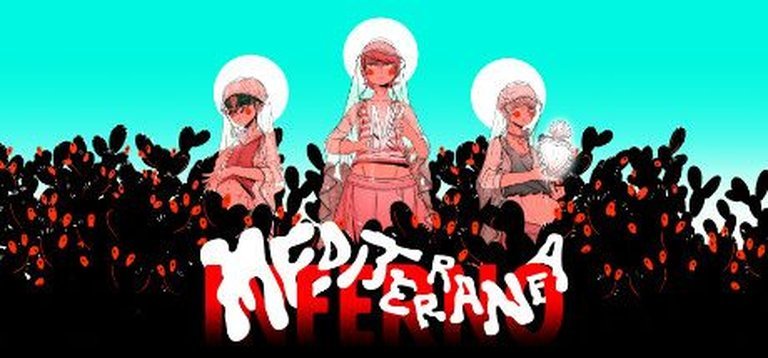
Mediterranea Inferno is a first-person visual novel set in contemporary Europe, where three friends reunite after years of COVID lockdowns, leading to a haunting, drug-fueled journey of betrayal, queer themes, and mature content. This brief five-hour experience blends point-and-click adventure elements with brutal twists and psychological depth, challenging players through a narrative that explores identity, trauma, and unexpected revelations.
Gameplay Videos
Where to Buy Mediterranea Inferno
PC
Mediterranea Inferno Guides & Walkthroughs
Mediterranea Inferno Reviews & Reception
eurogamer.net (100/100): Lorenzo Redaelli follows up 2020’s uncompromising The Milky Way Prince: The Vampire Star with a pulverising, shape-shifting visual novel of friendship, post-COVID trauma, and horror in the blistering Italian sun that’s as artistically dazzling as it is emotionally raw.
Mediterranea Inferno: Review
Introduction
In a medium often celebrated for escapism, Mediterranea Inferno stands as a blistering, unflinching confrontation with reality. This visual novel by Italian independent developer Eyeguys (Lorenzo Redaelli) and publisher Santa Ragione thrusts players into a sun-drenched Italian summer that blisters with psychological horror as much as it does with heat. Set against the backdrop of a world reeling from the aftermath of COVID-19 lockdowns, the game examines the fractured psyches of three young men—Claudio, Andrea, and Mida—as they attempt to reclaim lost time during a fateful retreat. More than a mere narrative, Mediterranea Inferno is a fever dream of desire, trauma, and generational disillusionment, wrapped in a visual style so vibrant it feels physically punishing. This review argues that Mediterranea Inferno is a masterwork of contemporary game storytelling, one that uses the microcosm of a post-pandemic vacation to dissect the hollowing out of identity in an era of collective trauma, all while setting new standards for artistic ambition in the visual novel genre.
Development History & Context
Mediterranea Inferno emerged from the singular vision of Lorenzo Redaelli, the creative force behind Eyeguys, who previously crafted the acclaimed Milky Way Prince: The Vampire Star. Redaelli’s intent was explicit: to deconstruct the myth of the Italian summer holiday—a romanticized, almost sacrosanct institution in Italian culture—by exposing its underbelly of commercialization and disillusionment. Set in Puglia (a region deeply personal to Redaelli, where he spent childhood summers) and released shortly after Italy’s COVID restrictions lifted in 2022, the game is a direct response to the pandemic’s isolating grip on a generation. Technically, the game was built using Unity, with a flowchart-driven narrative system allowing for branching paths. All art was hand-drawn in Photoshop using a Cintiq tablet, resulting in a unique visual language that blends 2D illustrations with stylized 3D elements. This approach, while not technically groundbreaking in an era of photorealism, was a deliberate choice to amplify the game’s themes of distorted reality and subjective perception. Developed during a time when indie games were increasingly leveraging personal narratives to explore societal fractures, Mediterranea Inferno arrived as a defiantly political and deeply personal statement, reflecting the anxieties of a world emerging from global crisis.
Narrative & Thematic Deep Dive
At its core, Mediterranea Inferno is a character study of three friends in their early 20s—Claudio, Andrea, and Mida—known collectively as the “Sun Guys” for their legendary status in Milan’s nightlife scene. The narrative opens in a club in 2020, capturing their mythic aura before a brutal time-skip to August 2022, post-lockdown. Their reunion in Puglia is fraught with tension: the pandemic has exacerbated their individual insecurities into existential crises. Claudio, once a charismatic leader, grapples with a shattered identity in a generational void. Andrea, once the group’s social linchpin, is hollowed by loneliness, reduced to swiping desperately on hookup apps for connection. Mida, seemingly the most successful (as a model), is obsessed with control and validation, unable to escape the echo of unrequited love.
The plot unfolds through player-driven choices: each day, the trio selects activities (beach, club, cemetery), and players allocate “summer coins” to purchase “Mirages”—surreal, hallucinatory sequences that plunge characters into their deepest desires and fears. These Mirages are not mere indulgences; they are cathartic descents into Inferno. Andrea’s Mirage is a hyper-sexualized paradise of beach parties and suggestive fruit consumption, masking his terror of solitude. Claudio’s is a nostalgic fantasy of baroque grandeur, a rejection of the present. Mida’s is a cold, isolating underwater prison, a reflection of her emotional detachment.
Thematic depth lies in the game’s allegorical power. The Italian summer becomes a metaphor for post-pandemic society: a myth of paradise masking dysfunction. Religious iconography (statues of the Virgin Mary, “holy cards”) saturates the visuals, symbolizing the Catholic guilt that haunts the characters and the cultural baggage of a nation clinging to its past while crumbling in the present. The narrative also confronts queer identity head-on, with unabashed depictions of desire and rejection, challenging heteronormative assumptions. As the game progresses, the characters’ pursuit of “Heaven” (a promised endless summer) devolves into a competition fueled by jealousy and resentment. The dialogue oscillates between poetic introspection (“Hope is like the absence of thought; the harder you chase it, the more elusive it becomes”) and theatrical melodrama, mirroring the characters’ fractured selves. Ultimately, Mediterranea Inferno is a purgative experience, forcing players to confront how trauma fester in silence and how the myth of redemption can become a prison.
Gameplay Mechanics & Systems
As a visual novel, Mediterranea Inferno prioritizes narrative and choice over complex gameplay, but its mechanics are ingeniously woven into its themes. The core loop revolves around daily activities: players select from options like lounging by the pool, visiting a cemetery, or clubbing, each influencing the story’s tone. Activities earn “summer coins,” which are spent on Mirages—character-specific hallucinatory sequences. This system creates a brutal zero-sum economy: only one character can experience a Mirage per day, and four are needed for “ascension” to Heaven. This mechanic forces players to play favorites, exacerbating the characters’ rivalries and reflecting the game’s theme of limited resources in a post-pandemic world.
Mirages are the gameplay centerpiece, offering limited exploration (e.g., clicking on objects in static scenes) to uncover narrative fragments. While linear in outcome, they are visually distinct, aligning with each character’s psyche. Replayability is encouraged by multiple endings (ranging from bleak to hopeful) and hidden elements like “Holy Cards,” which unlock a bonus “special fruit” ending. The UI is minimalist—dialogue boxes, choice menus, and inventory screens—allowing the art and writing to dominate. However, this simplicity can be a double-edged sword; critics noted that some choices feel superficial, with Mirages often converging on similar emotional beats regardless of player input. Yet, the game’s genius lies in how its limitations serve its themes: the constrained choices mirror the characters’ inability to escape their self-destructive cycles. The brevity of a playthrough (3–4 hours for 60% of content) is a strength, ensuring the narrative’s intensity remains undiluted, though some players may crave deeper interactivity.
World-Building, Art & Sound
Mediterranea Inferno’s world is a character in itself: Puglia, rendered as a hyper-stylized hellscape of paradise. The setting is not merely a backdrop but a psychological landscape. The villa, beaches, and clubs are saturated with an oppressive red and pink palette, evoking both the scorching sun and the characters’ internal bleeding. Religious symbols—votive statues, iconography—are distorted to the point of grotesquery, reflecting the game’s critique of Italy’s Catholic heritage as a source of repression. This visual language is a masterclass in environmental storytelling: a scene of a character lounging by the pool might bleed into a nightmare of drowning, or a club montage could unravel into a violent chase, blurring the line between reality and mirage.
The art direction, by Redaelli, blends hand-drawn illustrations with 3D elements, creating a layered, almost tactile effect. Textures range from the smooth gloss of marble floors to the jagged spikes of prickly pears (a recurring symbol of forbidden fruit). Character designs are exaggerated—Claudio’s sharp angles, Andrea’s fluidity—mirroring their archetypal roles. Religious iconography is repurposed: a confessional booth marooned in a desert, saints with glassy eyes, creating a gothic horror aesthetic that channels Italian cinema (Fellini’s Juliet of the Spirits, Argento’s neon-soaked giallo).
The soundtrack, also by Redaelli, is a tour de force. It fuses vintage Italo disco and 70s Italian new wave with contemporary electronic and hyperpop, shifting seamlessly from dreamy synths to chaotic, distorted beats during chase sequences. Music acts as a psychological barometer: serene piano underscoring quiet moments gives way to thumping bass in Mirages, culminating in perreo-inspired rhythms that turn horror into a grotesque dance. Sound design is equally meticulous—crackling fire, distant screams, the rustle of palm leaves—immersing players in the characters’ sensory overload. Together, the art and sound create a synesthetic experience, making the game’s heat, dread, and euphoria almost palpable.
Reception & Legacy
Mediterranea Inferno was met with widespread acclaim upon its 2023 PC release, earning a “Generally Favorable” score on Metacritic (84%). Critics lauded its ambition and emotional resonance. Eurogamer awarded it a perfect 100/100, calling it a “pulverising, shape-shifting visual novel of friendship, post-COVID trauma, and horror” that was “as artistically dazzling as it was emotionally raw.” Edge praised its “purgative potency,” while Noisy Pixel (90%) celebrated its “queer, brutal” storytelling. However, reception was polarized; some found its intensity overwhelming, with eShopper Reviews (58%) criticizing its “unlikable characters” and “bewildering story.”
Commercially, the game thrived as a cult hit, later expanding to consoles (PlayStation, Xbox, Switch in 2024) and accumulating a “Very Positive” user score on Steam (97%). It won the Excellence in Narrative award at the 2024 Independent Games Festival and was nominated for the Seumas McNally Grand Prize. Its legacy extends beyond accolades; it redefined the visual novel as a vehicle for socio-political critique, influencing games like The Cosmic Wheel Sisterhood in their exploration of identity and trauma. Redaelli’s unflinching approach to post-pandemic themes resonated in a world still grappling with lockdowns, making Mediterranea Inferno a touchstone for Gen Z’s disillusionment. As one Steam user wrote, “It made me ask my friends how lockdown really felt,” proving its power to spark conversation beyond the screen.
Conclusion
Mediterranea Inferno is not a game for the faint of heart. It is a searing, beautiful, and often agonizing journey into the psyche of a generation adrift. By using the Italian summer as a crucible for post-pandemic trauma, Lorenzo Redaelli crafts a narrative that is both deeply personal and universally resonant. Its gameplay, while minimalist, is a thematic masterstroke, turning choice into a moral dilemma and mirages into psychological battlegrounds. The art and sound design are not merely aesthetic but foundational, creating a world that feels both alien and intimately human.
In a landscape of games often content to entertain, Mediterranea Inferno dares to disturb. It confronts the viewer with uncomfortable truths about identity, desire, and the weight of history, all wrapped in a visually stunning package. Its critical and industry recognition—including the IGF’s top narrative honor—cements its place as a landmark work. Ultimately, Mediterranea Inferno is a triumph of vision over convention: a game that lingers in the mind long after the credits roll, a testament to the power of interactive media to hold up a mirror to society’s deepest wounds and most profound yearnings. It is, quite simply, one of the most important and unshakable games of its generation.