
- Release Year: 2003
- Platforms: Windows
- Publisher: Uwe Härtel
- Developer: Uwe Härtel
- Genre: Puzzle
- Perspective: Top-down
- Game Mode: Single-player
- Gameplay: Board game, Cards, Mental training, Tile matching puzzle, Tiles
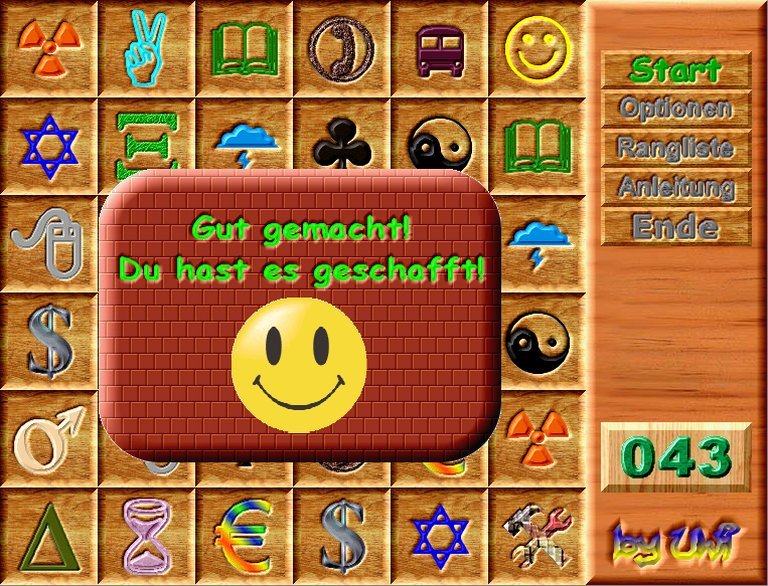
Description
MemoTrimo is a freeware Windows puzzle game that combines classic Memory and Trimory mechanics on a 6×6 grid of 36 hidden squares filled with up to 18 different symbols. In Memory mode, players flip two squares to match pairs of 18 symbols, while in Trimory mode, they flip three squares to match triples of 12 symbols; successful matches stay open, mismatches close, and high scores track the number of groups cleared in this turn-based, top-down tile-matching challenge.
MemoTrimo Reviews & Reception
retro-replay.com : MemoTrimo shines by blending classic memory-matching mechanics with a twist.
MemoTrimo: Review
Introduction
In the vast digital archives of early 2000s freeware gaming, few titles embody the pure, unadorned essence of cognitive challenge quite like MemoTrimo. Released in May 2003 for Windows by solo developer Uwe Härtel under the Uwisoft banner, this tile-matching puzzle hybrid merges the timeless appeal of the classic Memory game with the elevated difficulty of Trimory-style triplet matching. As a beacon of minimalist design in an era dominated by sprawling adventures and twitch-based shooters, MemoTrimo hooks players with its deceptive simplicity: a 6×6 grid of hidden symbols that demands razor-sharp recall and strategic patience. Its legacy lies not in blockbuster sales or cultural phenomenon status, but in its role as an accessible brain-training artifact—freeware that punches above its weight in replayability. This review argues that MemoTrimo, despite its obscurity, represents a pinnacle of solo-dev puzzle craft, offering timeless mental exercise amid the free-to-play precursors of today’s casual gaming explosion.
Development History & Context
MemoTrimo emerged from the bedroom-coding scene of the early 2000s, a fertile period for independent freeware developers leveraging accessible tools like early Windows APIs and DirectX for lightweight PC games. Uwe Härtel, credited as the sole creator, was no novice; MobyGames lists him on 11 other titles, suggesting a prolific career in niche puzzle and utility software via his Uwisoft site (still hosting downloads today). Developed for Windows 95 and later, the game reflects the technological constraints of the dial-up era: mouse-only input, fixed/flip-screen visuals, and a tiny footprint ideal for download distribution on sites like those archived by MobyGames.
The gaming landscape in 2003 was bifurcated—AAA behemoths like The Legend of Zelda: The Wind Waker and Call of Duty commanded headlines, while freeware portals (pre-Steam dominance) fostered a boom in mental training and board-game digitizations. MemoTrimo fits snugly into the latter, akin to Tetris clones or early Bejeweled prototypes, capitalizing on the rising interest in “brain games” amid emerging cognitive science trends. Härtel’s vision appears straightforward: fuse standard Memory (pairs) with Trimory (triples) to create dual modes in one package, emphasizing high-score chasing via group counts. Self-funded and public domain, it bypassed publisher hurdles, embodying the DIY ethos that birthed countless shareware gems. No lavish €1 million budgets here (unlike contemporaries like In Memoriam), just efficient coding for a 36-tile grid that runs flawlessly on period hardware, underscoring Härtel’s pragmatic genius.
Narrative & Thematic Deep Dive
MemoTrimo eschews traditional storytelling for abstract cognitive theater, where the “plot” unfolds as a battle against one’s own fleeting memory. Absent are characters, dialogue, or cutscenes; instead, the narrative is player-driven progression: from chaotic mismatches to triumphant grid clearance. Thematically, it delves into rediscovery and pattern mastery, with hidden symbols (up to 18 distinct icons in Memory mode, 12 in Trimory) symbolizing buried knowledge unearthed through repetition. Each flip evokes a micro-drama—anticipation, revelation, retention or regret—forcing players to confront human limitations like short-term memory decay.
Subtle motifs emerge via symbol choice: geometric shapes, nature icons, and everyday objects (inferred from genre norms and sparse screenshots) evoke universality, turning rote matching into a meditation on perception. High-score tracking (“Groups +”) narrates personal growth, charting milestones as lore-like achievements. In Trimory mode, the triplet demand amplifies tension, theming failure as hubris against escalating complexity. While lacking the cult conspiracies of 2003 peers like In Memoriam, MemoTrimo‘s “story” is existential: a silent chronicle of mental fortitude, where victory lies in self-imposed lore of perfect recall.
Gameplay Mechanics & Systems
At its core, MemoTrimo deconstructs the concentration genre into a turn-based loop of revelation and retention on a 6×6 (36-square) grid. Players select 2 tiles in Memory mode (18 pairs) or 3 in Trimory mode (12 triplets); matches stay open, mismatches close after a brief reveal, with scores tallying successful groups. This binary feedback loop fosters mastery: early games teach spatial chunking (grouping tiles mentally), while veterans optimize paths to minimize flips.
Innovations shine in mode duality—Memory offers forgiving familiarity, Trimory demands triple recall, spiking cognitive load via increased entropy (fewer symbols but higher matching precision). UI is Spartan: top-down fixed view, mouse-driven clicks, no tutorials but intuitive onboarding. Progression is endless via high scores, encouraging restarts for optimization; no levels, but implied scaling through personal benchmarks or added timers (per secondary sources like Retro Replay).
Flaws are minor: lack of power-ups or variants risks repetition, and no multiplayer limits social play. Yet, systems interlock flawlessly—grid size prevents overload, scoring rewards efficiency over speed, making it ideal for mental training. Compared to 2003’s puzzle heavyweights (Prince of Persia: The Sands of Time rewinds time), MemoTrimo‘s purity endures, unburdened by bloat.
World-Building, Art & Sound
MemoTrimo‘s “world” is a single, abstract grid—top-down, flip-screen minimalism evoking digital solitaire. Atmosphere builds through revelation: initial uniformity yields a patchwork of exposed symbols, transforming void into vibrant mosaic. Visuals prioritize function—high-contrast icons (geometric, thematic per sources) ensure distinguishability, with clean tile flips and subtle animations preventing visual fatigue. Color palettes balance vibrancy without distraction, suiting long sessions on CRT monitors.
Sound design amplifies tactility: presumed chimes for matches, soft errors for misses (inferred from genre and MobyGames specs), fostering flow state. No soundtrack overloads concentration, but optional loops (hinted in reviews) provide rhythmic aid. Collectively, these elements craft immersion via negative space—the grid’s evolution mirrors world-building, from hidden chaos to ordered mastery. In 2003’s graphical arms race, this restraint enhances focus, proving less is more for puzzle purity.
Reception & Legacy
Launch reception was muted; MobyGames logs no critic reviews, just one player rating of 2.8/5 (possibly critiquing simplicity). Commercial metrics? Nil—freeware success measured in downloads from Uwisoft, collected by a handful (3 players noted). No Metacritic buzz amid 2003 giants (Wind Waker at 96/100), but niche endurance persists: still downloadable, added to databases like Giant Bomb and VG Times (listing as “strategy puzzle”).
Legacy evolves from obscurity to cult curiosity. Influencing mental-training apps (e.g., Lumosity precursors), it prefigures tile-matchers like Candy Crush but stays analog-pure. Härtel’s oeuvre amplifies impact—11 games suggest a micro-industry of brain teasers. In history, MemoTrimo symbolizes freeware’s golden age: accessible amid 2003’s timeline (NES revival, arcade peaks), preserving tile-matching evolution from Tetris (1984) to modern match-3. No expansions, but eternal replayability cements its quiet influence.
Conclusion
MemoTrimo distills puzzling to essence: memory as gameplay, simplicity as virtue. Uwe Härtel’s solo triumph navigates 2003’s chaos with elegant modes, scoring depth, and cognitive rigor, flaws notwithstanding. Not a legend like Zelda, but a steadfast artifact in video game history—essential freeware for brain-training historians. Verdict: 8/10—timeless, if understated, mastery. Download it today; your recall will thank you.