
- Release Year: 1997
- Platforms: Windows
- Publisher: Macmillan Interactive Publishing, Marshall Media Ltd.
- Developer: MultiMedia Corporation plc, The
- Genre: Educational, Puzzle
- Perspective: 1st-person
- Game Mode: Single-player
- Gameplay: Drag and drop, Mental training, Point and select
Description
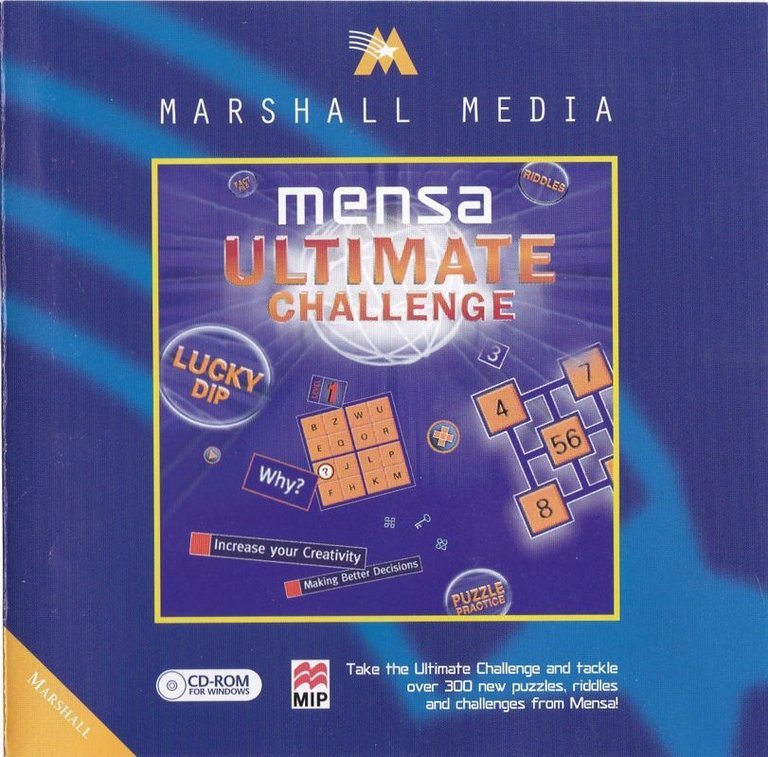
Mensa Ultimate Challenge is an educational puzzle game released in 1997 for Windows. It offers a collection of riddles, puzzles, and mental exercises designed to enhance brainpower. The game features various sections including Riddles, Puzzle Practice, Lucky Dip, Fact File, and the Ultimate Challenge, which tests players with increasingly difficult questions across multiple levels.
Mensa Ultimate Challenge Free Download
Mensa Ultimate Challenge: Review
Introduction
In the late 1990s, as the gaming industry leaned into flashy 3D graphics and action-packed narratives, Mensa Ultimate Challenge (1997) dared to be different. Developed by The Multimedia Corporation and published by Macmillan Interactive Publishing, this Windows CD-ROM title positioned itself as a cerebral workout disguised as entertainment. Leveraging the prestigious Mensa brand—a society for high-IQ individuals—the game promised to “boost brainpower” through a curated collection of puzzles, riddles, and logic tests. But was it a legitimate mental gymnasium or a glorified quiz book? This review dissects its design, legacy, and enduring relevance in the niche market of educational gaming.
Development History & Context
Studio Vision & Constraints
The Multimedia Corporation, a London-based developer known for titles like Mensa Mindbenders (1996), aimed to merge educational rigor with digital interactivity. With Robert C. Pape leading programming and Adele Carroll as producer, the team collaborated closely with Mensa Limited to ensure puzzles met the organization’s standards. The late ’90s CD-ROM era allowed for expansive content delivery, but technological constraints were evident: the game ran exclusively in full-screen mode, with limited multimedia flourishes beyond static images and basic MIDI-style music composed by Steven Faux.
The Gaming Landscape
Released alongside point-and-click adventures and early 3D platformers, Mensa Ultimate Challenge catered to a niche audience. It echoed the rise of “edutainment” titles like Where in the World Is Carmen Sandiego? but targeted adults rather than children. Its turn-based, cerebral gameplay stood in stark contrast to the reflex-driven zeitgeist of Tomb Raider or Quake.
Narrative & Thematic Deep Dive
Structure as Substance
The game lacks a traditional narrative, opting instead for a thematic focus on self-improvement. The “Fact File” section, penned by Mensa, frames the experience as a journey to “unleash your unique potential,” with essays on memory enhancement, creativity, and decision-making. This didactic tone positions the player as a student rather than a protagonist, with puzzles serving as exams to validate intellectual prowess.
Mensa’s Branded Authority
By licensing the Mensa name, the game inherits an aura of elitism. The inclusion of Robert Allen as a Mensa consultant lent credibility, but the reliance on pre-existing puzzle archetypes—number sequences, word riddles, magic squares—often feels more like a repackaged trivia product than an innovative mental challenge.
Gameplay Mechanics & Systems
Core Modes
The game features five primary modes:
1. Riddles: Forty text-based conundrums (e.g., lateral-thinking puzzles) with instant answers.
2. Puzzle Practice: Twenty-five categories of logic problems, from algebraic grids to symbol-matching.
3. Lucky Dip: Randomized selections from Puzzle Practice.
4. Fact File: A digital manual for cognitive self-help.
5. Ultimate Challenge: Timed exams with escalating difficulty (e.g., 20 questions in 40 minutes).
Interaction & Progression
Inputs alternate between keyboard typing and mouse-driven drag-and-drop, though the clunky UI—a relic of ’90s design—often disrupts immersion. Skipping questions and revisiting mistakes alleviates frustration, but the lack of adaptive difficulty or progress tracking limits long-term engagement.
World-Building, Art & Sound
Functional Aesthetics
The visual design is utilitarian: static screens with bland icons and stock photography (supplied by Pictor International). Illustrator Martin Jessup’s contributions are minimal, confined to basic diagrams. The first-person perspective evokes a sterile testing environment rather than a vibrant world.
Sound Design
Charles Noue’s voiceover adds a touch of gravitas, while Steven Faux’s optional soundtrack—looping MIDI melodies—does little to enhance the experience. The overall atmosphere leans more “corporate training module” than “captivating game.”
Reception & Legacy
Critical Silence
Notably, Mensa Ultimate Challenge left barely a ripple in gaming discourse. No critic reviews were archived on MobyGames, and player testimonials are absent. Its commercial performance is similarly opaque, though its presence on eBay as a sub-$10 relic hints at limited demand.
Influence & Echoes
While the game itself faded into obscurity, its DNA persists in modern brain-training apps like Lumosity and Peak. Its timed challenge format prefigured the standardized testing mechanics of later puzzle titles, and the Mensa brand continues to license similar products (American Mensa Academy, 2012).
Conclusion
Mensa Ultimate Challenge is a fascinating artifact of ’90s edutainment—a well-intentioned but flawed attempt to gamify cognitive improvement. Its rigid structure and lack of polish hinder its appeal as a game, yet its earnest focus on mental agility remains commendable. For puzzle purists, it offers a retro curiosity; for historians, a case study in the risks of prioritizing education over engagement. While it never achieved the cultural footprint of contemporaries like Myst, its niche ambition secures a minor footnote in the annals of educational gaming.
Final Verdict: A cerebral time capsule—more IQ test than interactive marvel—best suited for nostalgia-driven enthusiasts or Mensa completists.