
- Release Year: 2024
- Platforms: Windows
- Developer: Efrain Mazu
- Genre: Action
- Perspective: Diagonal-down
- Gameplay: Direct control, giant robot, Mecha, Roguelike, Shooter, Vehicular combat
- Setting: Futuristic, Sci-fi
Description
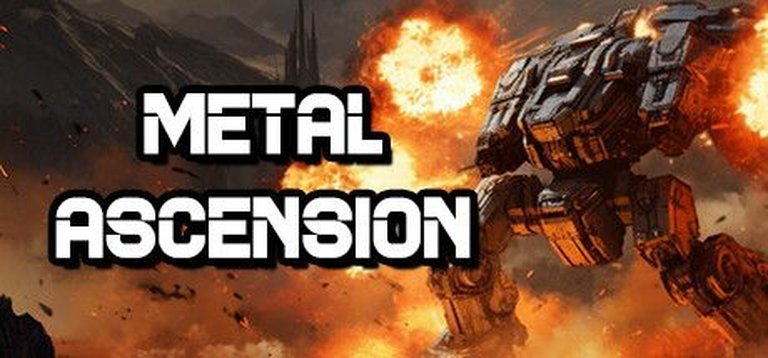
Metal Ascension is a sci-fi action roguelite shooter that combines reverse bullet hell mechanics with vehicular combat in a futuristic setting. Players pilot customizable mechs, battling waves of enemies across dynamically generated floors. With over 150 unlockable parts, players can upgrade their giant robots, choose between auto-firing or manual aiming combat styles, and strategically collect resources between intense 20-60 second survival waves. The fast-paced runs (under 30 minutes) challenge players to climb floors, enhance their stats, and ultimately ascend as legends of mechanized warfare.
Where to Buy Metal Ascension
PC
Metal Ascension Patches & Updates
Metal Ascension: Reverse Bullet Hell Meets Mech Mayhem in an Uneven Roguelite Experiment
Introduction
In the oversaturated landscape of indie roguelites, Metal Ascension (2024) dares to fuse Nuclear Throne’s top-down chaos with Daemon X Machina’s mech customization—a bold pitch for players craving mechanized carnage. Developed by the elusive studio Don Pachi, this “reverse bullet hell” survival game promises high-octane runs where players ascend procedurally generated floors while outfitting their mech with over 150 modular parts. Yet behind its explosive premise lies a turbulent launch marked by technical missteps and unfulfilled potential. Does Metal Ascension ascend as a cult gem or crash under the weight of its ambition? This review dissects every circuit and weld.
Development History & Context
Metal Ascension emerges from Don Pachi, a developer with scant public presence and no prior major titles. The credits reveal a fractional team of 11 contributors, including sole creator Efrain Mazu and composer Kouichi Morita (credited under the alias Maou Damashii). Built in Unity, the game leans heavily on asset store purchases—Mech Constructor for rigging, War FX for explosions, and Total Music Collection for audio—resulting in a patchwork aesthetic that struggles for cohesion.
Released January 11, 2024, the game entered a hyper-competitive market where polished roguelites like Hades and Risk of Rain 2 dominate. Don Pachi’s vision was clear: streamline the genre into 30-minute sprints of “establishing fire superiority” via modular mechs. Yet the studio’s inexperience shows in its post-launch patches, which hastily addressed game-breaking bugs like soft-locks and achievement glitches (e.g., v1.3.1 removing level caps for orbital weapons). The rushed development cycle—evidenced by placeholder UI elements and inconsistent tooltips—reflects the financial pressures facing indie devs in an era of Steam’s algorithm-driven discoverability.
Narrative & Thematic Deep Dive
Metal Ascension eschews traditional storytelling for a blunt premise: “ascend as a legend” by conquering 20 waves of mechanical foes. The lack of lore or world-building is a glaring omission in a genre where titles like Returnal weaponize narrative mystery. Pilots, added post-launch via a March 2024 update, offer minimal personality, defined solely by mechanical buffs/debuffs (e.g., “+15% damage, -10% armor”).
Thematically, the game explores survival through attrition: a lone mech against impossible odds. Yet this theme clashes with its upgrade loop, where player progression hinges not on skill but RNG-dependent loot drops. The cold, utilitarian tone—mirrored in menus resembling assembly blueprints—echoes FTL: Faster Than Light’s sterile pragmatism but lacks its emergent storytelling. Metal Ascension’s universe feels hollow, a scaffold for systems rather than a living world.
Gameplay Mechanics & Systems
Core Loop & Progression
Runs revolve around surviving 20-60 second waves, scavenging materials between rounds, and upgrading your mech at shops. The “reverse bullet hell” tagline misleads: instead of dodging projectiles, players unleash barrages against swarming drones and turrets. Customization offers depth, with over 150 parts—ranging from flamethrower arms to shield generators—permitting “over 1,000,000 combinations.” Yet early-game imbalances trivialize builds: automatic weapons outclass manual-aim options, and orbital drones (later patched to scale infinitely) overshadow primary weapons.
Roguelite Elements & Economy
Meta-progression is skeletal. Unlocked parts carry into subsequent runs, but the absence of permanent stat boosts (e.g., health, mobility) forces players into tedious grinding. The shop’s economy falters: “blue coins,” rare currency for premium gear, drop inconsistently, while relics (passive buffs like “10% shop discounts”) suffer from stacking bugs, as noted in player discussions (“10% sale relics only work on first selection“).
Combat & Controls
Top-down shooting lacks weight; mechs glide frictionlessly across arenas, and collisions feel inconsequential. Enemy AI follows rudimentary patterns—charging or circling—with later waves merely inflating health pools. The March 2024 pilot system introduces light tactical variance (e.g., pilots altering dash distance), but controls remain floaty, undermining precision in dense fights.
World-Building, Art & Sound
Visual Design
The game’s diagonal-down perspective apes Hotline Miami but struggles with visual clutter. Mech designs, borrowed from the Mech Constructor asset pack, lack personality—generic humanoid frames with interchangeable weapons. Environments are sparse, looping the same industrial arenas with palette-swapped hazards. Explosions (via War FX) dazzle initially but repeat to distraction.
Audio Landscape
Kouichi Morita’s synth-rock score elevates the chaos with pulsating basslines, yet tracks loop too abruptly, breaking immersion. Weapon SFX—gatling guns thudding, lasers sizzling—satisfy, but enemy death sounds recycle a mere three crunches. The absence of voice acting or atmospheric drones leaves the world feeling sterile.
Reception & Legacy
Metal Ascension launched to “Mostly Negative” Steam reviews (38% positive), lambasted for bugs, unbalanced economies, and repetitive design. Players cited progression blockers like the bugged “10,000 kills” achievement and inconsistent difficulty spikes in later waves (“Wave 20 feels artificially inflated“). Post-launch patches added content (endless mode, pilots) but failed to rectify core issues.
Its legacy remains uncertain. While the game’s modular mech-building teases innovation—forging a path between Brigador’s simulation and Vampire Survivors’ accessibility—its execution lacks refinement. Industry peers have taken note: the “reverse bullet hell” concept resurfaced in April 2024’s Astral Ascension, executed with cleaner combat loops. Metal Ascension’s influence may yet simmer in niche circles, but its commercial underperformance (1 MobyGames collector) suggests a footnote in roguelite history.
Conclusion
Metal Ascension is a case study in unrealized ambition. Its modular mech-building and aggressive pacing flirt with greatness, hampered by janky systems, asset-flip aesthetics, and a disastrous launch. Don Pachi’s post-release support demonstrates passion, but the foundation needs reforging. For roguelite completists, it’s a curious artifact—a $7.49 lesson in design overreach. For others: wait for a sequel, or replay Into the Breach.
Verdict: A diamond-rough prototype buried under rubble—approach with tempered expectations.