
- Release Year: 2003
- Platforms: Android, Arcade, iPad, iPhone, Neo Geo, Nintendo Switch, PlayStation 2, PlayStation 3, PlayStation 4, Windows Apps, Windows, Xbox One, Xbox
- Publisher: Hamster Corporation, Ignition Entertainment Ltd., MEGA Enterprise Co., Ltd., SNK Playmore Corporation
- Developer: SNK Playmore Corporation
- Genre: Action
- Perspective: Side view
- Game Mode: Co-op, Single-player
- Gameplay: Arcade, Aviation, Flight, Platform, Shooter, Tank, Vehicular
- Setting: 2030s
- Average Score: 70/100
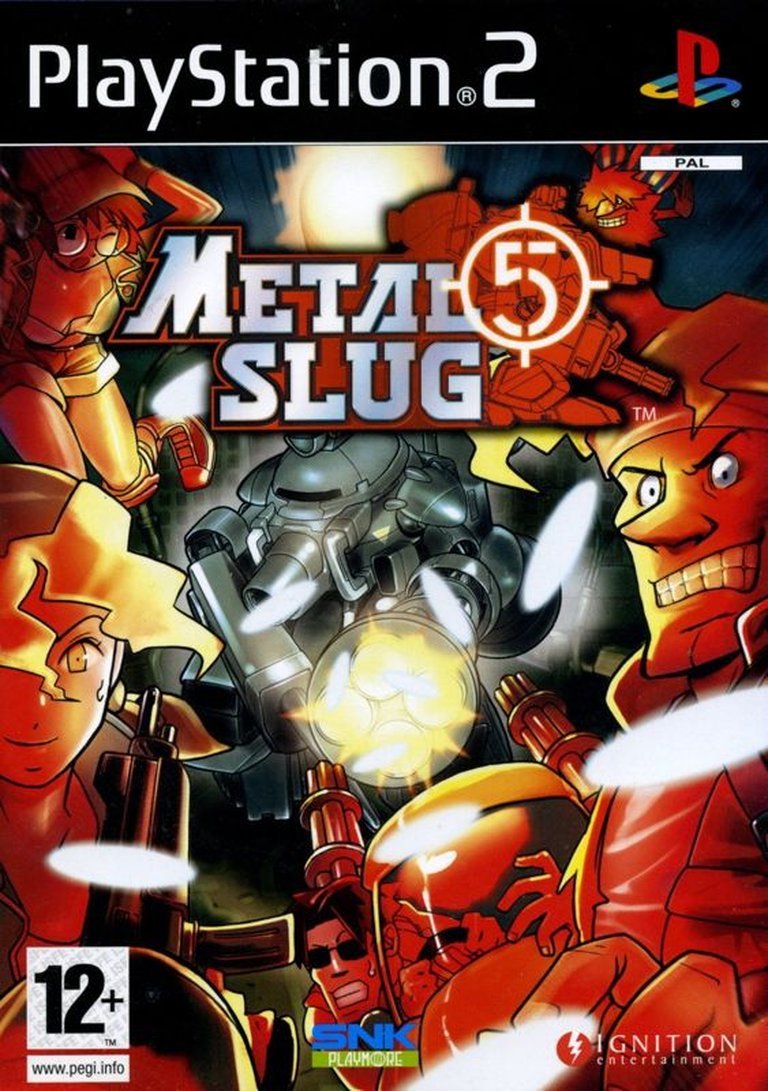
Description
Set in the 2030s, Metal Slug 5 is a side-scrolling run-and-gun arcade shooter where players control Marco, Tarma, Eri, and Fio as they combat the paramilitary Ptolemaic Army. This new enemy force has stolen a disc containing top-secret Metal Slug data from a research installation, and the heroes must recover it through chaotic action, featuring new vehicles like the Spider Slug and Slug Gunner, alongside a sliding move for evasion.
Gameplay Videos
Metal Slug 5 Guides & Walkthroughs
Metal Slug 5 Reviews & Reception
imdb.com (70/100): An improvement over 4, no doubt.
gamesreviews2010.com : With its engaging run-and-gun gameplay, a compelling narrative involving the Ptolemaic Army, and the introduction of new mechanics, Metal Slug 5 (2003) solidifies its place in the series as both a continuation and an innovation.
neo-geo.com : Superb as usual.
Metal Slug 5 Cheats & Codes
PlayStation 2 (CodeBreaker, NTSC-U)
Enter codes using a CodeBreaker or GameShark device.
| Code | Effect |
|---|---|
| B4336FA9 4DFEFB79 | Enable Code (Must Be On) |
| 9B8E1299 A3293C40 | Enable Code (Must Be On) |
| DAA806BD AF621389 | Enable Code (Must Be On) |
| F689FF41 0C19AFF8 | Enable Code (Must Be On) |
| 1553A451 33D4F8E6 | Infinite Time |
PlayStation 2 (Action Replay MAX, US)
Enter codes using an Action Replay MAX device.
| Code | Effect |
|---|---|
| 1VUB-UKUC-M8G4B | Master Code – Must Be On |
| 2NCK-020A-2C26M | Master Code – Must Be On |
| 18MU-BPDU-Q0CFE | Infinite Time |
| 7HRE-TMYV-F41V7 | Infinite Time |
| 9HP5-744V-NBXEP | Enable All Missions |
| JG1F-ZV8Q-JMF1E | Enable All Missions |
| 5MNC-4V4C-J4ZEF | All Trophy Items |
| WY76-B7ZG-UD1TC | All Trophy Items |
| 77B5-N82J-K9EU8 | Invincible |
| D8UV-MJHB-GTUP9 | Invincible |
| 46HF-JHPW-8XFYJ | Invincible |
| 8GB8-BC90-RP42F | Infinite Lives |
| 0ZAP-Q9CK-VBCU8 | Infinite Lives |
| 7BTX-1982-04Q7R | Infinite Ammo: All Weapons |
| 6CRN-XHQH-B96T2 | Infinite Ammo: All Weapons |
| CJYW-BR63-EDZN6 | Infinite Ammo: All Vehicles |
| R5CZ-7CKJ-GMFAQ | Infinite Ammo: All Vehicles |
| N6ZJ-XF8J-98CB7 | Infinite Bombs |
| F01Q-M8DT-DQHEA | Infinite Bombs |
| HEFD-KMJZ-A1FNF | L1+L2 For Max Rescues |
| 0Y31-BCQN-NVPMU | L1+L2 For Max Rescues |
| J3MH-UYFW-872P5 | L1+L2 For Max Rescues |
| J8DA-3J6H-T6PX6 | Max Score |
| E95C-47AK-FKEH3 | Max Score |
| G10H-9HKQ-4Q8A1 | Hold R1 For Super Jump |
| 9F4J-KCQT-ECE25 | Hold R1 For Super Jump |
| 1ZAH-1RNU-M1EC7 | Hold R1 For Super Jump |
| FBQZ-GVR5-V11GY | Hold R2 To Hover |
| ZFWM-K4EK-48TT5 | Hold R2 To Hover |
| K6NM-QYZX-RXCYG | Hold R2 To Hover |
| QX5V-17GY-RVR8J | Weapon Always Shotgun |
| 0BFM-BTKB-JZYJF | Weapon Always Shotgun |
| D3DR-NZ09-07CER | Weapon Always Shotgun |
| EHF9-7U5J-22JD0 | Weapon Always Small Rocket |
| UBTX-8HD8-XD4FM | Weapon Always Small Rocket |
| D3DR-NZ09-07CER | Weapon Always Small Rocket |
| E0CK-QU41-DXYGU | Weapon Always Small Flame Thrower |
| XWWF-7HGJ-346AU | Weapon Always Small Flame Thrower |
| D3DR-NZ09-07CER | Weapon Always Small Flame Thrower |
| Y4MF-6QB1-DAJCF | Weapon Always Heavy Machine Gun |
| JJBM-RERH-30KTR | Weapon Always Heavy Machine Gun |
| D3DR-NZ09-07CER | Weapon Always Heavy Machine Gun |
| ZFWD-DD5G-1HHWH | Weapon Always Laser |
| 9V47-5DZA-EG4PM | Weapon Always Laser |
| D3DR-NZ09-07CER | Weapon Always Laser |
| 96U8-3Q7K-QA03X | Weapon Always Large Rocket |
| 3UGG-1X27-42PGR | Weapon Always Large Rocket |
| D3DR-NZ09-07CER | Weapon Always Large Rocket |
| RZFY-BN41-8QVQR | Weapon Always Large Flame Thrower |
| AVZ3-MKGR-NYWWA | Weapon Always Large Flame Thrower |
| D3DR-NZ09-07CER | Weapon Always Large Flame Thrower |
| 8AT5-5P21-WVF3M | Weapon Always Machine Gun x2 |
| RBFP-UPY5-QXD9D | Weapon Always Machine Gun x2 |
| D3DR-NZ09-07CER | Weapon Always Machine Gun x2 |
| Q8AZ-MVGZ-KZ2GA | Weapon Always Giant Laser |
| DWAW-D64N-JMCFJ | Weapon Always Giant Laser |
| D3DR-NZ09-07CER | Weapon Always Giant Laser |
| W00N-JFFX-TRVW9 | Weapon Always Crazy Rockets |
| R2Y9-WWX3-84ZK1 | Weapon Always Crazy Rockets |
| D3DR-NZ09-07CER | Weapon Always Crazy Rockets |
| 4R20-4NU6-87FCZ | Weapon Always Rollerbomb |
| 9RM3-5V51-K2FQ4 | Weapon Always Rollerbomb |
| D3DR-NZ09-07CER | Weapon Always Rollerbomb |
| T5RQ-QW0U-XNM14 | Weapon Always Bounce Grenade |
| EZDU-AK73-CUUEE | Weapon Always Bounce Grenade |
| D3DR-NZ09-07CER | Weapon Always Bounce Grenade |
| MXTK-A611-40CY8 | Weapon Always Giant Bullets |
| YM58-VT2D-RMG2M | Weapon Always Giant Bullets |
| D3DR-NZ09-07CER | Weapon Always Giant Bullets |
| A3FF-014A-DCBVQ | Invincible |
| TWED-W4FF-JR1K6 | Invincible |
| PXDU-CKTK-GDB1R | Invincible |
| PW8Q-P8X2-BA2E2 | Infinite Lives |
| DNKJ-7WYW-8DVA5 | Infinite Lives |
| UT1Y-ZH8P-NH2V5 | Infinite Ammo: All Weapons |
| 5BJD-8AGN-MVN5C | Infinite Ammo: All Weapons |
| QBCX-YY5T-R016P | Infinite Bombs |
| 016C-XDJ9-HBA4X | Infinite Bombs |
| GMJ6-QRUE-B4W5Y | Max Score |
| TWNU-HW76-E6G8W | Max Score |
| T5JX-ECBH-NM9V9 | Hold R1 For Super Jump |
| CRTR-91PW-8YNUN | Hold R1 For Super Jump |
| NHYK-37ZQ-M3CY0 | Hold R1 For Super Jump |
| KWFW-HTQX-VWB5J | Hold R2 To Hover |
| BABU-ZWH4-9YZDV | Hold R2 To Hover |
| 6691-EFF3-U0QJT | Hold R2 To Hover |
| 2ME1-URW8-4H1B8 | Weapon Always Shotgun |
| QTT5-XAH5-M5BFK | Weapon Always Shotgun |
| A0UQ-3UPF-793HQ | Weapon Always Shotgun |
| XG7K-B7P0-WCRCB | Weapon Always Small Rocket |
| BJZT-D00H-5FEUQ | Weapon Always Small Rocket |
| A0UQ-3UPF-793HQ | Weapon Always Small Rocket |
| K16T-XQ63-Q78U0 | Weapon Always Small Flame Thrower |
| ZRAG-DZUF-F8AZP | Weapon Always Small Flame Thrower |
| A0UQ-3UPF-793HQ | Weapon Always Small Flame Thrower |
| 7FXB-KR7Q-Y6ZK3 | Weapon Always Heavy Machine Gun |
| 2HV4-2J9V-F5B42 | Weapon Always Heavy Machine Gun |
| A0UQ-3UPF-793HQ | Weapon Always Heavy Machine Gun |
| R5R8-Y63P-1ANT8 | Weapon Always Laser |
| 95F0-TPCN-UC977 | Weapon Always Laser |
| A0UQ-3UPF-793HQ | Weapon Always Laser |
| KE8E-Z2YE-DYADU | Weapon Always Large Rocket |
| Y8T2-PMNN-QMZ58 | Weapon Always Large Rocket |
| A0UQ-3UPF-793HQ | Weapon Always Large Rocket |
| AKU9-A2NV-JPRT5 | Weapon Always Large Flame Thrower |
| KHMQ-KHTY-K5R0Q | Weapon Always Large Flame Thrower |
| A0UQ-3UPF-793HQ | Weapon Always Large Flame Thrower |
| R4N3-D8CC-A3HC6 | Weapon Always Machine Gun x2 |
| FMW9-895P-DRVXF | Weapon Always Machine Gun x2 |
| A0UQ-3UPF-793HQ | Weapon Always Machine Gun x2 |
| PBWB-QB2E-X1TFT | Weapon Always Giant Laser |
| T5J2-AEXE-P1AKZ | Weapon Always Giant Laser |
| A0UQ-3UPF-793HQ | Weapon Always Giant Laser |
| AVH8-YKMV-41Q18 | Weapon Always Crazy Rockets |
| JGCR-TW0C-1PPT1 | Weapon Always Crazy Rockets |
| A0UQ-3UPF-793HQ | Weapon Always Crazy Rockets |
| RD5Y-GXB1-NC913 | Weapon Always Rollerbomb |
| 6AC0-89NY-EFTRA | Weapon Always Rollerbomb |
| A0UQ-3UPF-793HQ | Weapon Always Rollerbomb |
| CZNY-M7ZR-0QCY5 | Weapon Always Bounce Grenade |
| 6NJK-7YUM-M6VEK | Weapon Always Bounce Grenade |
| A0UQ-3UPF-793HQ | Weapon Always Bounce Grenade |
| H0QN-90QK-MGZPW | Weapon Always Giant Bullets |
| Z67M-60V2-RDARX | Weapon Always Giant Bullets |
| A0UQ-3UPF-793HQ | Weapon Always Giant Bullets |
Metal Slug 5: The Swan Song of an Arcade Era
Introduction: A Series at a Crossroads
The Metal Slug series is synonymous with explosive, joyful anarchy—a pixel-perfect symphony of run-and-gun chaos, irreverent humor, and hand-drawn artistry that defined the Neo Geo arcade’s golden age. By 2003, however, the landscape had shifted. SNK Playmore, reborn from bankruptcy, was navigating the twilight of its legendary hardware. Metal Slug 5, developed in tandem by SNK Playmore and Noise Factory, arrived not as a revolutionary leap but as a polished, transitional statement. It is a game caught between the series’ iconic past and an uncertain future, introducing meaningful mechanical tweaks while simultaneously feeling like a compressed, sometimes incomplete, distillation of the Metal Slug formula. This review will argue that Metal Slug 5 is a fascinating paradox: a technically proficient and aesthetically cohesive entry that is ultimately hindered by its rushed development and a palpable sense of creative conservation, making it a brilliant but flawed finale to the classic 2D arcade era.
Development History & Context: The Last Neo Geo Stand
The development of Metal Slug 5 is a story of transition and constraint. Following Metal Slug 4—developed by the Korean studio Mega Enterprise—production shifted back to SNK Playmore’s internal teams, with Noise Factory taking the lead programming role. Key personnel included producer “Moon,” director “MoonHeehaw,” and sub-director Toru Hagihara, a veteran of the series. This was the last mainline Metal Slug developed for the aging Neo Geo MVS hardware, a system whose 68k-based architecture was increasingly outmatched by 3D-capable rivals.
The project timeline was notoriously tight, reportedly rushed to meet a 2003 deadline. This compression is etched into the game’s very code. Extensive unused assets—including entire bosses (the “Stone Turtle” and “Ptolemaios”), alternative vehicles, weapon sprites (like the omitted Flame Shot), and even different stage orders—point to a significant amount of planned content being cut. Debug mode reveals a stage order of 3-4-1-2-5, while the final game uses 1-2-3-4-5, suggesting last-minute narrative or difficulty reshuffling. This “rushed” feeling is a critical part of Metal Slug 5‘s identity; it feels like a brilliant prototype that never quite reached its full potential.
The gaming landscape of 2003 was dominated by 3D action and the rising power of the PlayStation 2 and Xbox. The Neo Geo, once the king of arcade performance, was a niche, expensive platform. Metal Slug 5‘s arcade release in November 2003 was thus a valiant, if commercially doomed, last stand for its hardware family. Its subsequent ports to PS2, Xbox (often bundled with Metal Slug 4), and Windows were crucial for reaching a wider audience but arrived in a market where the series’ 2D charm was increasingly seen as nostalgic rather than cutting-edge.
Narrative & Thematic Deep Dive: A New Crusade, An Old Darkness
Metal Slug 5 executes a clean break from the series’ established lore. General Donald Morden’s Rebel Army, a staple source of satirical military villainy, is entirely absent. In his place emerges the Ptolemaic Army—a paramilitary syndicate with a distinct identity: archaeologist-espionage cultists. This shift is the game’s most significant narrative innovation.
The plot is a straightforward espionage thriller: the Ptolemaic Army raids a research facility, stealing a disc containing all the secrets of the next-generation Metal Slug project, including PF Squad combat data and analysis of Morden’s forces. This breach is catastrophic; the Regular Army’s every tactical advantage is compromised. Peregrine Falcon (PF) Squad’s Marco Rossi and Tarma Roving are dispatched to recover the disc. Simultaneously, SPARROWS unit’s Eri Kasamoto and Fio Germi are investigating the Ptolemaic Army’s pattern of archaeological looting. Their paths converge at “The Corridor of Fire,” an ancient ruin where the Ptolemaics have established a base, protected by native tribes and, in a shocking turn, giant, worshipped Metal Slugs.
This confluence of plots—cyber-espionage and archaeological horror— launches the quartet on a globe-trotting mission through African jungles, desert ruins, industrial complexes, and underwater facilities. The Ptolemaic Army’s goal evolves from mere theft to something more esoteric: using the stolen data to unlock and control an ancient, world-threatening power. The climax reveals this power to be a colossal Avatar of Evil, a demonic entity summoned from the ruins, blending the series’ military sci-fi with overt supernatural horror.
Thematically, Metal Slug 5 explores technological sabotage and the hubris of unlocking forbidden knowledge. The Ptolemaics are not mere warlords; they are zealots seeking power from a past that should have remained buried. This gives the conflict a more primal, sinister edge. However, the game’s execution is arguably its weakness. The serious, almost grim aesthetic—masked enemies with no expressive faces, desaturated backgrounds, and a heavy metal score—sacrifices much of the series’ signature slapstick and personality. The humor that came from seeing grenade-happy soldiers or captured POWs is largely absent, replaced by a uniform, menacing tone. The narrative is delivered through sparse, in-level cutscenes (a step up from the minimal text of MS4) but lacks the character banter and cinematic flair of MS3. The story is serviceable but forgettable, a plot engine for the action rather than a compelling saga.
Gameplay Mechanics & Systems: Refinement Over Revolution
At its core, Metal Slug 5 is pure, unadulterated run-and-gun. The control scheme is identical to its predecessors: run, jump, crouch, shoot in eight directions, and throw grenades. The genius lies in the immediate, tactile feedback and the sublime animation that brings every action to life. The fundamental loop—mow down hordes, dodge with pixel-perfect precision, hop into a vehicle for carnage, fight a towering boss—remains untouched because, frankly, it doesn’t need fixing.
The game’s two major mechanical innovations are the Slide-Dash and Dual-Wielding.
-
Slide-Dash: By pressing the jump button while crouching, the character performs a low, fast slide. This is not an invincibility frame; it’s a precise mobility tool. It allows players to thread through narrow passages (like in Mission 1’s temple), dodge low-flying projectiles, and maintain offensive fire (as guns can be fired during the slide, but grenades cannot). It’s a fantastic addition that adds a new layer to defensive maneuvering without breaking the game’s delicate balance. Unfortunately, its implementation is somewhat underutilized. While required in a few specific spots, it often feels like an optional luxury rather than an integral system, a missed opportunity to design levels more explicitly around this new movement option.
-
Dual-Wielding (Weapon Combination): Building on the weapon variety of MS4, MS5 allows players to hold two special weapons simultaneously—a primary slot and a secondary slot. Pressing the weapon-switch button toggles between them, enabling on-the-fly tactical shifts. This is a profound addition to the series’ strategic depth. A player could equip a Rocket Launcher for heavy armor and a Heavy Machine Gun for crowds, switching based on the threat. It encourages smarter inventory management and rewards players who understand enemy wave composition. This system, more than the slide, is MS5‘s most significant and lasting gameplay contribution.
The vehicle roster is a mixed bag. Returning favorites like the SV-001 (Metal Slug tank), Slug Flyer, and Slug Mariner (submarine) are as satisfying as ever. The three new vehicles introduce unique mechanics:
* Slug Gunner: The standout. A bipedal mech/tank hybrid. It fires a rapid-fire gatling gun, has a chassis-mounted cannon, and can perform a close-range explosive “pile bunker” punch. Its defining feature is the ability to transform between walker and tank modes via a dedicated button, changing its movement and firing arc. It’s powerful, versatile, but clunky, perfectly capturing the “heavy weapons” fantasy.
* Slug Mobile: A car with a 360-degree Vulcan cannon and bomb launcher. Its gimmick is tragic: you cannot eject. If the Slug Mobile is destroyed, you die instantly and respawn in a new one. This high-risk, high-reward mechanic is interesting but frustrating, and the vehicle’s stage (a high-speed highway chase) is one of the game’s least inspired.
* Spider Slug (Augensterm): A spider-like walker tethered to floors/ceilings. The jump button raises or lowers the cockpit. It boasts dual 360-degree Vulcans and a powerful harpoon. It’s fun and novel but feels like a one-stage gimmick, much like the Slug Mobile.
A notable absence is the lack of transformative status effects (zombies, mummies, monkeys) that defined MS3‘s anarchic spirit. The only returning transformation is “Fat” (from MS1), available only in Mission 1. This removal of chaotic, gameplay-altering states makes MS5 feel more straightforward and, for some veterans, less surprising.
The game’s structure is shorter and more linear than its predecessors. With five missions instead of six, and fewer branching paths (though some exist, like in Mission 2’s windy city), the runtime is brisk—a competent player can finish in under an hour. This brevity is a constant point of criticism. The difficulty curve is also perceived as easier, partly due to the liberal continues in home ports and a perceived drop in enemy aggression compared to MS3.
World-Building, Art & Sound: A Cohesive, if Darker, Vision
Metal Slug 5 represents a deliberate aesthetic shift towards a grittier, more “serious” tone. The series’ signature irreverence is dialed back. The Ptolemaic Army’s design is key: soldiers wear masks, gas masks, or robes, obscuring faces and eliminating the expressive, often goofy, enemy sprites of Morden’s ranks. Their animations are more tactical, less slapstick. Even the humble POWs (prisoners of war) have fewer comedic interactions.
The background art is a high point. While some assets are edited from previous games, MS5 introduces a wealth of new, detailed environments:
* Mission 1’s lush, vibrant African riverfront and torch-lit temple is a stunning opener.
* Mission 2’s “Windy Day” features a crumbling metropolis with whirling debris and dramatic parallax scrolling.
* Mission 3’s industrial factory complex is a masterclass in layered, mechanical backgrounds with rotating fans, steam vents, and conveyor belts.
* Mission 4’s underwater segment is notably darker and more atmospheric than MS3‘s brighter ocean, using a deep blue palette and eerie lighting.
* Mission 5’s ancient ruins and final demonic fortress escalate the supernatural menace.
The soundtrack, composed by Toshikazu Tanaka, is arguably the series’ most distinctive. It wholly embraces a heavy metal and hard rock aesthetic. Tracks like “Heavy African,” “Intrigue,” and the boss theme “Final Attack” are driven by distorted guitar riffs, pounding drums, and dark synths. This score perfectly matches the game’s serious, cult-like antagonists and urgent mission parameters. It’s a bold, cohesive choice that aged better than many of the more experimental tracks in earlier entries. The sound design is punchy and clear, with satisfying weapon impacts, vehicle roars, and the iconic announcer voice (“Heavy Machine Gun!”, “Slug Gunner!”).
This unified artistic direction—darker palette, masked enemies, metal soundtrack—gives MS5 a strong identity. It feels deliberately different, not just more of the same. However, in pushing for a “cooler” vibe, it sacrifices some of the unpredictable, cheeky charm that made the first three games so beloved. The humor becomes lean, the environments oppressive, and the overall experience, while impressive, can feel emotionally monolithic.
Reception & Legacy: A Solid, Yet Flawed, Finale
Metal Slug 5‘s reception was mixed-to-positive, with a notable gap between critic and player scores. Aggregate critic scores hover around 66-71% (MobyGames, Metacritic for the MS4&5 bundle), while player ratings are significantly higher (MobyGames 4.2/5, GameSpot users 8.1 for PS2). This divergence highlights the core schism: critics, often series veterans, saw a short, undemanding iteration; players, especially new to the series or the genre, enjoyed a tight, accessible slice of arcade action.
Critical Consensus:
* Praised: Fluid animations, variety of new vehicles (especially Slug Gunner), excellent dual-wielding system, cohesive heavy metal soundtrack, and the return of robust 2-player co-op.
* Criticized: Severe brevity (5 missions, ~30-60 minutes), lack of innovation beyond slide/dual-wield, reused enemy AI and behaviors (many Ptolemaic soldiers are reskins), easier difficulty (partly due to unlimited continues on home ports), and the absence of the series’ signature humor and transformative chaos (no zombies, aliens, or funny status effects). The final boss, a giant demon, was divisive—some found it epic, others called its attacks “cheap.”
Commercial Performance: As the last major Neo Geo MVS release, its arcade presence was limited by the platform’s decline. Home console sales for the bundled Metal Slug 4 & 5 were modest (est. ~90k combined in Japan/NA per VGChartz). Its true commercial longevity comes from re-releases:
* Metal Slug Anthology (2006): Bundled with the first six games.
* ACA NeoGeo line (2018-Present): Ubiquitous on PS4, Switch, Xbox One, PC, and mobile. These emulated ports, with rewind, save states, and online leaderboards, have been its primary access point for new audiences, selling steadily in digital storefronts.
* Mobile ports (2021): Continued its reach.
Legacy and Influence: Metal Slug 5‘s legacy is complex:
1. The End of an Era: It is the final original 2D Metal Slug on Neo Geo hardware, marking the close of SNK’s classic arcade development cycle. The next mainline, Metal Slug 6, moved to the Atomiswave board.
2. Ptolemaic Army Canon: The faction and its masked leader became recurring elements in the series’ expanded universe, most notably in the mobile games Metal Slug Attack and Metal Slug Awakening, where their lore as relic-hunting cultists is expanded.
3. Mechanical Seeds: The dual-wielding system was a clear evolutionary step, influencing weapon management in later titles. The slide-dash, while not frequently replicated, demonstrated a willingness to tweak core mobility.
4. A Cautionary Tale: Its reputation among hardcore fans is often that of a rushed, incomplete product. The discovery of unused assets ( bosses Stone Turtle and Ptolemaios, alternate vehicles) has fueled a modding community that has created “restored” ROM hacks, a testament to the perceived potential left untapped. Director Toru Hagihara has reportedly expressed interest in remaking it to realize those cut ideas.
5. Position in the Pantheon: In the consensus of fans and historians, Metal Slug 5 sits below the holy trinity of 1, 2/X, and 3. It is seen as superior to the more maligned Metal Slug 4 but lacking the ambition, scope, and sheer joyful excess of Metal Slug 3. It is a competent, polished, but safe entry—a game that refines mechanics but doesn’t reinvent the wheel, and in doing so, highlights the creative stagnation creeping into the series at that time.
Conclusion: A Polished, Yet Incomplete, Swan Song
Metal Slug 5 is the Metal Slug game for completionists and analysts. It is a fascinating case study in a beloved series operating on autopilot—technically brilliant, aesthetically consistent, but narratively and structurally conservative. Its strengths are undeniable: the新增的 slide and dual-wielding mechanics are smart, the Slug Gunner is a masterpiece of mech design, the soundtrack is a genre-defining heavy metal triumph, and the hand-drawn artistry remains breathtaking. It delivers the core Metal Slug experience with precision and flair.
However, its flaws are equally glaring. The truncated length, the recycled enemy behaviors, the missing transformations, and the sobered tone strip away the series’ characteristic anarchic soul. The most damning evidence is in its unused files—ghosts of a grander game that was cut for time. This makes Metal Slug 5 feel less like a complete vision and more like a capable, interim product.
In the grand timeline of Metal Slug, it is not the pinnacle (MS3) nor the flawed misstep (MS4). It is the competent, confident, but ultimately transitional penultimate chapter of the Neo Geo era. It successfully polished the formula but failed to expand its imagination in meaningful ways. For the historian, it is a vital artifact—the last gasp of a classic hardware generation and a clear indicator of the series needing a breather before its eventual 3D experiments and hiatus. For the player, it is a fun, short, and beautiful co-op shooter that, while enjoyable, inevitably makes you yearn for the unfettered, transformative madness of the games that came before it. Its final verdict is one of respect, not reverence: a solid B-tier entry in a legendary franchise.