
- Release Year: 1997
- Platforms: Windows
- Developer: Ylian Saint-Hilaire
- Genre: Strategy, Tactics
- Perspective: Top-down
- Game Mode: Single-player
- Gameplay: Board game
- Average Score: 100/100
Description
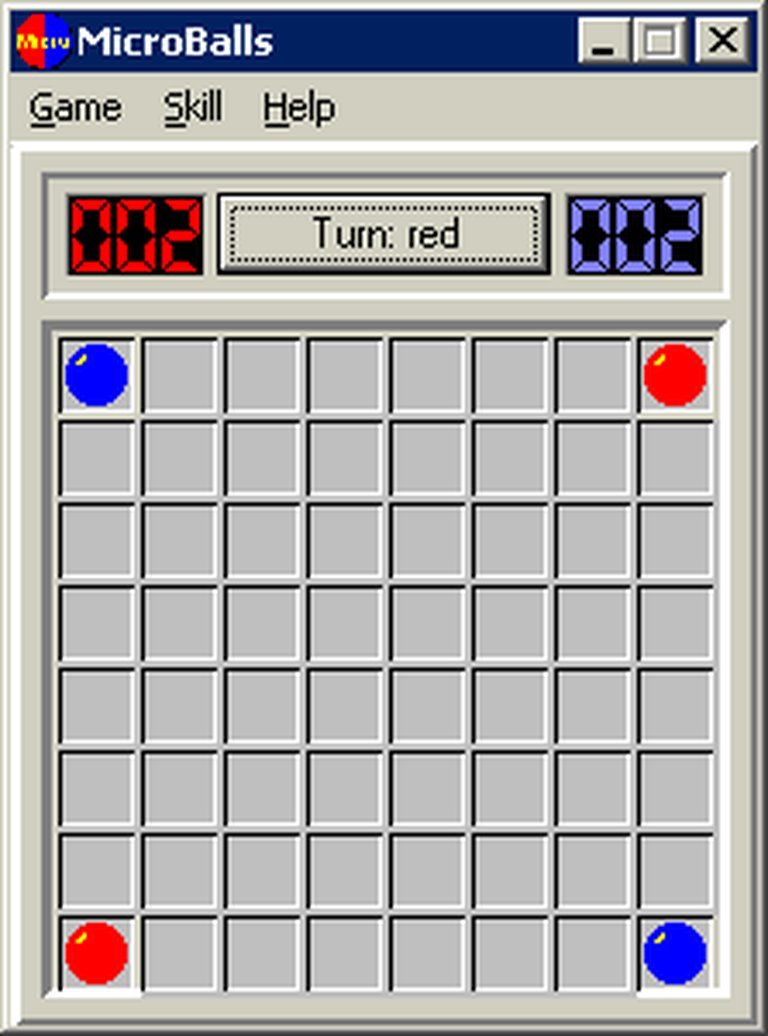
MicroBalls is a freeware single-player strategy game of territory capture on an 8×8 grid, where the player controls red tokens starting in diagonally opposite corners against the AI’s blue tokens in the remaining corners. Players take turns moving one token—either duplicating it to an adjacent cell or jumping it farther away to leave the origin empty—and any adjacent opponent tokens (in eight directions) are converted to the mover’s color; the game ends when one side cannot move, with victory awarded to the player with the most tokens.
MicroBalls Free Download
PC
MicroBalls Reviews & Reception
myabandonware.com (100/100): I’m glad something like this is on regular windows.
MicroBalls: Review
Introduction
In the shadow of 1997’s titans—GoldenEye 007 revolutionizing console shooters, Final Fantasy VII redefining RPGs, and Quake II pushing PC boundaries—a humble freeware gem emerged from obscurity: MicroBalls. This solo-developed Windows title by Ylian Saint-Hilaire captures the essence of digital board gaming at its purest, distilling territorial conquest into an 8×8 grid of strategic elegance. As a forgotten variant of the cult classic Ataxx, MicroBalls embodies the freewheeling indie spirit of late-90s PC shareware, where innovation thrived without budgets or hype. My thesis: While lacking narrative depth or visual flair, MicroBalls endures as a masterclass in minimalist design, offering timeless tactical depth that punches far above its pixelated weight, deserving rediscovery in an era of bloated blockbusters.
Development History & Context
MicroBalls arrived in 1997, a pivotal year for PC gaming amid the “3D acceleration standardization” boom (Pentium II 200 MHz rigs enabling Quake-style glory) and the dawn of 32/64-bit consoles like Sega Saturn, PlayStation, and Nintendo 64. Yet, Ylian Saint-Hilaire—a lone developer credited solely for MicroBalls v2.0—eschewed these trends, crafting a 2D board game for Windows using rudimentary tools suited to the era’s freeware scene. Released as public domain/freeware (downloadable via sites like MyAbandonware at a mere 15KB), it targeted mouse-driven desktops, aligning with Windows 95’s plug-and-play DirectX ease, which democratized indie dev post-Doom clones.
Saint-Hilaire’s vision appears rooted in cloning Ataxx (1990, a territory-capture arcade hit grouped with MicroBalls on MobyGames), blending it with Othello/Reversi flipping (noted in LaunchBox) and PushPull-esque pushing. No grand manifesto survives, but the game’s spartan specs—mouse-only input, two AI levels (“very easy” and “easy”)—suggest a passion project for quick, addictive sessions amid 1997’s industry “bloodbath” (GDC Vault: Michael Dornbrook warned of boom-bust cycles). Technological constraints? Minimal: 8×8 grid fits any 1997 PC, evading CD-ROM bloat or 3D demands. The gaming landscape was arcade-to-console dominated (e.g., Tetris legacy, Gran Turismo), but PC freeware thrived via downloads (pre-Steam), echoing Tetris‘ Soviet origins or SimCity‘s 1989 shareware roots. MicroBalls represents the unsung underbelly: solo coders preserving board-game purity against FMV fads (7th Guest) and MMORPG harbingers (Ultima Online).
Narrative & Thematic Deep Dive
MicroBalls forgoes traditional storytelling for abstract strategy, a hallmark of board-game digital ports like Othello or Ataxx. No plot, characters, or dialogue exists—players embody “red” tokens starting in diagonally opposite 8×8 corners, clashing with AI “blue” in a silent territorial war. This void is thematic genius: it evokes primal conquest, mirroring real-world games like Go or Checkers, where victory is raw dominance.
Deeper analysis reveals subtle motifs. Red vs. blue symbolizes binary conflict—player agency versus inexorable AI expansion—echoing 1997’s cultural tensions (Cold War echoes in GoldenEye, corporate dystopias in Fallout). Themes of proliferation (adjacent moves duplicate tokens) and conversion (flipping adjacent foes horizontally/vertically/diagonally) probe imperialism: grow or perish, assimilate or be assimilated. No lore, yet the grid becomes a microcosm of empire-building, akin to Ernest Adams’ GDC 1997 plea for “mythos” via borrowed mechanics (Tolkien/Madden). Dialogue? Absent, but mouse-clicks “speak” through token blooms, a dialogue of spatial rhetoric. In extreme detail: endings hinge on immobility (no legal moves), forcing reflection on overextension— a cautionary tale of hubris, where most tokens win, but quality trumps quantity. For a freeware title, its thematic purity rivals Tetris‘ zen minimalism, inviting philosophical replays.
Gameplay Mechanics & Systems
At its core, MicroBalls loops around turn-based territory capture: select a token, move adjacent (duplicate, leaving original) or jump afar (relocate, vacating origin), then auto-convert all eight surrounding enemy tokens to yours. Game ends when one side stalls; majority tokens claim victory. This deceptively simple loop innovates on Ataxx by emphasizing duplication’s risk-reward—spread thin invites counter-flips—while echoing Othello‘s encirclement sans lines.
Core Loops & Combat: Turns alternate strictly; no passes. Early game favors cautious duplication for board control, mid-game jumps enable aggressive leaps (e.g., infiltrate enemy clusters for mass flips). “Combat” is conversion cascades: a single adjacent placement can chain-flip clusters, creating euphoric reversals. Balance shines in 8×8 confines—over-duplication clogs your mobility, jumps risk isolation.
Progression & AI: No meta-progression; pure skill escalation via two levels. “Very easy” AI errs predictably (safe for newbies), “easy” anticipates jumps, forcing adaptation. Replayability stems from procedural positioning—diagonal starts ensure variance.
UI & Controls: Mouse-only perfection: click token, drag to cell. Minimalist HUD (token counts implied via visuals) avoids clutter, though lacking undo/explicit scores feels archaic. Flaws: No tutorials (learn by failure), binary difficulties limit scalability; innovations like diagonal flips add chaos absent in Reversi.
Systems interlock elegantly—duplication fuels flips, jumps reset momentum—yielding 5-15 minute matches with perfect information. Balance falters in endgames (stalemates possible?), but tactical depth rivals Chess lite, rewarding foresight over twitch.
World-Building, Art & Sound
The “world” is an abstract 8×8 grid: black voids birth red/blue tokens (player red), evoking cosmic voids or Petri dishes (micro-“balls” pun via Abandonware comments). Atmosphere builds via emergent chaos—empty board fills organically, colors bleeding like viral spread, fostering tension without scenery.
Visuals: Pixel primitives (screenshots on LaunchBox/Moby: title screen, gameplay, game over). Low-res tokens glow simply; no animations beyond placement/flips. Era-appropriate (Windows 3.1 vibes per reviews), it prioritizes clarity over flash—grids legible on 640×480 CRTs. Art direction: Monochrome minimalism amplifies strategy, akin Tetris‘ blocks, but static palette lacks Ataxx‘s flair.
Sound: Utterly silent—no BGM, SFX, or voices (freeware constraint). This vacuum heightens focus, immersion via absence; mouse-clicks provide tactile feedback. Contributions? Total purity: visuals frame tactics, silence demands mental visualization, elevating a “micro” scope to meditative plane. In 1997’s MIDI-heavy scene (Fat Man‘s GDC projections), it’s defiant asceticism.
Reception & Legacy
Launch reception: Nonexistent. MobyGames: No MobyScore, zero critic/player reviews (despite 623K+ total). Metacritic: TBD. MyAbandonware: Single 5/5 vote, comments jesting “microballs” innuendo or Windows 3.1 nostalgia. Collected by 2 Moby users; archive.org hosts 1996 uploads. Commercial? Freeware zenith—zero sales, infinite reach via downloads.
Reputation evolved modestly: Grouped as Ataxx variant, preserved on Abandonware/Retrolorian/LaunchBox. No influence traced (unlike Ataxx‘s clones), yet embodies 90s indie ethos amid Duke Nukem Forever delays. Legacy: Niche preservation artifact, influencing? Indirectly, minimalist tactics in Euclidea or Duet. In history (Museum of Play timeline: 1997 unmentioned), it spotlights freeware’s role pre-Steam, a “missing slice” like Pac-Man‘s pizza. Underrated: Fills void for portable Ataxx-lite, playable today sans emulation hassles.
Conclusion
MicroBalls distills 1997’s chaos into tactical serenity: solo-crafted freeware mastering duplication, flips, and foresight on a humble grid. Lacking story, polish, or fanfare, its strengths—addictive loops, pure mechanics—outshine flaws like limited AI/UI. In video game history, it claims a vital niche: testament to indie’s unheralded ingenuity, bridging Ataxx to modern abstracts. Verdict: Essential rediscovery for strategy purists—8.5/10. Download, conquer, and appreciate the quiet revolution.