
- Release Year: 2008
- Platforms: Windows
- Publisher: Microsoft Corporation
- Developer: Microsoft Corporation
- Genre: Compilation
- Perspective: First-person
- Game Mode: Online Co-op
- Gameplay: Piloting, Simulation
- Setting: Real world
- Average Score: 83/100
Description
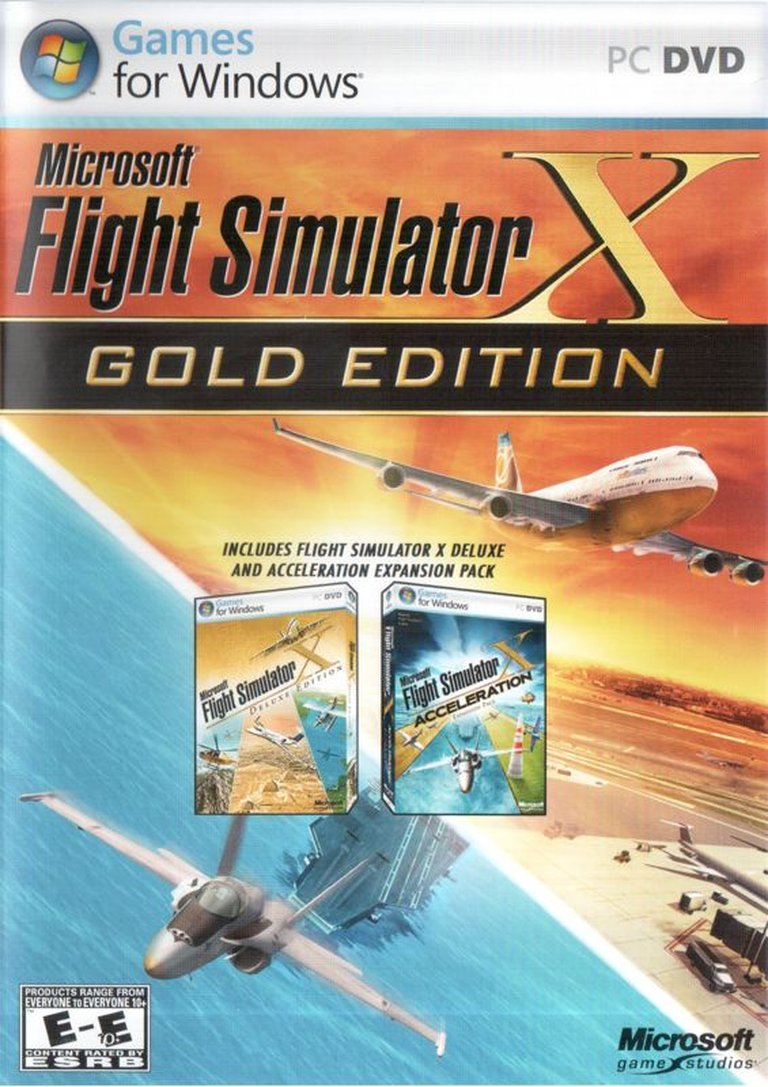
Microsoft Flight Simulator X: Gold Edition is a comprehensive compilation that bundles the original Deluxe Edition and its Acceleration expansion pack, released in 2008. This flight simulator allows players to pilot a diverse range of aircraft—from small gliders to jumbo jets—across a detailed recreation of Earth featuring over 24,000 airports, real-world geography, dynamic weather conditions, and immersive air traffic control. Built on an upgraded DirectX 10 engine for Windows Vista, it supports both single-player and multiplayer modes, offering a realistic aviation experience enhanced by jetways, ground equipment, and accurate navigation systems.
Gameplay Videos
Microsoft Flight Simulator X: Gold Edition Free Download
Microsoft Flight Simulator X: Gold Edition Cracks & Fixes
Microsoft Flight Simulator X: Gold Edition Patches & Updates
Microsoft Flight Simulator X: Gold Edition Mods
Microsoft Flight Simulator X: Gold Edition Guides & Walkthroughs
Microsoft Flight Simulator X: Gold Edition Reviews & Reception
citizenside.com : Overall, Microsoft Flight Simulator X: Gold Edition remains one of the best flight simulators available in the market.
thetechedvocate.org : Overall, Microsoft Flight Simulator X: Gold Edition is an excellent flight simulation game.
metacritic.com (80/100): A CPU- and GPU-draining masterpiece that’s about a year ahead of its time.
ebay.com (86/100): Perfect simulator for the flying enthusiast!
Microsoft Flight Simulator X: Gold Edition Cheats & Codes
PC
Use the following key combinations while in the game.
| Code | Effect |
|---|---|
| Ctrl + Shift + Y | Orders a tow plane for glider takeoff. |
| Y | Activates a special control mode for easier taxiing, takeoff, and landing. |
| Shift + E (quick release), then 2, 3, 4 | Opens and closes secondary exits and cargo hatches. (Varies by aircraft) |
| Shift + D | Triggers special effects. (Varies by aircraft) |
| Shift + C | Triggers special effects. (Varies by aircraft) |
| Shift + F | Calls a fuel truck to refuel the aircraft while parked at a gate. |
Microsoft Flight Simulator X: Gold Edition: A Monumental Ode to Aviation
Introduction
Microsoft Flight Simulator X: Gold Edition (2008) stands as the zenith of a legendary series, the culmination of decades of flight simulation evolution. More than a game, it is a meticulously crafted digital universe, a love letter to aviation that bridges the gap between hobbyist and aspirant pilot. Forged in the crucible of Microsoft’s Aces Game Studio and later preserved by Dovetail Games, this compilation—bundling the Deluxe Edition (2006) and the Acceleration expansion (2007)—redefined the genre. Its legacy is not merely technical but cultural, a cornerstone that proved simulation could be both accessible to newcomers and deep enough to sustain lifelong dedication. This review dissects its design ethos, technological ambitions, and enduring impact, arguing that FSX Gold remains a paragon of aspirational realism.
Development History & Context
Microsoft Flight Simulator X emerged from Aces Game Studio, a unit revered for its unwavering commitment to aviation authenticity. In 2006, the studio delivered FSX as the series’ tenth installment, marketed as a technological showcase for Windows Vista and DirectX 10. The vision was ambitious: to create a “living, breathing” world where every detail—from airport jetways to global weather systems—felt tangible. However, the era’s hardware constraints were stark. FSX was the first in the series to require DVD-ROM media, a necessity given its colossal data footprint (over 14 GB), yet it struggled with optimization, often demanding cutting-edge systems for smooth performance.
The gaming landscape in 2006–2008 was dominated by narrative-driven AAA titles, making FSX’s niche focus on simulation a bold move. Microsoft’s commitment was evident: they invested in real-world data partnerships (Navteq for terrain, Jeppesen for airports) and licensed audio from pilot Rod Machado for tutorials. Yet, Aces faced turmoil. In 2009, Microsoft disbanded the studio, citing “strategic priorities,” leaving FSX as their final entry. This abrupt closure underscored the tension between commercial viability and niche passion—a tension Dovetail Games later addressed by re-releasing FSX via Steam in 2014, ensuring its survival.
Narrative & Thematic Deep Dive
Though devoid of traditional plot, FSX weaves a profound narrative through its structure and systems. The game’s “story” is one of transformation: the player’s journey from novice to virtuoso. The Learning Center acts as the narrative backbone, with Machado’s voice guiding pilots through graded challenges—from Private Pilot to Airline Transport Pilot certifications. Each flight becomes a chapter, whether a simple VFR (Visual Flight Rules) hop or a complex ILS (Instrument Landing System) approach. Missions expand this into episodic storytelling: rescuing stranded hikers (“Alpine Rescue”) or piloting a 747 through a thunderstorm (“Night Storm”). These tasks are punctuated by dynamic events—fireworks over Paris, volcanic eruptions—transforming routine flights into memorable dramas.
Themes of mastery and perseverance permeate the experience. The Rewards system—unlocking achievements for flawless landings or long-haul flights—reinforces a cycle of aspiration. Dialogue, sparse yet purposeful, emanates from Air Traffic Control (ATC) interactions, where calm professionalism contrasts with the chaos of emergencies. Ultimately, FSX’s narrative is existential: it invites players to find meaning in the pursuit of perfection, where a single buttery smooth landing becomes a triumph.
Gameplay Mechanics & Systems
FSX Gold’s gameplay is a symphony of interconnected systems, designed for both accessibility and depth.
Core Loops:
– Free Flight: The sandbox mode, offering unfettered exploration of Earth’s 24,000+ airports. Players can fly a Cessna 172SP over the Amazon or a Boeing 737 into Tokyo Narita, with real-time weather downloaded from Jeppesen.
– Missions: Structured objectives with branching paths. Completing “Red Bull Air Race” with the P-51D unlocks “Legendary Pilot” status, while failing to refuel mid-flight in “Oceanic Crossing” yields a “Resource Manager” reward.
– Training: Rod Machado’s tutorials use scenario-based learning: “Stall Recovery” teaches aerobatic maneuvers, while “IFR Flight” demystifies complex navigation.
Aircraft & Handling:
The Gold Edition boasts 24 default aircraft, including the Acceleration pack’s F/A-18 Hornet and EH-101 helicopter. Each features distinct physics: the Maule Orion’s bush-tail responsiveness contrasts with the Airbus A321’s fly-by-wire precision. The SimConnect API allowed third-party developers to expand these systems, enabling add-on aircraft with hyper-realistic FDEs (Flight Dynamics Engines).
Progression & Systems:
– ATC: Players can act as virtual controllers, managing traffic with radar screens in Deluxe mode, adding a meta-layer of responsibility.
– Damage: Though disabled by default, modding could re-enable visual damage, rewarding risky maneuvers.
– Multiplayer: Co-op flights (e.g., shared Cessna control) and competitive air racing via Acceleration fostered community.
Yet, these systems were not without flaws. Frame drops during dense scenery and mission bugs (e.g., missing gauges in Standard Edition) marred the experience. Service Packs 1 and 2 addressed performance, but the game’s CPU-bound nature persisted.
World-Building, Art & Sound
FSX’s world is its crowning achievement—a near-encyclopedic recreation of planet Earth, built on Navteq’s geographical data and Jeppesen’s aviation charts. Landmarks are rendered with reverence: Stonehenge’s monolithic stones, Victoria Falls’ mist, and Charles Lindbergh’s grave serve as navigational waypoints. Major cities like New York and London are augmented with photorealistic textures (60cm/pixel in Acceleration’s Berlin and Istanbul), while rural areas rely on “autogen”—procedurally generated barns and forests.
Visuals pushed DirectX 10’s limits, with dynamic lighting, water reflections, and wing flex during turbulence. Yet, these assets came at a cost; lower settings reduced realism to cartoonish simplicity. The art direction balanced realism with playability, ensuring airports felt bustling without overwhelming hardware.
Sound design is equally meticulous. Stan LePard’s main menu theme (“Pilot for Hire”) became iconic, its orchestral swell evoking adventure. In-flight audio is layered: engine whines shift with throttle inputs, ATC chatter crackles with static, and wind buffets the cockpit during turbulence. The dynamic audio system adapts to altitude—thinner air at high altitudes muffles engine noise—immortalizing the physics of flight.
Reception & Legacy
Upon release, FSX garnered praise for its ambition but criticism for its performance. GameSpot lauded its “attention to detail” and “approachable missions” (8.4/10), while IGN lamented its “lack of graphical improvement” over FS2004 (7.0/10). Despite these mixed reviews, it sold 1 million copies by 2008, cementing its status as a benchmark for simulation.
Its legacy is twofold. Technically, FSX’s engine birthed Lockheed Martin Prepar3D (2010), a military-grade simulation used for pilot training. Its SDK sparked a cottage industry of add-ons—Aerosoft’s airports, PMDG’s 747—proving that post-Aces, the community could innovate where the studio could not. Culturally, it democratized aviation, inspiring countless real-world pilots. As Time noted in 2016, FSX ranked among the “50 Best Video Games of All Time” for its “sobering beauty.”
Dovetail’s Steam Edition (2014) ensured this legacy endured, replacing GameSpy with Steam multiplayer and modernizing compatibility. Yet, the 2020 reboot—powered by satellite imagery and Azure AI—surpassed FSX’s scope, rendering it a historical artifact. Yet for many, FSX Gold remains the purest expression of flight: a world where the journey, not the destination, is the destination.
Conclusion
Microsoft Flight Simulator X: Gold Edition is a flawed masterpiece—a testament to a bygone era of simulation where passion often outpaced technology. Its blend of rigorous realism and evocative storytelling created a space where players could not just fly, but feel the sky. While its performance issues and dated visuals are undeniable, its impact is immeasurable: it preserved the soul of aviation in a digital age and proved that the most compelling stories are often written by the players themselves.
Final Verdict: FSX Gold is not merely a game but a time capsule—a monument to the art of flight simulation that, for all its imperfections, soars higher than most of its contemporaries. It is, and will remain, an essential chapter in gaming history.