
- Release Year: 2011
- Platforms: Windows
- Publisher: rondomedia Marketing & Vertriebs GmbH
- Genre: Compilation
- Game Mode: Single-player
- Average Score: 70/100
Description
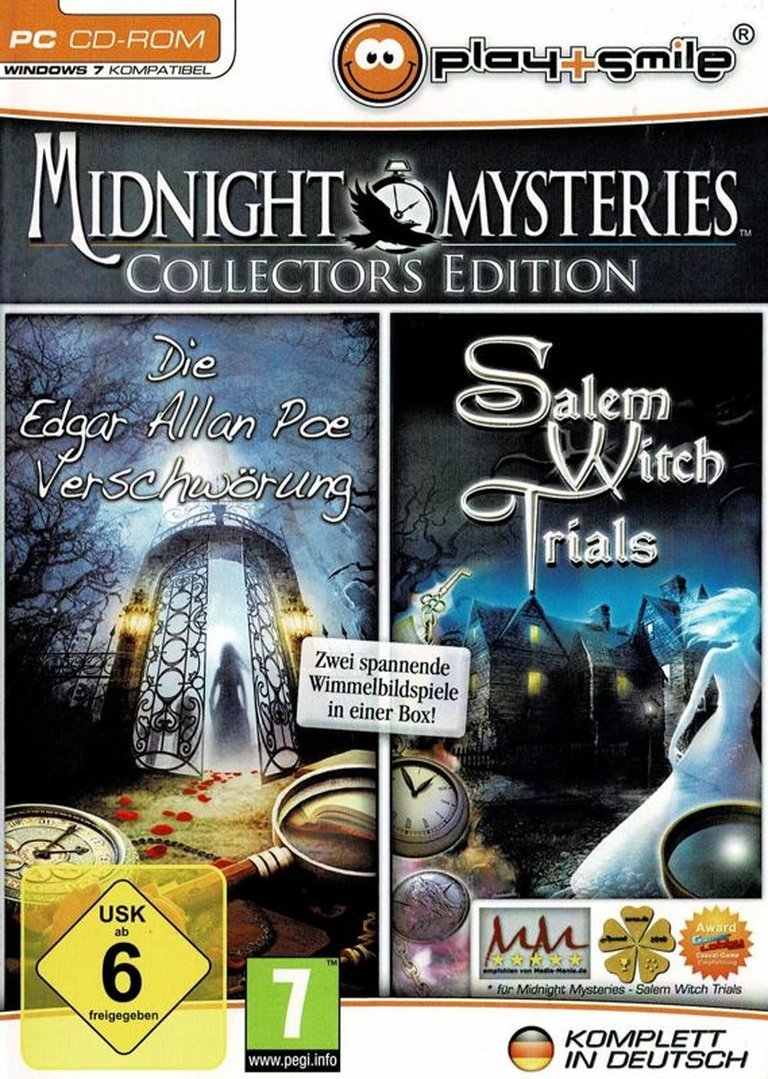
Midnight Mysteries: Collectors Edition is a compilation of two gripping hidden object adventures—’The Edgar Allan Poe Conspiracy’ and ‘Salem Witch Trials’—where players assume the role of a writer tasked with aiding restless spirits of historical figures. Journey through time to unravel dark conspiracies, solve puzzles, and uncover secrets behind the untimely deaths of Edgar Allan Poe and characters tied to the Salem Witch Trials, blending supernatural mystery with real-world history in a haunting atmospheric setting.
Midnight Mysteries: Collectors Edition Guides & Walkthroughs
Midnight Mysteries: Collectors Edition Reviews & Reception
store.steampowered.com (72/100): The master of macabre, Edgar Allan Poe, leads you on a shadowy journey to finally solve the mystery of his death.
steambase.io (68/100): Midnight Mysteries has earned a Player Score of 68 / 100.
Midnight Mysteries: Collectors Edition – A Hauntingly Niche Gem in Hidden Object History
Introduction
In the late 2000s, when casual gaming surged through digital storefronts like Big Fish Games and Steam, a peculiar series emerged that fused historical intrigue with paranormal detective work: Midnight Mysteries. The 2011 Collectors Edition—a retail compilation bundling The Edgar Allan Poe Conspiracy (2009) and Salem Witch Trials (2010)—represents a microcosm of MumboJumbo’s ambitious vision. This review contends that while the compilation exemplifies the era’s hidden-object genre limitations, its inventive weaving of literary history into interactive mysteries secures its legacy as a cult curiosity for narrative-driven casual gamers.
Development History & Context
Studio Vision & Technological Constraints
MumboJumbo, a now-defunct Dallas-based studio, specialized in casual titles like Luxor and Jewel Quest. Their Midnight Mysteries series (2009–2015) aimed to elevate hidden-object games with story depth, targeting adults through historical and literary themes—a rarity in a market saturated with fantasy and match-3 puzzles. Director Ben Gripkey’s pitch was audacious: recontextualize iconic American authors’ deaths as paranormal cold cases, blending factual biography with supernatural fiction.
The Casual Gaming Landscape
Released amidst the hidden-object boom (2008–2012), the Collectors Edition leveraged low technical barriers to broaden accessibility. Designed for Windows XP/Vista with 256MB RAM requirements, these games prioritized simplicity over innovation. Yet MumboJumbo’s bite-sized development cycles—6–12 months per title—allowed rapid iteration. Later entries (Devil on the Mississippi, Haunted Houdini) polished mechanics, but the 2011 compilation packaged the foundational duology unaltered.
Narrative & Thematic Deep Dive
The Poe Conspiracy: Unearthing Betrayal
The inaugural game casts players as an author visited by Poe’s ghost, tasked with solving his 1849 death—a real historical enigma. MumboJumbo fictionalizes it as a conspiracy involving Poe’s rejected fiancée Elmira Royster and her brothers, who orchestrate his murder to prevent their sister’s “dishonor.” The plot weaves Poe’s works (The Raven, The Purloined Letter) into environmental puzzles, while TV Tropes notes tropes like the Bottomless Pit and You Have Outlived Your Usefulness as villains dispatch accomplices.
Salem Witch Trials: Sins of the Fathers
Nathaniel Hawthorne’s ghost anchors the sequel, tormented by ancestral guilt over his grandfather’s role in the 1692 witch trials. Players confront Judge Hathorne’s spectral tyranny and exonerate accused women like Sarah Good, whose reunion with her daughter Dorothy embodies Together in Death catharsis. Themes of collective hysteria and generational shame are underscored by symbolic puzzles, such as erasing the scarlet “W” (Mark of Shame) branding Salem’s victims.
Shared DNA: Conspiracy & Redemption
Both games frame history as an unresolved crime. Ghosts aren’t mere quest-givers; they’re victims pleading for closure. This Conspiracy motif—intertwining factual ambiguity (Poe’s opium use, Hawthorne’s Puritan ties) with supernatural redemption—elevates the series beyond disposable casual fare.
Gameplay Mechanics & Systems
Core Loop: Hidden Objects & Time Travel
The Collectors Edition epitomizes the genre’s standards: scavenger hunts for context-irrelevant items (e.g., a locket in a barn), logic puzzles (jigsaws, cryptograms), and dialogue trees with spectral NPCs. Salem Witch Trials introduces time-hopping—players shift between 1692 and 1850 Salem—using era-specific clues (e.g., a colonial ledger unlocking a Victorian desk).
Innovations & Flaws
MumboJumbo’s attempts to innovate falter:
– Collectible Clovers: Unlock an “unlimited hidden-object mode,” a grindy bonus with minimal payoff.
– UI Clunkiness: Static cursors and pixel-hunt scenarios frustrated players (Steam reviews cite “tedious backtracking”).
– Pacing Issues: Historical tangents (Poe’s deep-cut references) disrupt momentum, appealing to literature buffs but alienating casual audiences.
Yet the “Deduction Board”—a case-file interface connecting clues—hints at MumboJumbo’s aspiration toward detective-game sophistication.
World-Building, Art & Sound
Gothic Aesthetics & Atmospheric Sound
The series’ visual identity leans into moody, Edward Gorey-esque shadows. Poe’s settings—a rain-lashed cemetery, brick-walled catacombs—evoke Gris Grimly illustrations, while Salem’s autumnal forests and Puritan chapels channel Arthur Rackham. Though limited by Flash-era art (stiff animations, recycled assets), the painterly backdrops immerse players in literary melancholy.
Sound as Narrative Device
Voice acting is uneven (Poe’s ghost veers between gravitas and hamminess), but environmental audio excels: creaking floorboards, whip-poor-will cries, and Philip Glass-esque piano loops sustain tension. Salem’s trial sequences use discordant strings to mirror judicial chaos—a high point in acoustic storytelling.
Reception & Legacy
Launch Reception
The compilation itself garnered scant coverage, but constituent titles earned mixed-to-positive receptions:
– Steam: Poe Conspiracy holds “Mostly Positive” reviews (72% of 62 ratings), praised for atmosphere but critiqued for janky controls.
– Aggregated Scores: Videogamegeek users rated Salem Witch Trials 5.5/10, citing “repetitive HOG [hidden-object game] tropes.”
– Sales: Though unquantified, MumboJumbo’s 2012 Trilogy re-release and Steam re-listings (2015–2025) suggest enduring niche appeal.
Industry Influence
While not revolutionary, the series bridged hidden-object conventions with narrative ambition. Later titles like Ghostwriting (2015) expanded interactivity, letting players “rewrite” Dickens’ plots—a mechanic echoed in Dontnod’s Life is Strange. More critically, its historical ghost framing inspired clones like Dark Tales and Grim Legends.
Conclusion
Midnight Mysteries: Collectors Edition is a time capsule of late-2000s casual gaming—flawed yet fascinating. MumboJumbo’s marriage of literary detective work and supernatural drama remains its crown jewel, even as technical constraints and genre conventions curb its reach. For historians of hidden-object games, it’s essential; for players seeking haunting narratives, it’s a flawed but poignant portal into America’s Gothic unconscious. Like Poe’s ghost, it lingers—not as a masterpiece, but as a whisper of what casual storytelling could aspire to be.
Final Verdict: A 7/10 curio—best suited for genre devotees and literary completists.