
- Release Year: 1999
- Platforms: Windows
- Publisher: Avanquest Software S. A., Brightstar Entertainment Ltd., IDDK Group, MumboJumbo, LLC
- Developer: IncaGold Ltd.
- Genre: Action, Driving, Racing
- Perspective: 1st-person
- Game Mode: Single-player
- Gameplay: Avoid traffic, Street racing
- Setting: Nighttime, Public roads
- Average Score: 41/100
Description
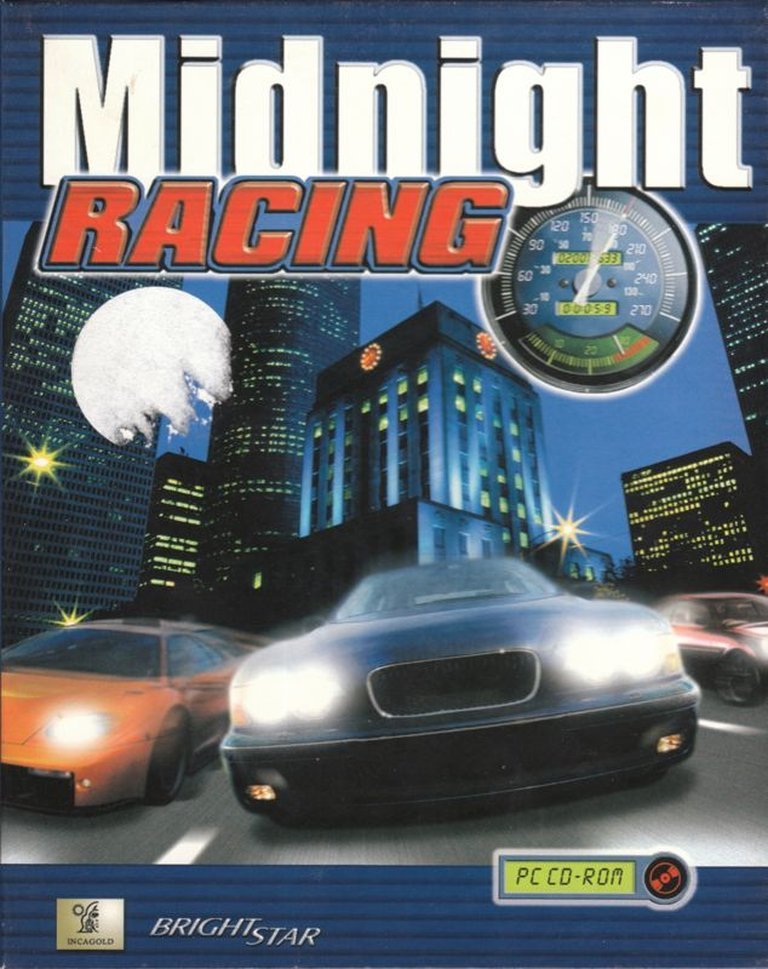
Midnight Racing is a street racing game where players engage in illegal nighttime races on public roads, driving speedy sports cars while avoiding normal traffic to finish first. The game features three initial cars with two unlockable ones, 10 tracks, and 12 camera angles.
Gameplay Videos
Midnight Racing Free Download
Midnight Racing Reviews & Reception
gamepressure.com (42/100): It’s a warm summers night,with the stress of the day behind you,a clear sky full of stars,a sea of city lights,the lust for freedom wakes the desire for adventure,and with a 300 hp sports coupe looking down a long empty road there is only one thing you can do.
mobygames.com (37/100): Players Average score: 2.8 out of 5 (based on 8 ratings with 0 reviews)
myabandonware.com (45/100): Midnight Racing is a video game published in 1999 on Windows by MumboJumbo, LLC, Brightstar Entertainment Ltd., IDDK Group, Brightstar Games, Avanquest Software S. A..
Midnight Racing: Review
In the twilight of the 20th century, as the racing genre was exploding with innovation and spectacle, a modest budget title emerged from the shadows. Midnight Racing, released in 1999 by IncaGold Ltd. and published by Brightstar Entertainment, was never destined for the pantheon of racing greats. Yet, its story is one of quiet persistence, technical ambition within limitations, and a glimpse into the era’s underground street racing fantasies. This is not a tale of triumph, but of survival—a game that, despite harsh criticism and technical hurdles, found a niche audience and left a faint but enduring mark on the genre’s history.
Development History & Context
The late 1990s were a golden age for racing games, with franchises like Need for Speed, Gran Turismo, and Test Drive setting new standards for realism, presentation, and depth. Against this backdrop, Midnight Racing was conceived as a low-budget, high-concept entry into the street racing subgenre. Developed by IncaGold Ltd., a studio with a modest portfolio, the game aimed to capture the thrill of illegal nighttime races on public roads—a theme that would later be popularized by the Midnight Club series.
The technological constraints of the era are evident in every aspect of Midnight Racing. Built using the 3DGE engine, the game was designed to run on systems with as little as a Pentium II 200 MHz processor and 32 MB of RAM. This meant sacrificing visual fidelity for accessibility, resulting in boxy environments, simple car models, and a reliance on darkness to mask graphical shortcomings. The developers’ vision was clear: create an immersive street racing experience that could run on the average PC of the time, even if it meant compromising on polish.
The gaming landscape of 1999 was dominated by high-profile releases, and Midnight Racing struggled to stand out. Its budget pricing and niche appeal positioned it as a curiosity rather than a contender, but its very existence speaks to the era’s appetite for racing games of all stripes.
Narrative & Thematic Deep Dive
Midnight Racing offers little in the way of narrative, eschewing story-driven campaigns for a focus on pure racing. The game’s premise is simple: you are a street racer, competing in illegal nighttime events on public roads. There are no characters to speak of, no rivalries to cultivate, and no overarching plot to follow. Instead, the game relies on its setting and atmosphere to convey its themes.
Thematically, Midnight Racing taps into the allure of the underground street racing scene—a world of speed, danger, and rebellion. The night serves as both a literal and metaphorical backdrop, representing freedom from societal constraints and the thrill of the forbidden. However, the game’s execution is rudimentary, with minimal effort made to flesh out this world or give it depth. The result is a hollow experience, one that hints at greater possibilities but never delivers on them.
Gameplay Mechanics & Systems
At its core, Midnight Racing is a straightforward arcade racer. Players choose from a selection of sports cars and compete in races across ten tracks, each set in a different environment—countryside, suburbs, and towns. The game features three cars at the start, with two unlockable vehicles (an SUV and a Mini) available for those who complete specific challenges.
The gameplay loop is simple: race, avoid traffic, and finish first. The controls are responsive enough, though the handling feels arcadey and lacks the nuance of more sophisticated racers. The AI is inconsistent, ranging from sluggish to erratic, and the lack of tuning or customization options limits replayability.
One of the game’s more notable features is its camera system, which offers twelve different angles. However, only one of these is truly useful, and the rest feel like padding. The game also includes a LAN multiplayer mode, though its appeal is limited by the lack of online play and the niche nature of the game.
The most significant technical issue is a 3D card conflict that prevents the game from running on some systems. This, combined with the game’s basic graphics and sound design, makes for a frustrating experience for many players.
World-Building, Art & Sound
Midnight Racing is a game of contrasts. Its world-building is minimal, with environments that are dark, boxy, and repetitive. The night-time setting, while thematically appropriate, is used to mask the game’s graphical limitations rather than to create a compelling atmosphere. The cars are simple and lack detail, and the lighting effects are rudimentary at best.
The sound design is equally basic. Engine noises are droning and repetitive, crash effects are simple, and there is no in-game music to speak of. The result is an auditory experience that does little to enhance the gameplay or immerse the player in the world.
Despite these shortcomings, there is a certain charm to Midnight Racing‘s simplicity. It is a game that wears its limitations on its sleeve, offering a glimpse into a bygone era of PC gaming when ambition often outstripped technical capability.
Reception & Legacy
Upon its release, Midnight Racing was met with mixed to negative reviews. Critics praised its low price and accessibility but lambasted its lack of depth, technical issues, and basic presentation. PC Gamer UK gave it a 59%, noting its “fairly major 3D card conflict” and limited appeal. Absolute Games (AG.ru) was even harsher, awarding it a 10/100 and calling it a “full gaming nightmare.”
Players were equally divided. While some appreciated its budget-friendly nature and straightforward gameplay, others found it lacking in comparison to more polished titles. The game’s MobyScore remains unassigned, reflecting its niche status and limited impact.
In the years since its release, Midnight Racing has faded into obscurity, remembered more for its technical issues and basic design than for any groundbreaking features. However, it remains a fascinating artifact of its time, a reminder of the era’s racing game boom and the challenges faced by budget developers.
Conclusion
Midnight Racing is not a great game, nor is it a particularly memorable one. It is, however, a significant piece of gaming history—a snapshot of a time when the racing genre was exploding with creativity and ambition, and when even modest titles could find an audience. Its legacy is one of quiet persistence, a game that, despite its flaws, managed to carve out a place for itself in the crowded landscape of late-90s PC gaming.
For collectors and retro enthusiasts, Midnight Racing offers a glimpse into the past, a reminder of the genre’s humble beginnings and the challenges faced by developers working within tight constraints. It may not be a classic, but it is a testament to the enduring appeal of racing games and the creativity of those who make them. In the end, Midnight Racing is a game that, like the night it celebrates, is best appreciated in the shadows.