
- Release Year: 2020
- Platforms: Linux, Macintosh, Windows
- Publisher: Unknown
- Developer: Unknown
- Genre: Adventure, Horror, Visual novel
- Perspective: Fixed / flip-screen
- Game Mode: Single-player
- Gameplay: Menu structures
- Setting: Contemporary
- Average Score: 80/100
Description
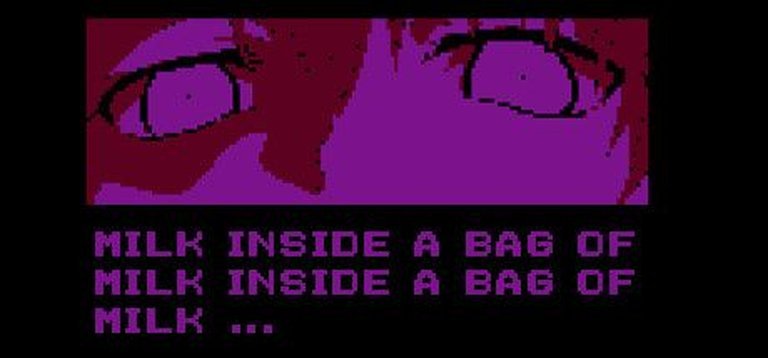
Milk inside a bag of milk inside a bag of milk is a psychological horror visual novel developed by Nikita Kryukov, released in 2020. The game follows an unnamed female protagonist as she embarks on a seemingly simple task: buying a bag of milk from a grocery store. However, the journey becomes a harrowing exploration of her severe trauma and inner turmoil. Players assume the role of a voice in her head, guiding her through obsessive thoughts, hallucinations, and crippling social anxiety. The narrative delves into her struggles with communication, grief, and the lingering effects of her father’s suicide, culminating in a surreal confrontation where she breaks the fourth wall. The game blends mundane errands with deep psychological horror, offering a brief but emotionally intense experience.
Gameplay Videos
Where to Buy Milk inside a bag of milk inside a bag of milk
PC
Milk inside a bag of milk inside a bag of milk Free Download
Milk inside a bag of milk inside a bag of milk Guides & Walkthroughs
Milk inside a bag of milk inside a bag of milk Reviews & Reception
en.wikipedia.org (80/100): Equipped with a strong, distinctive production style thanks to its disturbing retro art and the foreboding discomfort of its droning music, it’s a memorable indie gem that will never be forgotten once experienced.
metacritic.com (80/100): It’s about 20 minutes long, and right now costs less than 50p. I went into this thinking it was a cool approach to being outright strange, and left being surprisingly touched by its depth of truthfulness, if lacking in tangible hope.
Milk inside a bag of milk inside a bag of milk: A Masterclass in Psychological Horror and Minimalist Storytelling
Introduction: The Unassuming Genius of a $1.49 Visual Novel
In the vast, often overwhelming landscape of indie games, few titles have left as profound an impression as Milk inside a bag of milk inside a bag of milk. Released on August 26, 2020, by Russian developer Nikita Kryukov, this 20-minute visual novel defies conventional expectations of what a game can—and should—be. At its core, it is a harrowing, deeply personal exploration of mental illness, trauma, and the fragility of human perception, all wrapped in a deceptively simple premise: help a young girl buy a bag of milk for her mother.
From its cryptic title to its minimalist, monochromatic visuals, Milk is a game that lingers long after the credits roll. It is a work that challenges players not with complex mechanics or sprawling narratives, but with raw, unfiltered emotional honesty. The game’s brilliance lies in its ability to transform the mundane into the monstrous, to turn a routine errand into an odyssey of psychological torment. It is a testament to the power of indie development, where a single creator’s vision can resonate with thousands, if not millions, of players worldwide.
This review will dissect Milk inside a bag of milk inside a bag of milk in exhaustive detail, examining its development, narrative depth, gameplay mechanics, artistic choices, and lasting impact. We will explore how Kryukov’s solo effort became a cultural touchstone for discussions about mental health in gaming, and why its legacy continues to grow years after its release.
Development History & Context: The Birth of a Psychological Phenomenon
The Solo Genius of Nikita Kryukov
Milk inside a bag of milk inside a bag of milk is the brainchild of Nikita Kryukov, a Russian indie developer whose work is defined by its introspective, often surreal approach to storytelling. Kryukov is a one-person studio, handling every aspect of the game’s creation—writing, art, programming, and music—using the Ren’Py engine, a popular tool for visual novel development. His previous projects, such as how it all ended, demonstrate a consistent fascination with psychological themes and experimental narratives, but Milk stands as his most acclaimed and widely recognized work to date.
The game’s development was remarkably swift, with Kryukov completing it in just three days. This rapid turnaround is a testament to both his creative vision and the constraints of indie development. Rather than viewing these limitations as obstacles, Kryukov embraced them, crafting a game that thrives on its minimalism. The result is a tightly focused experience that eschews unnecessary fluff in favor of raw, emotional storytelling.
The Gaming Landscape in 2020: A Perfect Storm for Indie Horror
Milk arrived at a pivotal moment in the gaming industry. The year 2020 was marked by a global pandemic that forced millions into isolation, heightening awareness of mental health struggles and the importance of empathy in media. Against this backdrop, indie horror games—particularly those exploring psychological themes—found a receptive audience. Titles like Doki Doki Literature Club! and Omori had already proven that visual novels could tackle complex emotional subjects with depth and nuance, paving the way for Milk’s success.
The game’s release on Steam, published by Missing Calm, further amplified its reach. Priced at just $1.49 (and frequently discounted), Milk was accessible to a wide audience, allowing it to garner attention through word-of-mouth and organic discovery. Its subsequent port to the Nintendo Switch in 2022, bundled with its sequel, introduced the game to an even broader player base, solidifying its status as a modern indie classic.
Technological Constraints as Creative Strengths
Milk’s development was shaped by the technological constraints of its time. The Ren’Py engine, while powerful, is inherently limited in its capacity for complex graphics or gameplay mechanics. Rather than fighting against these limitations, Kryukov leaned into them, crafting a game that relies on atmosphere, dialogue, and sound design to convey its narrative.
The game’s minimalist visuals—static, monochromatic illustrations with distorted text—are not a sign of laziness or lack of skill, but a deliberate artistic choice. These sparse, abstract images force players to fill in the gaps with their imagination, making the experience deeply personal and subjective. Similarly, the game’s looping ambient soundtrack, composed by Kryukov himself, enhances the sense of unease and disorientation, immersing players in the protagonist’s fractured psyche.
Narrative & Thematic Deep Dive: The Horror of the Mundane
Plot Summary: A Simple Errand, a Complex Mind
Milk inside a bag of milk inside a bag of milk follows an unnamed young woman—referred to by fans as “Milk” or “Milk-chan”—as she attempts to complete a seemingly simple task: buying a bag of milk from a nearby grocery store. The player assumes the role of an inner voice in her head, guiding (or hindering) her through this errand. What should be a straightforward journey becomes a nightmarish ordeal, as the protagonist’s severe mental illness—characterized by symptoms akin to schizophrenia, dissociation, and trauma—distorts her perception of reality.
The game begins in the protagonist’s cluttered apartment, a physical manifestation of her fractured psyche. From there, the player must navigate her through a series of incremental challenges: getting dressed, leaving the apartment, walking to the store, selecting the milk, and interacting with the cashier. Each step is fraught with psychological barriers, as the protagonist’s intrusive thoughts, hallucinations, and paranoia threaten to derail her progress.
One of the game’s most striking moments occurs when the protagonist encounters a mysterious figure in the store who can only say the word “O.” This surreal interaction, repeated ad nauseam, underscores the protagonist’s inability to communicate effectively with the outside world. Later, she hallucinates a bear instead of an oncoming truck, further highlighting her tenuous grip on reality.
The narrative reaches its emotional climax when the protagonist breaks the fourth wall, addressing the player directly. In this moment, she reveals the traumas that have shaped her life, including her father’s suicide and the ongoing struggles with her mental health. The player’s role as her inner voice becomes a double-edged sword: a source of both comfort and torment, depending on the choices made throughout the game.
Themes: Mental Illness, Trauma, and the Illusion of Control
Milk is, at its core, a game about the lived experience of mental illness. It does not romanticize or sensationalize its subject matter; instead, it presents an unflinching, often brutal portrayal of what it means to navigate the world with a fractured mind. The game’s themes are multifaceted, touching on everything from the stigma of mental health to the limitations of medication and therapy.
-
The Horror of the Mundane
One of the game’s most powerful themes is the way it transforms everyday tasks into insurmountable challenges. For the protagonist, buying milk is not a simple errand but a Herculean feat, one that requires immense mental and emotional effort. This theme resonates deeply with players who have experienced mental illness, as it captures the often-overlooked struggles of daily life. -
The Unreliable Narrator
The protagonist’s perception of reality is constantly shifting, making it difficult for players to discern what is “real” and what is a hallucination. This narrative technique immerses players in her subjective experience, forcing them to question their own understanding of the game’s events. The fourth-wall-breaking moment, where the protagonist addresses the player directly, further blurs the line between fiction and reality. -
Trauma and Its Aftermath
The game does not shy away from exploring the long-term effects of trauma. The protagonist’s father’s suicide looms large over her psyche, shaping her interactions with the world and her own sense of self-worth. The game’s refusal to provide easy answers or a neat resolution reflects the messy, ongoing nature of trauma recovery. -
The Illusion of Control
As the player, you are tasked with guiding the protagonist through her journey, but your control is limited. The choices you make can either help or hinder her, but there is no guarantee of success. This theme underscores the fragility of agency in the face of mental illness, where even the best intentions can lead to unintended consequences.
Character Analysis: The Girl, the Voice, and the Mother
-
The Girl (Milk-chan)
The protagonist is a deeply complex character, defined by her struggles with mental illness. Her perception of the world is fragmented, filled with hallucinations, intrusive thoughts, and moments of dissociation. She is both vulnerable and resilient, a survivor who continues to push forward despite the overwhelming odds against her.Her relationship with the player—who embodies her inner voice—is central to the game’s narrative. This voice can be a source of support, encouraging her to complete her task, or it can exacerbate her distress, feeding into her darker thoughts. The dynamic between the two is a powerful exploration of the internal conflicts that define mental illness.
-
The Voice (The Player)
The player’s role as the inner voice is one of the game’s most innovative narrative devices. Rather than controlling the protagonist directly, the player influences her thoughts and actions through dialogue choices. This mechanic creates a sense of intimacy and complicity, as the player becomes an active participant in the protagonist’s psychological struggle.The voice is not a neutral observer; it is shaped by the player’s choices, which can range from supportive to outright cruel. This duality reflects the complex nature of internal monologues, where even well-meaning thoughts can become distorted or harmful.
-
The Mother
The protagonist’s mother is a peripheral but deeply unsettling figure. She is depicted with a blank, mask-like face, devoid of pupils—a visual representation of the protagonist’s emotional detachment. Their interactions are strained, filled with unspoken tension and unresolved trauma.The mother’s role in the narrative is ambiguous. She is both a caretaker and a source of stress, embodying the complicated dynamics of familial relationships in the context of mental illness. Her presence looms large over the protagonist’s journey, serving as a reminder of the broader social and emotional challenges she faces.
Gameplay Mechanics & Systems: Simplicity as a Virtue
Core Mechanics: A Visual Novel with a Twist
Milk inside a bag of milk inside a bag of milk is, at its heart, a visual novel. The gameplay is minimalist, focusing on dialogue choices and narrative progression rather than complex mechanics. Players advance the story by clicking through text and selecting from a series of dialogue options, each of which influences the protagonist’s psychological state.
The game’s simplicity is one of its greatest strengths. There are no puzzles to solve, no inventory to manage, and no combat sequences. Instead, the gameplay is entirely focused on the protagonist’s internal struggle, making it an intensely personal and immersive experience.
Dialogue Choices and Branching Paths
The game’s branching narrative is driven by the player’s dialogue choices. These choices determine whether the protagonist succeeds in her quest to buy milk or succumbs to her psychological barriers. The game features two primary endings:
-
“Milk Bought” (Positive Ending)
This ending is achieved by consistently choosing supportive dialogue options, encouraging the protagonist to push through her fears and complete her task. It is a bittersweet victory, as the protagonist’s struggles are far from over, but it offers a glimmer of hope in an otherwise bleak narrative. -
“Not This Time” (Negative Ending)
This ending occurs when the player’s choices exacerbate the protagonist’s distress, leading to a breakdown. The protagonist fails to buy the milk, and the game restarts, reinforcing the cyclical nature of her struggles.
The game’s branching paths are subtle but impactful. Small choices—such as how the player responds to the protagonist’s intrusive thoughts—can have significant consequences, making each playthrough feel unique.
UI and Accessibility
The game’s user interface is intentionally sparse, reflecting its minimalist aesthetic. The text is presented in a distorted, often difficult-to-read font, which enhances the sense of disorientation but can be challenging for some players. The lack of a traditional save system—players can save at any point but cannot load previous saves—adds to the game’s unforgiving nature, reinforcing the theme of irreversible consequences.
Despite its simplicity, Milk is not without its flaws. Some players have criticized the game’s lack of polish, particularly in its English translation, which can be awkward or unclear at times. Additionally, the game’s brevity—clocking in at around 20 minutes—may leave some players wanting more. However, these criticisms are minor in the grand scheme of things, as the game’s emotional impact far outweighs its technical limitations.
World-Building, Art & Sound: Crafting a Nightmare
Setting and Atmosphere: The Horror of the Everyday
Milk takes place in a seemingly ordinary urban environment—a grocery store, a street, an apartment building—but the protagonist’s perception transforms these mundane locations into something far more sinister. The game’s setting is a reflection of her fractured psyche, where even the most familiar places become alien and threatening.
The grocery store, for example, is not just a place to buy milk but a labyrinth of psychological barriers. The protagonist’s interactions with the cashier are fraught with anxiety, and her hallucinations—such as the mysterious figure who only says “O”—turn the store into a surreal nightmare. Similarly, the street outside is not a safe passage but a gauntlet of potential dangers, from oncoming trucks to unseen threats lurking in the shadows.
Visual Design: Minimalism as a Narrative Tool
The game’s visual design is intentionally sparse, relying on static, monochromatic illustrations to convey its narrative. The protagonist and other characters are depicted in a distorted, abstract style, with exaggerated features and unsettling expressions. This artistic choice enhances the game’s psychological horror, as it forces players to fill in the gaps with their imagination.
The use of color—or rather, the lack thereof—is particularly striking. The game’s monochromatic palette, dominated by shades of black, white, and gray, creates a sense of detachment and isolation. The occasional use of red—such as in the protagonist’s eyes or the bloodstains in her hallucinations—serves as a jarring contrast, underscoring the game’s darker themes.
Sound Design: The Music of Madness
The game’s soundtrack, composed by Kryukov himself, is a masterclass in atmospheric sound design. The music is minimalist, relying on looping ambient tracks to create a sense of unease and disorientation. The protagonist’s internal monologue is accompanied by a droning, almost hypnotic score, which mirrors her psychological state.
One of the most effective uses of sound in the game is the sudden silence that occurs when the protagonist returns home. The music stops, replaced by the sound of wind blowing—a stark contrast to the earlier cacophony of her thoughts. This moment is deeply unsettling, as it underscores the protagonist’s isolation and the futility of her struggles.
Reception & Legacy: A Cultural Touchstone
Critical Reception: Praise for Its Honesty
Milk inside a bag of milk inside a bag of milk was met with widespread critical acclaim upon its release. Reviewers praised the game for its raw, unflinching portrayal of mental illness, as well as its innovative narrative structure and atmospheric design.
- Lilia Hellal of Rice Digital described the game as “a memorable indie gem that will never be forgotten once experienced,” highlighting its “disturbing retro art and foreboding discomfort.”
- Jesse Grodman of DreadXP praised the game’s handling of mental health, noting that it “avoids oversimplification and instead offers a deeply empathetic portrayal of psychological distress.”
- John Walker of Buried Treasure gave the game an 8/10, commending its honesty and emotional depth, even as he acknowledged its lack of tangible hope.
The game’s reception was not universally positive, however. Some critics and players found the game’s brevity and lack of resolution frustrating, while others criticized its minimalist visuals and awkward translation. Despite these criticisms, Milk has maintained a strong reputation as one of the most authentic and impactful depictions of mental illness in gaming.
Commercial Success and Player Response
Milk’s commercial success is a testament to its emotional resonance. Priced at just $1.49, the game has sold millions of copies, with an estimated gross revenue of over $2 million. On Steam, it boasts a 96% positive rating from over 30,000 user reviews, a rare feat for any game, let alone an indie visual novel.
The game’s impact extends beyond its sales figures. Players from around the world have shared their personal stories of how Milk helped them understand their own struggles with mental illness. On platforms like Reddit and Steam, discussions about the game often devolve into deeply personal reflections, with players praising its honesty and emotional depth.
Legacy and Influence: A New Standard for Psychological Horror
Milk inside a bag of milk inside a bag of milk has left an indelible mark on the gaming industry. Its success has paved the way for other indie developers to explore complex psychological themes, and its influence can be seen in games like Milk outside a bag of milk outside a bag of milk (its direct sequel) and Omori.
The game’s legacy is particularly notable in its portrayal of mental illness. Unlike many mainstream games, which often sensationalize or romanticize psychological struggles, Milk presents an unfiltered, often brutal depiction of what it means to live with a fractured mind. This honesty has resonated with players and critics alike, cementing the game’s status as a cultural touchstone.
Conclusion: A Masterpiece of Minimalism and Emotional Depth
Milk inside a bag of milk inside a bag of milk is a game that defies easy categorization. It is a psychological horror experience, a visual novel, and a deeply personal exploration of mental illness, all rolled into one. Its brilliance lies in its simplicity—in its ability to transform the mundane into the monstrous, to turn a routine errand into an odyssey of psychological torment.
Nikita Kryukov’s solo effort is a testament to the power of indie development, where a single creator’s vision can resonate with millions. The game’s minimalist visuals, atmospheric sound design, and raw emotional honesty combine to create an experience that is as unsettling as it is profound.
While Milk is not without its flaws—its brevity, lack of polish, and occasional awkwardness—these are minor quibbles in the face of its overwhelming emotional impact. The game’s legacy is secure, not just as a critical and commercial success, but as a cultural touchstone that has helped countless players understand and articulate their own struggles with mental illness.
In the end, Milk inside a bag of milk inside a bag of milk is more than just a game. It is a mirror, reflecting the fragility of the human mind and the resilience of those who struggle to navigate it. It is a masterpiece of minimalism and emotional depth, and it deserves a place in the pantheon of great indie games.
Final Verdict: 9.5/10 – A Haunting, Unforgettable Experience