
- Release Year: 2002
- Platforms: Windows
- Publisher: e-Games
- Developer: 3LV Games
- Genre: Miniature golf, Sports
- Perspective: 1st-person
- Game Mode: Hotseat
- Gameplay: Obstacle course, Physics-based
- Setting: Space, Themed
- Average Score: 80/100
Description
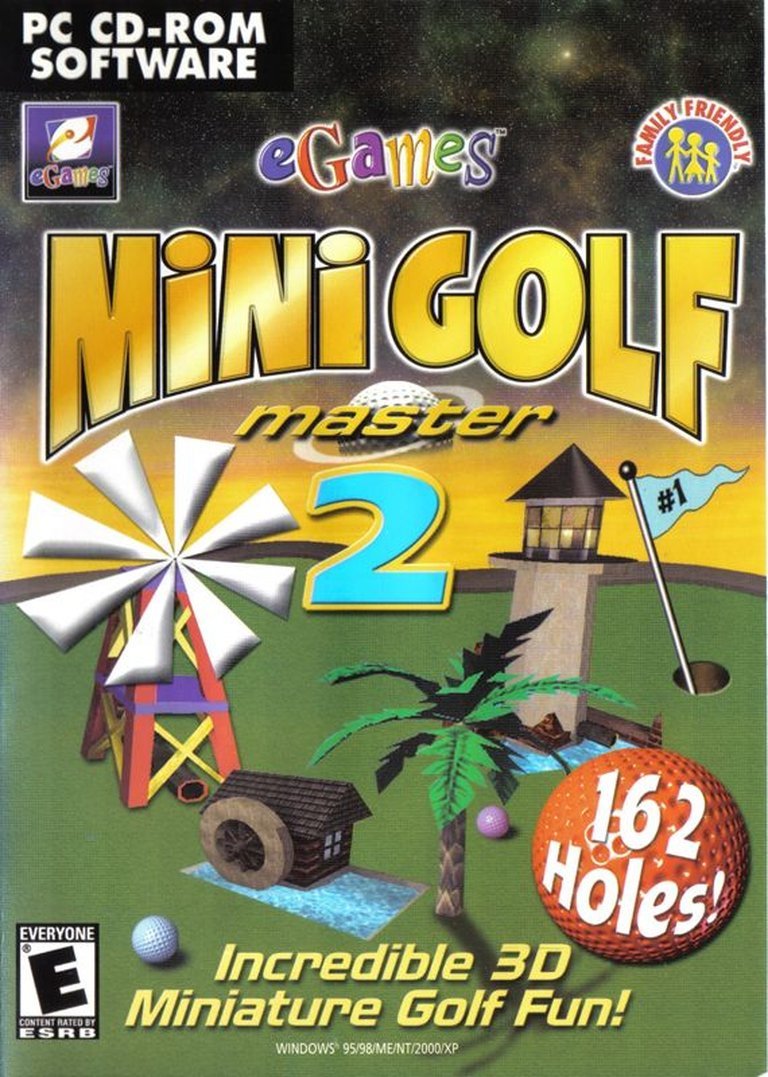
Mini Golf Master 2, a re-issue of Mini-Golf Megaworld, is a casual mini-golf game for up to four players released in 2002 on Windows. Featuring simple controls via keyboard or mouse, the game includes themed cups like Bronze and Silver with multiple nine-hole courses, each creatively designed with obstacles, hazards, and special features. Players navigate varied holes shaped like letters or dinosaurs, enjoy sound effects and music, and can compete in practice mode or the normal game mode which records scores and features a Hall of Fame.
Gameplay Videos
Mini Golf Master 2 Free Download
Mini Golf Master 2 Mods
Mini Golf Master 2 Guides & Walkthroughs
Mini Golf Master 2: A Nostalgic Dive into Whimsical Virtual Putting
Introduction
In the golden age of budget PC gaming, few titles captured the unbridled joy of casual competition quite like Mini Golf Master 2. Released in 2002 as a rebranding of the earlier Mini-Golf Megaworld, this unassuming title encapsulates the era’s charm: accessible multiplayer mechanics, imaginative level design, and a dedication to pure, unadulterated fun. As a sequel to the 1999 original, it refined the formula while doubling down on its core appeal—transforming miniature golf into a vibrant, physics-driven spectacle. Yet, despite its niche status, Mini Golf Master 2 remains a cult classic, a testament to the creativity of small studios like 3LV Games and the enduring appeal of local multiplayer in an increasingly online world. This review dissects its legacy, dissecting its development, thematic ambitions, gameplay intricacies, and cultural footprint to argue why it deserves more than just a footnote in gaming history.
Development History & Context
The Studio and Vision
Developed by the modestly sized 3LV Games and published by the prolific budget-label e-Games, Mini Golf Master 2 emerged from a lineage of specialized sports titles. The 11-person team, including programmers Michael Maynard and Jonathan Wright, artists Andy Chang and Mark Morgan, and sound designer Will Loconto, brought a scrappy passion to the project. Their vision was clear: distill the tactile joy of real-world mini-golf into a digital format that prioritized accessibility and creativity over technical spectacle. As a re-issue of Mini-Golf Megaworld, the sequel aimed to expand the original’s offerings while leveraging the familiarity of its predecessor’s mechanics—a pragmatic approach for a title destined for bargain bins.
Technological Constraints and Innovations
Running on the LithTech Talon engine, the game operated within the technological limitations of early-2000s Windows PCs. Its 3D environments were rendered in a first-person perspective, with courses appearing to “float in space,” a clever workaround for hardware constraints that lent itself to whimsical, impossible geometry. The installation process notably integrated a proprietary game browser, a hallmark of e-Games’ titles, which doubled as a launcher but also tied the game to its era’s reliance on CD-ROM distribution. This choice, while functional, foreshadowed compatibility issues for modern players, highlighting the delicate balance between convenience and future-proofing.
The Gaming Landscape of 2002
Released amid a saturation of casual sports games, Mini Golf Master 2 carved its niche by emphasizing local multiplayer. The late ’90s and early 2000s saw a boom in CD-ROM compilations (e.g., Galaxy of Sports), where titles like this thrived as party-friendly alternatives to complex AAA releases. Its direct competitors, such as 1999’s Mini Golf Master and later titles like Crazy Mini Golf 2, focused on similar themes, but Mini Golf Master 2 distinguished itself through its thematic variety and physics-based challenges. It reflected a market hungry for accessible, low-stakes experiences—a stark contrast to the emergent trends of online multiplayer and cinematic storytelling.
Narrative & Thematic Deep Dive
A World Without Words
Mini Golf Master 2 eschews traditional narrative, instead weaving its story through environmental storytelling and thematic cohesion. The game’s “cups” (Bronze and Silver) serve as narrative anchors, each containing five courses with distinct visual identities. Courses range from geometric shapes (e.g., a giant “E”) to fantastical scenarios—sending a ball through a dinosaur’s legs or navigating pirate ships. These settings function as self-contained micro-universes, where the absence of dialogue forces players to interpret themes through design. For instance, the “War Torn” course (implied by the original Mini Golf Master’s themes) hints at chaos via land mines and hazards, while “Space Holes” evokes wonder through teleportation pads and zero-gravity elements.
Underlying Themes: Creativity and Control
At its core, the game celebrates unbridled creativity. Each hole is a playground of physics and imagination, turning mundane obstacles like ramps and water hazards into puzzles that reward experimentation. This ties into a broader theme of control: players must master shot strength (via an orange power bar) and direction, but courses introduce chaos—teleports, moving hazards, and unpredictable bounces—that remind players that even perfect plans can unravel. The result is a metaphor for life itself: strategy meets serendipity. The lack of characters or plot isn’t a flaw but a feature, focusing the experience on the player’s agency and the courses as silent protagonists.
Gameplay Mechanics & Systems
Core Mechanics: Simplicity Meets Depth
The gameplay loop is deceptively simple. Players aim using a directional arrow (controlled via mouse or arrow keys) and adjust shot power with a horizontal orange bar, activated by spacebar or mouse click. This dual-input system ensures accessibility, while a “Professional” mode adds an accuracy layer for seasoned players. The progression structure—a series of cups with locked courses—encourages replayability: unlocking the Silver Cup requires sub-par performance on Bronze courses, incentivizing skill refinement. Each course’s nine holes blend standard mini-golf fare (hills, loops) with unique twists, such as ball-cannons that transport the ball across gaps.
Multiplayer and Replayability
Supporting 1-4 players locally, Mini Golf Master 2 shines as a social experience. Hot-seat matches turn living rooms into arenas, with shared frustration at near-misses and collective cheers for hole-in-ones. The game distinguishes between “Practice” (unrecorded) and “Normal” (Hall of Fame-enabled) modes, catering to both casual sessions and competitive play. Critically, the physics engine, while rudimentary by modern standards, provides satisfying ball-bounce mechanics and obstacle interactions, ensuring that even early courses feel dynamic.
Innovations and Flaws
The game’s greatest innovation lies in its thematic variety—holes shaped like letters or dinosaurs transform abstract challenges into vivid experiences. However, limitations emerge in consistency: some hazards (e.g., land mines) feel arbitrary, and the fixed camera angle occasionally obscures critical angles. The lack of a course editor or AI opponents restricts longevity, though this aligns with its focus on multiplayer.
World-Building, Art & Sound
Visual Design: Whimsy and Imagination
Courses are rendered in a vibrant, stylized 3D, with a first-person perspective that immerses players in each hole’s scale. Environments like the “dinosaur legs” course or a cosmic “Space Holes” backdrop prioritize readability over realism, using exaggerated colors and shapes to evoke fantasy. The “floating in space” aesthetic—a product of technical constraints—becomes a signature feature, creating surreal, gravity-defying layouts. Art direction, led by Andy Chang and Ronn Harbin, balances cohesion and diversity, ensuring each cup feels unique yet part of a cohesive whole.
Sound Design: Functional but Forgettable
Audio elements are serviceable but unremarkable. Sound effects include ambient birds, celebratory cheers for hole-in-ones, and a sarcastic clap for bogeys—injecting personality without overwhelming. Music, composed by Will Loconto, appears only on scorecards, opting for thematic silence during gameplay to focus on the clatter of ball physics. While the lack of dynamic audio limits immersion, the minimalist approach avoids distracting from the core mechanics.
Atmosphere: The Joy of Discovery
Despite its simplicity, the game excels in atmosphere. Courses feel alive, with obstacles that trigger animations (e.g., spinning windmills, erupting volcanoes) and physics that reward curiosity. The “Hall of Fame” menu, with its nostalgic chiptunes, reinforces the game’s celebratory tone, framing high scores as achievements worthy of remembrance.
Reception & Legacy
Critical and Commercial Reception
Upon release, Mini Golf Master 2 garnered modest attention. MobyGames records a single critical review: CNET’s 60% score, which praised its accessibility but noted repetitive sound design and limited single-player appeal. Player reviews, sparse but positive (e.g., a 3.0/5 on Backloggd), highlighted its multiplayer charm. Commercially, it thrived in bargain bins, leveraging e-Games’ distribution network to reach families and casual gamers. Its rebranding as Mini-Golf Megaworld in some regions diluted brand recognition but widened its audience.
Longevity and Influence
Though it never achieved mainstream fame, Mini Golf Master 2 left an indelible mark on niche communities. It preserved the spirit of late-’90s mini-golf games like Miniverse Minigolf, while its thematic diversity foreshadowed modern titles such as Walkabout Mini Golf (2020). The game’s preservation on platforms like the Internet Archive and MyAbandonware underscores its cult status, with players fondly recalling childhood multiplayer sessions. Its legacy lies in demonstrating that compelling gameplay need not require AAA budgets—creativity and accessibility can foster enduring appeal.
Conclusion
Mini Golf Master 2 is more than a relic of budget gaming; it’s a time capsule of an era when local multiplayer and imaginative design reigned supreme. While its narrative is minimal and its mechanics are straightforward, its strength lies in execution: vibrant courses satisfying physics, and a multiplayer loop that transforms simple putting into communal joy. Its flaws—a lack of depth for solo players, dated visuals—are overshadowed by its charm, proving that even modest titles can resonate when built on passion.
In the pantheon of sports games, Mini Golf Master 2 occupies a unique space: not a groundbreaking innovator, but a cherished outlier. For historians, it exemplifies the creativity of indie studios in the early 2000s; for players, it remains a delightful nostalgia trip. Its place in history is secure—not as a revolution, but as a testament to the timeless appeal of a well-putt ball and a shared laugh.
Final Verdict: 7/10 – A flawed but fondly remembered gem that captures the pure, unpretentious joy of digital mini-golf.