
- Release Year: 2019
- Platforms: Macintosh, Nintendo Switch, PlayStation 4, Windows, Xbox One, Xbox Series
- Publisher: Asterion Games, Samustai Ltd.
- Developer: Armatur Games
- Genre: Adventure, Strategy, Tactics
- Perspective: Diagonal-down
- Game Mode: Single-player
- Gameplay: Roguelike, RPG elements
- Setting: Fantasy
- Average Score: 40/100
Description
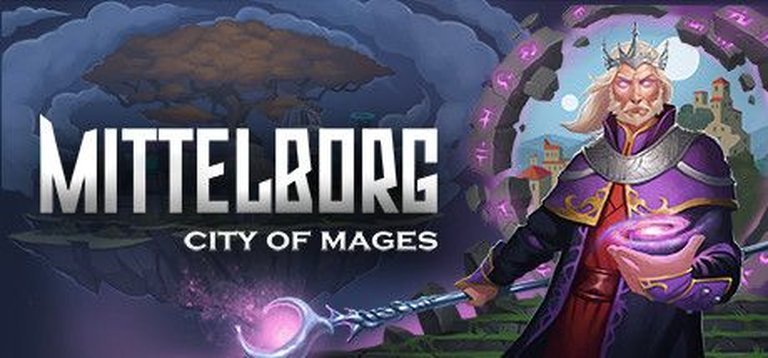
Mittelborg: City of Mages is a fantasy strategic adventure blending roguelike elements, resource management, and turn-based tactics, where players are crowned Chancellor of a mystical city ruled by mages, facing tough decisions, mystical tempests, and the looming chaos threatening its future in a diagonal-down 2D world.
Gameplay Videos
Where to Buy Mittelborg: City of Mages
PC
Mittelborg: City of Mages Reviews & Reception
metacritic.com (34/100): Mittelborg: City of Mages is a simplistic game with dull mechanics and no high stakes within the lackluster story.
monstercritic.com (39/100): Played almost entirely on one screen with clunky controls and game play which has you at the mercy of a random number generator, Mittleborg: City of Mages is quite a tedious game to play.
purenintendo.com (30/100): Mittelborg: City of Mages is a simplistic game with dull mechanics and no high stakes within the lackluster story.
lifeisxbox.eu : it felt so freaking good to finally make it.
Mittelborg: City of Mages: Review
Introduction
In the shadowed heart of a multiversal nexus, where the Tree of Order stands as the fragile arbiter between cosmic harmony and encroaching chaos, Mittelborg: City of Mages dares players to don the immortal crown of Chancellor—a role that promises rebirth amid endless tempests but delivers a gauntlet of grueling decisions and permadeath’s sting. Released in 2019 by Russian indie studio Armatur Games, this strategic adventure hybrid arrived amid a roguelike renaissance, blending city management, resource juggling, and narrative intrigue in a fantasy realm teetering on oblivion. Yet, for all its lofty ambitions of weaving player agency into a tapestry of moral quandaries and tactical rebirths, Mittelborg stumbles under the weight of shallow systems, clunky interfaces, and labored localization. My thesis: While its premise evokes the epic guardianship of titles like Thea: The Awakening, Mittelborg ultimately falters as a compelling roguelike city-builder, offering fleeting highs of emergent strategy amid pervasive tedium— a curious artifact of indie experimentation that historians may one day revisit as a cautionary tale of untapped potential.
Development History & Context
Armatur Games, a modest Russian indie outfit, birthed Mittelborg: City of Mages using the accessible Unity engine, a choice emblematic of the late 2010s indie boom where solo or small teams could craft ambitious hybrids without AAA budgets. Published by Asterion Games (alongside Samustai Ltd. for select ports), the game launched on Steam for Windows on June 20, 2019, at a budget-friendly $14.99, quickly expanding to Mac, Nintendo Switch (July 2020), and consoles like PlayStation 4, Xbox One, and Xbox Series X|S in 2021. This multi-platform rollout reflected the era’s console indiepocalypse, where Switch’s portability lured strategy titles seeking a handheld audience post-Slay the Spire‘s roguelike surge.
The 2019 gaming landscape was saturated with roguelites (Hades loomed on the horizon) and management sims (They Are Billions, Surviving Mars), but Mittelborg carved a niche as a “story-driven roguelike strategy” with city-building flair. Technological constraints were minimal—requiring just a 2 GHz CPU, 2 GB RAM, and OpenGL 2.0 support—allowing low-spec accessibility, yet this simplicity exposed flaws like imprecise mouse-drag controls and Joy-Con drift woes on Switch. Armatur’s vision, gleaned from the Steam blurb, centered on an immortal protagonist’s Sisyphean rule: protect the Tree of Order from “mystical tempests” via rebirth cycles, echoing roguelike persistence while nodding to Russian fantasy traditions (think Rage of Mages lineage in related titles). No grand controversies marred development, but the game’s Russian roots shone through in dual-language support (English/Russian), with translation woes plaguing Western reception. In hindsight, Mittelborg embodies the indie grind: bold synthesis of genres amid Steam’s deluge, where visibility hinged on algorithmic whims rather than polish.
Narrative & Thematic Deep Dive
At its core, Mittelborg‘s narrative unfurls as a cosmic tragedy of stewardship, positioning the player as the reborn Chancellor of Mittelborg—a liminal city safeguarding the Tree of Order, a metaphysical barometer of universal balance. The Ancient Order of Mages (Viates) venerates this arboreal nexus, which yields aether to stave off chaos; its withering, triggered by the prior Chancellor’s vanishing expedition, unleashes tempests blending melee assaults (red), magical barrages (blue), wind harvests (purple), and portal expeditions (yellow). Themes of burdened immortality dominate: death is tutorialized as progression, retaining buffs and knowledge across runs, transforming failure into a philosophical grind. Moral dichotomies abound—sacrifice a warrior or mage? Pardon rebels or execute? Drench the sacred in blood or preserve it?—forcing players to weigh short-term survival against long-term entropy.
Characters are archetypal yet evocative: mages as expendable zealots, guards as cannon fodder, spirits and nomads as chaotic interlopers. Events interweave “hundreds of unique” vignettes, from portal jaunts yielding lore scrolls (altering choices) to potion-brewing quests revealing multiversal “dozens of worlds” and “hostile races.” Yet, execution falters via labored translation—clunky English (“laboured via translation writing,” per critics) renders dialogue distractingly wooden, muting thematic depth. The plot crescendos in revelations of Mittelborg’s secrets, but linearity and RNG dilute agency; hand-holding tutorials dictate early choices, undermining the “tough decisions” promise. Thematically, it probes power’s corrosion (“Power is a heavy burden”), rebirth’s isolation, and order’s fragility against chaos—resonating with roguelike ethos—but shallow delivery evokes mobile lore dumps more than Disco Elysium-esque depth. For historians, it’s a microcosm of Eastern European fantasy: stoic guardianship amid apocalypse, akin to Pathologic‘s grim fatalism.
Gameplay Mechanics & Systems
Mittelborg‘s loop bifurcates into Serenity (preparation) and Tempest (defense), a turn-based cadence spanning 20+ rounds per “reign.” Core systems revolve around resource management: currency from windcatchers (upgradable towers harvesting purple gusts, yielding 20–300+ gold), aether from the Tree, and expedition loot (potions, buffs via yellow portals). Assign mages (recruited via towers) to structures—garrison (physical defense), magical shield, windcatchers, portals—via click-and-drag, boosting efficacy (+30% def). Upgrades (levels 1–3) expand slots and outputs, while events demand triage: brew potions from scavenged elements for survival edges, or sacrifice mages to heal the Tree.
Roguelike rebirth is innovative: death funnels damage to the Tree; failure grants permanent buffs, honing “unique tactics” across runs. Combat is abstracted—no direct battles, just text resolutions—emphasizing prediction (guess tempests or prep universally). Progression feels emergent post-tutorial: early doom (5–6 deaths) yields satisfaction, as potion synergies and windcatcher prioritization snowball. Yet flaws abound: shallow strategy (RNG-heavy, “mercy of random number generator”), clunky UI (no multi-mage drag, Switch menu frustrations sans touch), excessive hand-holding (tutorial locks actions), and mobile-esque linearity. Replayability stems from choices mattering (Steam tag), but 2D point-and-click interface grates, with potion brewing a rare highlight amid clicking tedium. Innovative? Permabuff roguelike management. Flawed? Tediously prescriptive, lacking sandbox depth.
World-Building, Art & Sound
Mittelborg pulses as a diagonal-down, 2D scrolling diorama: a fixed/flip-screen vista of hand-drawn spires, glowing Tree, and tempest-ravaged walls, evoking a brooding fantasy hub “between all realms” with sci-fi undertones (portals to alien worlds). Atmosphere builds via stark contrasts—serene builds shattered by storms—fostering siege mentality, though mundane visuals (uninspired per critics) lack dynamism. Expansions tease “huge” scope: dozens of worlds teeming with “thousands of intertwined destinies,” from undead hordes to mercenary sieges, blending fantasy archetypes with chaotic biodiversity.
Art direction prioritizes function: clean 1280×720 sprites suit tactical overview, but static presentation wastes potential (no animated battles). Sound design elevates: 10 original orchestral tracks weave “powerful magic,” their swelling strings underscoring rebirth’s gravitas and tempests’ fury— a sonic lifeline amid gameplay doldrums. Together, they forge immersion: wind howls signal opportunity, aether hums promise power, yet clunky UX (shonky on Switch) severs the spell, rendering world-building a backdrop to frustration rather than transcendence.
Reception & Legacy
Launch reception skewered Mittelborg: Steam’s Mixed (59% positive from 76 reviews, 115 total), Metacritic’s 34/100 (Switch, “Generally Unfavorable” from 5 critics), MobyGames’ 10% (one review). Detractors lambasted “painfully shallow strategy” (Digitally Downloaded), “clunky controls” (Finger Guns, Starbit), “boring gameplay” (Screen Rant, Pure Nintendo), and “poor translation” (universal). Switch ports amplified woes (no touch, drift issues). Positives emerged niche: LifeisXbox’s 85% praised roguelike revelation (“dying necessary”), potion joy, windcatcher highs; some Steam users lauded replay value.
Commercially obscure (3 MobyGames collectors), it faded amid 2019’s indie torrent. Legacy? Minimal direct influence—no clear successors cite it—but echoes in roguelike builders (Dawnfolk, Curious Expedition 2). As historian, I see it as a footnote: emblematic of Eastern indies’ ambitious fusions (cf. Grimshade bundle-mate), hampered by localization pitfalls, presaging mobile-to-console pitfalls Nintendo eyed post-2020. Cult potential lingers for permabuff tinkerers, but it’s no genre-shaper.
Conclusion
Mittelborg: City of Mages aspires to immortal guardianship, its roguelike rebirths and tempest defenses crafting a compelling thesis on chaos’s inevitability—yet execution crumbles under shallow mechanics, interface woes, and narrative stumbles, transforming epic potential into tedious grind. Armatur Games’ vision shines in orchestral swells and moral thorns, but it fails to enchant, evoking mobile mediocrity over strategic symphony. In video game history, it claims a modest pedestal: a flawed experiment in hybrid indiedom, best for patient strategists craving light management amid fantasy lore. Verdict: Skip unless roguelike diehards seek hidden buffs—its Tree withers, but sparks of order endure for the dedicated. Score: 5.5/10.